Pricing used to change once a year (maybe). Now it changes every quarter, and for AI companies, sometimes every few weeks.
Every change ripples through quoting, billing, collections, and revenue recognition, and most finance teams are still absorbing that ripple manually.
That gap is exactly what AI revenue management is designed to close.
In this guide, we cover what AI revenue management is, how it differs from revenue cycle management in healthcare, where AI fits across the revenue lifecycle, and the best practices that separate teams getting real returns from teams running stalled pilots.
What is AI revenue management?
Understanding AI in revenue management starts with a simple distinction.
- Traditional automation follows rules you write in advance.
- AI based revenue management systems go further, reading contracts, predicting payment behavior, flagging anomalies, and adapting workflows based on what the data shows.
Instead of a finance analyst re-keying contract terms into a billing tool, an AI driven revenue management platform extracts those terms, builds the billing schedule, and keeps quotes, invoices, and revenue schedules in sync automatically.
AI revenue management vs AI revenue cycle management
A quick note on terminology, because two similar phrases describe two different worlds.
AI in revenue cycle management is a healthcare term. Revenue cycle management (RCM) covers how hospitals, health systems, and medical practices handle patient registration, insurance eligibility, claims coding, denials, and reimbursement.
AI revenue management in the B2B software and AI world is about the quote-to-cash process: pricing, quoting, billing, collections, and revenue recognition.
The mechanics differ, but the goal is the same. Both use AI to reduce manual work, catch errors before they cost money, and get cash in the door faster.
This guide focuses on the B2B SaaS side.
If you build software for healthcare providers and want the claims and compliance angle, our guide to billing for healthcare SaaS companies covers that part.
How AI works across the revenue lifecycle
AI revenue management is not one feature. It is a set of capabilities applied at each stage between a signed contract and recognized revenue.
Here is where it shows up in practice.
Each stage compounds the one before it. Clean quoting data makes billing accurate, and accurate billing makes collections and recognition nearly automatic.
That is why teams that treat these stages as one connected workflow, starting with a solid CPQ implementation, see better results than teams automating stages in isolation.
The same logic applies downstream: SaaS invoicing accuracy determines how much work your collections process has to do, and AI dunning works best when the invoices it chases are correct in the first place.
5 benefits of AI in revenue management
The benefits of AI in revenue growth management compound over time, because every automated workflow frees capacity and every prediction gets sharper with more data.
- Less manual work. Contract extraction, invoice generation, and reconciliation stop consuming analyst hours. Finance teams shift from data entry to exception handling and analysis.
- Less revenue leakage. Unbilled usage, missed escalators, and expired discounts get caught automatically. This matters most for companies with usage based pricing, where manual metering almost guarantees something slips through.
- Faster cash collection. Predictive prioritization and automated follow-ups shrink the gap between invoicing and payment. Strong DSO management becomes a system property rather than a monthly scramble.
- Protected margins. AI revenue margin management means monitoring the profitability of every pricing model as costs and usage shift, so a popular plan never quietly becomes an unprofitable one. This is especially urgent for AI companies whose inference costs change month to month.
- Pricing agility. When billing and recognition adapt automatically, launching a new pricing model takes days instead of quarters. That agility is becoming table stakes.
6 best practices for AI revenue management
AI adoption is nearly universal, but returns are not. McKinsey research on the state of AI shows revenue increases from AI are most commonly reported in marketing and sales, strategy, and corporate finance, yet most organizations still struggle to scale beyond pilots.
These practices separate the teams that capture value from the teams that stall.
- Fix your data foundation first. AI trained on inconsistent contract data produces confident nonsense. Standardize how contracts, usage events, and customer records are structured before layering intelligence on top.
- Start where the pain is measurable. Pick the workflow with the clearest baseline, whether that is DSO, close time, or leakage rate. A measurable before-and-after builds the case for expanding scope.
- Keep humans on exceptions. Let AI handle the 95 percent of routine cases and route genuine edge cases to people. Teams applying AI in accounts receivable this way get automation gains without customer relationships suffering from tone-deaf outreach.
- Insist on explainability. Every AI-generated invoice, schedule, and journal entry should trace back to a contract clause or usage record. If your auditors cannot follow the logic, neither can you.
- Design for pricing change. Your pricing will evolve, so choose systems that absorb complex pricing structures without engineering tickets. If every new model requires custom code, you have automated the past instead of the future.
- Govern models like financial controls. Set review cadences for AI outputs, monitor drift in predictions, and document who owns overrides. Revenue data feeds your financial statements, and the governance bar should match.
What to look for in AI-powered revenue management software
The market splits into point tools that automate one stage and platforms that connect the whole lifecycle.
Whichever route you take, evaluate AI-powered revenue management software against the capabilities below.
How Alguna approaches AI revenue management
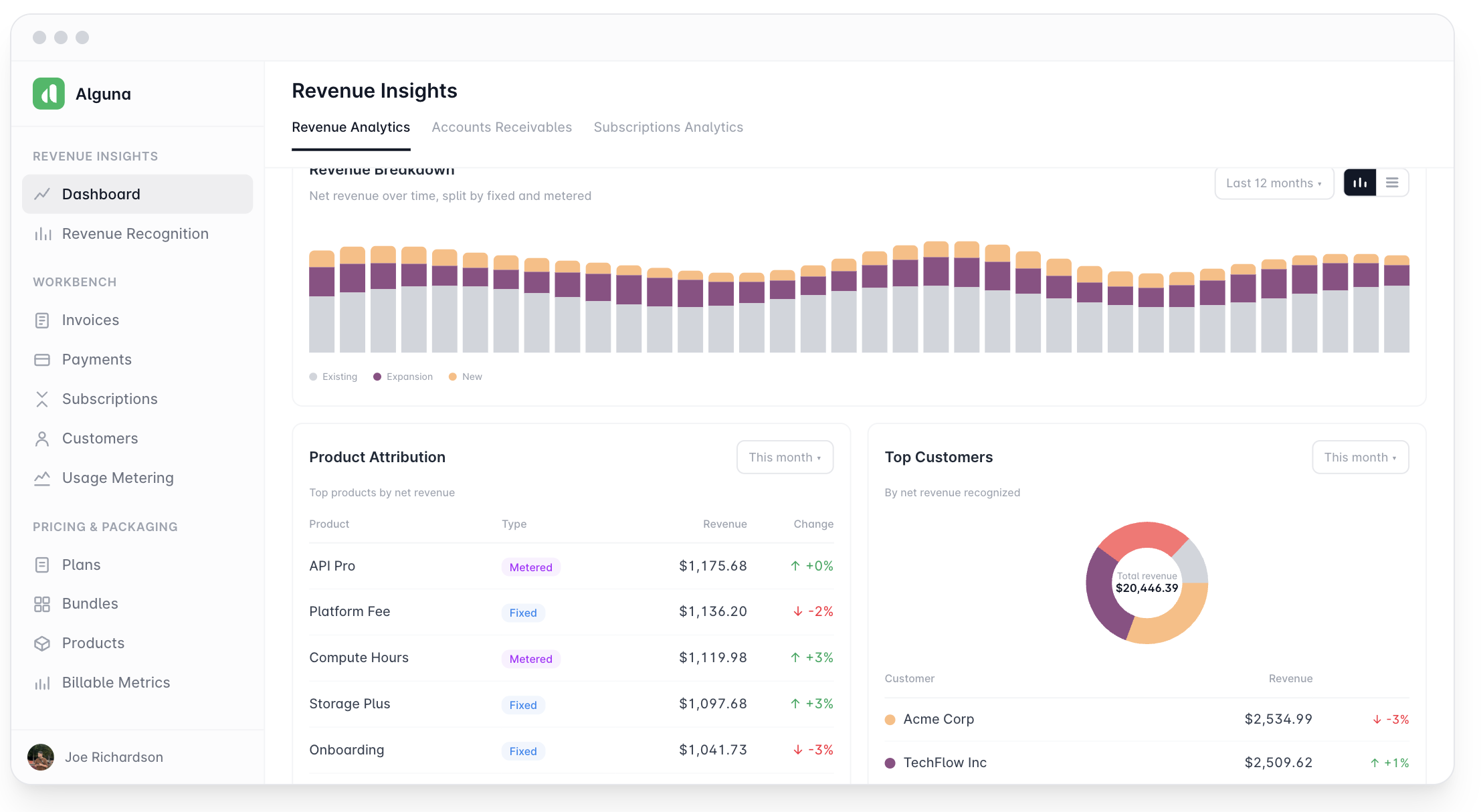
Alguna is an AI-driven revenue management platform built for SaaS, AI, and fintech companies. We unify CPQ, real-time usage metering, billing, and revenue recognition on a single data model, so what sales quotes is exactly what finance bills and recognizes.
Contracts AI speeds up quoting, an AI agent handles collections chasing, and contract amendments trigger recalculated ASC 606 and IFRS 15 schedules automatically.
The platform is modular, so you can start with the workflow that hurts most, and most teams go live in weeks rather than months.
Book a demo and bring your real pricing scenarios.
Bring intelligence to your entire revenue engine
AI revenue management is not about replacing your finance team. It is about giving them a revenue engine that keeps up with modern pricing, catches problems before they cost money, and closes the books without heroics. The companies winning in the AI era treat revenue operations as a system to be engineered, not a pile of spreadsheets to be survived.
Start with your most painful workflow, prove the value in one billing cycle, and expand from there. And if you want a platform built for that journey from day one, we would love to show you how Alguna handles your pricing, live and unscripted.
Frequently asked questions about AI-driven revenue management
Is AI revenue management the same as revenue automation?
They are closely related. Revenue automation is the broader practice of using software to streamline revenue processes, including rule-based workflows that have existed for years. AI-driven revenue management adds the intelligence layer: prediction, extraction, anomaly detection, and adaptive workflows that improve with data.
Where should a small finance team start?
Start with collections. It has the clearest metric (DSO), the fastest feedback loop, and mature tooling. Intelligent collections systems can show measurable results within one or two billing cycles, which builds the case for automating billing and revenue recognition next.