Usage based pricing for SaaS has moved from an experiment to a mainstream growth lever, and SaaS usage based pricing is now a board-level conversation rather than a billing footnote.
OpenView's State of Usage-Based Pricing report predicted that 61% of the general SaaS index would adopt some form of usage based pricing, with another 21% planning to test it.
In this guide, we'll define the model, compare it to subscriptions and seats, cover best practices, walk through how to implement it, look at the metrics that matter, the challenges to plan for, real examples, and the SaaS billing platforms with usage-based pricing built in.
What is usage based pricing for SaaS?
For example, a customer who processes 5 million API calls pays more than one who processes 500,000. The price scales with consumption, so it tracks the value a customer gets.
There isn't one single way to do it. Most usage-based pricing SaaS models fall into a handful of archetypes, and many companies combine them.
Here's how the common structures compare:
Usage based pricing vs subscription pricing for SaaS
The clearest way to understand the usage-based pricing model is to set it against the two structures it most often replaces or blends with.
The usage based pricing vs subscription pricing SaaS debate isn't about which is universally better, it's about which aligns price with the value your product delivers.
Meaning:
- Subscriptions are predictable but can over-charge light users and under-charge heavy ones.
- Pure usage aligns perfectly with value but makes revenue harder to forecast.
- Hybrid models try to capture the best of both.
If you want to go deeper on the recurring side of this comparison, our guide to subscription billing software breaks down where traditional models still make sense and where they start to strain.
Per-user pricing vs usage-based pricing for SaaS
A specific version of this question is worth its own section, because it's where the most money is won and lost: per-user pricing vs. usage-based pricing for SaaS products.
Seat-based pricing assumes the value a customer receives scales with the number of people who log in. For collaboration tools, that assumption often holds. For automation, APIs, and AI, it breaks down (very) quickly.
Kyle Poyar, who led OpenView's pricing research, has argued the point directly: the value a customer gets rarely ties to how many people log in, and with AI automation it can even move in the opposite direction, because the more work the software does autonomously, the fewer humans need a seat. He put the broader trend simply: “usage-based pricing will be the key to successful monetization in the future” (TechCrunch).
The economics of SaaS per seat pricing vs usage based pricing have shifted further with AI. Andreessen Horowitz's LLMflation analysis found that, for a model of equivalent performance, inference cost falls roughly 10x every year: what cost about $60 per million tokens in 2021 cost about $0.06 by late 2024.
When the cost to deliver value collapses but a seat license stays flat, the link between price and value snaps. Usage and outcome models track that curve far better.
If seats are still central to your business, our breakdown of seat-based pricing covers exactly where it works and where it quietly leaks revenue.
Why usage based pricing is taking over SaaS
As "early" as 2021, OpenView found usage based pricing adoption up 32% from the prior year, with nearly 45% of the roughly 600 surveyed companies already using the model (OpenView).
It made the case that usage-based companies outperform peers on two metrics investors care about most:
- Net dollar retention
- Cost of customer acquisition payback.
Since then, the conclusions have only strengthened.
Three forces explain the durability of the trend:
- Value alignment. Customers increasingly expect to pay in proportion to value received, not a flat license fee negotiated once a year.
- Built-in expansion. As customers succeed and use more, revenue grows without a separate upsell motion. Snowflake and Datadog, two canonical usage-based companies, have been cited by OpenView with net dollar retention around 160% and 130% respectively.
- AI monetization. Benchmarkit found 44% of SaaS companies now charge for AI-powered features, and usage and outcome models are the natural fit for products whose cost and value are driven by consumption rather than headcount.
7 best practices for usage based pricing SaaS
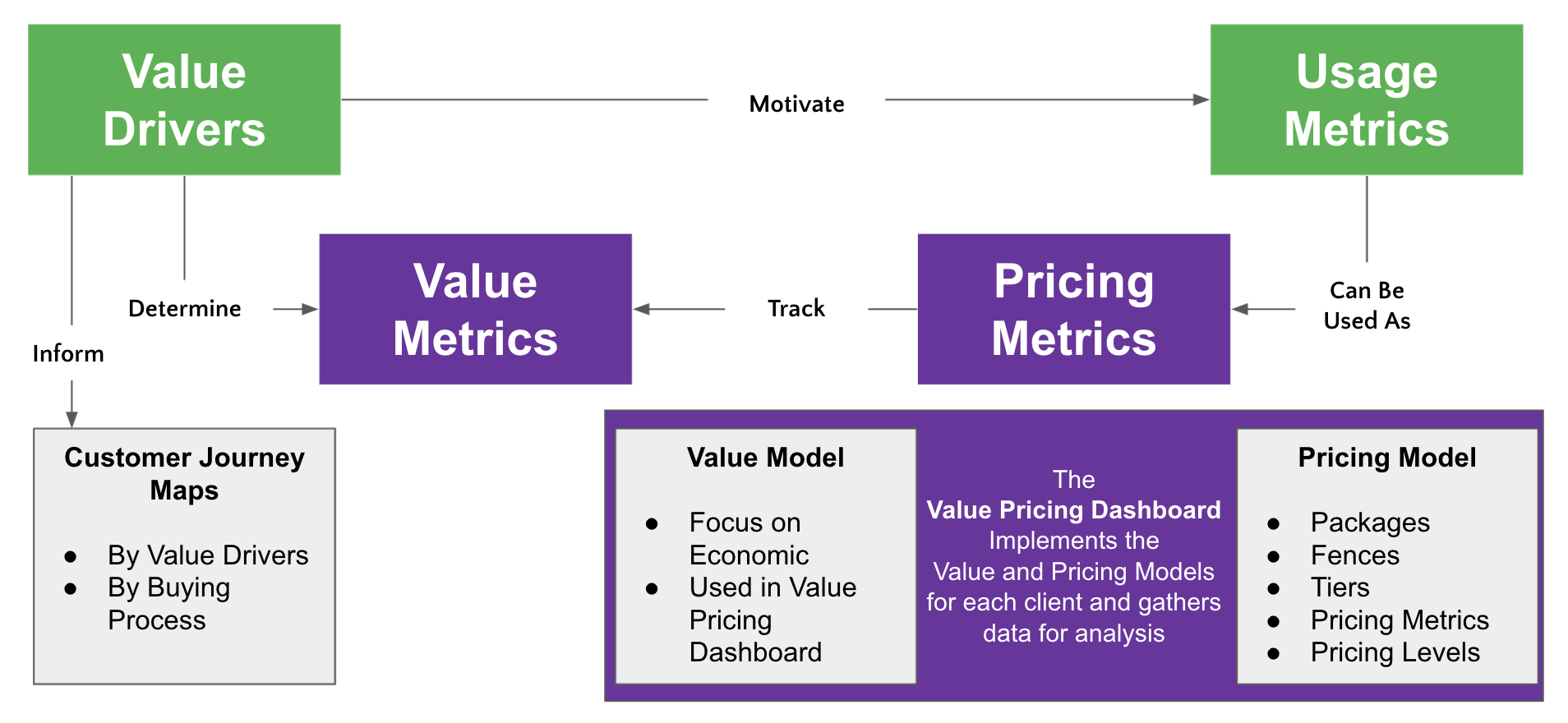
Adopting the model well is harder than flipping a switch. These best practices for usage-based pricing in SaaS teams come from what consistently separates smooth rollouts from painful ones.
- Pick a value metric customers understand. The unit you bill on should rise with the value a customer gets, be predictable enough to budget for, and be hard to game. Our 7-step framework for choosing the right value metric walks through how to test candidates.
- Meter accurately and in real time. Usage you can't measure cleanly is usage you can't bill for. Instrument the product to emit reliable usage events before you price against them.
- Make pricing transparent. Surface live usage and projected charges to customers. Bill shock is the fastest way to lose trust and trigger churn in a consumption model.
- Protect revenue predictability. Combine usage with minimum commitments, prepaid credits, or a subscription floor so finance can still forecast. This is why most teams land on hybrid.
- Guard your margins. For AI products especially, model your cost of goods against your pricing. If inference or compute costs move, your pricing needs the flexibility to move with them.
- Keep pricing changes out of engineering's backlog. If every packaging tweak needs a developer ticket, you'll experiment far too slowly. No-code configuration lets revenue teams ship changes in hours.
- Align sales and customer success comp. Reward landing accounts and driving adoption, not just initial contract size, so the team behaves in line with how the model actually makes money.
8 steps to implement usage based pricing for SaaS
If you're mapping the best way to implement usage-based pricing saas 2026 plans around, this sequence keeps the project grounded. It moves from strategy to instrumentation to billing, in the order that avoids the most rework.
- Define the value metric and pricing model. Decide what you charge for and whether you're going pure usage, tiered, prepaid, or hybrid.
- Instrument usage tracking. Make sure your product reliably emits the events you intend to bill on, at the granularity you need.
- Choose your metering and billing infrastructure. Decide whether you'll build in-house or adopt a platform. Many teams connect payment APIs that support metered billing usage-based pricing for saas products through a dedicated billing layer rather than wiring everything by hand.
- Configure pricing and packaging. Set up your tiers, rates, overages, credits, and commitments. With no-code usage-based pricing tools, revenue teams can do this without engineering.
- Connect quoting to billing. Use a CPQ built for usage-based pricing so what sales quotes flows straight into what finance bills, with no manual re-keying.
- Automate invoicing and collections. Generate accurate invoices from real usage and let billing automation handle the repetitive work, including dunning on failed payments.
- Wire up revenue recognition. Keep what you sold, billed, and recognized in sync under ASC 606 and IFRS 15 so month-end close stays clean.
- Test, launch, and iterate. Pilot with a segment, watch the metrics below, and refine. Offline testing and small pilots de-risk the move before a full rollout.
Metrics for SaaS usage-based pricing success
Old SaaS dashboards built around fixed monthly recurring revenue don't fully capture a consumption model.
The metrics for SaaS usage-based pricing success skew toward expansion, retention, and unit economics.
Because usage revenue lands only after the work happens, these metrics live or die on the quality of your invoice-to-cash cycle. The faster and cleaner that cycle, the more reliable your reporting.
Challenges of usage based pricing for SaaS providers
The model isn't free of friction. The challenges of implementing usage-based saas pricing are real, and so are the challenges of usage based pricing for saas providers once they're live.
Going in with eyes open is the difference between a model that compounds and one that creates monthly fire drills.
- Revenue is harder to forecast. Variable usage means variable revenue. Commitments, floors, and good analytics are the antidote.
- Billing is genuinely complex. Real-time metering, proration, overages, and credits are difficult to get right with spreadsheets or generic tools.
- Bill shock erodes trust. Customer feedback on usage-based saas pricing 2025 surveys repeatedly flagged surprise invoices as the top complaint. Transparency and usage alerts are non-negotiable.
- Margins can compress. If your delivery costs change and your pricing can't, profitability suffers. This is acute for usage-based billing for AI services.
- Failed payments hit harder. More frequent, variable invoices mean more chances for payment failure. An accounts receivable AI agent can chase overdue invoices and reduce involuntary churn.
Top platforms for SaaS companies to manage usage-based pricing models
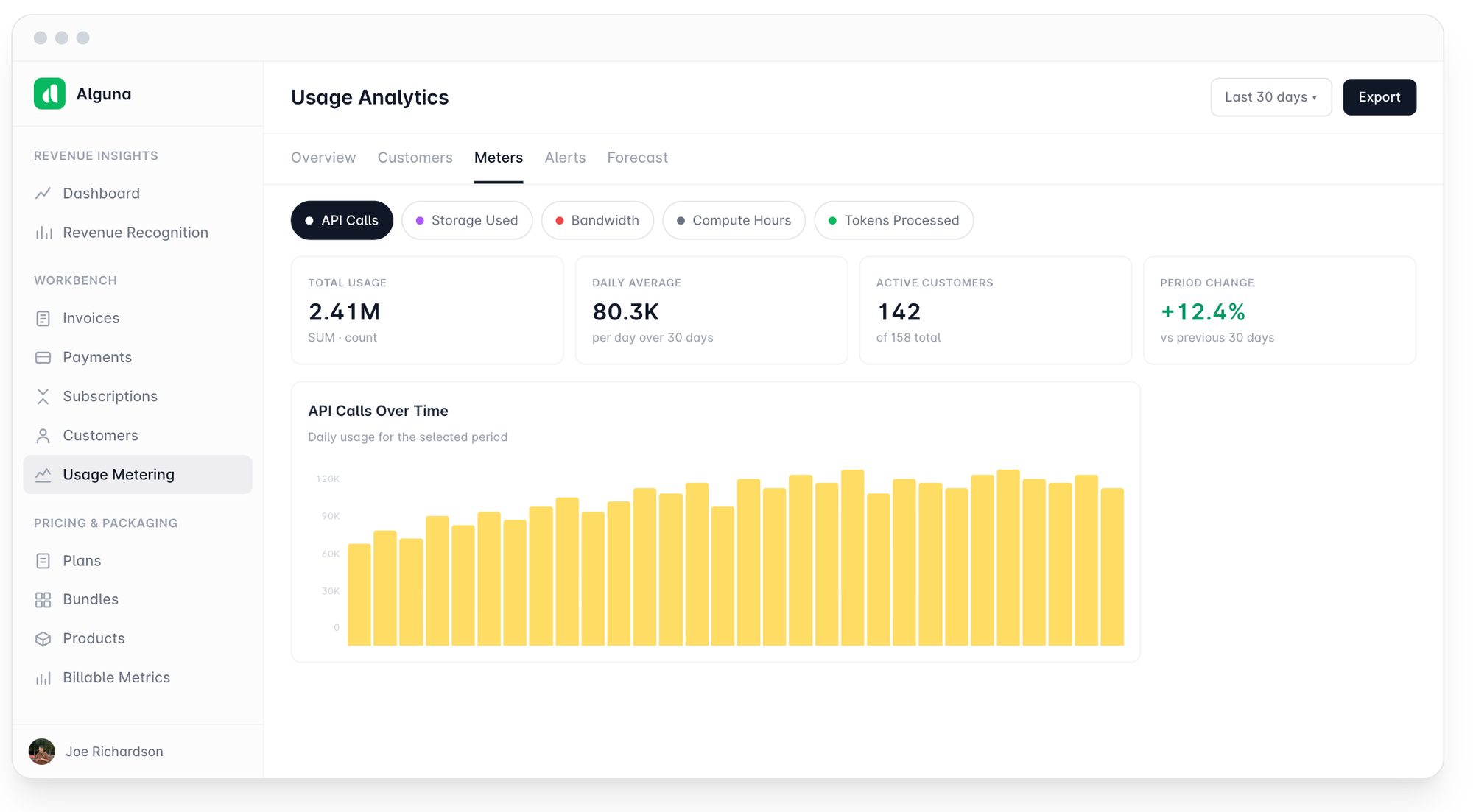
Running a usage-based pricing model for SaaS requires the right billing platform. Because the right tooling is what turns a pricing strategy into accurate invoices.
That's why today's top platforms for SaaS companies to manage usage-based pricing models consist mostly of newer players (rather than incumbents built purely for seat-based subscriptions).
SaaS billing platforms with usage-based pricing
Below are three top platforms for SaaS companies to manage usage-based pricing model to put on your shortlist for evaluation:
- Alguna: AI-native monetization platform purpose-built for usage-based revenue. Backed by Y combinator.
- Metronome (now part of Stripe): Usage-based billing platform for API companies.
- Lago: Open-source platform for developer-led teams.
When teams evaluate the top platforms for SaaS companies to manage usage-based pricing models, they're really asking three things:
- Can it meter usage in real time?
- Can non-engineers change pricing?
- Does it connect quoting through to revenue recognition?
Quick look: Alguna - A SaaS billing platform with usage-based pricing
Alguna is an AI-native, end-to-end revenue automation platform built for modern SaaS, AI, and fintech companies. Rather than bolting usage onto a legacy subscription tool, we unify no-code CPQ, real-time usage metering, billing, invoicing, and revenue recognition in one system, and add an accounts receivable AI agent on top.
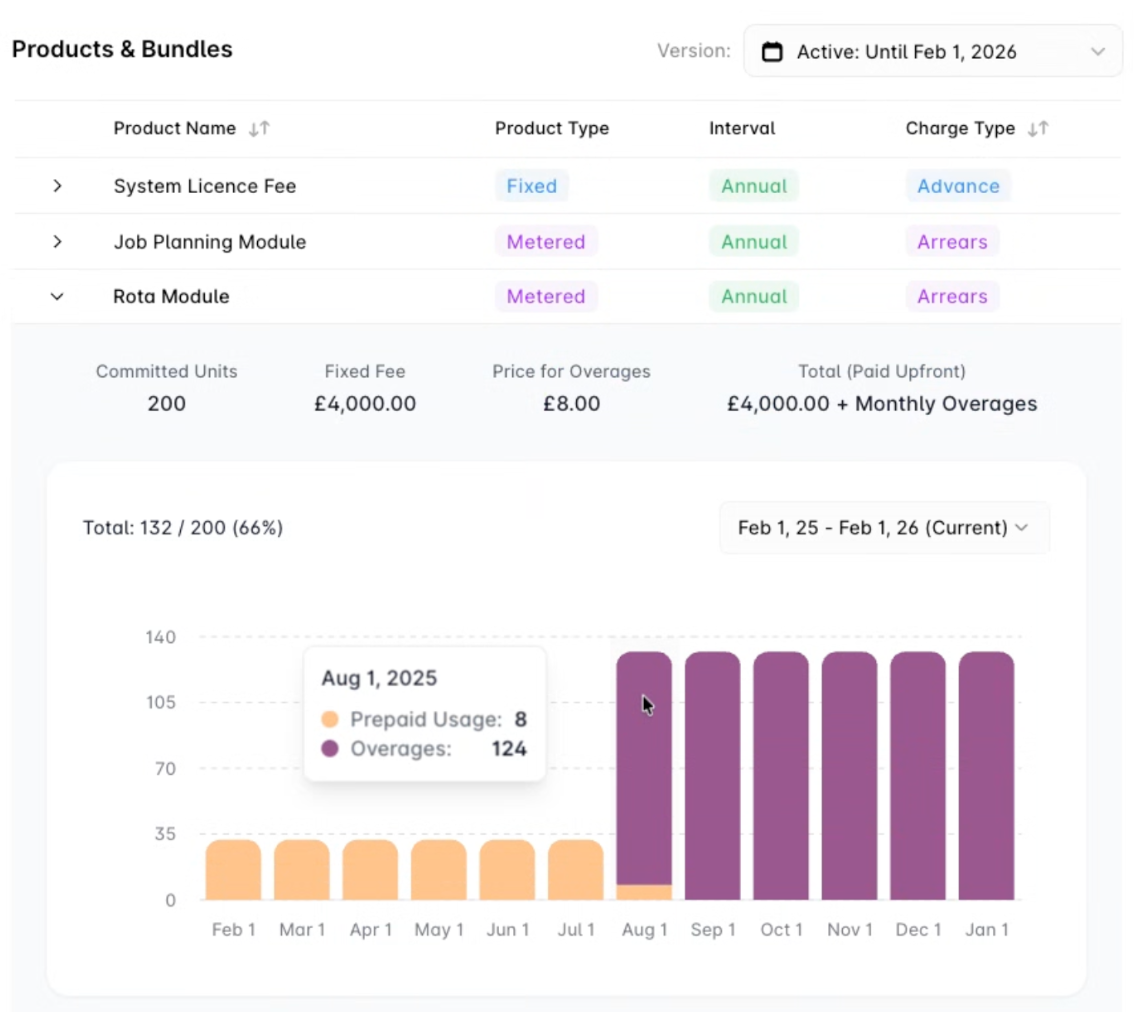
Reps configure usage, hybrid, or outcome-based quotes without engineering, the approved terms create the billing and usage schedule automatically, and finance works from a single source of truth from the first quote through to cash collected and recognized.
Because we charge a flat fee and never take a percentage of your revenue, platform costs stay predictable as you scale, which matters most for the thin-margin AI products that lean hardest on usage.
- Shane Curran, CEO at Evervault
Read the case study
Bringing usage based pricing to your SaaS
Usage based pricing has moved from experiment to expectation for modern SaaS, AI, and API-driven companies, because it does something subscriptions and seats can't: it ties what you charge to the value your customers actually receive. The hard part was never the strategy, it was the infrastructure to run it accurately at scale.
That's the problem we built Alguna to solve. If you're ready to quote, bill, and recognize revenue for usage, hybrid, or outcome-based models without an engineering bottleneck.
Book a demo and see how fast a platform built for SaaS usage-based pricing can solve your billing headaches.
Frequently asked questions about SaaS usage based pricing
What is the best billing system for usage-based pricing for a SaaS company?
There's no single answer to the best billing system for usage-based pricing for saas company searches, because it depends on your model, volume, and stage. The consistent requirements are real-time metering, no-code pricing changes, and a path from quote to revenue recognition in one place.
Alguna is built around exactly those needs, especially for AI, fintech, and multi-entity SaaS.
Who offers the best usage-based pricing among SaaS billing vendors?When buyers ask who offers the best usage-based pricing among saas billing vendors, the honest answer is that fit beats fame. Developer-first tools suit high-volume API companies with engineering to spare; finance-led platforms suit subscription-heavy businesses.
Alguna sits in the middle, giving revenue teams no-code control over complex usage and hybrid models without an engineering dependency.
How do vendors secure compliant usage-based pricing for global SaaS operations?
Teams searching how vendors secure compliant usage-based pricing global saas operations rely on are really asking about multi-entity billing, multi-currency invoicing, tax handling, and audit-grade revenue recognition under ASC 606 and IFRS 15.
The answer is a platform that keeps usage data auditable and ties quoting, billing, and rev rec together, so compliance isn't reconstructed manually each quarter.
What is the difference between usage-based and subscription pricing?Subscription pricing charges a fixed recurring fee regardless of consumption. Usage-based pricing charges according to how much a customer uses. Hybrid models combine a recurring base with variable usage, which is why they so often deliver the best growth and retention.
What are the best tools for implementing usage-based billing without coding?
The best tools let revenue teams set up metering, pricing, and invoicing through a point-and-click interface, so packaging changes don't need a developer ticket. Prioritize real-time usage metering, no-code pricing configuration, and a clean path from quote through to revenue recognition.
Alguna was built for exactly this, so non-technical revenue teams can launch and change usage, tiered, prepaid, or hybrid pricing on their own.
I want to implement usage based pricing without coding, what tools can I use?
You can use a no-code billing platform that handles metering, rating, and invoicing for you. With Alguna, you configure your pricing model yourself, connect your CRM and product usage with no-code integrations, and the approved terms create the billing schedule automatically. There's no need to write or maintain custom billing code.
How to implement hybrid pricing models for SaaS products with both flat fees and usage charges?
Combine a recurring base fee with variable usage on the same invoice. Define your flat component, such as a subscription floor or platform fee, then define your usage component, meaning the metered units and rates. Add included allowances or overage rules to bridge the two, and co-term everything so the customer receives one clear invoice.
The hard requirement is a billing system that meters usage in real time and reconciles it with the subscription. Hybrid is the most common modern structure precisely because it pairs predictable revenue with usage-driven expansion.
What are the best subscription billing platforms for SaaS companies with usage-based and fixed pricing models simultaneously?
The strongest fit is a platform that treats usage and subscription as first-class citizens rather than bolting metering onto a recurring core. Look for flexible billing cycles, real-time metering, and consolidated invoicing across both models.
Our guide to SaaS subscription management software compares the options, and Alguna unifies fixed and usage-based components in one no-code system.
How do I automate usage-based billing for my SaaS product?
Automate the full loop: ingest usage events from your product, rate them against your pricing, generate invoices automatically, collect payment, and recognize revenue. Layer dunning on top to handle failed payments.
Our guide to automated billing software shows how the pieces fit together. With Alguna, usage flows straight into accurate invoices on whatever schedule you set, with no manual reconciliation.
Best usage-based billing software for SaaS API calls?
For API-call billing, the metering engine matters most. Prioritize real-time metering that stays accurate at high event volume, per-call or tiered rating, and the option of prepaid credits or minimum commitments.
API and AI companies typically bill on calls, tokens, or compute, so accuracy at scale is non-negotiable. Alguna meters any custom metric, including API calls, in real time and turns those events into accurate invoices.
How do I add usage-based billing to my existing SaaS product that just added AI features?
Start by picking the usage metric that maps to your AI feature's value and cost, often tokens, API calls, or successful outcomes. Instrument those events, then add a usage component alongside your existing subscription rather than replacing it, so current customers stay on familiar terms while you monetize the new AI usage.
Watch your gross margin per unit closely, since AI delivery costs can move fast. Our primer on AI billing covers the model in depth.