Ramp contracts is one of the most common ways modern B2B companies close large, multi-year deals.
They give buyers a gentler on-ramp and give sellers a locked-in commitment. The catch is that they are operationally heavy. A single agreement can carry three or four different price points, staggered start dates, and revenue that has to be recognized on a schedule that looks nothing like the invoice schedule.
Get the structure right and you accelerate large deals while protecting cash and compliance. Get it wrong and you create billing errors, revenue leakage, and a finance team that dreads every renewal.
This guide breaks down what ramp contracts are, why they matter, the best practices for structuring them, and how to execute them cleanly using a modern CPQ with Alguna.
What is a ramp contract?
Instead of paying the same amount every period, the customer ramps up: they commit to a lower figure at the start and a higher figure later, often tied to a rollout plan, an onboarding period, or expected adoption.
The defining feature is that all of those steps live inside one contract that both parties sign once. The customer is not renegotiating each year. The schedule of increases is agreed up front, which is exactly why ramp deals are attractive to sellers: the future expansion is contractually committed, not hoped for.
Ramp contract vs standard contract
A standard subscription charges a flat, recurring amount for the full term. A ramp contract changes the charge at defined milestones. The table below shows the difference using a simple three-year example.
| Period | Standard contract | Ramp contract |
|---|---|---|
| Year 1 | $120,000 | $60,000 (50 seats) |
| Year 2 | $120,000 | $120,000 (100 seats) |
| Year 3 | $120,000 | $180,000 (150 seats) |
| Total contract value | $360,000 | $360,000 |
Both deals are worth the same over three years. The ramp version simply backloads the revenue to match how the customer actually adopts the product, which lowers the barrier to signing and ties the expansion to a firm commitment.
Key terms you will hear
- Ramp schedule: The agreed timeline of price or volume changes across the term.
- Ramp period: The early phase where the customer pays a reduced rate while they onboard or roll out.
- Committed volume: The minimum seats, units, or spend the customer agrees to at each step.
- Total contract value (TCV): The full value of the agreement across every ramp step combined.
- Overage: Usage above the committed band in a given period, billed at a pre-agreed rate.
Why ramp contracts matter for B2B revenue teams
Ramp deals are not a niche tactic anymore. They have grown alongside the broader shift toward longer, commitment-heavy enterprise agreements. According to Zylo, multi-year contracts grew from 23 percent to 38 percent of SaaS agreements in a single year (Zylo, 2026), and Gartner has reported that more than 70 percent of enterprise SaaS contracts already exceed 24 months in duration (via Monetizely, citing Gartner). When deals run that long, a flat price for the whole term rarely matches how the customer grows.
The financial case is just as strong. Expansion from existing customers is now the dominant growth engine in B2B SaaS. Benchmarkit found that the largest companies draw the majority of their new ARR from expansion, climbing to a median of 58 percent and higher as they scale (Benchmarkit, 2025). Ramp contracts capture that expansion contractually, at signature, rather than leaving it to a future renewal conversation.
That matters because retention and expansion now drive valuation. A McKinsey analysis of more than 100 B2B SaaS companies found that top-quartile performers on net revenue retention trade at a median 24x EV/Revenue, against roughly 5x for the bottom quartile (via SaaS Mag, citing McKinsey). For context, SaaS Capital pegs median net revenue retention for scale-stage private companies around 104 percent, with enterprise segments reaching 115 percent or more (SaaS Capital, 2025). Ramps are one of the cleanest ways to bake that expansion into the contract from day one.
There is a trade-off. A ramp adds complexity to billing and revenue recognition, and complexity is where revenue leaks. To keep ramps from turning into a finance headache, most teams pair them with billing automation so each step bills correctly without manual intervention.
Common types of ramp contracts
Ramp contracts come in a few recognizable shapes. Most real-world deals combine two or more of these.
- Seat ramps: the committed number of users grows at each step, which suits phased rollouts across teams or regions.
- Price ramps: the per-unit or subscription price increases on a set schedule, often after an introductory discount in year one.
- Usage commitment ramps: the committed consumption band (API calls, tokens, transactions) steps up over time, with overages billed above each band.
- Free or discounted ramp periods: the first few months are free or heavily discounted while the customer onboards, then the full rate begins.
- Hybrid ramps: a combination, such as a platform fee that ramps alongside a usage commitment that also ramps, common in modern AI and usage-based deals.
Which shape fits depends heavily on your pricing model. If you are still deciding how to price the underlying product, our guide to enterprise SaaS pricing models and our framework for choosing a value metric are useful starting points before you layer a ramp on top.
6 best practices for ramp contracts
A ramp is only as good as the discipline behind it. These practices keep ramp deals profitable and clean to operate.
1. Tie the ramp to a real adoption plan
The ramp schedule should mirror how the customer will actually deploy the product, not an arbitrary discount curve. When steps align with onboarding milestones or rollout phases, the customer sees the logic and is far more likely to hit each commitment.
2. Commit the volume, not just the time
Term length alone is a weak lever. Data on more than 15,000 contracts suggests that moving from single-year to multi-year is worth only about 2 to 3 percentage points of additional discount, while committing to more volume moves the needle far more (Mostly Metrics, 2025). Structure ramps around growing committed volume so the expansion is contractual.
3. Set overage rates before you sign
Every usage-based ramp needs a clear, pre-agreed rate for consumption above the committed band. Negotiating overages after the fact is where disputes and write-offs start. Define them in the contract and make sure your billing system can apply them automatically.
4. Plan revenue recognition up front
Under ASC 606, the cash you invoice and the revenue you recognize are rarely the same on a ramp deal. Discounts and free periods often have to be spread across the full term. Decide the recognition treatment when you structure the deal, not at quarter close, and keep revenue recognition connected to the same source of truth as billing so the two never drift apart.
5. Make every step visible to finance and the customer
Surprises kill renewals. Both your finance team and the customer should be able to see exactly what changes, when, and by how much. A clear schedule reduces billing disputes and protects the relationship when the price steps up.
6. Protect cash flow through the ramp period
A backloaded ramp means lighter revenue early, so cash discipline matters more, not less. Tight collections and clean invoicing during the ramp keep the deal healthy. If ramps are stretching your working capital, our guides on how to improve cash flow and DSO management cover the levers that help most.
How to structure and execute a ramp contract
Here is a practical, repeatable sequence for building a ramp deal that holds up operationally.
- Map the customer's growth. Start with how and when the customer will expand: headcount, regions, usage, or product adoption. The ramp should follow that curve.
- Choose the ramp type. Decide whether you are ramping seats, price, usage commitments, or a hybrid, based on your pricing model and the customer's plan.
- Define each step explicitly. Write down the price, committed volume, and start date for every period. Ambiguity here becomes a billing error later.
- Set guardrails. Agree overage rates, minimum commitments, and any caps before signature, so usage outside the band is handled automatically.
- Confirm the revenue treatment. Work out how discounts, free periods, and step-ups are recognized across the term under ASC 606.
- Generate the quote and contract. Use a CPQ that can model multiple price points in one quote and sync the signed terms straight into billing, so what sales sold is exactly what finance bills.
- Automate the schedule. Let your billing engine advance through each step on its own, applying the correct rate every period without manual edits.
- Monitor and prepare for renewal. Track consumption against each committed band so you walk into renewal with data, not guesswork.
How Alguna executes ramp contracts with CPQ
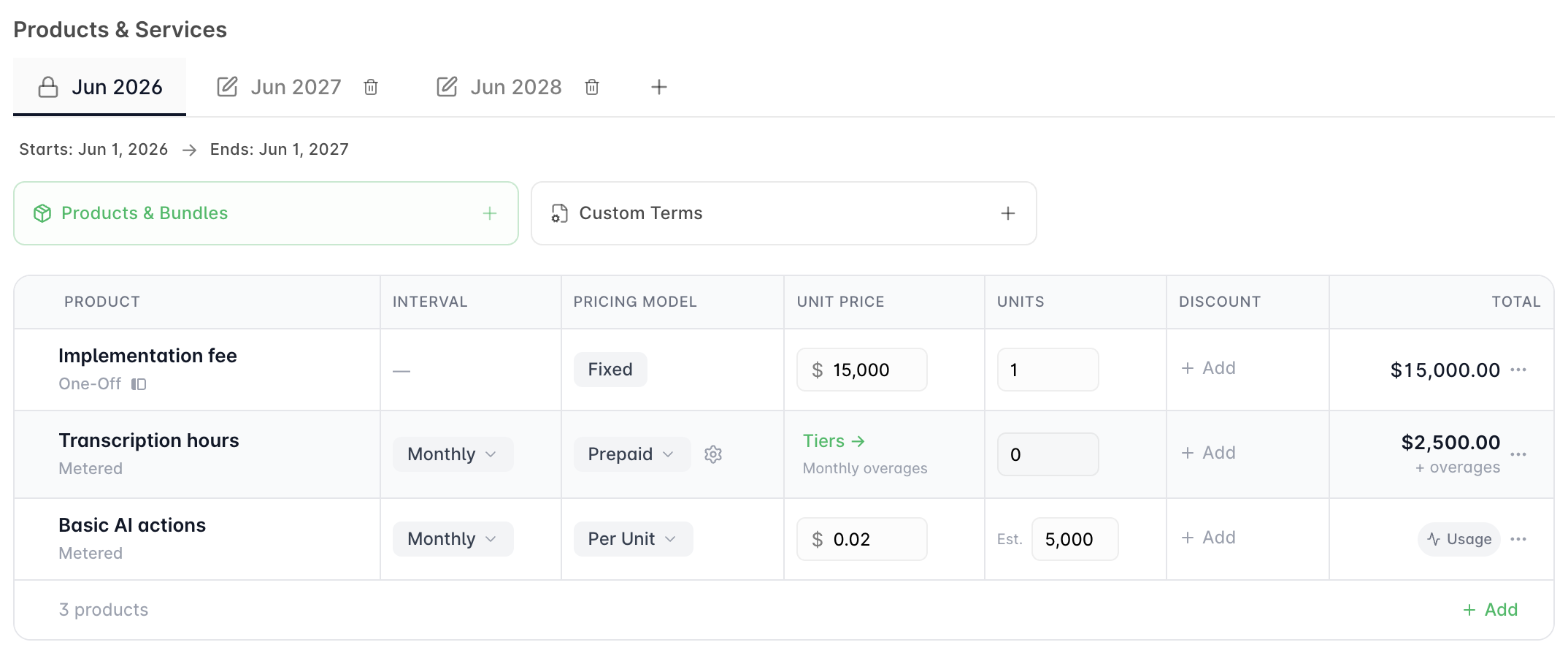
This is exactly where a purpose-built CPQ earns its keep. Alguna CPQ is a no-code configure, price, quote tool built to handle complex, multi-step deals that break legacy tooling, including ramps, multi-year commitments, and usage-based pricing.
Here is how a ramp comes together in practice.
- Model the whole ramp in one quote. Alguna's pricing engine supports flat, tiered, usage-based, prepaid with overages, and hybrid models, so a single quote can carry every step of the ramp instead of being stitched together by hand.
- Bundle what the deal actually contains. You can combine one-off setup fees, recurring subscriptions, and usage-based services in one quote, which matters when a ramp mixes a platform fee with a growing usage commitment.
- Keep sales in sync. Alguna CPQ integrates natively with Salesforce and HubSpot, so reps build ramp quotes without leaving the CRM and approvals stay in one place.
- Sign in line and hand off cleanly. Customers can review pricing, accept terms, and sign directly within the proposal through embedded e-signature, and the signed terms flow straight into billing.
- Bill and recognize automatically. Because CPQ syncs natively with Alguna Billing and Revenue Recognition, each ramp step bills at the right rate and the revenue impact is visible in real time, with no spreadsheet reconciliation between what was quoted and what was invoiced.
The result is that the ramp you negotiate is the ramp you bill and the ramp you recognize, end to end. For a fuller picture of how the steps connect, see our breakdown of the quote to cash process.
Common ramp contract mistakes to avoid
- Managing the ramp in spreadsheets. Manual tracking is the single biggest source of missed step-ups and billing errors on ramp deals.
- Forgetting the revenue recognition schedule. Treating invoiced cash as recognized revenue on a ramp will fail an audit.
- Leaving overages undefined. Unpriced usage above the committed band turns into disputes and write-offs.
- Ramping time without ramping commitment. A longer term with no volume commitment gives away predictability for very little in return.
- Disconnecting sales from finance. When the quote and the billing system are separate, the ramp drifts and revenue leaks.
Frequently asked questions about ramp contracts
What is a ramp contract in simple terms?
It is a single agreement where the price or committed volume increases in scheduled steps over the term, so a customer can start small and grow into the full price while committing to that growth up front.
How is a ramp deal different from a discount?
A discount lowers the price of a fixed package. A ramp changes the package itself over time, usually by growing the committed seats, usage, or price at defined milestones.
Are ramp contracts only for enterprise deals?
They are most common in large, multi-year enterprise agreements, but mid-market deals with a clear rollout plan or onboarding period use them too.
How do you recognize revenue on a ramp contract?
Under ASC 606, the invoice schedule and the revenue schedule often differ, and discounts or free periods may need to be spread across the term. The cleanest approach is to keep revenue recognition tied to the same system that handles quoting and billing.
Close bigger deals with the flexibility of ramp contracts
Ramp contracts let you close bigger deals by meeting customers where they are and committing their growth in writing. The structure is straightforward to understand and genuinely hard to operate by hand, because a single deal can carry several price points, staggered dates, and a revenue schedule that does not match the cash.
The teams that win with ramps are the ones that connect quoting, billing, and revenue recognition into one flow, so the deal they sell is the deal they bill and recognize.
If you want to see how Alguna handles ramps, multi-year commitments, and usage-based deals in one platform, book a demo.