Seat-based pricing has been the default for software for the better part of two decades. You count the people who log in, you charge per user, and revenue grows as your customer hires. It's simple to quote, easy to forecast, and familiar to every buyer.
But the ground is shifting.
As AI agents take on work that used to require a human at a keyboard, the link between headcount and value is starting to break, and the seat is no longer the clean proxy for value it once was.
Ben Murray, founder of The SaaS CFO, puts the tension plainly: “For decades, SaaS expansion revenue was driven by headcount growth. AI introduces the possibility of the opposite: a customer can stay on your platform but quietly shrink their seat count as agents replace the employees who used to need licenses.” The market is pricing that risk in.
That doesn't mean the seat is dead.
For plenty of products, it's still the right call. What's changed is that pricing is becoming a blend, and the smartest revenue teams are learning when to charge per seat, when to charge for usage, and how to combine the two without creating an operational mess.
In this guide, we break down what seat-based pricing is, where it works, where it falls short, how its economics compare to usage-based pricing, and the top-rated platforms for combining seat-based and usage-based pricing in one billing system.
What is seat-based pricing?
For example, if a company buys 25 seats at $40 per seat per month, it pays $1,000 a month, whether all 25 people log in daily or half of them never sign in. The seat is the billable unit, and the bill scales with the size of the team rather than with how much the product is used.
The seat-based pricing model became dominant for good reasons:
✅ It's transparent, both sides understand exactly what they're paying for.
✅ It's predictable, which makes revenue easy to forecast and budgets easy to approve.
How seat-based pricing works in practice
- Each licensed user counts as one seat, and the customer is billed per seat on a recurring monthly or annual cycle.
- Seats are usually tied to a tier or plan, so a Growth plan seat costs more than a Starter plan seat and unlocks more features.
- Adding users mid-contract triggers a true-up, where the customer is charged for the extra seats, often prorated to the rest of the billing period.
- Removing users typically takes effect at renewal rather than immediately, which protects the vendor's committed revenue.
Seat-based pricing for AI tools and enterprise code assistants
Seat-based pricing for AI tools is where the model gets genuinely complicated. The problem is a mismatch between how you charge and how your costs behave.
A seat is a fixed monthly price, but every AI action, every token generated, every inference run, carries a variable cost that scales with usage. When a single power user runs thousands of AI requests a day on one seat, a flat per-seat fee can quietly turn that account unprofitable.
When margins are that sensitive to usage, charging purely by the seat leaves you exposed.
So when should you still use seat-based pricing for enterprise code assistants and similar AI tools? The honest answer is: as a floor, rarely as the whole story. A per-seat fee can work well as a base layer that covers access, support, and predictable platform costs, particularly when you're selling to enterprises that want budget certainty and a clean per-developer line item.
The catch is that you almost always want a usage or consumption component layered on top to capture the cost and value of heavy AI workloads. For a deeper look at how AI products are priced, our guide to AI pricing models walks through the trade-offs.
Understanding the limitations of seat-based pricing
Understanding the limitations of seat-based pricing is the first step toward knowing when to move beyond it.
The model has four structural weaknesses that get more pronounced as products become more usage-intensive.
- Value and price drift apart. A seat measures how many people have access, not how much value they get. A light user and a power user pay the same, which feels unfair to one and leaves money on the table with the other.
- Credential sharing caps your reach. When seats are expensive, customers rationalize sharing logins to keep costs down, which limits how deeply you actually penetrate an account.
- Expansion is tied to hiring. Per-seat revenue grows when your customer's headcount grows. In an economy where AI agents reduce the need for human seats, that expansion engine can stall or reverse.
- It ignores variable cost. For any product with usage-driven costs, a flat seat fee can't track the expense of serving a heavy account, which compresses margin exactly where volume is highest.
Seat-based vs usage-based pricing: The economics
The SaaS per seat pricing vs usage based pricing economics come down to a single trade-off: predictability versus alignment. Seat-based pricing gives you stable, forecastable revenue but loosens the tie between what customers pay and what they actually get.
Usage-based pricing, where customers pay for what they consume (API calls, tokens, compute, transactions), aligns price tightly with value but makes revenue harder to predict. The table below lays out how the two models compare across the dimensions finance teams care about most.
The case for hybrid pricing
Most modern revenue teams don't pick one model and live with its downsides. They blend them. A hybrid pricing strategy pairs a predictable recurring component (often per seat or a platform fee) with a variable, usage-based charge that scales with consumption. You keep the forecastable baseline that finance and investors want, and you capture the upside from heavy users that pure seat pricing misses.
The benefits of hybrid pricing over a seat-based SaaS model are concrete. You stabilize MRR with the recurring layer while opening a second, usage-driven expansion path that isn't capped by your customer's headcount. You align price with value, so power users pay proportionally more and light users aren't overcharged into churn. And you future-proof your monetization for a world where AI agents, not employees, drive much of the consumption.
The operational challenge is that hybrid pricing only works if your systems can actually bill for it, which is where hybrid billing comes in: the ability to meter usage, apply seat and platform fees, and produce one accurate invoice across both.
Best practices for seat-based and hybrid pricing
Whether you stay on seats, move to usage, or blend the two, a handful of principles separate pricing that compounds revenue from pricing that quietly leaks it.
- Anchor to a value metric. Choose the unit that most closely tracks the value your customer is trying to maximize, whether that's seats, queries, outcomes, or a combination.
- Keep a predictable floor. Even usage-heavy products benefit from a recurring base, such as a platform fee or a minimum commitment, that protects revenue and reassures finance teams on both sides.
- Make usage transparent. Surface real-time usage and spend so customers never face bill shock. Transparency is what keeps consumption pricing from eroding trust.
- Set caps, bands, and clear overage rules. Guardrails protect customers from runaway bills and protect you from disputes, which makes hybrid models far easier to sell.
- Revisit pricing on a schedule. Pricing isn't a one-time decision. Review it at least annually against cost structure, usage patterns, and what your market will bear.
- Let finance own pricing changes. If every pricing tweak needs an engineering sprint, you'll experiment less and move slower. No-code billing tools put that control where it belongs.
How to choose a billing platform for a seat-based pricing model
Picking the right billing platform for a seat-based pricing model (especially one you plan to evolve into a hybrid model) is mostly about avoiding a rebuild later.
Here's a practical sequence to work through.
- Map your current and planned models. List how you charge today and how you expect to charge in 18 months. If usage or outcomes are on the roadmap, screen for them now.
- Confirm native seat plus usage support. The platform should handle per-seat fees, metered usage, and both on a single invoice without custom code or spreadsheet workarounds.
- Check mid-contract handling. Seat true-ups, proration, upgrades, downgrades, and minimums should be automatic, not manual reconciliation jobs.
- Pressure-test the metering. If you bill on usage, the meter has to stay accurate at volume, with deduplication so a single action never bills twice.
- Look downstream. Strong platforms connect billing to collections, dunning, revenue recognition, and your ERP so the whole invoice-to-cash flow stays clean.
- Prioritize no-code flexibility. Finance and product teams should be able to launch and adjust pricing without waiting on engineering. Our overview of usage based billing software covers what to look for here in more detail.
5 top-rated platforms for combining seat-based and usage-based pricing
If you've decided to blend models, the question becomes which system can actually run it. Below are five top platforms for seat-based and usage-based pricing, each able to handle both a per-seat layer and metered usage in one place.
We lead with our own platform, then cover four other strong options so you can match the fit to your stage and stack.
Platform comparison at a glance
1. Alguna: Combine seat-based and usage-based pricing in a no-code CPQ and automated billing engine
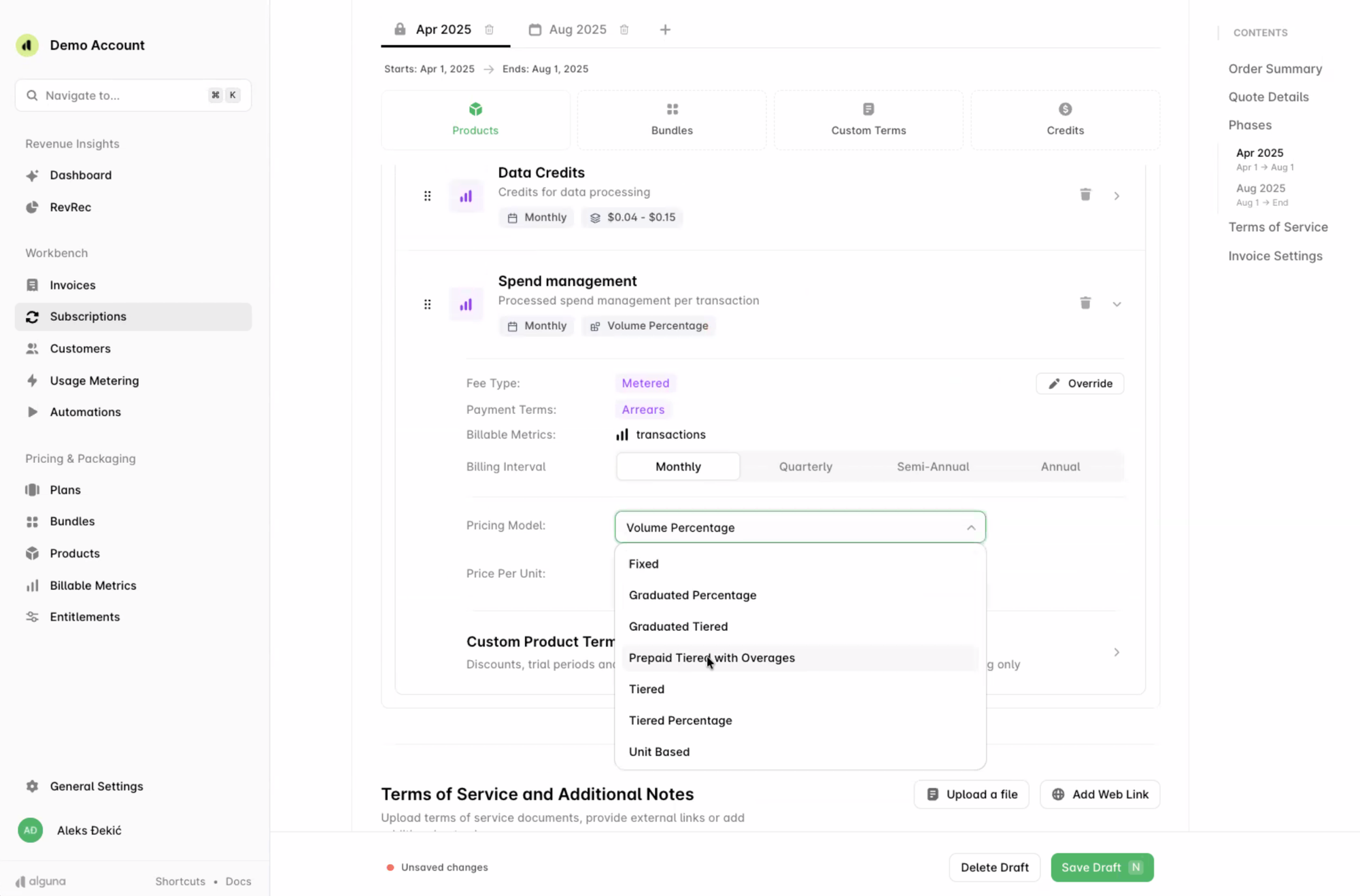
Alguna is an end-to-end revenue automation platform for combining seat-based and usage-based pricing.
Headquartered in San Francisco and London, UK, Alguna was built from the ground up for SaaS and AI companies that deal with complex, fast-changing pricing.
We bring quoting, billing, invoicing, collections, and revenue recognition into one connected system, so a seat-based, usage-based, or hybrid model is configured once and runs end to end. Our flexible billing engine supports subscription, usage-based, milestone, and hybrid structures, and our no-code CPQ lets finance and revenue teams build and change pricing in minutes rather than waiting on engineering.
Downstream, the platform pairs real-time AR visibility with automated collections and dunning, multi-method payments, and auto-reconciliation that syncs to QuickBooks, Xero, NetSuite, and your ERP. Our AR Agent works each overdue account like a collections specialist from a single workspace called Control Tower, and we never take a cut of your revenue. If you're combining seats with usage and want one source of truth from quote to cash, that breadth is the differentiator.
2. Tabs
Tabs is a revenue automation platform focused on the contract-to-cash workflow, with native support for subscription, seat-based, usage-based, and hybrid pricing. Its signature move is treating the signed contract as the source of truth: it extracts terms directly from agreements and turns them into billing logic, including automated true-ups when seats change mid-contract, proration, and moving minimums. It also covers collections and ASC 606 revenue recognition and integrates with NetSuite, QuickBooks, Sage Intacct, and Salesforce.
3. Chargebee
Chargebee is one of the most established subscription billing and revenue management platforms on the market, and it's especially strong for SaaS companies managing the full subscription lifecycle. Its billing engine supports flat-rate, tiered, per-seat, and usage-based models, and it adds automated dunning, ASC 606 compliant revenue recognition, and global tax handling. For teams whose pricing is subscription-first with a usage component layered on, it's a mature, well-supported choice.
4. Maxio
Maxio, formed from the merger of Chargify and SaaSOptics, pairs a flexible billing engine with deep SaaS financial reporting. It supports per-seat, per-unit, tiered, volume, stair-step, and hybrid models, and it can consolidate usage and flat-rate charges on the same invoice. Notably, Maxio meters its own pricing on your billings volume rather than your seat count, and it's known for GAAP-ready revenue recognition and investor-grade metrics. Published pricing starts around $599 per month for up to $100,000 in monthly billings.
5. Stripe Billing
Stripe Billing sits at the center of many billing stacks, particularly for engineering-led teams already running on Stripe. It supports metered and usage billing, tiered and volume pricing, and hybrid plans, with invoicing, global payments, revenue recognition, and a robust developer API. For high-volume or complex usage, teams often pair it with a dedicated metering layer, but as a flexible, developer-friendly foundation for seat plus usage, it's hard to beat.
Seat-based pricing isn't dead
Seat-based pricing isn't going away, but it's no longer the safe default it used to be.
For collaboration tools and role-based software, the seat still maps cleanly to value. For AI tools, code assistants, and anything with usage-driven costs, a pure per-seat model leaves margin and expansion revenue on the table.
The winning approach for most teams is a hybrid: a predictable seat or platform fee for stability, plus a usage component that scales with the value customers actually receive.
The hard part was never deciding to blend models, it's running them cleanly. That takes a billing system that can meter usage, apply seat fees, handle mid-contract changes, and close the books without manual work.
If you want to see how that looks end to end, book a demo with Alguna and we'll walk through seat, usage, and hybrid billing with your pricing in mind.
Frequently asked questions
What is seat-based pricing in simple terms?
It's a model where customers pay a recurring fee per user, or seat. Buy 10 seats and you pay for 10 users, regardless of how heavily each person uses the product.
Is seat-based pricing better than usage-based pricing?
Neither is universally better. Seat-based pricing gives you predictable revenue and suits collaboration tools, while usage-based pricing aligns price with value and suits APIs and AI products. Many teams combine both in a hybrid model.
Why is seat-based pricing under pressure from AI?
AI agents do work that used to require human users. When one agent replaces several employees, a customer can keep using your product while needing fewer seats, which undermines headcount-driven expansion revenue.
Can one platform handle both seat-based and usage-based pricing?
Yes. Platforms like Alguna, Tabs, Chargebee, Maxio, and Stripe Billing all support seat fees and metered usage, and the strongest of them can put both on a single, accurate invoice.