A few years ago, most B2B software companies could sum up their pricing in a single sentence: a flat monthly fee per seat, with maybe three tiers to pick from.
That is no longer true for a growing share of the market.
Between usage-based add-ons, credit systems for AI features, and enterprise contracts with custom minimums and overages, complex pricing structures have become the norm rather than the exception, especially for AI-native and API-driven products where cost scales with consumption instead of headcount.
This guide covers what complex pricing structures are, why they have become so common, the types you are most likely to run into, and the best practices and billing solutions for complex pricing structures that keep sales, finance, and product aligned as pricing gets more sophisticated.
What are complex pricing structures?
Instead of charging a flat rate per seat or per account, a complex pricing structure calculates the final invoice from several variables that can each change independently from one billing cycle to the next.
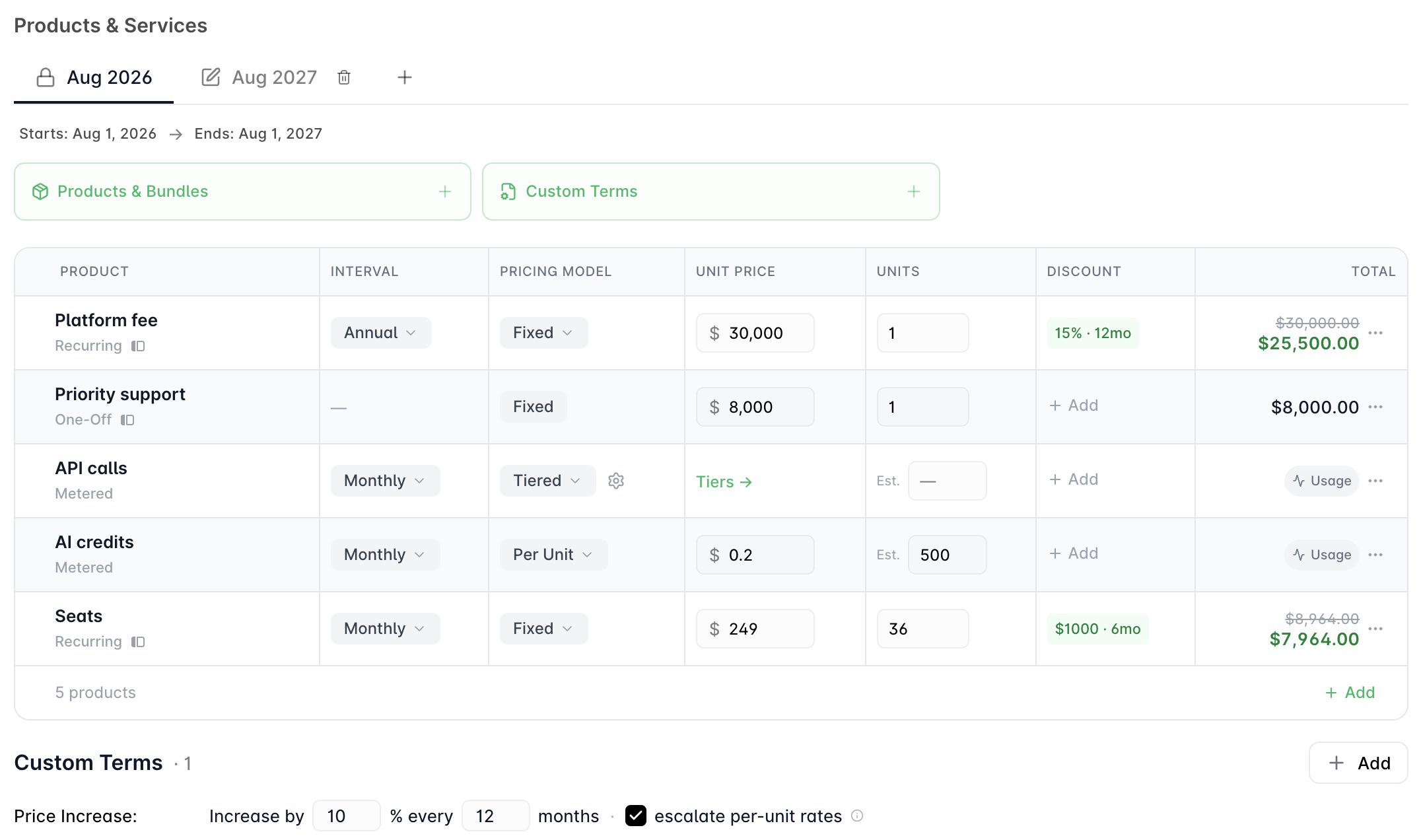
In practice, complex pricing structures tend to show up as:
- A base platform fee plus metered usage above an included allowance
- Tiered per-unit rates that change as volume grows
- Credit-based systems where different product actions consume credits at different rates
- Minimum commitments with overage charges once usage exceeds what was committed
- Multi-entity or parent-child contracts that consolidate several subsidiaries or business units into one invoice, a structure we cover in our guide to multi-entity subscription billing
None of these elements is complicated in isolation. The complexity comes from combining several of them and calculating them accurately, invoice after invoice, without someone rebuilding the math by hand.
Why pricing has gotten more complex in the AI era
The shift toward complex pricing structures is a direct response to how AI has changed both the cost of delivering software and how customers judge the value they are getting.
When AI performs the work itself, whether that is writing code or resolving a support ticket, value shifts from the number of users to the output the software produces, which pushes companies toward usage-based and hybrid structures instead of flat per-seat fees.
This is one reason seat-based pricing starts to break down once a product's value comes from output rather than headcount.
The numbers back this up.
ICONIQ's 2026 State of AI report found that while 58 percent of AI companies still include a subscription or platform component in their pricing, consumption-based pricing (35 percent) and outcome-based pricing (18 percent) have both grown meaningfully over the past six months, and 37 percent of companies plan to change their AI pricing model in the next 12 months.
ICONIQ's separate 2026 State of Go-to-Market research found that 48 percent of companies now describe hybrid as their primary pricing model, with consumption-based structures continuing to gain ground.
This complexity is not free for buyers either. Zylo's 2026 SaaS Management Index, built on more than 40 million tracked SaaS licenses, found that 78 percent of IT leaders experienced unexpected charges tied to consumption-based or AI pricing in the past 12 months, and that spend on AI-native applications rose 108 percent year over year.
When pricing gets more complex on the vendor side, it tends to get less predictable on the buyer side too, which makes well-instrumented billing solutions for complex pricing structures more of a competitive advantage than a back-office concern.
6 common types of complex pricing structures
Most complex pricing structures are built from a handful of recurring components. The table below breaks down the most common ones and where each tends to fit best.
For a closer look at how larger organizations combine several of these components, see our breakdown of how the fastest-growing companies structure enterprise pricing.
The operational challenges complex pricing structures create
Complex pricing structures solve a real problem: they align what customers pay with the value they get. But they also introduce operational risk if the underlying systems cannot keep up.
The most common issues we see:
- Inaccurate invoices when usage data, contract terms, and the billing system live in different places and have to be reconciled manually
- Sales reps quoting deals the CPQ cannot express cleanly, which leads to rework once the deal reaches billing
- Revenue recognition complications under ASC 606 when variable consideration is hard to estimate at the time a contract is signed
- Forecasting difficulty, since revenue is no longer a simple function of seats multiplied by price
- Bill shock and disputes when customers cannot see their usage in real time, which slows down collections and stretches out days sales outstanding
None of these problems are inherent to complex pricing itself. They tend to show up once the pricing model has outgrown the tools built to support it.
7 best practices for managing complex pricing structures
- Anchor pricing to a clear value metric. Customers should be able to predict roughly what they will pay based on something they understand and control, whether that is API calls, seats, or resolved tickets.
- Keep the base simple, and layer complexity only where it earns its place. A base subscription plus one or two usage dimensions is easier to sell and support than five.
- Instrument usage before you price it. You cannot bill accurately for something your product does not measure reliably.
- Give customers real-time usage dashboards and spend alerts. This is one of the most effective ways to prevent disputes and reduce bill shock.
- Align CPQ, billing, and revenue recognition on a single source of truth. When quoting, invoicing, and recognition rely on separate systems, discrepancies compound with every renewal or amendment.
- Put guardrails on variable spend, such as usage caps or approval thresholds, so customers do not get an unpredictable bill and finance does not get an unpredictable forecast.
- Review pricing regularly rather than once a year. As usage patterns and product capabilities shift, especially for AI features, the pricing model needs to keep pace.
4 billing solutions for complex pricing structures
The right billing solutions for complex pricing structures need to do three things well: model the pricing logic without requiring a developer for every change, meter usage accurately in real time, and connect that usage data cleanly to invoicing and revenue recognition.
We built Alguna specifically for this problem. Alguna combines CPQ, real-time usage metering, billing, and revenue recognition in one no-code platform, so a hybrid contract with a base fee, tiered overages, and a multi-year ramp can be quoted, billed, and recognized without custom engineering.
Alguna is built for AI, SaaS, and fintech companies running usage-based, hybrid, or otherwise complex pricing models, and teams evaluating it often compare it against more narrowly scoped no-code usage-based pricing tools that cover only one part of the workflow.
Whichever platform you choose, treat it as part of a broader revenue automation strategy rather than a standalone tool.
Complex pricing structures touch sales, product, and finance at once, and the billing system is only as effective as the B2B billing processes built around it.
How to implement billing solutions for complex pricing structures
Getting the model right on a whiteboard is the easy part. Making it work in production, across every invoice and every renewal, requires a specific sequence.
- Map every pricing dimension already in your contracts. Before you can automate anything, you need a complete inventory of every base fee, tier, credit, minimum, and discount currently live across your customer base.
- Choose the value metric your customers will actually understand and that reflects the cost you incur to serve them.
- Decide your structure. Most companies land on a hybrid model, a base fee plus usage or credits, since it balances revenue predictability with room to capture expansion as usage grows.
- Select CPQ and billing tooling that can express the model without engineering work for every change. If your quoting tool cannot represent tiers, overages, and credits in one contract, sales ends up working around it, which is where errors creep in.
- Automate revenue recognition so that variable consideration, usage-based components, and multi-year ramp structures common in enterprise deals all flow into ASC 606-compliant schedules without manual spreadsheets.
- Roll out gradually. Pilot the new structure with a subset of customers or new logos before migrating your full base, and give your team time to adjust the rest of your quote-to-cash workflow and support processes.
Complex pricing structures will become the norm
Complex pricing structures are not going away. As AI reshapes both the cost of running software and how customers measure its value, hybrid, usage-based, and outcome-based models will keep gaining ground on flat, seat-based pricing. T
he companies that get the most out of this shift are the ones that treat pricing complexity as a design problem rather than an afterthought, and that choose billing solutions for complex pricing structures built to handle that complexity from day one.