The subscription billing market is splitting in two.
On one side: The old guard. Platforms like Chargebee, Zuora, Recurly, Maxio, and Stripe were built for a world where SaaS pricing meant flat monthly plans, annual contracts, and a dedicated billing ops person to look after the system.
They've accumulated features over a decade, but the weight of that legacy shows. Long implementations, dated interfaces, rigid pricing model support, and contracts that feel like they were written for a different era.
On the other side: The new guard. A wave of platforms, including YC backed Alguna, French startup Hyperline, Tabs, and Sequence are built from scratch for the way modern SaaS companies actually operate.
Usage-based pricing, hybrid models, developer-first APIs, and the kind of implementation timeline that's measured in days or week rather than quarters (let alone years).
This guide puts both generations head-to-head, so you can make a fully informed decision as your evaluate the best subscription management software for your SaaS business.
What is SaaS subscription management software?
It sits between your product and your bank account, handling everything that would otherwise require custom engineering or painful manual work: generating invoices, collecting payments, managing trials and grace periods, handling failed payments, recognizing revenue correctly, and reporting on the metrics that tell you how your business is actually performing.
What it does (and what it replaces)
Without dedicated subscription management software, SaaS companies typically cobble together a combination of a payment processor, a spreadsheet, a custom billing database, and manual accounting workflows.
This works at very small scale and breaks badly everywhere else.
A proper subscription management platform replaces all of that with a single system of record for your recurring revenue.
Core capabilities include:
Subscription lifecycle management. Creating and modifying plans, handling upgrades and downgrades mid-cycle, managing trials, processing cancellations, and calculating prorations automatically.
Billing and invoicing. Generating accurate invoices on schedule, whether that's monthly, annual, usage-based, or a hybrid of all three. Handling edge cases like mid-cycle changes, custom terms, and one-off charges without manual intervention.
Payment collection and dunning management. Charging payment methods on the right date, handling declined cards intelligently with smart retry logic, sending dunning emails, and recovering failed revenue that would otherwise churn.
Revenue recognition. Allocating collected revenue to the correct accounting period in compliance with ASC 606 / IFRS 15. Particularly important for annual subscriptions, multi-element arrangements, and companies approaching an audit or fundraising round.
Metrics and reporting. Calculating MRR, ARR, churn rate, net revenue retention, LTV, and cohort performance. The are the numbers your leadership team, board, investors, and finance team need to understand the health of the business.
Who needs it?
Any SaaS company with recurring revenue needs some version of subscription management software.
The question is when the complexity justifies a dedicated platform over a basic payment processor.
For most companies, that inflection point comes earlier than expected. Typically when pricing gets complex (usage-based components, multiple tiers, annual vs. monthly), when revenue recognition becomes important for fundraising or audit purposes, or when engineering time spent maintaining custom billing logic starts to add up.
Old guard vs. new guard: What's the difference?
The old guard platforms, Chargebee, Zuora, Recurly, Maxio, weren't badly designed. They were designed for their time.
When they were built, SaaS pricing and packaging was simpler: pick a plan, charge monthly, maybe offer an annual discount.
The tooling they created reflected that world, and it worked well enough for long enough that they accumulated large customer bases, extensive integrations, and feature sets that took years to build.
The problem is that SaaS pricing has fundamentally changed (or well, SaaS is dead according to some), and these platforms haven't kept pace.
Usage-based billing has moved from niche to mainstream. Product-led growth means customers self-serve through complex plan changes without ever talking to sales. Pricing experimentation happens constantly. Engineering teams expect API quality that matches Stripe's, not what was acceptable in 2014.
The new guard, Alguna, Hyperline, Tabs and a handful of others, were built with none of that legacy bloat. They made deliberate architectural choices that the old guard can't easily replicate: native metering infrastructure, pricing models as first-class objects, developer APIs designed for the current standard, and UX built for the speed modern teams expect.
4 practical differences that show up everywhere:
- Implementation. New guard platforms go live in days to weeks. Old guard platforms routinely take months, often with an SI partner and a dedicated internal admin.
- Pricing model support. Outcome-based, hybrid, and consumption pricing are native on new guard platforms. On old guard platforms, they're typically bolt-ons that create edge cases and engineering debt.
- Developer experience. New guard APIs are clean, well-documented, and feel like Stripe. Old guard APIs reflect the layered complexity of years of feature additions.
- Cost. New guard platforms are typically cheaper to buy and dramatically cheaper to implement and maintain. Old guard platforms look cheaper on the pricing page and then hit you with implementation, professional services, and admin overhead.
That said, the old guard isn't irrelevant. For large enterprises with deeply complex multi-entity billing needs, Zuora's depth is hard to match. And Chargebee and Maxio have accumulated enough features to serve mid-market companies very well.
The question is whether that feature breadth justifies the overhead, and for most SaaS companies in 2026, the answer is no.
How we evaluated these tools
We evaluated every platform across six dimensions that reflect real purchasing decisions:
1. Pricing model flexibility: Flat-rate, usage-based, per-seat, hybrid, and custom pricing support.
2. Revenue recognition: ASC 606 / IFRS 15 compliance, deferred revenue, multi-element arrangements.
3. Integration ecosystem: CRM, ERP, accounting, and data warehouse connectivity out of the box.
4. Developer experience: API quality, webhook reliability, SDKs, and documentation depth.
5. Dunning and churn recovery: Smart retry logic, payment failure handling, churn prevention.
6. True cost at scale: All-in pricing at $1M, $5M, and $10M ARR including implementation overhead.
• How painful is implementation?
• What happens when my pricing gets complex?
• Can this handle revenue recognition?
• What does it actually cost at scale?
Benchmark · 2026
Overall scores
Scored out of 10 across six criteria, weighted equally.
SaaS subscription management software: Platform overviews
Alguna: Most flexible SaaS subscription management software for complex pricing
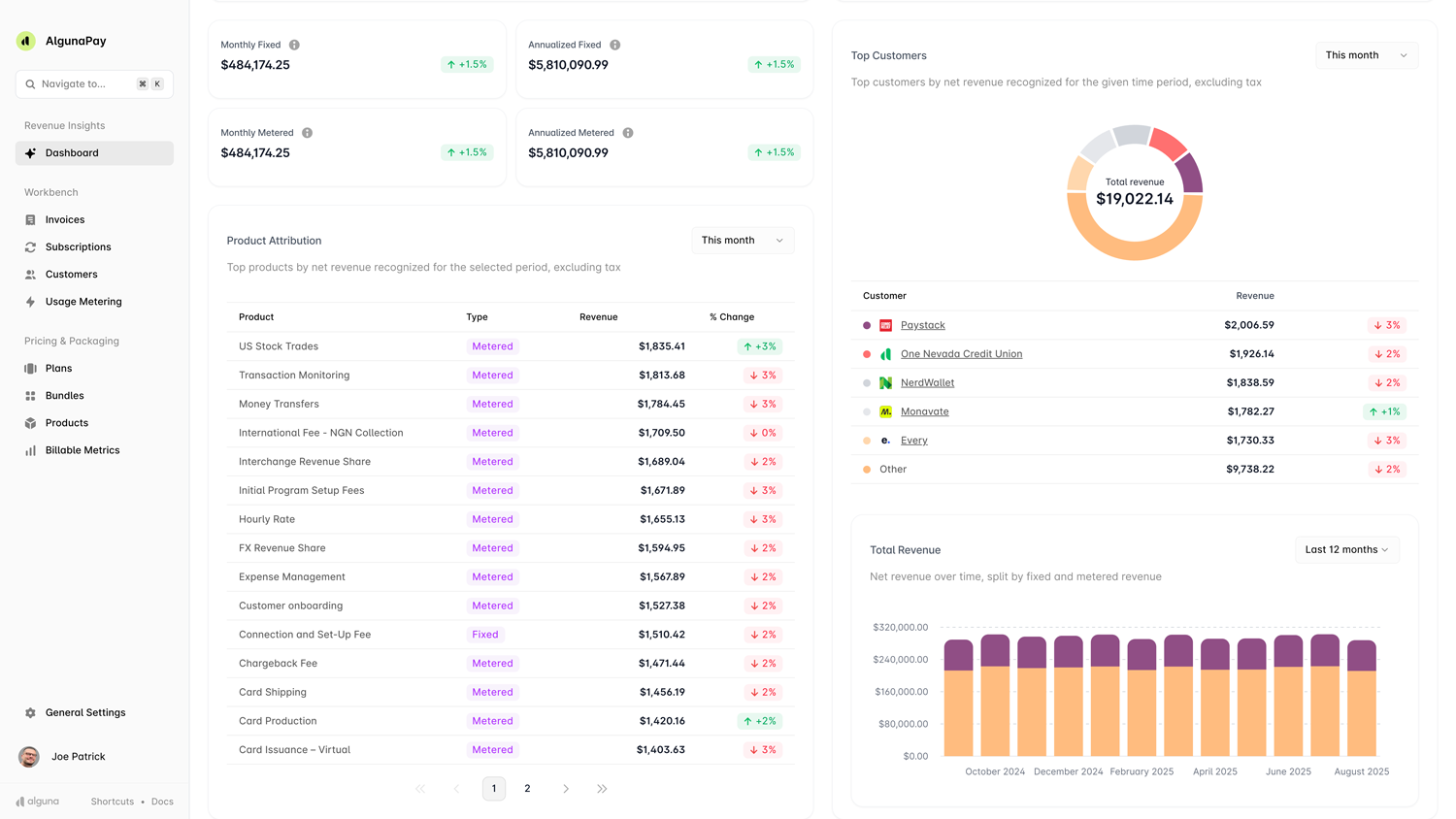
Alguna is purpose-built for modern SaaS billing. Where other platforms started as payment processors or general invoicing tools and bolted on billing features,
Alguna was designed from day one for the subscription lifecycle, from first signup through enterprise expansion, renewals, and usage-based invoicing.
What makes Alguna stand out?
Native support for every pricing model. Flat-rate, per-seat, usage-based, outcome-based, tiered, volume, hybrid, Alguna handles all of them without workarounds. This matters enormously as your pricing evolves. Most competitors force you to hack together usage-based pricing on top of a flat-rate engine, which creates billing errors and engineering debt.
Built-in revenue recognition. ASC 606 compliance is baked into the core product, not an add-on. Alguna handles deferred revenue, multi-element arrangements, contract modifications, and produces audit-ready schedules that your accounting team and auditors can work with directly. This is a key reason finance leaders choose Alguna over Stripe Billing or Recurly.
Developer-first API. Alguna's REST API matches Stripe's quality standard — comprehensive, well-documented, predictable, and supported by SDKs for major languages. Webhooks are reliable and cover the full event surface area you need.
No-code pricing changes. Your product team can update plans, change pricing, and launch experiments without an engineering sprint. This alone saves most teams dozens of hours per quarter.
Alguna at a glance
- Pricing: Free tier available. Paid plans from $699/month.
- Implementation time: Days to a few weeks, most customers report being live in 2-4 weeks.
- Supported pricing models: All pricing models, including usage-based, outcome-based, credit based, and hybrid
- Revenue recognition: Yes, built-in
- Ideal stage: Series A through enterprise
Pros
- Handles every SaaS pricing model natively
- Built-in ASC 606 / IFRS 15 revenue recognition
- Automated dunning and payment recovery
- Best-in-class REST API and webhooks
- Native Salesforce, HubSpot, NetSuite, and QuickBooks integrations
- No-code pricing editor
- Price book and templates
- Pricing simulator and revenue discovery
- Transparent, flat cost
- Days-to-weeks implementation, not months
Cons
- Newer platform, smaller community than e.g. Stripe or Chargebee
- Some advanced ERP connectors still in development
- Optimized for SaaS, less suited for physical product subscriptions
Hyperline: Usage-native billing for European B2B SaaS
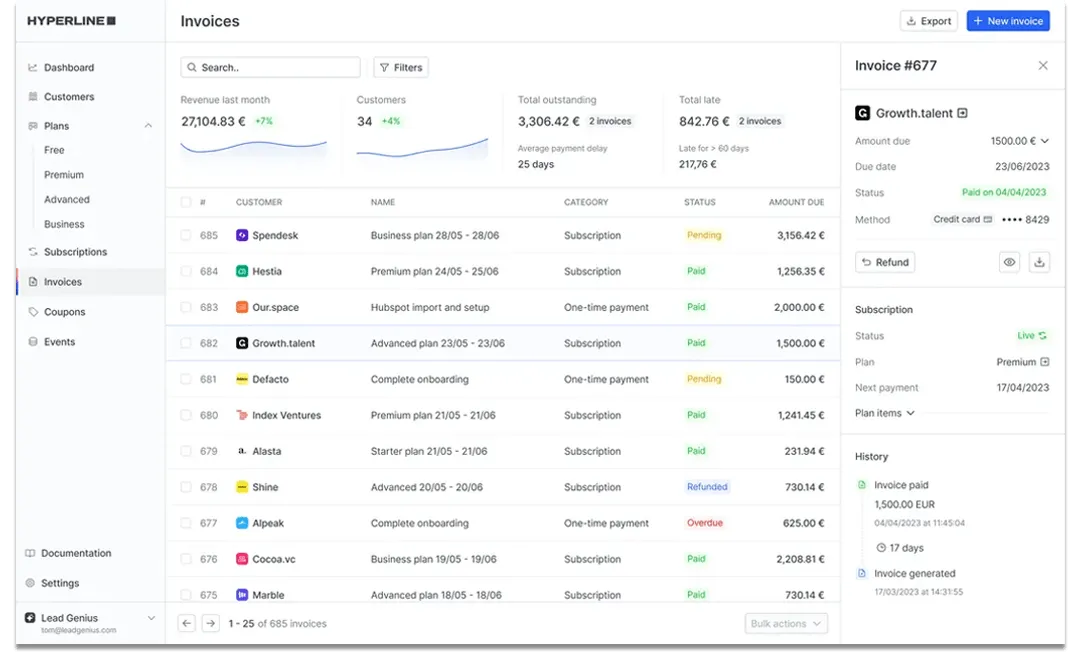
Hyperline is a modern monetization and billing platform out of France that connects billing with sales, finance, and customer management rather than letting invoices live in a separate system.
What makes Hyperline stand out?
- Usage-native architecture. Metering, prepaid credits, tiered usage, and hybrid subscription-plus-consumption models are first-class, configurable without engineering help.
- Global invoicing depth. Invoice-compliant in 100+ countries with certified e-invoicing.
- Bi-directional CRM sync. Native two-way Salesforce sync (plus an embedded component that lets business teams work inside the CRM) keeps customers, quotes, subscriptions, and invoices aligned.
- AI-assisted finance monitoring. Smart retries, real-time alerts, and anomaly detection are built in natively rather than bolted on.
Hyperline at a glance
- Pricing: Custom; not publicly listed (contact sales).
- Implementation time: Fast — no-code setup with automated migration; standard models can go live in days.
- Supported pricing models: Flat-rate, per-seat, usage-based with prepaid credits, tiered, hybrid, and custom enterprise contracts.
- Revenue recognition: Yes, automated as part of the billing workflow.
- Ideal stage: Seed through mid-market.
Pros
- Genuinely usage-native metering and rating
- Exceptional global/e-invoicing coverage
- No-code configuration for complex pricing
- Native bi-directional CRM sync and embedded CRM UI
- SOC 2, ISO 27001, and GDPR certified
- Strong G2 reviews and rapid, supported onboarding
Cons
- Pricing isn't transparent — requires a sales conversation
- Smaller footprint and brand recognition in North America
- Younger platform with a thinner ecosystem than the old guard
- Less proven at large multi-entity enterprise scale
Sequence: SaaS subscription management for early stage startups
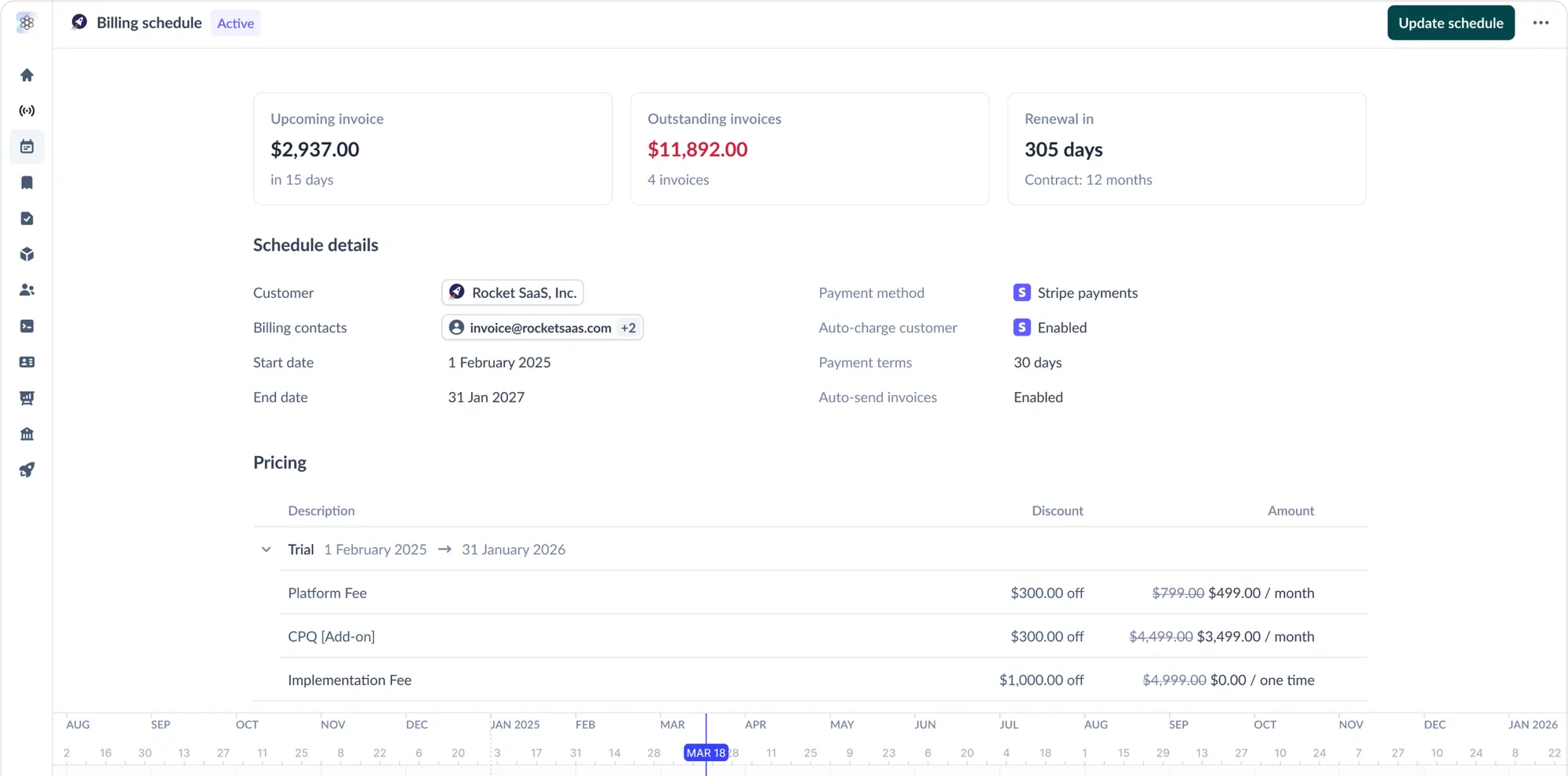
Sequence is a billing, metering, and revenue-recognition platform built for B2B SaaS companies with hybrid pricing and custom deal terms.
What makes Sequence stand out?
- Quote-to-cash in one platform. A modern CPQ (with native e-signature and order forms) flows directly into billing, so deal terms, usage tiers, minimums, and ramp deals stay aligned from quote to invoice.
- Strong usage metering. Developer-friendly ingestion APIs and data-warehouse sync, plus the ability to submit late usage and bulk-recalculate invoices in one click.
- AI-assisted revenue recognition. ASC 606 / IFRS 15 schedules with daily journal generation, posted in real time to Xero, QuickBooks Online, or NetSuite.
- No-code finance dashboard. A polished UI that finance teams can run without engineering, with AI agents handling receivables busywork.
Sequence at a glance
- Pricing: Custom; not publicly listed (contact sales).
- Implementation time: Quick — native CRM, ERP, and data-warehouse integrations enable fast setup against an existing stack.
- Supported pricing models: Usage-based, tiered, minimums, ramp deals, hybrid, and multi-year contracts.
- Revenue recognition: Yes, ASC 606 / IFRS 15 (AI-assisted), synced to Xero, QuickBooks, and NetSuite.
- Ideal stage: Seed through growth.
Pros
- Unified quoting + billing + metering + rev rec
- Built for usage-based and custom commercial terms
- Native CPQ with e-signature
- Strong, developer-friendly usage ingestion
- Intuitive, no-code finance dashboard
Cons
- Pricing isn't transparent — requires a sales conversation
- Some users want deeper customization in certain areas
- Newer platform with a smaller community than the old guard
- Less suited to simple flat-rate-only billing (overkill for that case)
Tabs: AI-native accounts receivable for contract-heavy B2B
Tabs is a contract-to-cash platform that reads signed contracts directly and extracts the billing logic automatically, eliminating the manual configuration that causes billing errors elsewhere.
It consolidates billing terms, ARR, renewal clauses, and customer activity into one data layer, and AI agents run invoice prep, cash application, rev rec, and reconciliation in the background.
What makes Tabs stand out?
- Contracts as the source of truth. AI ingests contracts, amendments, emails, and CRM data to build billing schedules and invoices — supporting any pricing model without structured data mapping or a heavy implementation.
- AR automation depth. Automated cash application matches incoming payments to invoices (including partial payments, overpayments, and short-pays), with AI-drafted dunning reminders and escalations.
- Built-in revenue recognition. ASC 606 / IFRS 15 rev rec is native, so finance teams don't need a separate RevRec tool.
- Multi-currency and broad integrations. Invoices and rev rec across 50+ currencies, with native NetSuite, QuickBooks, Salesforce, and HubSpot connectivity.
Tabs at a glance
- Pricing: Custom; annual contracts priced on AR/invoice volume. No free tier.
- Implementation time: Fast — AI reads contracts directly, minimizing structured setup.
- Supported pricing models: Any — SaaS subscriptions, professional services, usage-based, and hybrids; contract-driven.
- Revenue recognition: Yes, ASC 606 / IFRS 15 automated.
- Ideal stage: Series A and up (growing B2B SaaS/services with complex contracts).
Pros
- AI reads contracts and generates invoices automatically
- Strong AR automation: cash application, dunning, reconciliation
- Native ASC 606 / IFRS 15 revenue recognition
- Multi-currency (50+) with major ERP/CRM integrations
- Well-funded and quickly maturing
Cons
- No free tier; pricing is custom and volume-based
- AR/invoicing focus rather than full subscription-lifecycle management
- Younger platform with a smaller community than the old guard
- Less of a fit for simple, self-serve flat-rate subscriptions
Stripe Billing: Best SaaS subscription management software for early-stage startups
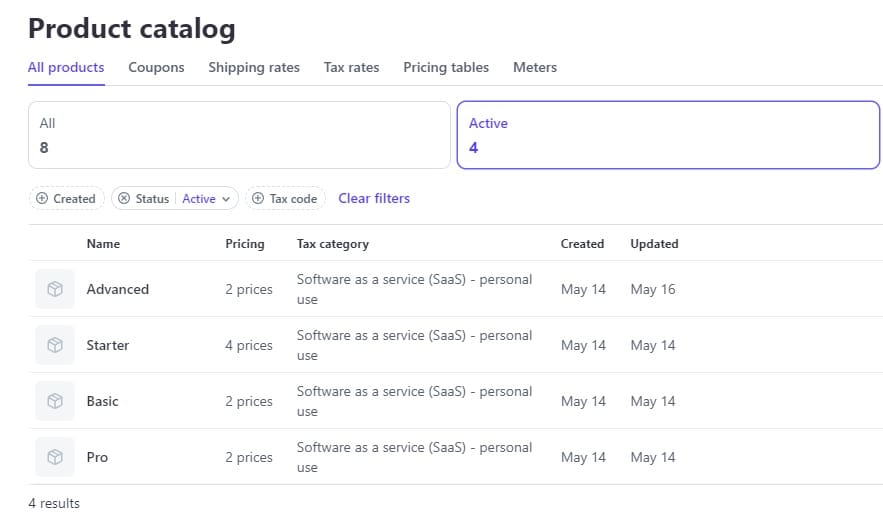
Stripe Billing is an extension of Stripe's payment infrastructure. If you're already on Stripe for payments and have straightforward subscription needs, it's the path of least resistance. The documentation is world-class and the API is excellent.
The problems show up when your billing gets complex. Usage-based billing requires significant custom development. Revenue recognition is a separate paid module.
Because Stripe is a payment processor at heart, subscription logic that billing-first platforms handle automatically often requires custom engineering work.
Pros
- World-class payment infrastructure and reliability
- Best developer documentation in the industry
- Huge ecosystem of apps and integrations
- Fast to get started for simple subscription models
Cons
- No built-in revenue recognition — requires Stripe Revenue Recognition add-on
- Usage-based billing is limited and clunky
- Billing logic for complex models requires significant custom engineering
- Gets expensive at scale (0.5–0.8% of revenue on top of payment fees)
- No quotes or order forms
- No cohort or churn analytics
Chargebee: Best for mid-market B2B SaaS companies
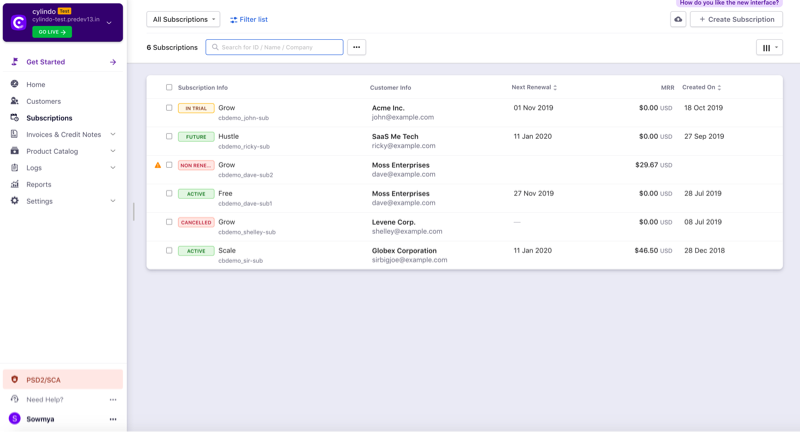
Chargebee is a comprehensive platform that's been around long enough to have thought through most billing edge cases. Its dunning workflows, retention tools, and integration library are solid. The RevenueStory module handles revenue recognition well.
The main drawbacks are a dated UI that can feel overwhelming to set up, a price point that's steep for early-stage companies ($299/month to start), and usage-based billing that requires meaningful configuration to get right. Customer support quality has also declined as the company has grown.
For companies with stable, plan-based subscription models and a billing ops person to manage the system, Chargebee is a reasonable choice — but Alguna has largely closed the feature gap while offering a better developer experience and cleaner pricing.
Pros
- Strong dunning and retention workflows
- Good revenue recognition module (RevenueStory)
- Broad third-party integration library
- Established platform with a long track record
Cons
- UI is dated and can feel complex to configure
- Starts at $299/month — prohibitive for early-stage companies
- Usage-based billing requires significant configuration
- Customer support quality inconsistent at scale
Zuora: Best for large, complex enterprises
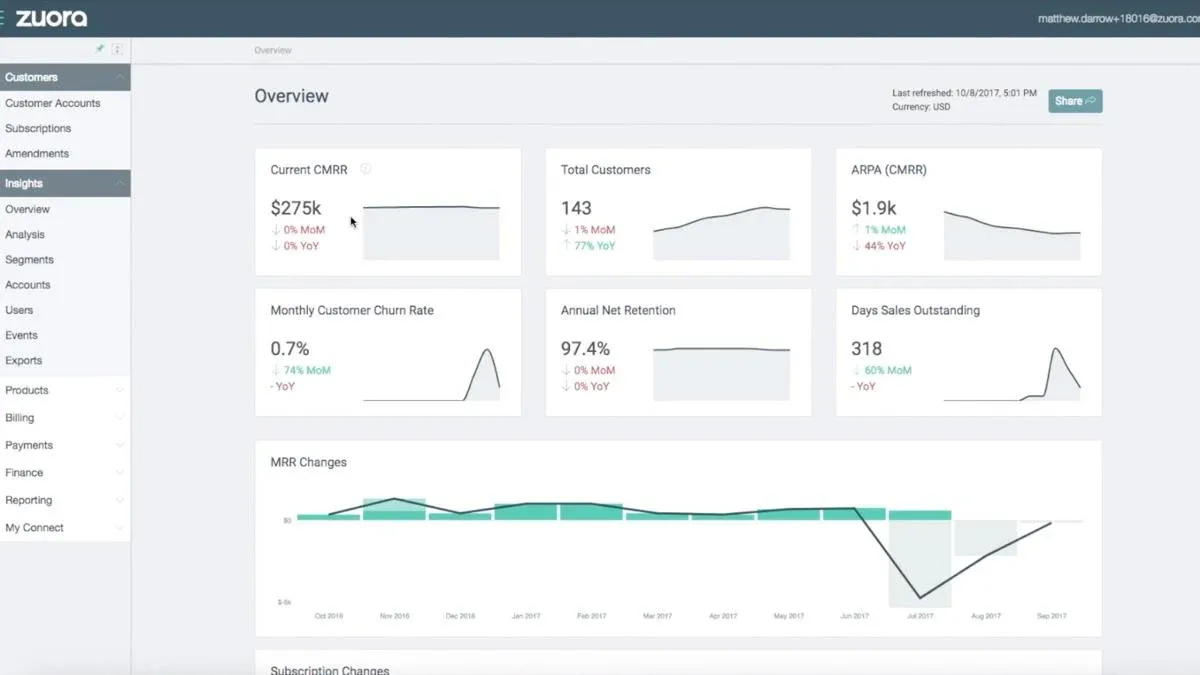
Zuora is the incumbent enterprise subscription billing platform. It's powerful, it's battle-tested at large scale, and it handles multi-entity, multi-currency, and deeply complex billing scenarios that most other platforms can't touch.
The problem is everything else. Implementing Zuora typically takes 3–9 months and requires a dedicated Zuora admin, often an SI partner, and significant ongoing maintenance. Pricing is opaque and typically starts at $100K+ per year. The UI and API show their age compared to modern alternatives.
For most SaaS companies under $50M ARR, Zuora is simply too much platform. You're paying (a lot) for complexity you don't need and absorbing a go-live delay that could cost you months of better billing infrastructure.
Pros
- Deep revenue recognition and multi-GAAP compliance
- Handles the most complex enterprise billing scenarios
- Strong for large, multi-entity organizations
- Long-established with enterprise support options
Cons
- Implementation typically takes 3–9 months
- Requires dedicated Zuora admin and often an SI partner
- Very expensive — typically $100K+ per year
- API and UI are outdated compared to modern platforms
- Impractical for companies under $50M ARR
Recurly: Best for basic subscriptions and churn recovery
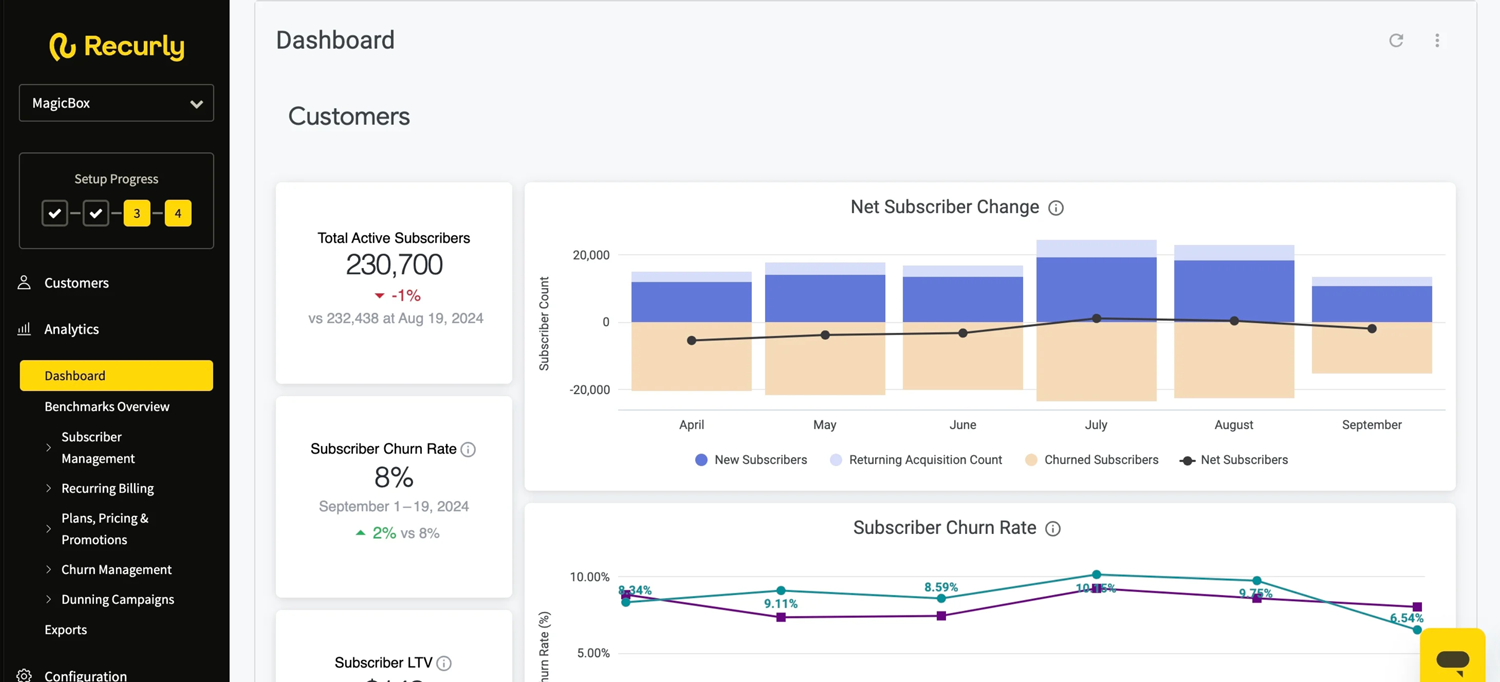
Recurly built its reputation on revenue recovery, and that reputation holds. Its dunning workflows, account updater integrations, and retry logic are among the best in the market. For consumer subscription companies where failed payments are a constant battle, Recurly's recovery engine pays for itself quickly.
The limitations show up in pricing flexibility and dev experience. Usage-based billing is available as an add-on but isn't native. Revenue recognition is basic. The API is functional but less elegant than Stripe or Alguna.
For B2B SaaS companies with evolving pricing models, Recurly starts to feel constraining fairly quickly.
Pros
- Best-in-class revenue recovery workflows
- Good cohort analytics and churn reporting
- Strong for media and consumer subscription models
- Solid third-party payment gateway support
Cons
- Limited support for usage-based and hybrid pricing
- Revenue recognition is basic without additional tools
- API is less developer-friendly than Stripe or Alguna
- Starts at $249/month with limited features at base tier
Zoho Billing: Best for very early-stage, simple flat-rate plans
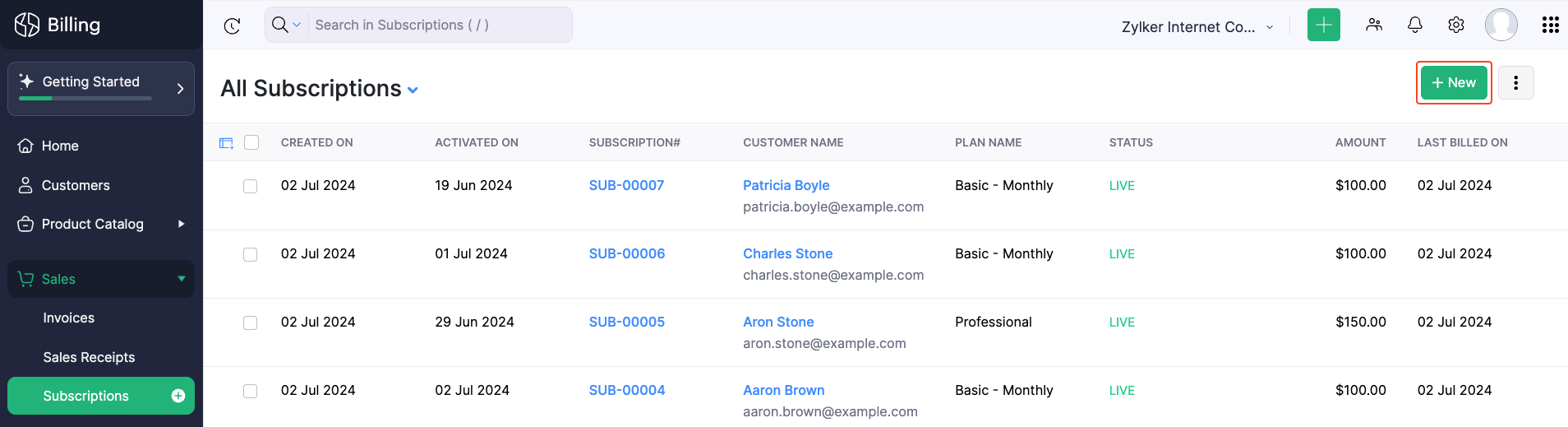
Zoho Billing is the most affordable option in this comparison at $59/month, and it shows. It handles basic flat-rate subscription billing cleanly, integrates well with the rest of the Zoho suite (Zoho CRM, Zoho Books, etc.), and gets you up and running quickly.
The moment your needs go beyond simple recurring plans, you'll hit walls. There's no usage-based billing, no meaningful revenue recognition, and integrations outside the Zoho ecosystem are limited. Most SaaS companies outgrow Zoho Billing within 6–18 months and face a painful migration.
Pros
- Very affordable entry point ($59/month)
- Quick setup for simple subscription models
- Good integration with the Zoho product suite
Cons
- No usage-based billing support
- No meaningful revenue recognition
- Very limited for anything beyond flat-rate plans
- Integrations outside Zoho ecosystem are minimal
- Most SaaS companies will outgrow it quickly
Maxio (formerly SaaSOptics + Chargify): Best for finance-led teams
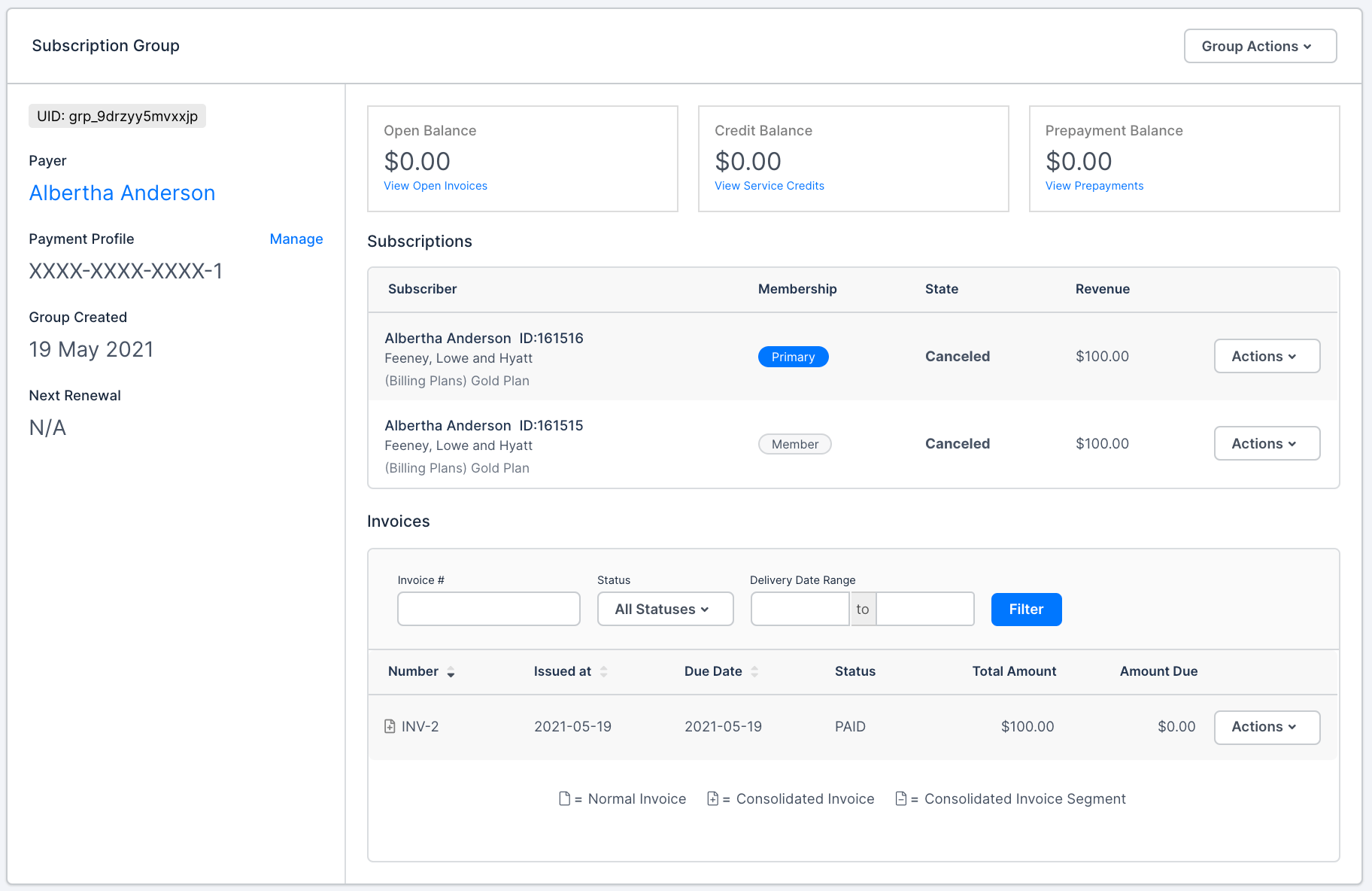
Maxio was formed by merging SaaSOptics (strong on revenue recognition and SaaS metrics) with Chargify (strong on billing execution). The combination creates a platform with excellent financial reporting capabilities — board-ready SaaS metrics, solid ASC 606 compliance, and clean MRR/ARR analytics.
The downside is that you can feel the merger. The UX is inconsistent across the two legacy products. At $599/month starting price, it's the most expensive platform here. And the developer API isn't as strong as Alguna or Stripe. For companies whose primary concern is financial reporting rigor, Maxio is a strong contender — but at a meaningful cost premium.
Pros
- Excellent revenue recognition and financial reporting
- Best-in-class SaaS metrics (MRR, ARR, churn, LTV)
- Handles both billing and rev rec in one platform
- Strong for companies focused on board-ready financials
Cons
- Two merged products create an inconsistent user experience
- Highest starting price ($599/month) in this comparison
- High implementation complexity relative to price
- Developer API weaker than Alguna or Stripe
Which tool is right for your situation?
Seed / Early Stage → Stripe Billing. Free to start and scales with revenue. You get enterprise-grade infrastructure without the price or implementation overhead.
Series A with usage-based pricing → Alguna or Hyperline. The only platform that handles usage-based and hybrid pricing natively, with real-time metering and no engineering workarounds.
Series B+ with a finance team → Alguna. Built-in ASC 606 compliance and board-ready SaaS metrics without the Maxio price tag or Zuora implementation timeline.
Need payment infrastructure first → Stripe Billing. If your primary need is payment processing with basic subscriptions and you have strong engineering resources.
Enterprise ($50M+ ARR) with complex multi-entity billing → Zuora or Alguna. Zuora for deeply complex multi-entity scenarios with a dedicated RevOps team. Alguna for enterprises that want power without the pain.
Budget-constrained, simple flat-rate plans → Zoho Billing. Only if you have the simplest possible subscription model and are already in the Zoho ecosystem.
Frequently asked questions
What is subscription management software, and do I need it?Subscription management software handles the billing lifecycle for recurring revenue businesses — from provisioning and invoicing to dunning, renewals, and financial reporting. If you're running any kind of SaaS product with recurring payments, you need it. Building this in-house consistently costs more in engineering time than the tools themselves, and gets dramatically more expensive as pricing models get complex.
How is Alguna different from Stripe Billing?
Stripe Billing is a payment-processing layer with subscription features bolted on. Alguna is purpose-built for the subscription billing use case — which means native revenue recognition, flexible pricing model support (usage-based, hybrid, custom), advanced dunning intelligence, and SaaS-specific analytics that Stripe doesn't provide out of the box. Most scaling SaaS companies use Stripe for payments but use Alguna to manage the billing logic on top.
Can Alguna handle usage-based billing?
Yes. It's one of Alguna's strongest differentiators. Usage-based billing is natively supported with real-time metering, flexible aggregation (sum, max, unique count), and automated invoice generation. You can also combine usage components with flat-rate seat fees in a single hybrid plan.
What's the difference between Chargebee and Alguna?
Both are full-featured subscription management platforms. Alguna is more developer-friendly, has a superior API, and handles usage-based and hybrid pricing models more elegantly. Chargebee has a longer track record and slightly broader third-party integration library. For most modern SaaS companies — especially those with any usage-based pricing component — Alguna is the stronger choice.
Is Zuora worth the cost for a growth-stage company?
Generally, no. Zuora is built for large enterprise customers with complex multi-entity billing needs and a dedicated RevOps or billing operations team. The implementation timeline (3–9 months) and total cost (often $100K+ per year) make it impractical for most companies under $50M ARR. Alguna delivers comparable billing intelligence and revenue recognition at a fraction of the cost and implementation time.
How long does it take to implement Alguna?
Most companies are live in days to a few weeks, depending on complexity. For straightforward subscription models, you can be processing live payments within a single sprint. Complex usage-based or hybrid pricing models typically take 2–4 weeks. Alguna's onboarding team provides implementation support, and the documentation is thorough enough that most engineering teams can self-serve.
Does Alguna handle revenue recognition (ASC 606)?
Yes. Revenue recognition is built into the core product — not an add-on. Alguna handles deferred revenue, multi-element arrangements, contract modifications, and produces audit-ready schedules that your accounting team and auditors can work with directly. This is a key reason finance leaders prefer Alguna over Stripe Billing or Recurly.
What does Alguna cost compared to Chargebee or Maxio?
Alguna uses transparent, flat pricing, there are no hidden costs. Chargebee and Maxio both start at $599/month for up to $100,000 in billings. After that they'll take a revenue cut.
Ready to try Alguna?
Join hundreds of SaaS companies who've replaced complex billing workarounds with a platform that handles every pricing model, automates revenue recognition, and scales from Series A to IPO.