Billing used to be simple. You sent an invoice, the customer paid, and you moved on. That world is gone. Modern revenue and finance teams juggle subscriptions, usage-based charges, credits, hybrid plans, and contracts that change mid-term, and the old way of handling all of it (spreadsheets, manual data entry, and rigid billing scripts) cannot keep up.
But billing as we know it has changed.
AI for billing takes the repetitive, error-prone parts of the billing process off your plate so your team can focus on strategic work.
In this guide, we break down what AI billing is, how it differs from traditional automation, what it can do for SaaS companies and beyond.
What is AI billing?
Traditional billing automation follows rules you set up in advance: if an invoice is 7 days overdue, send reminder A.
AI billing takes unstructured inputs like signed contracts and customer emails, makes decisions within the guardrails you define, and adapts as conditions change.
In practice, most platforms blend the two, using dependable rules for routine steps and AI for the judgment calls.
Put simply, AI billing is one part of a broader move toward revenue automation, where software handles the full path from quote to cash with far less manual effort.
AI billing vs "traditional" billing automation
| Dimension | Traditional billing automation | AI billing |
|---|---|---|
| Setup logic | Fixed rules and templates | Learns from contracts and data, then adapts |
| Contract handling | Manual data entry | Reads and extracts terms automatically |
| Exceptions and disputes | Routed to a human queue | Detected, classified, and triaged |
| Collections | Scheduled reminders only | Reads replies, captures promises, escalates |
| Cash application | Manual matching | Auto-reconciles cash to the ledger |
| Oversight | Static and all-or-nothing | Tunable autonomy (monitor, suggest, act) |
Why AI in billing matters now
Three pressures are pushing finance teams toward AI in billing at the same time.
- Pricing got complicated. Usage-based, tiered, and hybrid models mean invoices are no longer a flat monthly figure. Calculating them by hand invites errors and revenue leakage.
- Cash is harder to collect. Across North America, 43% of credit-based B2B sales are now overdue, per the 2025 Atradius Payment Practices Barometer. Late payments tie up working capital and stretch out your collections cycle.
- Manual work does not scale. As you add customers and pricing variations, the headcount needed to keep billing accurate grows faster than the revenue it supports.
Rules-based automation helps, but it breaks the moment something falls outside the script.
AI billing handles the messy middle: the disputed line item, the partial payment, the customer who replies asking for a new date.
That is also why teams adopt AI to reduce DSO and protect cash flow without simply hiring more people.
What AI billing automation can do
AI billing automation covers the full billing lifecycle, not just one step.
Here is where it tends to help most:
- Contract extraction. Upload a signed contract and the system pulls out pricing, terms, products, and start dates automatically.
- Invoice generation. Accurate invoices are produced from real consumption and contract data, including for usage and hybrid plans.
- Collections and dunning. Follow-ups adjust to context, and replies are read and acted on. This is the core of intelligent collections and a major use case for AI in accounts receivable.
- Cash application. Incoming payments are matched to invoices, which makes reconciling accounts receivable far less of a month-end scramble.
- Anomaly detection. Unusual charges, missing payments, and likely errors get flagged before they reach the customer.
- Forecasting. Payment history and behavior feed more reliable predictions of when cash will actually land.
| Billing stage | What AI does |
|---|---|
| Quote and contract | Extracts pricing, terms, and products from signed contracts |
| Invoicing | Generates accurate invoices, including usage and hybrid models |
| Payments | Offers multiple payment methods and retries failed charges |
| Collections | Sends context-aware follow-ups, reads replies, captures promises to pay |
| Cash application | Matches incoming payments and reconciles them to the ledger |
| Reporting | Surfaces real-time AR metrics and flags anomalies |
AI billing automation for SaaS companies
SaaS revenue management is uniquely messy. A single account might combine a subscription, metered usage, one-off services, and mid-cycle upgrades, all on terms negotiated per deal.
That complexity is exactly why flexible billing and usage-based pricing are so hard to manage with spreadsheets.
AI billing automation for SaaS companies addresses this by reading each contract, rating usage correctly, and producing invoices that match what was actually sold. It pairs naturally with B2B billing workflows and subscription management, since both depend on getting recurring and variable charges right every cycle.
For a SaaS finance team, the payoff is concrete: fewer billing errors, faster close, less revenue lost to mistakes, and a billing operation that grows without a matching jump in headcount.
What are AI billing agents?
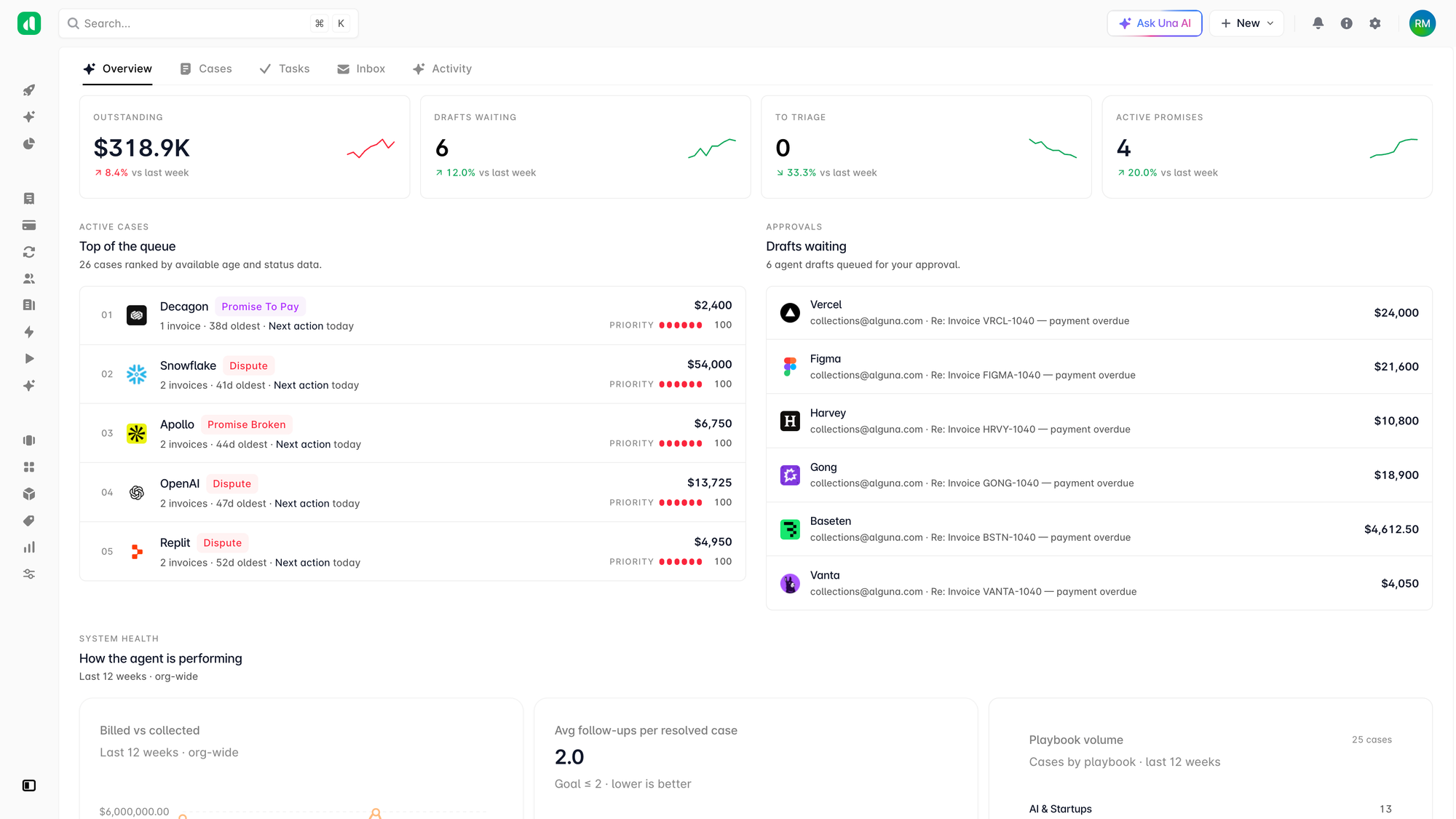
AI billing agents are software agents that can plan and carry out multi-step billing and collections tasks on their own, rather than waiting for a person to trigger each action.
A billing agent might draft an invoice, send a payment reminder, read the customer's reply, capture a promise to pay, pause outreach when a dispute appears, and escalate the exceptions that need a human.
The key is control.
Good AI billing agents sit on an autonomy ladder, so you decide how much they do without you. In monitor mode they watch and report. In suggest mode they draft actions for your approval. In act mode they execute within hard limits you set.
This is closely related to the accounts receivable AI agent model, where the agent owns the routine work and your team owns the judgment calls.
How Alguna approaches AI billing
At Alguna, we built an end-to-end revenue management platform for the AI era, specifically designed to handle complex pricing and high-volume billing.
Our AR Agent autonomously manages the work that drains finance teams: it drafts and sends invoices and reminders, reads inbound replies, captures promises to pay, pauses on disputes, retries failed payments, and reconciles cash to your ledger. You stay in control through an autonomy ladder with monitor, suggest, and act modes, so the agent only does as much as you are comfortable with.
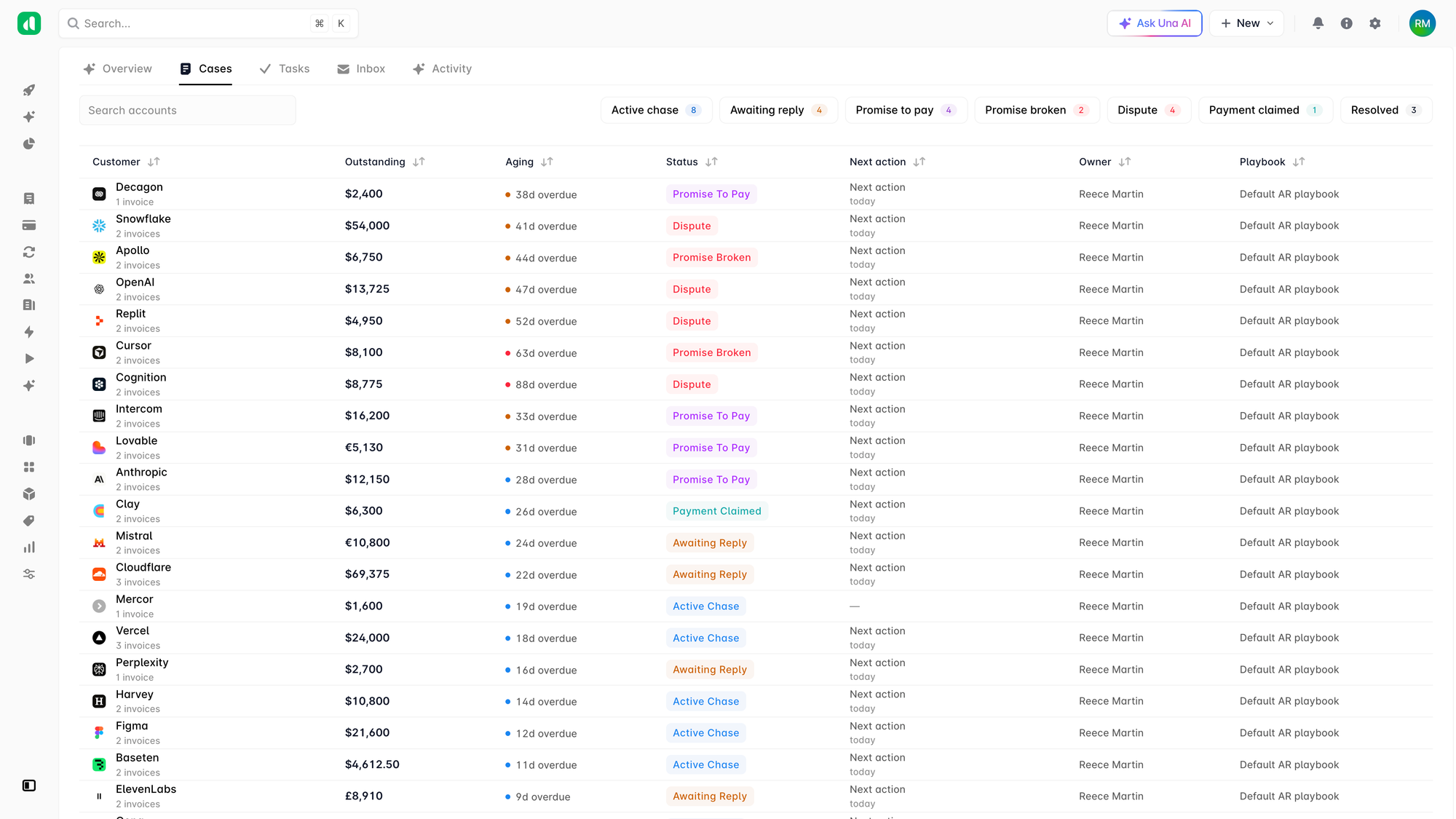
Everything runs from the Control Tower, a single workspace with five views.
- Overview shows live KPIs like outstanding balances, drafts waiting, and active promises.
- Cases gives you every overdue account with its status, aging, next action, and owner.
- Tasks holds agent drafts awaiting approval.
- Inbox classifies inbound customer email and links it to the right case.
- Activity is a full event timeline and audit log.
Together with real-time AR visibility, multi-method payments, and automated collections, that is what AI billing looks like in practice.
Book your personalized demo and we will walk you through Alguna's AR agent and Control Tower with your use case in mind.
The promise of end-to-end AI billing
AI billing is still early. The category is being built in real time, meaning standards are unsettled, best practices are still emerging, and most platforms are closer to their first chapter than their final form.
That's not a reason to wait, it's a reason to pay attention. The businesses adopting AI billing now are the ones shaping what it becomes, learning the edge cases before they're textbook, and compounding an advantage while competitors treat billing as a solved problem.
The technology will mature. The question is whether you'll have grown with it or be playing catch-up once it does.