Late payments are one of the most predictable problems. (And one of the most expensive.)
But your AR team shouldn't be spending their week copy-pasting the same follow-up email. But for most finance teams, that's exactly what's happening. 😰
For B2B companies alone, the average days sales outstanding (DSO) sits well above 45 days. In other words: Cash that's sitting in unpaid invoices instead of funding growth.
The best accounts receivable AI software doesn't just send reminders on a timer. It reads customer replies, captures payment commitments, handles disputes, and works your aging autonomously – so your team only touches the exceptions.
In this guide, we've reviewed the best accounts receivable AI software available on the market, including Alguna, Tabs, Monk, Paraglide, Fazeshift, and Sequence. We'll walk through what each platform does well, where it falls short, and how to evaluate which one fits your business.
What is accounts receivable AI software?
Accounts receivable (AR) software is the category of tools that help businesses manage the money they're owed, from generating and sending invoices through to tracking payments, following up on overdue accounts, and reconciling cash.
AI accounts receivable software takes that further.
Instead of a finance team manually working through aging reports and copy-pasting the same email 40 times a week, AI accounts receivable software can:
- Predict payment risk at the account level, based on historical behavior
- Prioritize which overdue accounts to focus collections efforts on
- Send personalized, contextually relevant follow-ups -- not generic dunning blasts
- Read and classify customer replies, capturing promises to pay and flagging disputes
- Reduce DSO by shortening the time between invoice and payment
A key metric you'll see throughout this guide: DSO (days sales outstanding) measures how long it takes, on average, to collect payment after a sale. Reducing DSO by even a few days can meaningfully improve cash flow.
The best AI accounts receivable software features for managing DSO include real-time aging dashboards, predictive risk scoring, automated cadences, and intelligent dispute handling.
For SaaS companies in particular, AR software also needs to handle usage-based models, which is where most legacy tools start to struggle.
Quick comparison: Accounts receivable AI software at a glance
Here's a high-level look at how the platforms stack up before we go deep on each one.
| Platform | Best for | Strengths | Limitations | Pricing |
|---|---|---|---|---|
| Alguna | Scaling B2B SaaS and AI native companies needing end-to-end CPQ, billing, revenue recognition, and AI AR automation | AR Agent + Control Tower; CPQ; usage-based billing; revenue recognition; autonomy ladder; SOC 2 compliant | Focused on B2B SaaS; less suited for high-volume transactional businesses | Custom pricing. |
| Tabs | Startups and SMBs needing simple invoice-to-cash automation | Clean UI, quick setup, automated reminders, payment portals | Limited support for complex pricing models; no full revenue lifecycle coverage | Custom. |
| Monk | Mid-market teams wanting AI-powered collections workflows | AI collections prioritization, 99.8% cash application accuracy, dispute management | Primarily a collections tool; limited billing capabilities | Contact for pricing |
| Paraglide | High-volume B2B finance teams wanting two-way AI billing communication | Conversational AI agents; 100+ language support; two-way email handling across full AR lifecycle | Early-stage; less suited for complex billing models or full quote-to-cash workflows | Contact for pricing |
| Fazeshift | Mid-market and enterprise teams needing multi-agent AR automation across ERP, CRM, and email | 8 specialized AI agents; 99% cash application accuracy; SOC 2 Type II; strong ERP integrations | Pricing not publicly listed; built for teams with larger, more complex AR operations | Contact for pricing |
| Sequence | B2B SaaS companies wanting to unify CPQ, billing, and receivables in one AI-powered platform | Contract intake via AI; flexible pricing engine; Sequence Agent for collections; revenue recognition | Not a standalone AR tool; best when replacing the full billing stack | Custom (platform fee based on billed revenue) |
6 best accounts receivable AI software in 2026
The market for AI accounts receivable software has evolved significantly in the past two years.
A first generation of AR tools automated the mechanical parts of collections, scheduled reminders, aging dashboards, basic dunning sequences. What we're seeing in 2026 is a second wave: platforms deploying true accounts receivable AI agents that read replies, understand context, capture payment commitments, and handle disputes autonomously.
The difference in outcomes is significant.
Below, we've covered six platforms across that spectrum, from full quote-to-cash platforms with embedded AR agents, to specialist AI collections tools, to conversational AR agents focused purely on the inbox layer.
The right choice depends on where you sit in the market and what you actually need automated.
1. Alguna
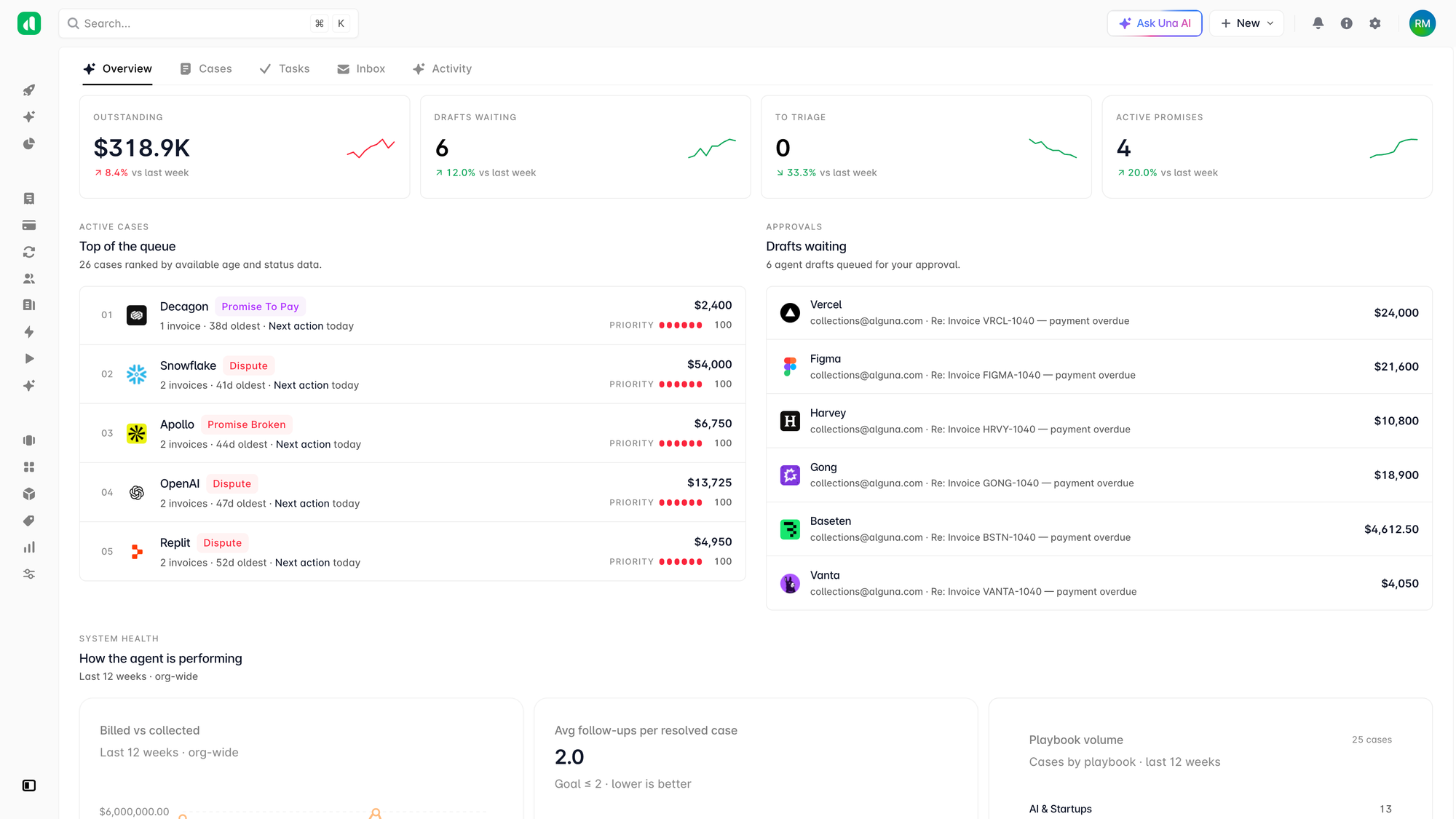
Alguna is an end-to-end revenue automation platform purpose-built for the AI era, complex pricing models, and companies with high-volume billing. Backed by Y Combinator and Mango Capital, they've set out to put an end to revenue leakage, once and for all.
It covers the full commercial lifecycle, from from quoting and contract management through to invoicing, collections, and revenue reporting, in one connected workspace.
What makes Alguna the standout option in this category is the Alguna AR Agent: an AI-powered collections agent that works your aging like a tireless specialist. It opens a case for every overdue account, drafts and sends follow-ups on your cadence, reads customer replies, captures promises to pay, pauses itself on disputes, and escalates edge cases to your team, all from a purpose-built workspace called Control Tower.
The result is a collections process that runs largely on its own, with humans reviewing exceptions rather than doing the legwork.
No need to rip and replace your entire stack at once.
Key features
- AI contract extraction: Upload an executed contract (PDF, Docx, etc.) and automatically extract all key data points such as pricing, terms, products, start dates, and more.
- AR Agent: An AI collections agent that autonomously manages your entire AR process: drafting, sending, reading replies, capturing promises, pausing on disputes, and escalating exceptions without manual input from your team.
- Control Tower workspace: A single command center for your AR operation with five views: Overview (live KPIs including outstanding, drafts waiting, active promises, and a prioritized queue), Cases (every overdue account with status, aging, next action, playbook, and owner), Tasks (agent drafts awaiting approval and team reminders), Inbox (inbound customer email classified and linked to the right case), and Activity (a full event timeline and audit log).
- Cadences and playbooks: Define multi-step follow-up sequences anchored to invoice sent, due date, last action, or promise date, with offsets, repeats, and per-step templates. Group work per invoice or per account depending on how your team operates.
- Promise-to-pay capture: When a customer replies with a payment commitment, the agent captures the promise, links it to the invoice, and auto-pauses the cadence through the promise date plus a grace window. Kept promises resolve the case; broken promises trigger your chosen behavior -- follow up, escalate, or flag for review.
- Dispute detection and handling: Inbound replies are classified in real time for intent (payment claim, promise, dispute, document request, wrong contact, and more). Disputes move the case to Dispute status, pause outreach, and drop an agent note explaining why (e.g., missing PO, amount disagreement) so a human can step in with full context.
- Configurable personas: Set up mailbox personas with a display name, signature, and tone (Friendly, Professional, or Firm) so early reminders stay warm and escalated balances get appropriately firm, all from your domain, in your brand's voice.
- CPQ and contract management. Build and send quotes in minutes. Deal terms connect directly to billing so there's no re-entry and no gap between what was sold and what gets invoiced.
- Flexible billing: Usage-based, outcome-based, seat-based, hybrid, and custom pricing models, the kind of complexity most AR tools simply can't handle.
- Revenue recognition: Automated, audit-ready revenue recognition built into the billing workflow, so finance teams don't need a separate tool to stay compliant.
- Integrations: Native connections with Salesforce, HubSpot, Stripe, and your general ledger, with multi-currency support across USD, EUR, GBP, and more.
Pros
- The only platform in this guide with a true AI AR agent that reads replies, captures promises, and handles disputes end-to-end
- Control Tower gives finance teams a single real-time command center for the entire AR motion
- Autonomy ladder means you can start in Monitor or Suggest mode and increase agent autonomy as confidence builds
- Hard-coded guardrails protect against legal and financial risk without requiring careful configuration
- Covers the full revenue lifecycle from quoting to cash, not just collections
- Handles complex billing models that most AR tools can't support
- SOCII and GDPR compliant
- Strong hands-on onboarding and migration support
Adam Liska, Co-founder and CEO at Airspeed (formely Glyphic)
Read the case study
Cons
- Newer platform with smaller ecosystems than incumbents
- Pricing is custom, so you'll need a demo conversation to get a number
Best for
- Companies that want AI-driven collections automation, not just scheduled reminders
- Finance teams looking to consolidate quoting, billing, and collections into one workflow
- Founders and CFOs who need real-time revenue visibility and a clear picture of outstanding cash
- Companies looking to reduce DSO without adding AR headcount
- Teams that want to start with human oversight and graduate to full agent autonomy over time
Pricing
Custom pricing based on business size and requirements. Alguna never takes a revenue cut.
See how Alguna reduces DSO and automates collections end to end. Book a demo and we'll walk you through the AR Agent and Control Tower with your use case in mind.
2. Tabs
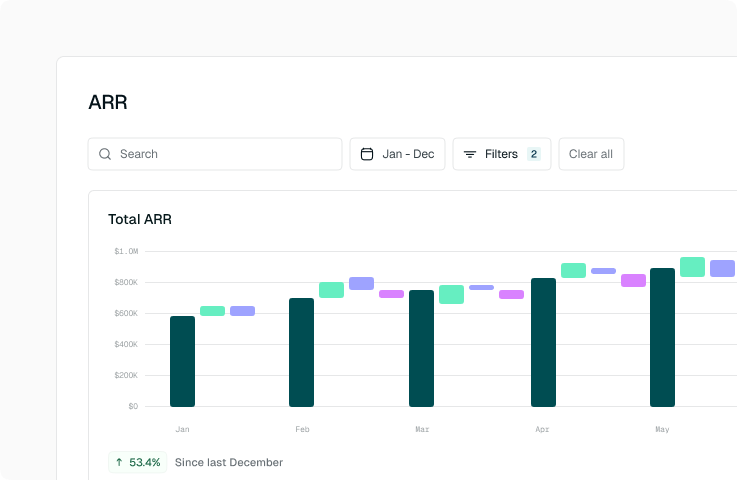
Tabs is an AR automation platform focused on simplifying the invoice-to-cash process for startups and growing SMBs. It's built to be quick to set up and intuitive to use – the kind of tool you can get running in a day without a dedicated AR team or a lengthy implementation project.
Tabs covers invoice creation and delivery, automated payment reminders, and basic collections workflows. It's a solid starting point for companies in the early stages of AR automation that need to stop manually chasing invoices without investing in enterprise-grade tooling.
Key features
- Automated invoice delivery and reminders. Send invoices and schedule payment follow-ups automatically, without manual intervention for each account.
- Payment portals. Customers pay directly from the invoice via an integrated payment link, reducing friction in the payment process.
- Collections dashboard. View outstanding invoices, aging buckets, and payment status in one place.
- Accounting integrations. Connects with QuickBooks and Xero for reconciliation without manual exports.
Pros
- Quick to set up -- minimal implementation time or technical resources required
- Clean, intuitive interface accessible to non-finance users
- Good fit for teams that just need core AR automation without complexity
Cons
- Limited support for complex or usage-based pricing models
- Doesn't cover quoting, contract management, or the broader revenue lifecycle
- Less AI capability than purpose-built AI collections tools -- closer to smart automation than genuine agent behavior
- May need supplementing with additional tools as the business scales
Best for
- Early-stage startups and SMBs with straightforward invoicing and collections needs
- Teams taking their first steps into AR automation and prioritizing simplicity over sophistication
Pricing
Tabs starts at approximately $299/month. Verify current pricing on their website before purchasing.
3. Monk
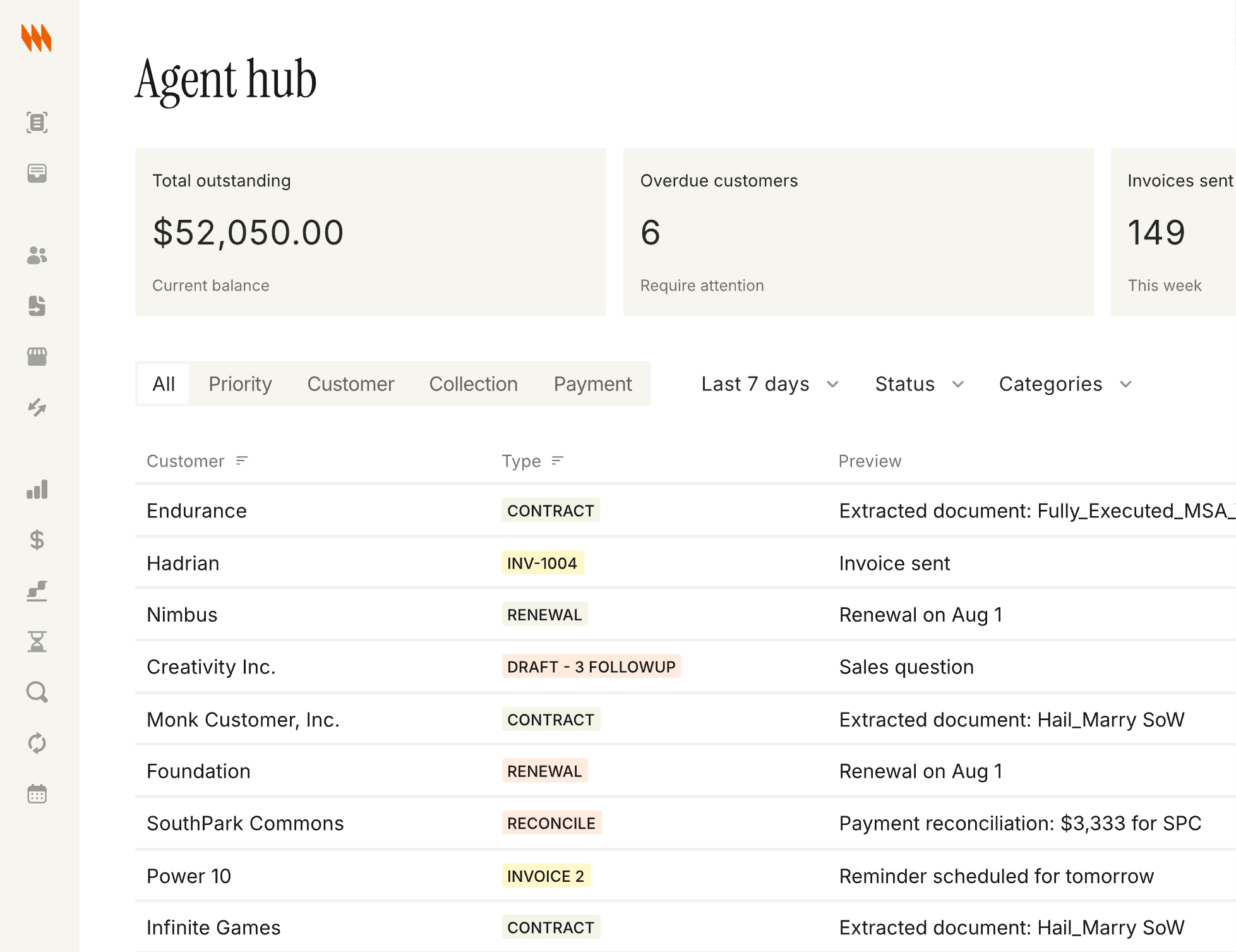
Monk is an AI-first AR automation platform built for mid-market finance teams that need genuine intelligence in the collections process, not just scheduled reminders.
Its core proposition is bringing high-accuracy cash application and AI-driven collections prioritization together in one platform.
Key features
- AI collections prioritization. Machine learning scores each customer's payment likelihood and surfaces the highest-risk accounts automatically, so your team works the right accounts first.
- Cash application. 99.8% matching accuracy across ACH, wire, credit card, and check payments, including complex parent-child hierarchies and consolidated remittances.
- Automated multi-channel outreach. Reminders and follow-ups dispatched across email and other channels based on account risk and payment history.
- Dispute management. Track and manage payment disputes in a centralized workflow with routing and resolution tracking.
- CRM integrations. Connects with Salesforce and other CRMs to keep collections aligned with customer relationship context.
Pros
- Strong AI capabilities specifically around collections prioritization and cash application accuracy
- Significantly reduces manual triage work for AR and finance teams
- Well-suited for organizations with high volumes of overdue accounts and complex payment scenarios
Cons
- Primarily a collections tool -- doesn't cover billing, quoting, or the broader quote-to-cash workflow
- Pricing isn't publicly listed, making it harder to benchmark during evaluation
- Best suited for teams with dedicated AR staff, not lean SaaS finance operations
Best for
- Mid-market companies with a dedicated collections or AR team
- Businesses managing high volumes of past-due invoices that need AI-assisted triage
- Finance teams where cash application accuracy is a major pain point
Pricing
Monk's pricing isn't publicly listed. Contact their sales team for a quote.
4. Paraglide
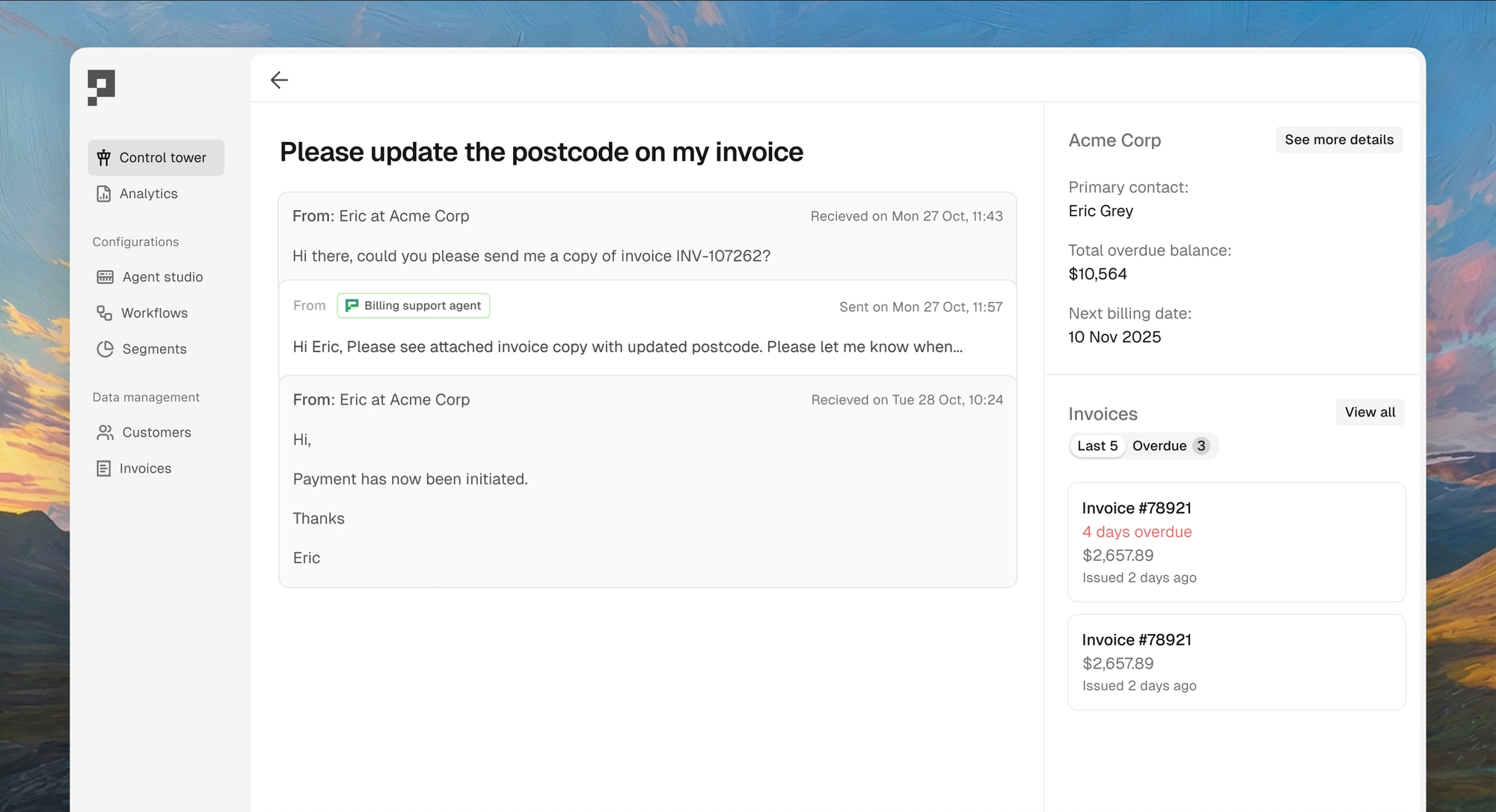
Paraglide is a newly funded AI-native AR platform that takes a fundamentally different approach to accounts receivable: instead of automating reminder sequences, it deploys AI agents that handle two-way billing communication end to end.
Key features
- Inbound reply handling. Agents read and respond to customer billing queries, document requests, and payment confirmations automatically, without human triage of the inbox.
- Multilingual support. Agents communicate in 100+ languages, making Paraglide particularly relevant for international B2B finance teams.
- Payment commitment tracking. When customers commit to payment dates, the agent logs the commitment and follows up if it's broken.
- ERP and billing integrations. Connects with ERPs and billing platforms to pull invoice data and keep records in sync.
Pros
- Genuinely conversational AI -- handles the two-way dialogue that most AR tools completely ignore
- Multilingual capability is a real differentiator for businesses with international customer bases
- Strong early traction and well-credentialed investors signal a credible product direction
- Addresses the specific bottleneck (billing conversations) that most dunning tools leave unresolved
Cons
- Early-stage company (founded 2025) -- track record and enterprise reliability are still being established
- Focused on the communication/inbox layer; doesn't cover billing, quoting, or cash application
- Less suited for B2B SaaS companies with complex usage-based billing models
- Pricing and roadmap details are limited given the company's early stage
Best for
- High-volume B2B finance teams where the inbox is the main bottleneck in collections
- International businesses that need multilingual AR communication at scale
- Teams already using an ERP or billing platform and looking specifically to automate the collections conversation layer
Pricing
Paraglide's pricing isn't publicly available. Contact their team directly for details.
5. Fazeshift
Fazeshift is an AI-native AR platform purpose-built for mid-market and enterprise finance teams. Where most AR tools give you one automation layer, Fazeshift breaks the workflow into eight purpose-built agents, each tuned for a specific task: cash application, collections, contract review, credit assessment, billing, payment dispute resolution, customer onboarding, and a self-service payment portal.
Key features
- Specialized AI agents. Purpose-built agents for Cash Application (99% accuracy), Collections, AI Contract Review, Credit, Billing, Payment Dispute, Payment Portal, and Onboarding.
- AI contract review and billing extraction. The contract review agent reads sales contracts, extracts billing terms, and automatically sets up invoicing in your ERP, including Stripe, NetSuite, and Sage Intacct.
- Collections automation. Personalized outreach adapted to each customer's payment history and behavior, with auto-escalation workflows for slow payers.
- Payment dispute agent. Monitors the inbox for customer responses, flags disputes, shares invoice copies, and routes exceptions for human review.
- ERP and CRM integrations. Works natively with Salesforce, NetSuite, SAP, and other core systems -- including an AppWrap partnership with NetSuite's Partner of the Year.
- SOC 2 Type II certified. Enterprise-grade security and compliance certification for businesses with strict data requirements.
Pros
- Most comprehensive multi-agent AR automation of any platform in this guide
- 99% cash application accuracy -- including complex parent-child hierarchies and partial payments
- Strong measurable outcomes: customers report 20% AR balance reduction and 60% fewer billing disputes
- SOC 2 Type II certification makes it viable for enterprise and regulated industries
- Works with existing systems rather than requiring a platform rip-and-replace
Cons
- Built for mid-market and enterprise -- not the right fit for lean SaaS teams or startups
- Pricing isn't publicly listed and likely reflects enterprise-tier investment
- The eight-agent model requires some upfront scoping to configure correctly
Best for
- Mid-market and enterprise companies with dedicated AR teams of five or more people
- Finance operations teams that need end-to-end automation from contract intake to cash posting
- Businesses with high invoice volumes and complex payment scenarios (parent-child hierarchies, multi-entity, multi-currency)
- Organizations with strict security and compliance requirements (SOC 2, regulated industries)
Pricing
Fazeshift's pricing isn't publicly available. Contact their team for a quote based on your invoice volume and feature needs.
6. Sequence
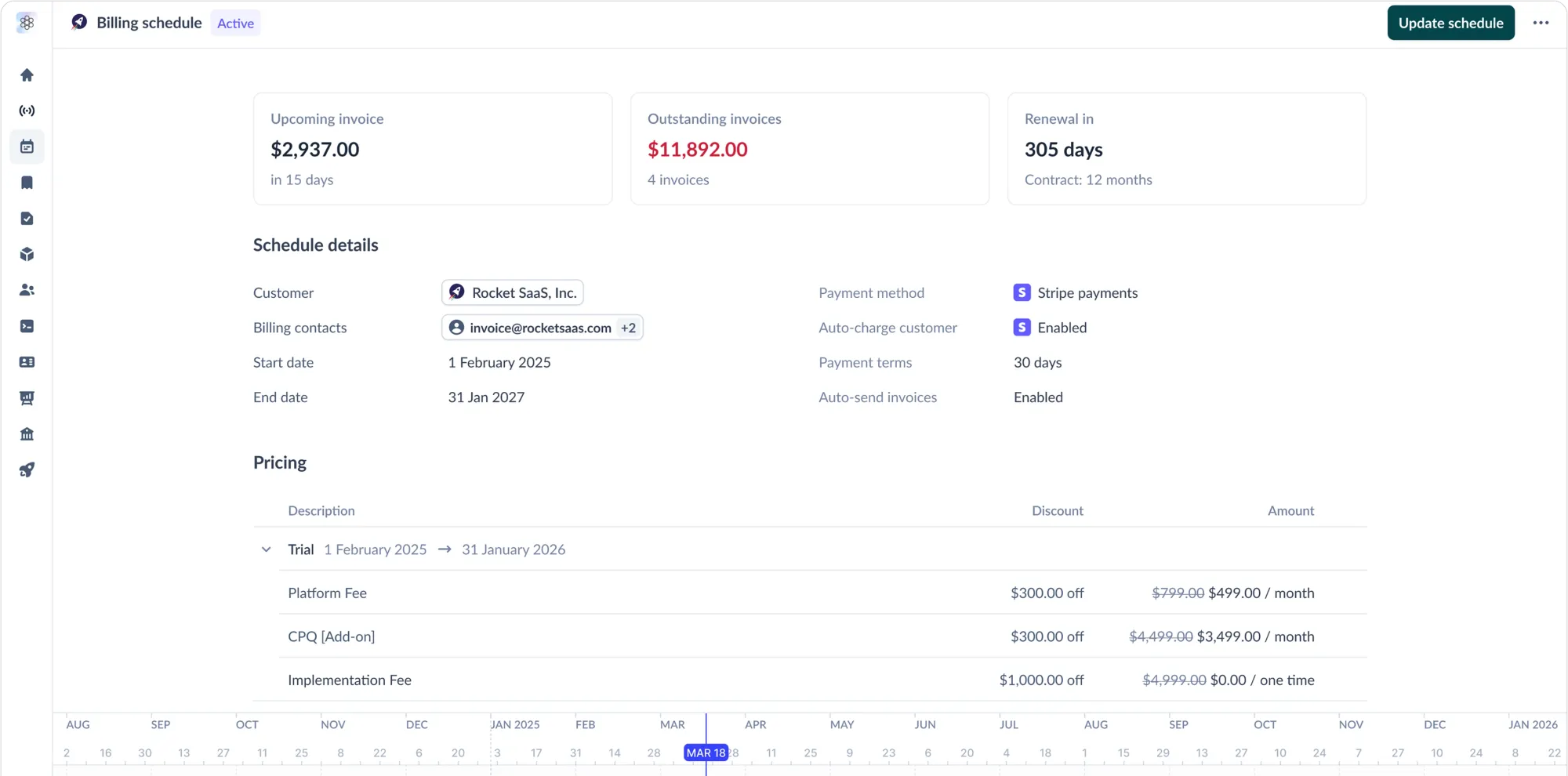
Sequence is an AI-powered quote-to-revenue platform for modern B2B finance teams. The platform covers billing automation, a flexible pricing engine, revenue recognition, usage metering, and a Sequence Agent for collections.
Think of it as the closest competitor to Alguna in terms of scope: both platforms target B2B SaaS companies that want to unify the full revenue workflow.
Key features
- AI contract intake. Forward contracts via Slack or email; Sequence's AI extracts pricing terms and sets up billing automatically for error-free invoice generation.
- Flexible pricing engine. Supports usage-based, seat-based, outcomes-based, commitment, credit, and graduated tier pricing -- from seed-stage to IPO.
- Sequence Agent. AI agents handle collections and receivables workflows, with humans reviewing and approving agent work through the Watchtower interface.
- CPQ. Build and send sales quotes that feed directly into billing, with embedded signing and approval workflows.
- Revenue recognition. ASC 606-compliant revenue recognition, assisted by AI, built into the billing workflow.
- Integrations. Native connections with CRMs, ERP systems, and data warehouses for fast implementation without overhauling your existing stack.
Pros
- Broad platform coverage from CPQ through to collections -- comparable scope to Alguna
- Contract-to-billing AI automation is genuinely differentiated for teams with high volumes of custom deals
- Flexible pricing engine handles almost any B2B billing model without custom engineering
- Strong product trajectory with a well-funded Series A and an active changelog
Cons
- Not a standalone AR tool -- most valuable when adopting Sequence as the full billing platform
- The Sequence Agent and Watchtower are newer capabilities; maturity and track record are still developing
- Custom pricing means you'll need a sales conversation to assess cost
- Less focused on the collections-specific features (promise capture, dispute handling, guardrails) that specialist AR platforms provide
Best for
- B2B SaaS companies wanting to unify CPQ, billing, and AR in a single AI-powered platform
- Finance teams with high volumes of custom contracts that need AI-assisted billing setup
- Companies that want to automate the full quote-to-revenue workflow, not just collections
Pricing
Sequence uses a monthly platform fee based on projected billed revenue and feature requirements. A free tier is available for startups under $1 million in annual revenue. Visit their pricing page for details.
How to evaluate AI accounts receivable software: 6 things to consider
Choosing the right AR software isn't about finding the longest feature list. Here's what actually matters when you're making this decision.
AI collections vs a full billing platform
The platforms in this guide fall into two broad camps: specialist AI collections tools (Monk, Paraglide, Fazeshift, Alguna's AR agent) that layer onto your existing billing stack, and full revenue automation platforms (Alguna, Sequence) that cover quoting, billing, and collections in one place.
If you're already happy with your billing setup and just need to automate collections, a specialist tool might be enough. If you're consolidating your finance stack, a platform that covers the full lifecycle will eliminate more manual work and data integrity issues.
AI vs automated reminders
A lot of platforms use the word "AI" to describe what is functionally a scheduled reminder sequence.
The distinction matters. Does the platform read customer replies and respond to them? Does it capture promises to pay and pause outreach accordingly? Does it handle disputes without human intervention? Real AI implementations do these things. Scheduled reminders don't.
Ask vendors to demo specifically how their platform handles a customer reply.
Billing model maturity
If you have usage-based, hybrid, or custom pricing, most AR tools will struggle. Make sure the platform can ingest your usage data, generate accurate invoices from it, and handle mid-period adjustments.
This is an area where platforms built specifically for the AI era, like Alguna and Sequence, have a meaningful advantage over tools designed for simpler billing models.
Controls and guardrails
If the platform uses AI agents for outreach, you need to understand how much control you have over what they do. Look for configurable autonomy levels (approve before sending vs. act within defined limits), approval thresholds tied to invoice amounts, and hard guardrails that prevent the agent from making legal threats, offering discounts, or admitting fault.
The autonomy ladder in Alguna's AR Agent is a good model to benchmark against.
Integration with existing stack
Your AR software needs to connect to your CRM, billing system, accounting software, and ERP without requiring manual data exports. Check for native integrations (not just Zapier workarounds) with the tools your team already relies on.
Implementation timelines
The biggest risk in switching financial software is the migration. Ask every vendor: how long does implementation take? Who does the heavy lifting? What does data migration involve?
A hands-on migration process significantly reduces risk and it's worth asking specifically for customer references who have migrated from a similar setup to yours.
Frequently asked questions about AI accounts receivable software
What is AI accounts receivable software?
Accounts receivable AI software automates the process of managing outstanding invoices and collecting payments from customers. Unlike basic dunning tools that send fixed-template reminders on a schedule, AI-powered AR platforms read customer replies, predict payment risk, capture payment commitments, handle disputes, and adjust collections behavior based on context – all with the goal of reducing DSO and improving cash flow.
What is an AI accounts receivable agent?
An AI AR agent is software that autonomously manages collections, drafting and sending follow-ups, reading and classifying customer replies, tracking promises to pay, pausing outreach when a dispute is detected, and escalating exceptions to your team. It's distinct from traditional dunning, which fires fixed templates on a timer without any understanding of what the customer actually said.
What are the best AI accounts receivable software features for improving DSO?
The features that have the biggest impact on DSO include: AI-powered payment risk scoring, automated multi-step collections cadences, promise-to-pay capture, real-time aging dashboards, and intelligent dunning intelligent dunning that adapts based on customer behavior. The combination of prediction, automation, and genuine reply understanding is what separates platforms that actually move DSO from those that just send more emails.
What's the difference between AR software and billing software?
Billing software generates and sends invoices. AR software manages what happens after the invoice is sent, tracking payments, following up on overdue accounts, and reconciling cash. Some platforms, like Alguna and Sequence, cover both in a unified workflow, which eliminates the data handoff between billing and collections that causes most accuracy problems.
How do I compare AI accounts receivable software platforms?
When you compare AI accounts receivable software, start with the type of AI capability (true agent behavior vs. scheduled automation), then evaluate billing model support, integration depth, autonomy controls, and pricing transparency. The comparison table at the top of this guide is a useful starting framework.
Is accounts receivable AI software suitable for SaaS companies?
Yes, SaaS companies benefit particularly from AI AR software because of the recurring, often complex billing cycles involved. The best platforms for SaaS handle usage-based billing, subscription changes, and prorated adjustments natively, rather than requiring manual calculations. Alguna and Sequence are both purpose-built for this use case.
What is the best AI implementation for accounts receivable automation software?
The most effective AI implementation in AR operates at the account level rather than the invoice level, scoring each customer's payment likelihood based on their specific behavior, reading and classifying their replies, and adapting the collections approach accordingly. Platforms like Alguna (AR Agent), Fazeshift (eight-agent architecture), and Paraglide (conversational agents) each represent different implementations of this approach, suited to different business contexts.
How long does it take to implement accounts receivable AI software?Implementation timelines vary widely. Simpler tools like Tabs can be up and running within days. Platforms that involve ERP integration or data migration from existing billing systems may take several weeks. The most important variable is how much support the vendor provides during the migration, a hands-on process significantly reduces risk and reduces the time your team spends on implementation.
Stop chasing payments
The gap between the AR teams that get paid on time and those that don't has never been more about effort. It's about tooling. The right accounts receivable AI software removes the manual work, eliminates the things that slip through the cracks, and gives your finance team the visibility they need to make decisions -- without spending their week copy-pasting follow-up emails.
Of the six platforms we've covered, Alguna is the most complete option for B2B SaaS companies: an end-to-end platform that connects quoting, billing, and collections in one place, with a genuine AI AR agent that works autonomously within the guardrails you set. If you're evaluating the market, it should be your first conversation.
“Alguna ticked every box I needed. Most importantly, it gave me a clear overview of revenue movements – something Stripe just couldn't provide.”
— Adam Liska, Co-founder and CEO at Airspeed (formerly Glyphic)
Book a demo to see Alguna in action