If you sell an API, an AI product, or anything priced on consumption, Orb is probably on your shortlist. It should be. Orb is one of the strongest developer-first usage billing platforms on the market.
But usage metering is only half of the job. The other half is everything that happens after the event lands: the enterprise contract with a ramped commitment, the annual plan paid monthly, the invoice your customer has to understand, the payment that has to clear before access is granted, and the journal entry your finance team has to reconcile in QuickBooks or NetSuite.
We talk to a lot of teams evaluating Orb, and to a few who already run on it. This post is an honest look at where Orb excels, where teams tell us they hit friction, and how Alguna approaches the same problems.
Orb is built for engineers who want full control over metering and rate cards.
Alguna gives you the same usage flexibility and scale, then carries it through contracts, invoicing, collections, and accounting in one system that finance and sales can run without being dependent on engineers.
Where Orb shines
Credit where it's due. When buyers describe Orb to us, the same strengths come up again and again.
- Raw event ingestion. Orb tracks individual usage events, not just pre-aggregated totals. You can stream live events, send aggregates, or upload CSVs.
- Custom metrics. Developers can define their own billable metrics directly from event data. That matters if you have dozens of API endpoints and pricing that changes every quarter.
- Flexible rate cards. Orb handles per-unit, tiered, and credit-based pricing well, and it's increasingly focused on AI and credit-burn models.
- Pricing experimentation. One buyer told us the feature they liked most was the ability to try different rate cards on the self-serve side and see the sensitivity before committing.
- Developer experience. Orb's API and documentation are consistently described as clean and well thought out, and stronger than finance-first tools.
If your business is mostly product-led, mostly self-serve, and engineering owns billing end to end, Orb is a credible choice.
📣 A note on Orb's acquisition. Adyen announced its acquisition of Orb on June 11, 2026, for $335 million, and the deal closed on July 1, 2026. Orb now runs as a wholly owned Adyen subsidiary under an incubator model.
If you're evaluating Orb today, it's worth asking how the roadmap, pricing, and support for payment processors other than Adyen will change.
Where teams tell us they hit friction
The gaps show up once billing has to serve sales, finance, and customers too, not only engineering.
These are the themes we hear most from teams evaluating Orb or moving off it.
1. One plan becomes four
A common pricing model: a base fee, included usage, optional overages, and a choice of monthly or annual payment. Conceptually that's one plan.
One team running on Orb told us they maintain four versions of every plan: monthly, annual, monthly with overages, and annual with overages. Every variant adds backend logic, API surface, and edge cases in the customer experience.
2. Enterprise contracts live somewhere else
Orb is strongest on self-serve. Teams with a sales-led motion alongside PLG keep asking the same question: what happens to quotes, order forms, ramped commitments, amendments, and approvals?
One evaluator summed it up: Orb was great for the PLG side, but the open question was how much cleanup the enterprise and sales side would still need. Another team on Orb told us their enterprise invoice customers aren't managed in Orb at all.
3. Accounting is an afterthought
For companies that run on QuickBooks, the integration matters as much as the metering. One buyer replacing Orb said it didn't treat QuickBooks as a first-class integration. They couldn't easily reconcile usage, invoice lines, and customer-level reporting between the two systems.
4. Customers can't see what they're paying for
Usage invoices raise questions. What did I use? How many credits are left? Why is this month higher? The same buyer wanted customers to see detailed usage behind each charge, not just a total, and found that hard to deliver.
5. Payment edge cases become manual work
Teams told us about three recurring issues:
- First payments. They wanted an upgrade or new subscription to activate only after the first charge clears, not before.
- Card mandates and 3DS. In markets like India, mandates often cover the subscription amount, so off-session overage charges above it fail and need manual follow-up.
- Expiring payment links. Invoice links that expire and must be regenerated by hand.
None of these are dealbreakers on their own. Together, they're the reason teams end up stitching Orb to a CPQ tool, an accounting workaround, and internal scripts.
The visibility as to like the credits aren't great. The product t starts to fall over when there's a lot of events in the system and it's recalculating things. It's very, very rigid in a lot of different areas.”
- Head of Finance at Series A company currently using Orb
How Alguna approaches usage-based billing
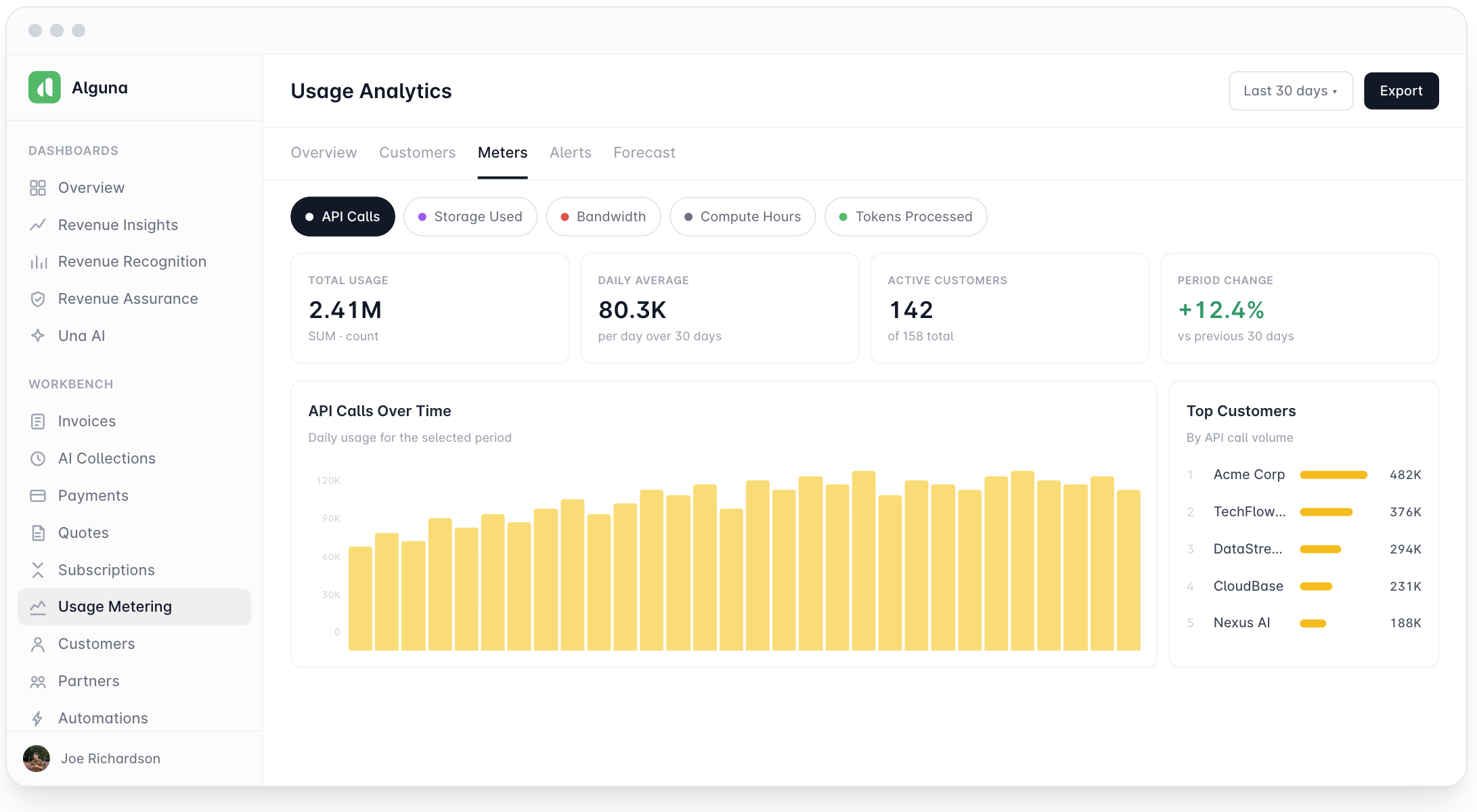
Alguna starts from the same place Orb does: raw events, flexible metrics, and any pricing model you can describe. The difference is that the event doesn't stop at a rate card.
It flows through the contract, the invoice, the payment, and the ledger in one system.
Usage without the code
- Ingest raw events through the API, or connect a warehouse like Snowflake, BigQuery, or ClickHouse.
- Define metrics in a no-code builder, so finance and RevOps can change pricing without an engineering ticket. One evaluator who had Orb at the top of their shortlist told us Alguna needed "even less code than Orb."
- Price on several dimensions at once with matrix pricing: region, provider, model, weight, or any combination. That's the lookup-table model logistics and AI infrastructure companies need.
Plans that flex instead of multiply
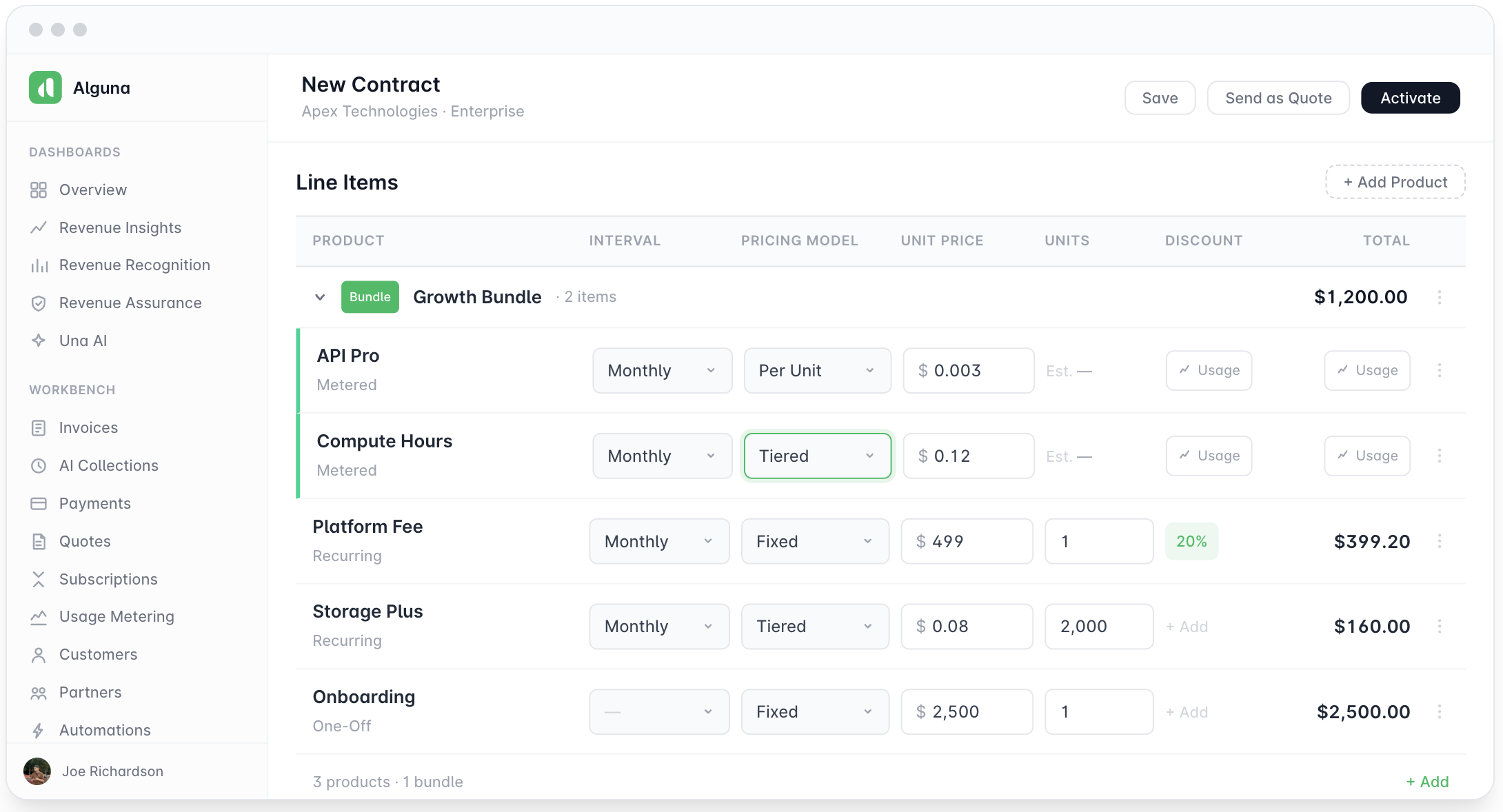
Start from one plan and set the terms on the subscription: commitment, included usage, overage rates, payment schedule, and price escalations.
Prepaid with overages, minimums, ramps, and free trials don't require a new plan for each combination.
Credits and wallets built in
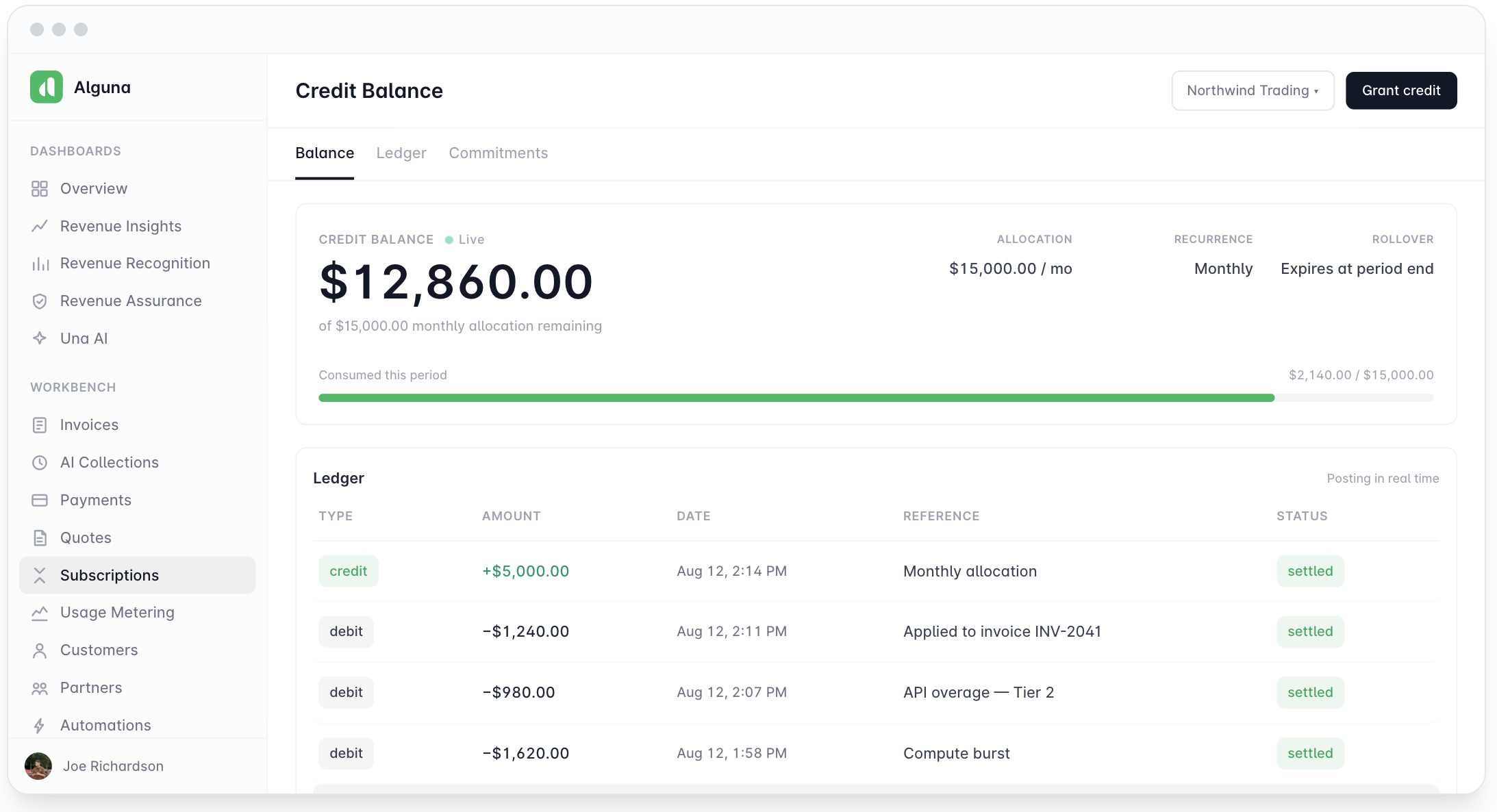
Prepaid credits, wallet top-ups, bonus credits, and entitlement gating are native. You can alert customers as balances run low and stop usage when credits hit zero.
Self-serve and enterprise on one price book
Quotes, approvals, e-signature through DocuSign, and two-way CRM sync with Salesforce, HubSpot, Attio, and Pipedrive live next to self-serve checkout.
A signed quote becomes a live subscription with no re-keying.
Finance-grade accounting
Native syncs to QuickBooks, NetSuite, Xero, Sage Intacct, and more. Revenue recognition schedules are generated from the same contract data that drives invoicing, so the numbers your finance team reports match what you billed.
Usage your customers can see
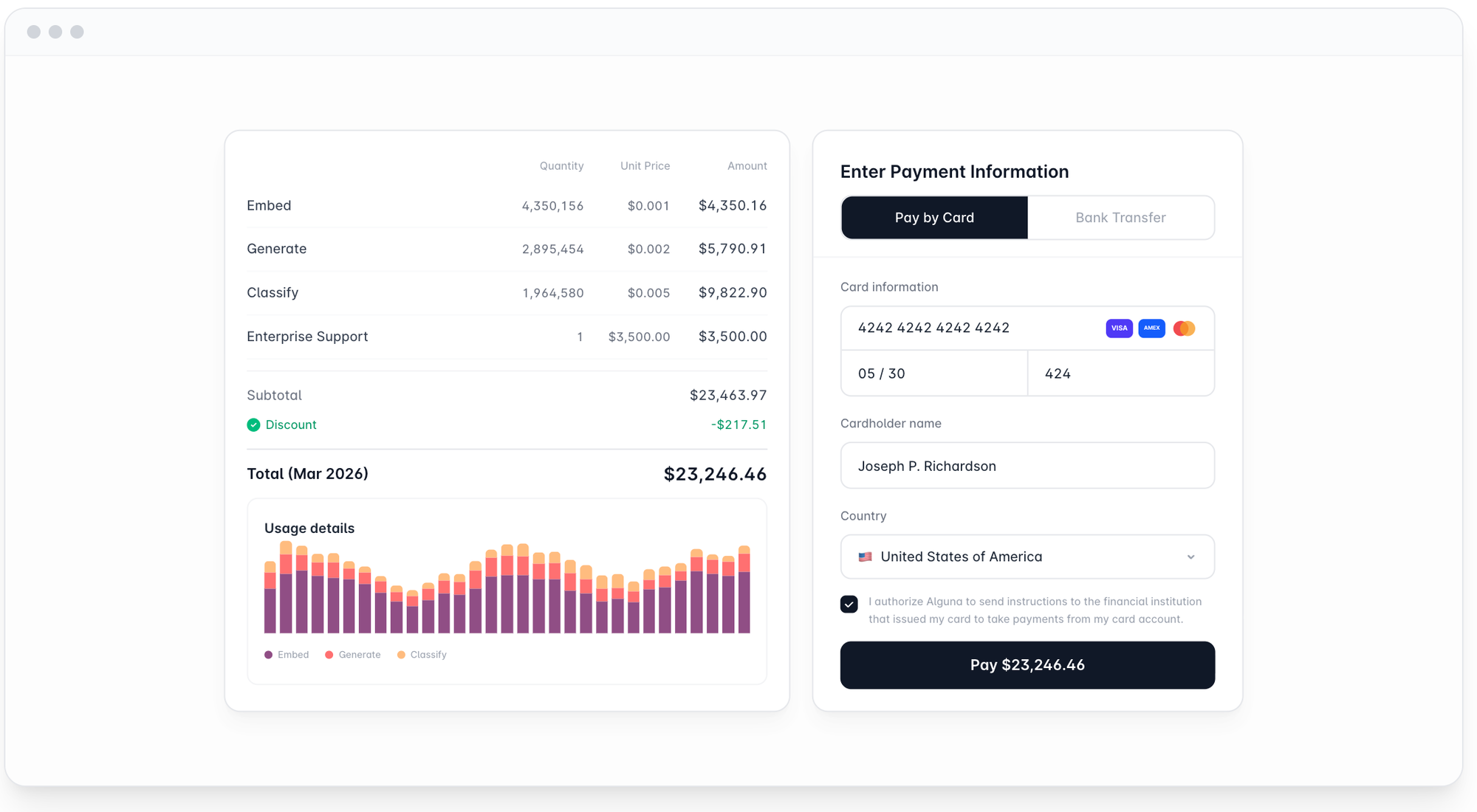
The customer portal shows usage against prepaid commitments, remaining credits, and usage charts behind each invoice line.
This means fewer "why is my bill higher?" tickets.
Test pricing before you ship it
Pricing simulations replay historical usage against a proposed plan, so you can see the revenue impact on real customers before you roll out a change.
That's the PLG experimentation Orb buyers value, applied to enterprise contracts too.
- Shane Curran, CEO at Evervault
Read case study
Alguna vs Orb at a glance
| Capability | Orb | Alguna |
|---|---|---|
| Raw event ingestion | Strong: live events, aggregates, CSV | Strong: API, CSV, and warehouse connectors |
| Custom metrics | Developer-defined | No-code builder for finance and RevOps |
| Multi-dimensional pricing | Some flexibility | Native matrix pricing |
| Credits and wallets | Strong, a strategic focus | Native, with top-ups and entitlement gating |
| Pricing experimentation | Rate-card testing for self-serve | Simulations on historical usage |
| Plan flexibility | Variants per billing term reported by customers | One plan, terms set per subscription |
| Quotes, approvals, CPQ | Limited | Built in, with e-signature |
| CRM sync | Available | Two-way: Salesforce, HubSpot, Attio, Pipedrive |
| Accounting sync | QuickBooks reported as shallow | QuickBooks, NetSuite, Xero, Sage Intacct and more |
| Revenue recognition | Limited | Built in |
| Customer usage visibility | Reported as limited | Portal with usage, credits, invoice detail |
| Best fit | Engineering-led PLG billing | PLG and enterprise on one platform |
Orb column reflects public positioning and what Orb users and evaluators have told us. Check current capabilities with Orb directly.
Orb column reflects public positioning and what Orb users and evaluators have told us. Check current capabilities with Orb directly.
Alguna vs Orb usage-based billing: Which one should you choose?
Choose Orb if:
- Your revenue is almost entirely self-serve and product-led.
- Engineering owns billing and wants to define every metric in code.
- Enterprise contracts, CPQ, and accounting are handled in other tools, and you're happy to keep it that way.
Choose Alguna if:
- You sell self-serve and enterprise, and want one price book for both.
- Finance, RevOps, or sales need to change pricing and contracts without engineering.
- Your pricing has several dimensions: models, regions, endpoints, commitments, credits.
- QuickBooks, NetSuite, or Salesforce need to match what you billed, without manual reconciliation.
- Your customers need to see their usage, credits, and invoice detail on their own.
Switching billing systems without the risk
Every Orb customer we've spoken to says the same thing: migrating a production billing system is risky. Get it wrong and you can't charge customers, or you charge them incorrectly. That's the right instinct.
So we don't ask for a big-bang cutover. A typical Alguna migration:
- Mirror your events. Send a copy of the usage you already send to Orb to Alguna.
- Run in parallel. Alguna calculates invoices for the same customers and periods, and you compare them line by line.
- Move a segment. Start with new customers or one plan, then expand.
- Cut over when the numbers match. Contracts, credits, and balances come across, and your accounting sync picks up where it left off.
If Orb handles your metering well but your sales, finance, and customer teams are working around it, it's worth a conversation.