If you're weighing Orb vs Stripe for usage-based billing, a lot have changed compare to last year.
Stripe closed its roughly $1 billion acquisition of Metronome in January to bring heavy-duty metering into its stack.
Meanwhile (just six months later), payments company Adyen agreed to acquire Orb for $335 million in cash.
Now, effectively, we're looking at two payment companies with a usage engine.
The real question is this: Which one can handle usage-based pricing smoothly? We're talking prepaid credits, ramping commitments, mid-month plan changes, failed payments, and the revenue reporting your finance team has to sign off on. And of course, offering customers complete transparency of their usage to avoid bill shock.
This guide compares both platforms honestly, using public product information and what we've heard firsthand from finance and engineering teams on Stripe and Orb during dozens of buyer calls.
We'll also show where Alguna fits if neither one covers your full workflow.
What is usage-based billing?
Usage-based billing charges customers based on what they actually consume (API calls, tokens, compute hours, messages, seats used) rather than a flat recurring fee.
In practice, most B2B companies run a hybrid: a platform fee or minimum commitment plus usage on top. If you're still shaping your model, our guide to consumption-based pricing covers the strategy side.
Running it well takes more than a meter. That's because a complete usage-to-cash flow, if you will, has five stages:
- Metering: capturing raw usage events from your product reliably, including late or backfilled data
- Rating: applying pricing logic (tiers, packages, minimums, credits, discounts) to turn usage into dollar amounts
- Invoicing: generating accurate invoices that customers can actually understand
- Collection: charging cards, handling bank transfers, retrying failed payments, and running dunning
- Revenue recognition and reporting: recognizing revenue over the right service period and keeping MRR, ARR, and the general ledger in sync
A few terms come up constantly when comparing platforms:
- Prepaid credits (credit burndown): customers buy a balance up front and usage draws it down
- Commitments: a contracted minimum spend, often annual, sometimes paid monthly, sometimes ramping year over year
- Overages: usage beyond the included allowance, billed at a set rate
- True-up: reconciling actual usage against the commitment at the end of a period
Stripe and Orb both cover metering, rating, and invoicing. Where they differ, and where buyers tell us the pain starts, is everything around those three steps.
Orb vs Stripe at a glance
| Platform | Best for | Strengths | Limitations | Pricing |
|---|---|---|---|---|
| Alguna | B2B SaaS and AI companies with hybrid or usage-based pricing that want finance, sales, and billing in one system | No-code pricing and metering, CPQ to billing in one flow, ASC 606 revenue recognition, AI-driven collections, flat pricing | Younger ecosystem than Stripe. Not built for B2C or self-serve consumer checkout at very high transaction volume | Free Starter tier, Growth from $699/month, and custom Enterprise. No revenue share |
| Stripe Billing | Developer-led teams already on Stripe Payments with simple to moderate usage pricing | Native payments, global reach, strong APIs, fast setup, Metronome now available for complex usage | Engineering-dependent, workarounds for complex contracts, weak finance tooling, fees grow with volume | 0.7% of billing volume (pay-as-you-go) plus payment processing. Metronome priced separately |
| Orb | Engineering-heavy AI and infrastructure companies with high event volumes and usage-first pricing | Usage-native architecture, SQL-based metrics, pricing simulations, retroactive recalculation | Rigid plan modeling, credit and overage workarounds, limited customer visibility, weak QuickBooks support | Custom pricing on all tiers (Core, Advanced, Enterprise), with no public rates |
Orb vs Stripe for usage-based billing: Where they really differ
On a features checklist, the two platforms look similar. Both meter events, both support tiered and package pricing, and both now belong to payments companies.
The differences show up in how they were built and who they were built for.
| Dimension | Stripe Billing | Orb |
|---|---|---|
| Starting point | Subscription billing extended to usage, with Metronome added for complex cases | Built usage-first around raw event data |
| Payments | Native Stripe Payments | Multi-processor today, with Adyen integration planned over time |
| Complex contracts | Ramps and custom terms often need stacked discounts or code | Variations often become separate plans |
| Credits and overages | Credit burndown supported, with enterprise commits via Metronome | Supported, but account-level credits and optional overages need workarounds |
| Finance usability | Built for developers, so finance teams lean on CSVs and spreadsheets | Built for engineers and billing ops, with thinner finance integrations below the Advanced tier |
| Quote to billing | Basic quotes, with contracts typically living elsewhere | No native CPQ, so subscriptions are often created manually after a deal closes |
| Pricing model | Percentage of billing volume | Custom, based on billings and event volume |
| Switching cost | High: customer IDs, entitlements, and payment methods embedded in your product | High: event schemas, plan mappings, and integrations to rebuild |
The short version:
- Stripe wins on payments and time to first invoice.
- Orb wins on metering depth for usage-first products.
Neither was designed to give a finance team end-to-end control from signed contract to recognized revenue, and that's the gap most of the pain points below come back to.
The 3 platforms compared
1. Alguna
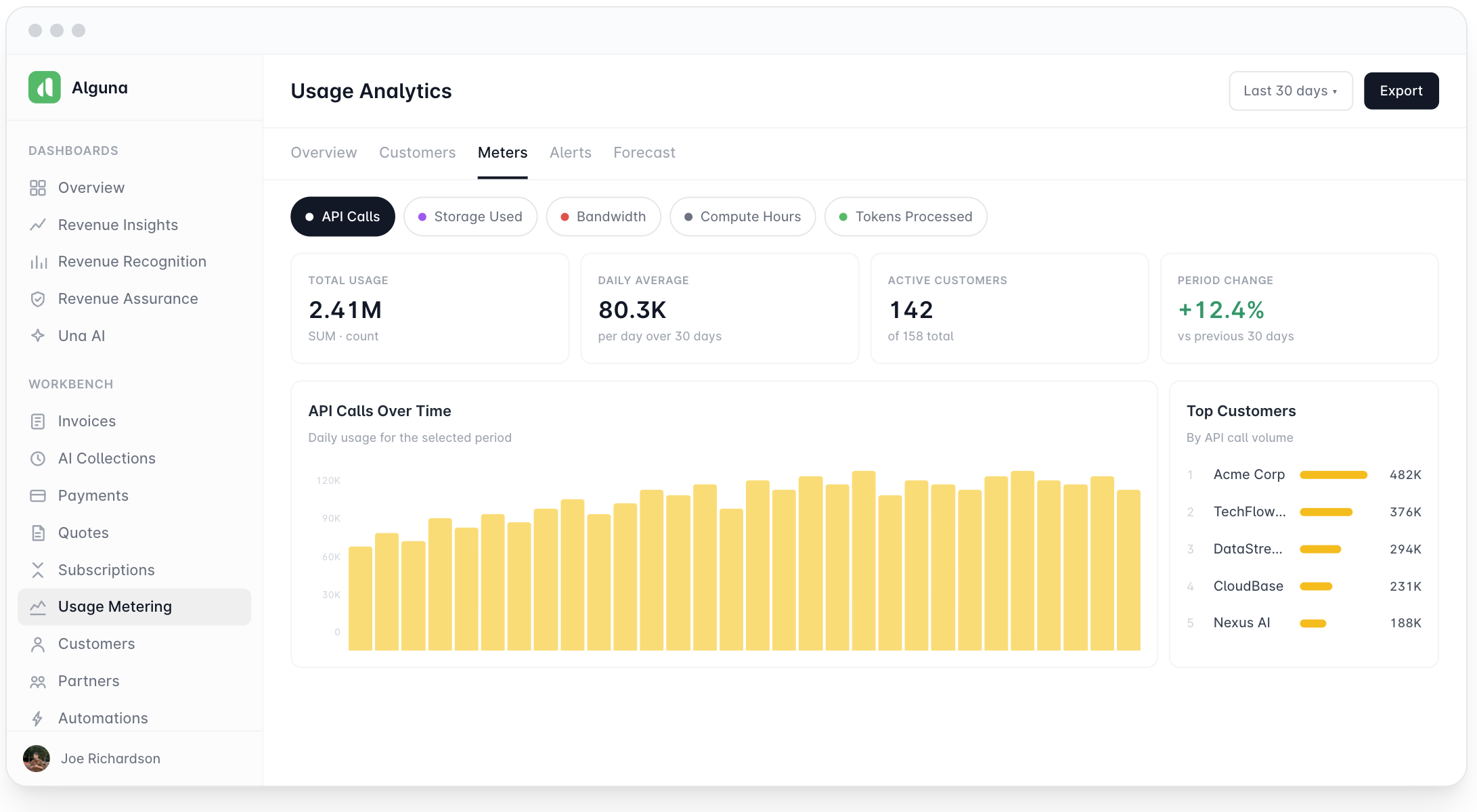
Alguna is an AI-native quote-to-cash platform built for B2B SaaS and AI companies running usage-based or hybrid billing.
Instead of treating metering as a standalone engine, Alguna connects pricing, quoting, contracts, usage, invoicing, collections, and revenue recognition in one system. A signed deal flows directly into a live subscription, with no re-keying of contract terms.
That matters because most of the problems buyers describe with both Stripe and Orb aren't metering problems. They're handoff problems: between sales and billing, between billing and the general ledger, and between engineering and finance. Alguna is designed so finance and RevOps teams can own billing day to day without filing engineering tickets.
- Shane Curran, CEO at Evervault
Read the case study
Key features
- No-code pricing and metering: define billable metrics from usage events and combine fixed fees, tiers, minimums and maximums, prepaid credits, and overages in one plan, without splitting a single offer into multiple plan variants
- CPQ and e-signature built in: sales can build compliant quotes for complex usage deals, route them for signature, and push signed terms straight into billing, so contracts and invoices never drift apart
- Revenue recognition: ASC 606 schedules for subscription, usage, and bundled arrangements, with recognized, deferred, and unbilled revenue views that tie back to the underlying invoices and usage
- AI-driven accounts receivable: an AR Agent that handles dunning cadences, captures promise-to-pay commitments, and classifies inbound replies, with configurable autonomy from monitor to suggest to act
- Entitlements and customer experience: entitlements that keep product access in sync with plans, a customer portal where buyers find contracts, invoices, and usage in one place, and an embedded checkout for in-product purchases
- Finance integrations: HubSpot, Salesforce, QuickBooks, Xero, and a real-time two-way NetSuite sync so payments applied in your ERP flow back into billing
Pros
- Finance and RevOps teams can change pricing, contracts, and subscriptions without engineering
- One logical plan can carry monthly or annual terms, overage settings, and discounts as properties
- Quote, contract, invoice, and revenue schedule share a single source of truth
- Flat monthly pricing means your billing costs don't scale with your revenue
- Can run on top of Stripe as your payment processor, so you don't have to rip out payments to fix billing
For teams leaving Stripe specifically, visibility is often the trigger.
Adam Liska, Co-founder and CEO at Airspeed (formerly Glyphic), said Alguna gave him "a clear overview of revenue movements, something Stripe just couldn't provide."
Cons
- Smaller integration marketplace than Stripe's ecosystem
- Not designed for high-volume B2C subscription checkouts
- Teams wanting to hand-code every billing rule may prefer a pure API-first engine
Best for
- B2B SaaS and AI companies moving from seat-based to hybrid or usage-based pricing
- Finance-led teams that want to own billing without an engineering queue
- Sales-led businesses with custom contracts, ramps, and commitments
- Companies outgrowing Stripe Billing or Orb but unwilling to take on a heavyweight ERP-style billing project
Pricing
Alguna publishes flat pricing: a free Starter tier for up to 10 invoices per month, a Growth plan from $699 per month, and a custom Enterprise tier.
Third-party pricing trackers such as UsagePricing note that Alguna doesn't charge per event, per seat, or as a percentage of billed revenue.
2. Stripe Billing (with Metronome)
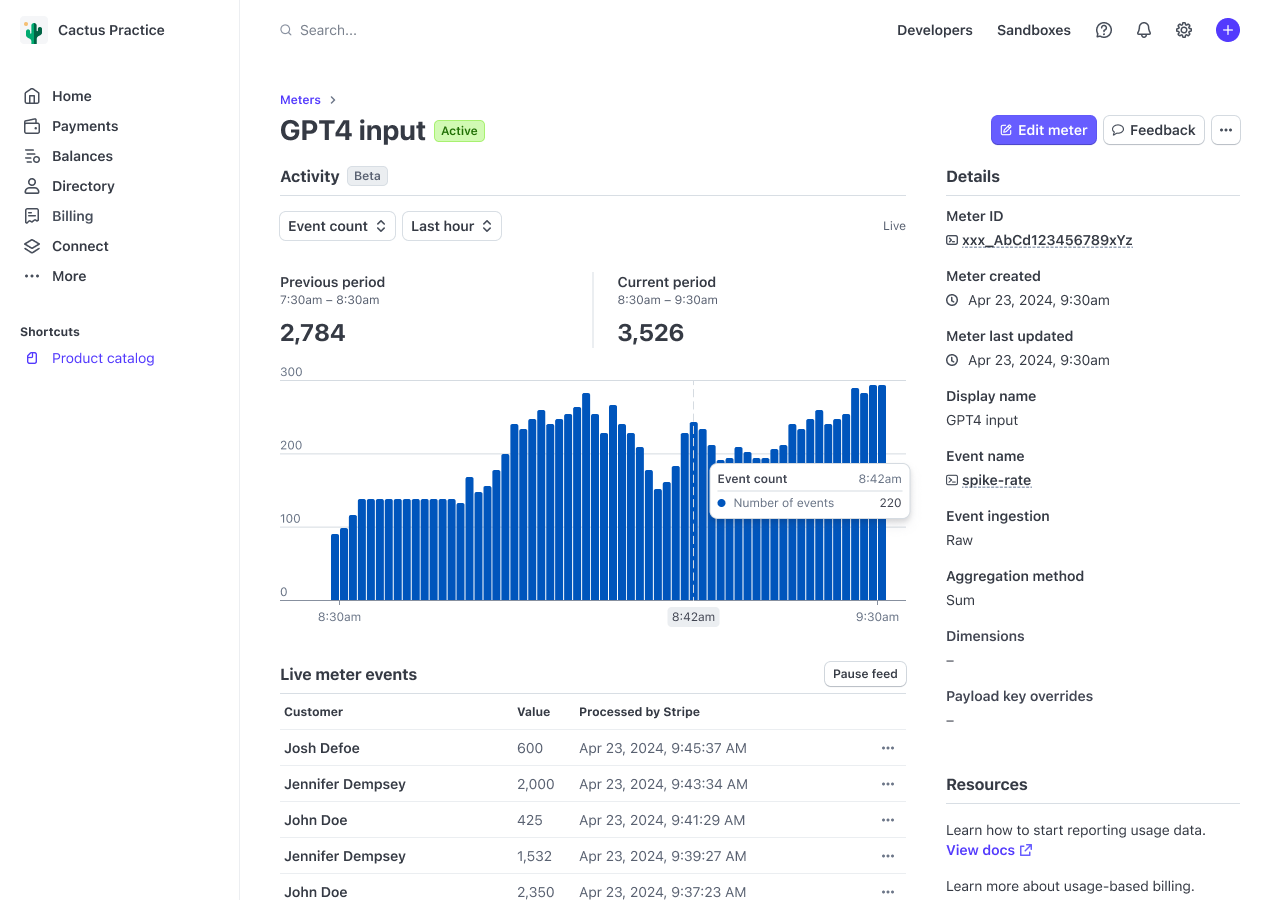
Stripe Billing is the natural starting point for early-stage companies already processing payments through Stripe.
It supports metered billing, tiered and package pricing, credit burndown, and hybrid models, and connects usage directly to payment collection. For most early-stage teams, it gets the first usage-based invoice out the door faster than anything else.
Stripe's 2026 story is about scale. With Metronome now part of Stripe, the company is extending into multidimensional metering, enterprise commitments, and bespoke contracts.
That closes some of the gaps engineering teams hit with native Stripe Billing.
What it doesn't change is the operating model: Stripe remains a developer-first platform, and the buyers we speak to consistently describe it as strong for payments but hard to run once billing becomes finance-led.
As one buyer put it when describing their custom trial-to-production pricing, the setup felt "super clunky," and they worried about accidentally overcharging customers.
Key features
- Usage metering via the Meters API: send usage events and Stripe aggregates them against configured meters, applying the pricing model at the end of each billing period
- Flexible pricing models: pay-as-you-go, tiered, volume, per-package, and hybrid pricing, plus newer pricing plans and rate cards built in the Dashboard
- Native payments and global reach: cards, wallets, bank debits, and local payment methods through Stripe Payments, with Stripe Tax and Radar available alongside
- Metronome for complex usage: a separately priced product for high-volume metering, enterprise commitments, and large product catalogs.
- Developer ecosystem: mature APIs, SDKs, webhooks, and a large partner network for extending billing behavior in code
Pros
- Fastest path to usage billing for teams already on Stripe Payments
- Excellent API design and documentation for engineering teams
- Payments, tax, fraud, and billing in one vendor relationship
- Metronome gives a credible upgrade path for very high event volumes
Cons
- Complex contracts often need workarounds: one buyer built ramping minimums out of multiple stacked discounts and called the discounting features "really annoying."
- Routine work like plan switches, adjustments, and re-enabling failed subscriptions frequently needs API calls or engineering time
- Large usage catalogs strain the UI. One buyer with roughly 64 usage meters said it struggled even after their subscription item limit was raised to 100.
- Revenue recognition and reconciliation often fall back to CSVs, with finance rebuilding invoices in accounting software
- Failed payments can push subscriptions into manual states and leave customers active after automatic cancellation
- Bank transfers and wires paid outside Stripe can leave invoices showing overdue, distorting cash and revenue reporting
- Percentage-based fees get expensive at scale: one buyer processing about $20 million a year estimated a proposed 0.3% fee at roughly $600,000 annually
- Metronome is a separate product with separate pricing, so the full usage stack can mean two systems to evaluate
Best for
- Developer-led startups with straightforward subscription plus usage pricing
- Product-led companies where most revenue comes through card payments
- Teams that have engineering capacity to own billing logic long term
- Very high-volume AI companies prepared to adopt Metronome alongside Stripe Billing
Pricing
Stripe Billing's pay-as-you-go plan costs 0.7% of billing volume on top of standard payment processing fees, with volume discounts on annual plans, according to ERPResearch.
Stripe says usage-based billing is included for up to 100 million usage events per month. Metronome is priced separately.
3. Orb (now part of Adyen)
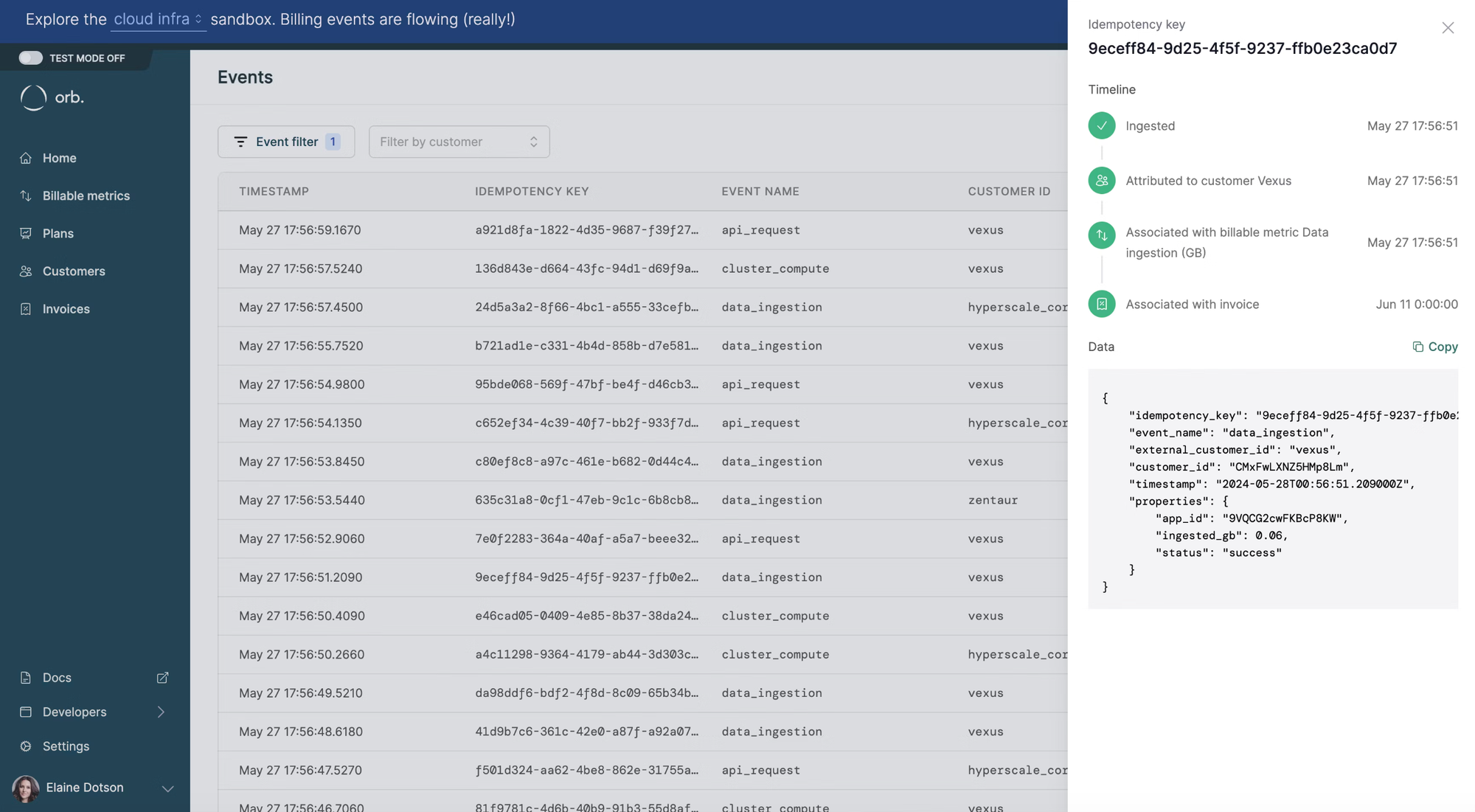
Orb is a usage-based billing platform built around raw event data. Rather than pre-aggregating usage, it stores granular events and calculates billable metrics with queries, which lets teams run pricing simulations against historical usage and recalculate invoices when data arrives late.
In June 2026, Adyen agreed to acquire Orb and run it under an incubator model, with continued support for multiple payment processors during the initial phase. Longer term, Adyen plans to move toward a single billing and payments experience. Engineering teams tend to like Orb's architecture.
The friction we hear about is operational: rigid plan structures, credit handling, and a product that feels disconnected from sales and finance. One buyer who had moved most of their surrounding billing logic in-house told us Orb had become "too expensive for what it is."
Key features
- Query-based metering: ingest raw usage events and define billable metrics with SQL, so new pricing dimensions don't require re-instrumenting your product
- Pricing simulations: test proposed price changes against historical usage before rolling them out to customers
- Retroactive recalculation: backfills and corrections can recalculate affected draft invoices without fully manual rework
- Flexible pricing primitives: unit, package, tiered, bulk, and matrix pricing, plus custom pricing units, minimums, and maximums
- Tiered integrations: Core covers metering, invoicing, and tax integrations. Advanced adds Salesforce, NetSuite, data warehouse sync, and customer hierarchies. Enterprise adds SLAs and dedicated support.
Pros
- Deep metering built for high-volume, usage-first products
- Strong tooling for experimenting with pricing on real data
- Handles late and corrected usage data better than most subscription-first systems
- Processor-neutral today, which avoids locking billing to a single payments provider
Cons
- Plan variations often become separate plans: one buyer needed four variants (monthly or annual, with or without overages) for what should have been one offer
- Annual commitments paid monthly are hard to express cleanly
- Credits tied to one subscription don't easily follow a customer across deployments, leading to manual credit grants
- Subscriptions can activate before the first payment succeeds, granting access that later needs revoking
- Edge cases like time-zone changes, backfills, and mid-month migrations can trigger voided invoices or apparent usage spikes
- Customers get limited visibility into usage, credit balances, and how invoice amounts were calculated
- QuickBooks isn't a first-class integration, and Salesforce sync sits on the Advanced tier
- Smaller workflow issues, such as regenerating expired invoice payment links, can take a long time to resolve
- Ownership change adds roadmap uncertainty while the Adyen integration plays out
Best for
- AI and infrastructure companies with very high event volumes and engineering-owned billing
- Product teams that want to iterate on usage pricing using historical data
- Companies already on Adyen, or planning to move payments there
- Teams with simple contract structures but complex usage metrics
Pricing
Orb doesn't publish prices. All three tiers (Core, Advanced, and Enterprise) are custom-quoted based on billings, event volume, and required features, as tracked by UsagePricing. Expect a sales-led process and budget for integration work on top of the license.
The pain points buyers report after go-live
Feature lists tell you what a platform can do. Buyer calls tell you what it's like to run.
Across our conversations with teams on Stripe and Orb, the same patterns keep surfacing.
| Pain point | On Stripe | On Orb |
|---|---|---|
| Complex pricing | Ramps, custom trials, and customer-specific terms built from coupons and stacked discounts | One logical offer split into multiple plan variants |
| Manual finance work | One team estimated about four hours of monthly cleanup across SQL queries, PDFs, and a shared limits table | Manual credit grants and multi-step workarounds for mid-month migrations |
| Revenue reporting | Deposits and trials distort ARR, and revenue is recognized at invoice date | Backfilled usage shows up as spikes, affecting ARR and customer explanations |
| Payment failures | Subscriptions revert to manual, and customers stay active after auto-cancellation | Access granted before the first charge succeeds |
| Sales handoff | Signed contract terms copied into Stripe by hand and drift over time | Described by one buyer as "completely disconnected" from the sales process |
| Switching risk | Customer IDs and entitlements embedded deep in the product | One buyer said it would take a catastrophic failure to justify migrating |
Notice that very few of these are metering failures. They're failures of ownership: who controls the source of truth, who can change a contract, and who finds out when a payment doesn't land. That's worth keeping in mind as you evaluate.
Frequently asked questions: Orb vs Stripe for usage-based billing
What's the main difference in Orb vs Stripe for usage-based billing?
Stripe Billing is a subscription billing product extended to usage, tightly tied to Stripe Payments, with Metronome now available for complex enterprise usage. Orb was built usage-first around raw event data and SQL-based metrics, and is processor-neutral for now under Adyen's ownership. Stripe is usually faster to launch, while Orb usually offers deeper metering. Both rely heavily on engineering to run.
Does Stripe own Metronome now?
Yes. Stripe completed its acquisition of Metronome in January 2026. Metronome is offered as a separately priced product alongside Stripe Billing for high-volume and enterprise usage-based billing.
Who owns Orb?
Adyen agreed to acquire Orb for $335 million in June 2026. Adyen said it will run Orb under an incubator model and continue supporting multiple payment processors in the initial phase, with a longer-term plan to unify billing and payments.
How much does Stripe Billing cost for usage-based billing?
Stripe Billing's pay-as-you-go plan is 0.7% of billing volume on top of payment processing fees. Stripe says usage-based billing is included up to 100 million events per month. Metronome has separate pricing.
How much does Orb cost?
Orb doesn't publish pricing. Core, Advanced, and Enterprise tiers are all custom-quoted, typically based on billing volume, event volume, and the integrations you need.
Can I keep Stripe for payments and use a different billing platform?
Yes. Many teams keep Stripe as their payment processor and move billing logic, contracts, and revenue recognition to a dedicated platform. Alguna supports this setup, which avoids asking customers to re-enter payment details.
Which is better for finance teams, Orb or Stripe?
Neither was built primarily for finance. Stripe is developer-first, and finance teams often rely on exports and spreadsheets for reconciliation and revenue reporting.
Orb is engineering-first, with richer finance integrations reserved for higher tiers. If finance owns billing, look for a platform with built-in revenue recognition, ERP sync, and no-code pricing changes.
Stop choosing between a payments add-on and a metering engine
The Orb vs Stripe for usage-based billing debate usually comes down to which compromise you'd rather live with. Stripe gives you payments and speed, but your finance team inherits workarounds, spreadsheets, and fees that grow with every dollar you bill.
Orb gives you serious metering, but your engineers inherit plan variants, credit workarounds, and a billing system that sits apart from sales and accounting. And in 2026, both come with a new owner and an integration roadmap you don't control.
If your pricing is simple and your engineers own billing, either can work. If you're selling custom contracts, prepaid credits, and hybrid plans, and finance needs to run billing without opening a ticket, you need a platform built around the whole quote-to-cash flow, not just the meter.
Alguna connects pricing, quotes, usage, invoicing, collections, and revenue recognition in one platform, with flat pricing that doesn't take a cut of your revenue. Bring your hardest contract and we'll model it live.
Book a demo with Alguna