If you're comparing Maxio vs Metronome, you're probably at a crossroads that a lot of software companies hit right now: your pricing has outgrown simple subscriptions, and you need a billing system that can keep up with what sales is selling and what product is shipping.
The shift is real. In Growth Unhinged's 2025 State of B2B Monetization survey, the share of companies using hybrid pricing jumped from 27% to 41% in a single year, while pure seat-based pricing fell from 21% to 15%. Buyers are pushing in the same direction: L.E.K. Consulting reports that 39% of CIOs now favor pricing tied to actual consumption.
Maxio and Metronome both promise to help, but they come at the problem from opposite ends. Maxio is a finance-first subscription and revenue platform built for B2B SaaS. Metronome is an engineering-first metering engine built for high-volume usage-based billing, and since January 2026 it has been part of Stripe.
In this guide, we break down how the two platforms compare on features, pricing, strengths, and limitations, and introduce a third option for teams that need both jobs done in one system.
What are Maxio and Metronome?
Before getting into the details, it helps to understand which category each platform actually belongs to, because "billing software" covers a lot of ground.
Maxio is a B2B subscription management and financial operations platform formed from the merger of Chargify (billing) and SaaSOptics (revenue recognition and SaaS metrics). Its center of gravity is the finance team: recurring invoicing, ASC 606 and IFRS 15 revenue recognition, deferred revenue schedules, and investor-grade SaaS reporting.
Metronome is usage-based billing infrastructure. It ingests raw product events (API calls, tokens, GPU seconds, and so on), turns them into billable metrics, and applies pricing, credits, and contract terms to produce invoices. Its center of gravity is the engineering and product team, and it is best known for powering AI companies such as OpenAI, Anthropic, Databricks, and NVIDIA, according to Sacra.
A few terms that come up throughout this comparison:
- Metering: capturing and aggregating product usage events so they can be priced.
- Rating: applying prices, tiers, and discounts to metered usage.
- Hybrid pricing: combining a recurring fee or seats with a usage component, often with prepaid credits or commitments. You can read more in our guide to hybrid pricing.
- Quote-to-cash: the full flow from building a quote to collecting payment and recognizing revenue. Here's a primer on the quote-to-cash process.
Maxio vs Metronome: Key differences at a glance
Here's how the two platforms stack up head to head before we look at each in depth.
| Category | Maxio | Metronome |
|---|---|---|
| Primary user | Finance and accounting teams | Engineering and product teams |
| Core strength | Revenue recognition and SaaS metrics | High-volume, real-time usage metering |
| Usage-based billing | Supported; upgraded metering with advanced formulas launched in beta in June 2026 | Core product; SQL-based billable metrics on raw events |
| Revenue recognition | Native ASC 606 and IFRS 15, with advanced module | Not native; passes data to your ERP or revenue system |
| Quoting (CPQ) | Offered following its RevOps acquisition | Not native; integrates with Salesforce on the Custom plan |
| Payments | 20+ payment gateways plus Maxio Payments | Native Stripe integration and cloud marketplaces |
| Pricing model | Flat tiers banded by monthly billings, plus add-on modules | Percentage of billing volume plus per-event fees |
| Ownership | Independent | Owned by Stripe since January 2026 |
The short version:
- Maxio is strongest after the invoice is created, when finance needs to recognize, report, and collect.
- Metronome is strongest before the invoice exists, when millions of usage events need to become accurate charges.
Neither covers the full journey from quote to recognized revenue on its own particularly well, which is why many teams end up evaluating a third option.
Comparison: Metronome vs Maxio vs Alguna
| Platform | Best for | Strengths | Limitations | Pricing |
|---|---|---|---|---|
| Alguna | AI, SaaS, and fintech companies running hybrid or usage-based pricing across self-serve and sales-led deals | Pricing, CPQ, usage metering, billing, AI collections, and revenue recognition in one no-code platform; unlimited events and seats | Younger platform with a smaller integration ecosystem; revenue recognition is an add-on on the Growth plan | Free Starter plan; Growth from $699/month; custom Enterprise Scale. Never a percentage of revenue. |
| Maxio | Finance-led B2B SaaS companies with mostly subscription revenue and strict reporting needs | Mature revenue recognition, SaaS metrics, A/R management, broad gateway and ERP coverage, unlimited users | Advanced usage metering still maturing; key capabilities sold as add-on modules; setup can be complex | Grow: $599/month up to $100K in monthly billings; Scale: custom quote |
| Metronome | Engineering-led AI and infrastructure companies with very high event volumes | Real-time metering at scale, SQL-based metrics on raw events, flexible rate cards, credits, and commits, native Stripe integration | Engineering-dependent; no native CPQ or revenue recognition; cost scales with billing volume; roadmap tied to Stripe | Startup: 0.8% of billing volume plus $0.04 per 1,000 events; Custom: sales-quoted |
1. Alguna: Best for teams that need metering and finance in one platform
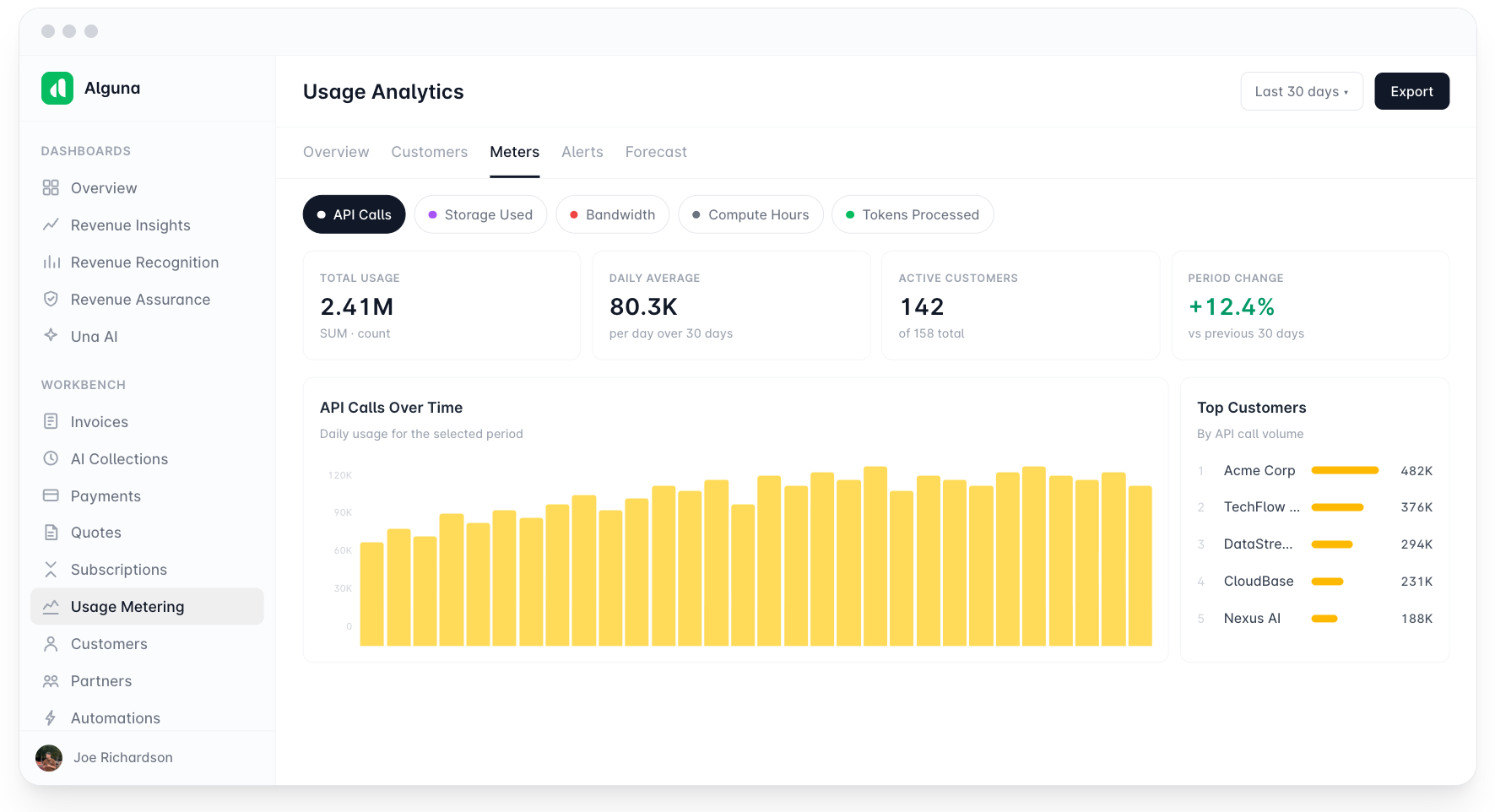
Alguna is an AI-native quote-to-revenue platform that unifies pricing, quoting, usage metering, billing, collections, and revenue recognition.
Backed by Y Combinator, Alguna was built for the exact gap this comparison exposes: companies whose pricing is too dynamic for a traditional subscription tool, but whose finance and sales teams need far more than a metering engine.
Where Maxio asks you to bolt usage onto a finance suite and Metronome asks you to bolt finance onto a metering engine, Alguna handles both natively.
Growth, RevOps, and Finance teams can launch and change pricing without opening an engineering ticket, while sales-led enterprise contracts and self-serve customers run side by side in the same system.
Key features
- No-code pricing and packaging: Configure fixed, tiered, graduated, volume, seat-based, percentage-based, and usage-based models, then combine them in a single contract alongside prepaid credits, ramps, and mid-term changes. Price changes can apply to new customers only or roll existing subscriptions over at renewal.
- Built-in CPQ and e-signature: Reps build quotes from the product catalog, route approvals, and collect signatures, and the signed deal automatically creates the subscription and first invoice. Learn more about configure, price, quote workflows.
- Unlimited usage metering: Ingest events via API or CSV with no ceiling on volume and no change to your pricing, define custom metrics, and sync usage in real time to your data warehouse.
- AI agent for accounts receivable: Alguna's AR agent works from a Control Tower workspace, captures promises to pay, handles disputes, and classifies inbound replies. Teams choose how much autonomy it has (Monitor, Suggest, or Act), with hard-coded guardrails throughout.
- Revenue recognition and enterprise controls: Automated revenue recognition, multi-entity billing, NetSuite and other ERP integrations, and bring-your-own payment processor on Enterprise Scale, all on a SOC 2 Type II certified platform.
- Developer access when you want it: A full API, webhooks, a TypeScript SDK, and an MCP server let engineering extend the platform without being on the critical path for every pricing change.
- Shane Curran, CEO at Evervault
Read the case study
Pros
- Covers the full quote-to-revenue flow, so you replace several tools instead of stitching them together
- Finance and RevOps can change pricing without waiting on developers
- Flat platform pricing with unlimited events and seats keeps costs predictable as usage grows
- Handles self-serve and enterprise contracts in one system
- White-glove migration and support in a shared Slack channel
Cons
- A younger platform than Maxio, with a smaller ecosystem of prebuilt integrations
- Revenue recognition is an add-on on the Growth plan rather than included by default
- May be more than you need if you only want a raw metering pipeline feeding another billing system
Best for
- AI companies charging on tokens, credits, or agent actions alongside subscriptions
- B2B SaaS teams moving from seat-based to hybrid pricing
- Companies running both product-led and sales-led motions
- Lean finance teams that want automation without a dedicated billing engineer
Pricing
Alguna offers a free Starter plan (up to 10 invoices a month, including usage-based metering). The Growth plan starts at $699 per month for up to 50 contracts or $1M ARR and adds CPQ, e-signature, and CRM and accounting integrations.
Enterprise Scale is custom and includes automated revenue recognition, multi-entity billing, ERP integrations, and white-glove migration. Event ingestion and seats are unlimited on every plan, and Alguna never takes a percentage of your revenue.
2. Maxio: Best for finance-led SaaS companies focused on reporting and compliance
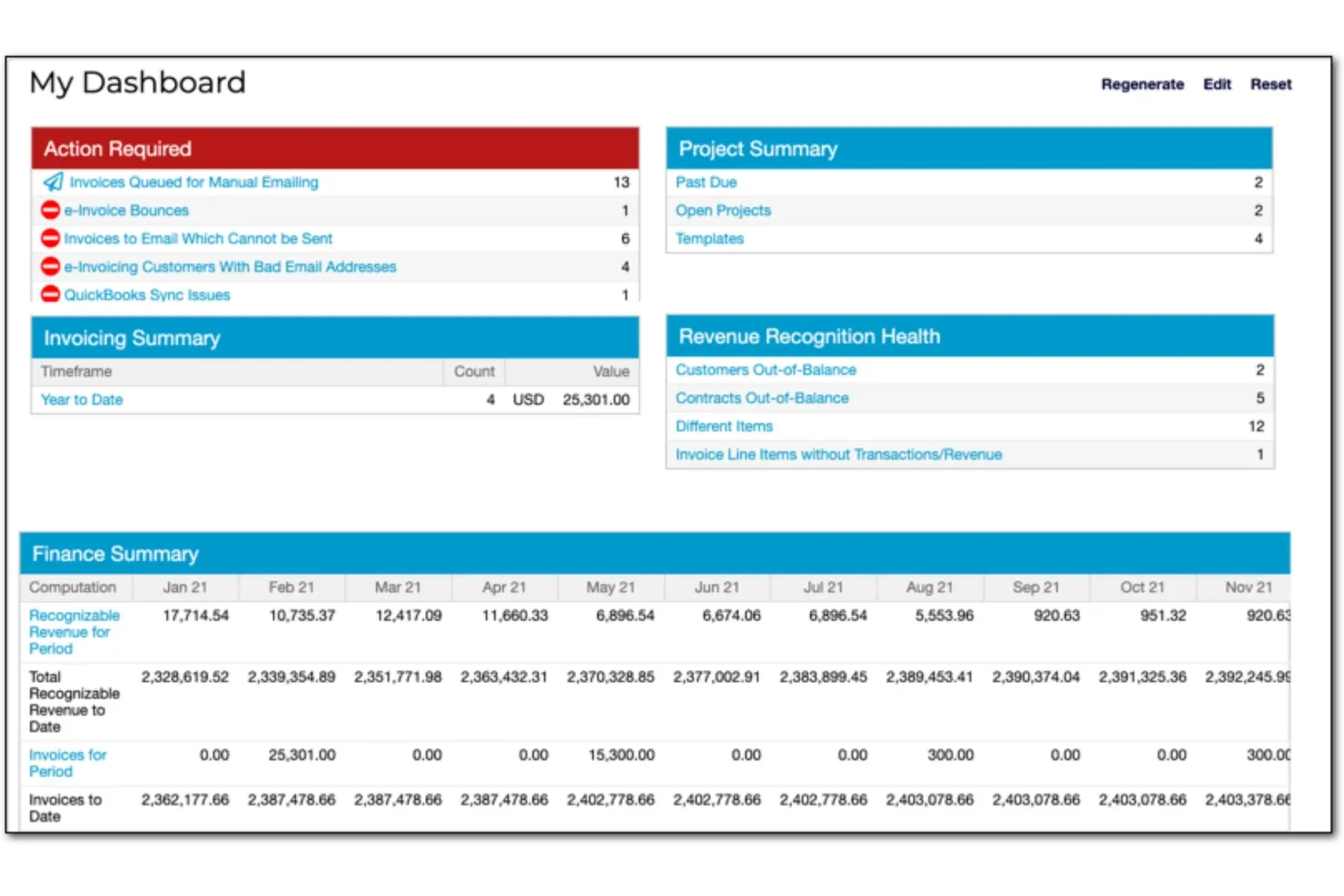
Maxio is a financial operations platform for B2B subscription businesses, formed by combining Chargify's billing engine with SaaSOptics' revenue recognition and reporting.
Over the past year Maxio has been extending beyond its finance roots. It now markets a CPQ product, a set of AI agents for close, collections, and pricing, tokens and wallets for credit-based models, and an upgraded metering experience that it released in beta in June 2026.
Key features
- Revenue recognition: Automated ASC 606 and IFRS 15 schedules covering scheduled, recognized, and deferred revenue, with performance obligations, standalone selling prices, carve-outs, and multiple revenue books on the higher tier.
- SaaS metrics and financial reporting: One-click reports for MRR and ARR, cohorts, renewal rates, and its well-known subscription momentum report, plus roll forwards, A/R aging, and DSO tracking.
- Subscription management: Product catalog, customer hierarchies, contract terms, self-service signup pages, free trials, a customer portal, and renewal management.
- A/R management: Collections and dunning workflows, message templates, and statements, with advanced A/R available on the Scale tier.
- Integrations and payments: QuickBooks, Xero, NetSuite, and Sage Intacct on the accounting side; Salesforce, HubSpot, and Pipedrive on the CRM side; and more than 20 payment gateways.
Pros
- Deep, audit-friendly revenue recognition that finance teams trust
- Rich out-of-the-box SaaS metrics reporting
- Unlimited users at no extra charge
- Broad gateway, CRM, and ERP coverage built over more than a decade
- Published entry price for companies under $100K in monthly billings
Cons
- Advanced usage metering is newer and was still labeled beta as of mid-2026
- Many capabilities, including advanced revenue management, multi-entity, and event-based billing, are add-on modules
- G2 reviewers rate it lower on ease of setup than some newer billing tools
- Annual payment is the default, with monthly or quarterly billing at a premium
- The platform grew through mergers and acquisitions, and some reviewers describe workflows that feel less unified as a result
Best for
- B2B SaaS companies whose revenue is mostly recurring subscriptions
- Finance teams preparing for audits, fundraising, or board reporting
- Companies that want billing and revenue accounting in the same system
- Teams with time and resources for a structured implementation
Pricing
Maxio's Grow plan costs $599 per month for companies with up to $100K in monthly billings. The Scale plan, for companies above that threshold, is quote-based with volume discounts.
Agreements are paid annually by default, and optional modules such as advanced revenue management, multi-entity, expense amortization, event-based billing, and EU hosting cost extra. A free developer sandbox is available for testing.
3. Metronome: Best for engineering-led companies with massive usage volumes
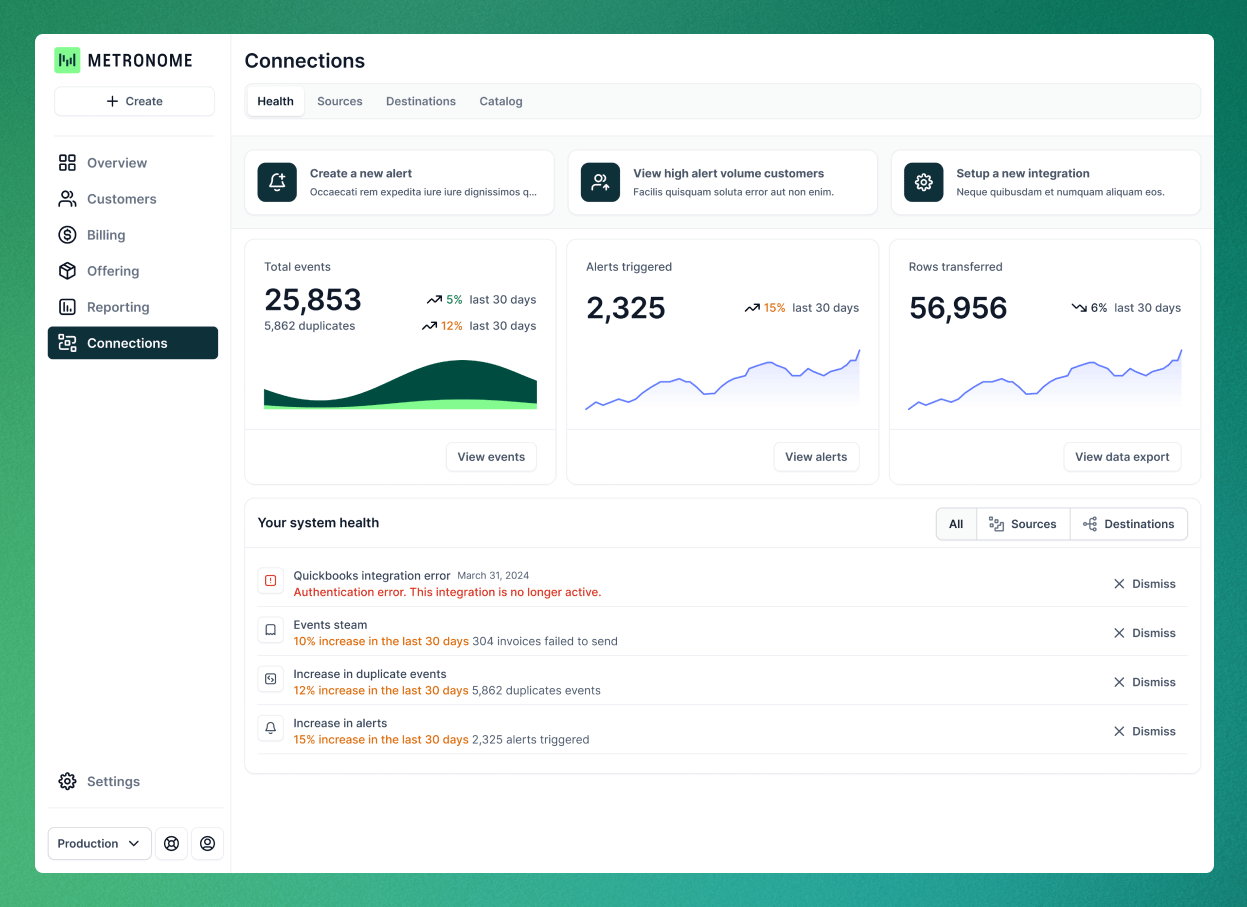
Metronome is a usage-based billing and metering platform built to turn huge streams of product events into accurate invoices.
Stripe announced its agreement to acquire Metronome in December 2025, and PYMNTS reports the deal closed in January 2026, with Stripe CEO Patrick Collison saying "the shift toward usage-based models will be a defining feature of the next decade."
Metronome still sells as a standalone product, and it now also powers advanced usage-based billing inside Stripe. According to pricing tracker UsagePricing, Stripe moved advanced usage-based billing out of its standard Stripe Billing rate and routes it to Metronome instead.
Key features
- Raw event ingestion and SQL metrics: Metronome stores raw usage events and lets engineers define billable metrics with SQL, so pricing logic can change without re-instrumenting the product. Streaming metrics support low-latency alerting for fraud and abuse.
- Rate cards, credits, and commitments: Centralized rate cards act as the pricing source of truth across self-serve, enterprise, marketplace, and reseller channels, with prepaid credits and commitment-based contracts as core building blocks.
- Per-customer contract customization: Discounts, overrides, and amendments can be layered on list pricing and scheduled to take effect immediately, in the future, or retroactively.
- Embeddable spend visibility: APIs, webhooks, and embeddable dashboards give end customers real-time insight into their usage and spend.
- Payments and downstream systems: Native Stripe integration, plus invoicing integrations with Salesforce, NetSuite, and the AWS, Azure, and GCP marketplaces, and data exports to your warehouse on the Custom plan.
Pros
- Proven at the scale of the largest AI companies
- Raw event storage makes backdating and pricing corrections more manageable
- Very flexible enterprise contract modeling with credits and commits
- Tight integration with Stripe payments
- Self-serve Startup plan with published rates
Cons
- Engineers need to define events and maintain billable metrics, so pricing changes often depend on them
- No native CPQ, so sales quoting lives in a separate system
- No native revenue recognition, so finance still needs another tool for ASC 606
- Percentage-of-billing-volume pricing means your bill grows as your revenue grows
- Its roadmap is now tied to Stripe, which matters if you want to stay processor-agnostic
Best for
- AI model and infrastructure companies billing on tokens, compute, or API calls
- Companies with very high event volumes and a strong data engineering team
- Businesses already committed to Stripe for payments
- Teams selling through cloud marketplaces
Pricing
Metronome's Startup plan charges 0.8% of billing volume plus $0.04 per 1,000 ingested events.
The Custom plan adds ERP, CRM, and marketplace integrations, data exports, a dedicated account manager, and enhanced SLAs, and is priced through sales.
How to evaluate billing software for your pricing model
The right answer in any billing comparison depends less on feature lists and more on how your company sells and who will own billing day to day.
Use these questions to pressure-test each option.
1. Where does your revenue complexity live?
If the hard part is accounting for annual contracts, deferrals, and audits, a finance-first tool like Maxio fits. If the hard part is turning billions of events into charges, a metering engine like Metronome fits.
If it's both, plus quoting enterprise deals, you need a platform that covers the whole flow, which is where Alguna sits. This is especially common among AI companies that sell credits to self-serve users and commitments to enterprise buyers.
2. Who will change pricing?
Ask each vendor to show you a live price change, start to finish. If it requires an engineer to edit metric definitions or deploy code, factor that into your time to market for every future pricing experiment.
3. What will it really cost at your volume?
Model total cost, not list price. Take a company billing $80,000 a month with 20 million usage events:
- Metronome Startup: 0.8% of $80,000 is $640, plus 20 million events at $0.04 per 1,000 is $800, for roughly $1,440 a month before any other tools. Both numbers rise as you grow.
- Maxio Grow: $599 a month, plus any add-on modules you need, until you cross $100K in monthly billings and move to a quoted Scale plan.
- Alguna Growth: Starting at $699 a month, CPQ included, up to 50 contracts or $1M ARR.
Then add the cost of the tools each platform doesn't replace, such as a separate CPQ, a revenue recognition system, or collections software.
4. How many systems will you be stitching together?
Every handoff between quoting, billing, and accounting is a place for errors to creep in. Map the full flow from signed contract to recognized revenue and count the integrations. Fewer handoffs means less revenue leakage.
- Adam Liska, CEO at Airspeed
Read the case study
5. How much lock-in can you accept?
With Metronome now part of Stripe, consider whether you want your billing logic tied to one payment processor. If you use multiple processors or plan to, prioritize platforms that let you bring your own.
6. How long until you're live?
Ask for realistic implementation timelines and references from companies of your size. Check what migration support is included and what costs extra.
Frequently asked questions: Metronome vs Maxio
What is the main difference in Maxio vs Metronome?
Maxio is a finance-first subscription billing and revenue recognition platform for B2B SaaS, while Metronome is an engineering-first usage metering and billing engine built for high event volumes.
Maxio is stronger on accounting and reporting, and Metronome is stronger on real-time, high-scale usage billing.
Is Metronome still available now that Stripe owns it?
Yes. Stripe completed the acquisition in January 2026, and Metronome continues to sell as a standalone product while also powering advanced usage-based billing within Stripe.
Does Maxio support usage-based billing?
Yes. Maxio supports usage-based and hybrid billing, and it released an upgraded metering experience with advanced formulas in beta in June 2026. Teams with very high event volumes should test it against their real data before committing.
Does Metronome handle revenue recognition?
Not natively. Metronome generates the billing data, then passes it to your ERP or a dedicated revenue recognition tool, so most finance teams pair it with another system for ASC 606 compliance.
Which is cheaper, Maxio or Metronome?
It depends on your volume. Maxio's $599 per month Grow plan is predictable below $100K in monthly billings. Metronome's percentage-plus-events model can look cheaper at very low volume but grows in step with your revenue and usage.
Can you use Maxio and Metronome together?
Some companies pair a metering engine with a finance suite, but running two systems means more integrations to maintain and more places for data to drift. Many teams instead choose one platform that covers metering, billing, and revenue recognition.
Is there an alternative that combines usage billing, CPQ, and revenue recognition?
Yes. Alguna combines usage metering, CPQ, billing, AI-powered collections, and revenue recognition in one platform at a flat monthly price. You can see how it compares directly in our Alguna vs Maxio breakdown.
Metering engine or finance suite? You don't have to choose
The Metronome vs Maxio decision really comes down to which half of your billing problem hurts most. Maxio gives finance teams mature revenue recognition and reporting but asks you to grow into usage billing. Metronome gives engineering teams world-class metering but leaves quoting and revenue accounting to other tools, and its pricing scales with every dollar you bill.
If your pricing is getting more dynamic and your finance, sales, and product teams all need to work from the same source of truth, a unified platform is usually the better long-term bet. Alguna handles usage metering, quoting, billing, collections, and revenue recognition in one place, with flat pricing that doesn't take a cut as you grow.