If you've been following the wave of AI transformation sweeping through finance, you've probably heard the term "accounts receivable AI agent" thrown around a lot lately.
But what does it actually mean? Is it just a fancier name for AR automation? Is it the same as dunning? And how does it differ from what your AR team already does?
These are all fair questions.
The terminology is moving as fast as the technology, and the distinctions matter if you're evaluating AR solutions or thinking seriously about how to modernize your collections process.
In this post, we break down what an accounts receivable AI agent is, how it differs from traditional dunning and AR automation, and how to put one to work in your business to help you collect faster, reduce DSO, and keep your cashflow humming.
To get more practical, we'll use Alguna's accounts receivable AI agent as an example.
What is an accounts receivable agent?
An accounts receivable AI agent reasons about what action makes sense for a given customer, at a given moment, based on the full context of that account.
The key distinction is autonomy. Unlike rule-based automation that fires a reminder on day 30 regardless of context, an AR agent considers a customer's payment history, invoice value, relationship tier, and the content of their last reply, then decides the right action.
This is what makes it one of the best AI-driven invoicing tools for reducing DSO.
The difference between an AI dunning agent and AI agents for accounts receivable
An AI dunning agent manages outbound collections communication: drafting and sending payment reminders, escalating tone as an invoice ages, and adapting messaging based on context. Its remit ends at the communication layer.
An accounts receivable AI agent includes dunning as one component but covers the full invoice-to-cash lifecycle. It also reads and classifies inbound replies, captures promises to pay, pauses outreach on disputes, retries failed payments, and reconciles cash to your ledger.
| Dunning agent | AR AI agent | |
|---|---|---|
| Scope | Payment reminders only | Full invoice-to-cash lifecycle |
| Trigger logic | Fixed time-based schedule | Context-aware: payment history, risk, account type, reply content |
| Reply handling | None | Reads and classifies every inbound reply; adapts accordingly |
| Promise-to-pay | Not tracked | Captured, linked to invoice, outreach paused automatically |
| Dispute handling | Not included | Detected from inbound mail; chase paused, case flagged for human |
| Payment retries | Basic or none | Smart retries by failure type, payment method, and customer profile |
| Reconciliation | Not included | Automatic match to invoice, sync to ERP/accounting system |
| Visibility | Sent/bounced status only | Real-time AR dashboard with aging, case status, and promise tracking |
⚠️ In practice, a lot of vendors use the terms loosely or interchangeably, so it's worth looking at actual capability scope rather than the label on the product. If a tool only manages outbound sequences and has no inbound reply understanding or promise tracking, it's functioning as a dunning agent regardless of what it's called.
Dunning is a feature. An AR agent is a function. Relying on dunning alone is like having a car that can only honk, without the ability to steer or brake.
5 core capabilities of an AR agent
At its most complete, an AR agent handles five interconnected functions:
| Capability | What it does |
|---|---|
| Real-time visibility | Live view of every outstanding invoice, surfacing overdue, at-risk, and upcoming balances by customer, segment, or sales rep |
| Automated collections | Sends personalized follow-ups on your cadence, adapting tone and escalation based on account context and customer behavior |
| Promise-to-pay capture | Detects when a customer commits to a payment date and amount, logs the promise, and pauses outreach through the promise date plus a grace window |
| Dispute handling | Classifies inbound replies in real time; pauses the chase when a dispute is detected and flags the case for human review |
| Auto-reconciliation | Matches incoming payments to open invoices and syncs results to your accounting system, eliminating manual month-end close work |
What an accounts receivable AI agent looks like in practice: A closer look at Alguna's AR agent
Alguna is a modern revenue automation platform that consists of a no-code CPQ, automated AR, billing, and revenue recognition. Each which can be used as a standalone product or purchased as an end-to-end quote-to-cash platform.
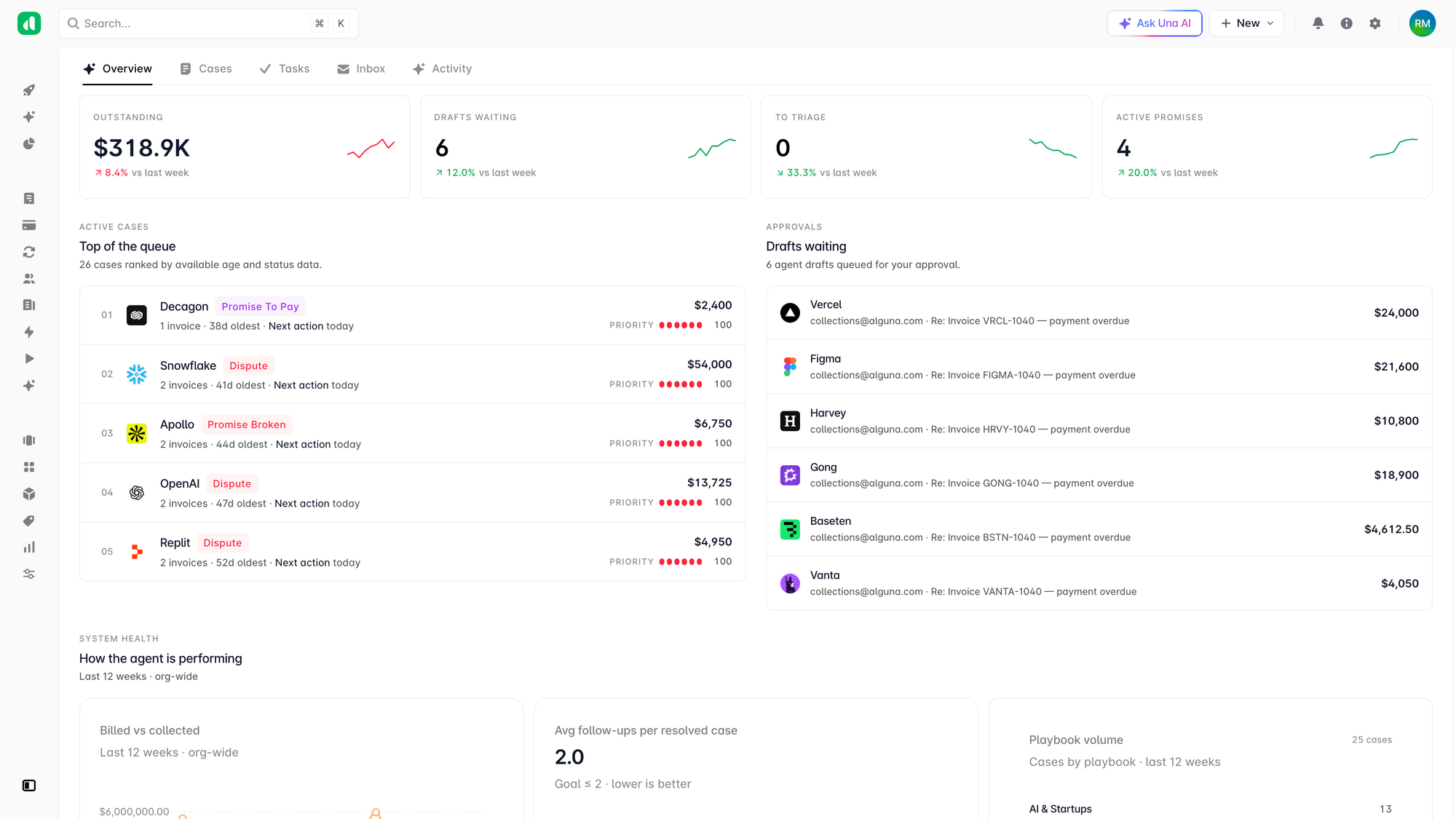
The most recent addition to the platform is an accounts receivable AI agent that acts as an always-on collections specialist. Finance teams use a single workspace called the Control Tower which comes with five views that cover the full AR motion.
Control Tower: 5 views that cover every AR workflow
| View | What you'll find there |
|---|---|
| Overview | Live KPIs (outstanding, drafts waiting, to triage, active promises), a prioritized queue, approvals panel, and an agent-performance strip showing billed vs. collected and average follow-ups per resolved case |
| Cases | Every overdue account as a case, with aging, status, next action, owner, and playbook. Filter by: Active chase, Awaiting reply, Promise to pay, Promise broken, Dispute, Payment claimed, Resolved |
| Tasks | The agent's drafts awaiting your approval and reminders it raises for your team, sorted by priority |
| Inbox | Inbound customer email, classified by attribution and intent, linked to the right case |
| Activity | A full event timeline for every case, event-sourced for a clean audit trail |
How the agent works the case
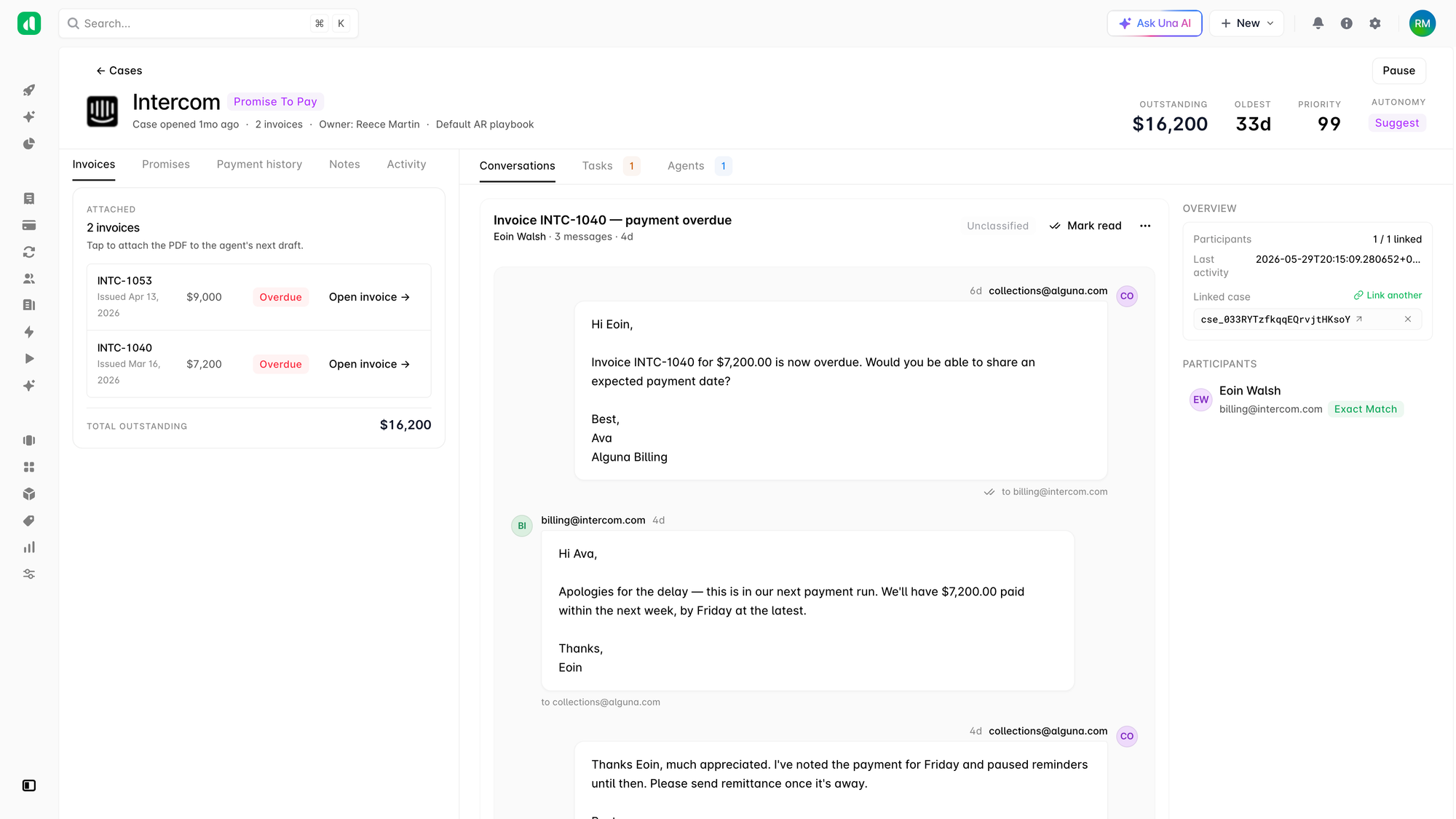
Once a case is open (i.e., an invoice goes overdue), Alguna's AR agent:
- Drafts and sends follow-ups on the cadence you've configured, anchored to invoice sent date, due date, last action, or promise date
- Adapts tone by persona so early reminders can be warm and friendly; escalated balances get a firmer voice, all on your sending domain with your signature
- Reads every customer reply and classifies it by intent: paid claim, promise to pay, dispute, document request, PO update, wrong contact, out-of-office, and more
- Captures promises to pay automatically when a customer commits to a date and amount, then pauses outreach through the promise window, and resumes or escalates if the promise is broken
- Pauses outreach on disputes, flags the case, and notes the reason (e.g., "Customer disputed the invoice: missing PO. Cadence paused pending corrected reissue.") so a human can step in
- Auto-closes the case when payment lands
You stay in control: The autonomy ladder
One of the more thoughtful design choices in Alguna's AR agent is its autonomy ladder, which lets you dial in exactly how much the agent does on its own, per playbook:
| Mode | What happens |
|---|---|
| Monitor | The agent observes and surfaces insights but takes no action. Good for getting comfortable with how it reads your AR before it touches anything |
| Suggest | The agent drafts every outbound message and queues it for one-click human approval in the Tasks view. Your team reviews before anything goes out |
| Act | The agent sends within your configured allowlist and approval thresholds. High-value accounts can still require sign-off, even in Act mode |
Hard guardrails are built in regardless of autonomy level: the agent is blocked from making legal threats, offering discounts, promising refunds or credit notes, admitting fault, or changing contract terms. Those actions require a human.
How does it differ from traditional AR automation?
Traditional AR automation tools handle the repetitive end of the process well. They generate invoices, send scheduled reminders, and log payment statuses. But they tend to be reactive and linear: they wait for things to go wrong before acting, and they don't adapt.
An accounts receivable AI agent is proactive and adaptive. It monitors your receivables in real time, identifies patterns before they become problems, and adjusts its approach based on what's actually happening. It also closes the loop by handling payment retries and reconciliation that most standalone tools leave to your team.
The spectrum of AR maturity
| Manual AR | Traditional automation | AR agent |
|---|---|---|
| Spreadsheets, manual follow-up, no real-time visibility | Scheduled reminders, basic invoice tracking | Autonomous, context-aware, full-lifecycle management |
| High time cost, prone to things slipping through | Reduces admin burden, but still reactive | Proactive, scalable without adding headcount |
| No reply handling or promise tracking | No inbound reply understanding | Reads replies, captures promises, handles disputes |
| Manual reconciliation at month-end | Partial or batch sync | Real-time auto-reconciliation to ERP |
Frequently asked questions about AI agents for accounts receivable
Is an accounts receivable agent the same as an AR automation tool?
Not exactly. Traditional AR automation tools handle specific tasks (sending invoices, scheduling reminders) based on fixed rules. An AR agent is more autonomous: it reasons about context, reads customer replies, captures promises to pay, handles disputes, and manages the full lifecycle from invoice to reconciled cash.
Do I need AI to have an effective AR process?
Not necessarily, but AI-powered AR agents significantly reduce the manual overhead involved in collections and reconciliation. Teams running manual or rule-based processes consistently report more time spent on follow-up, more errors in reconciliation, and less visibility into aging.
What's the difference between an AR agent and a collections agency?
A collections agency is a third party that takes over debt recovery, typically for accounts significantly past due. An AR agent operates within your business as part of your standard collections process, handling reminders, retries, and reconciliation for the full scope of your receivables, not just the hardest cases.
Is it safe to let an AI agent send collections emails?
With the right controls, yes. The safest starting point is Suggest mode, where every draft requires human approval before it goes out. Act mode with amount thresholds and hard guardrails (blocked from legal threats, discounts, credit-note promises, or fault admissions) gives you automation with meaningful oversight. The autonomy ladder exists precisely because different teams have different risk tolerances.
Can an AR agent handle inbound replies, not just outbound reminders?
Yes, and this is one of the most valuable capabilities. A well-designed AR agent classifies every inbound reply by intent (promise to pay, dispute, paid claim, PO update, wrong contact, out-of-office, and more), links it to the right case, and adjusts its behavior accordingly. This is what separates a true AR agent from a basic dunning scheduler.
What happens when a customer promises to pay but doesn't?
The agent captures the promise, links it to the invoice, and pauses outreach through the promise date plus a configurable grace window. If the payment doesn't arrive, the agent automatically triggers your chosen broken-promise behavior: follow up, escalate to a human, or flag for review. Nothing falls through the cracks.
Go from reactive to proactive AR
AI agents for accounts receivable aren't just a smarter reminder tool. It's a shift in how your AR function operates: from reactive and manual to proactive and autonomous, covering everything from real-time visibility and intelligent collections through to promise tracking, dispute handling, payment retries, and reconciliation.
Dunning is part of what an AR agent does. Traditional AR automation is a foundation it builds on. But the full value comes from a system that can manage the entire invoice-to-cash process, read context, respond to it, and hand off to humans only when the situation calls for it.
If you're still spending significant time each week chasing invoices, troubleshooting failed payments, or closing the books manually, that's the signal.