If you run finance at a software company, accounts receivable is where revenue either turns into cash or gets stuck.
The work looks simple from the outside: send an invoice, get paid. In practice, it is one of the messiest parts of running a SaaS business, and the numbers show it.
43% of credit-based B2B sales in the US are overdue, and bad debts affect around 5% of long-overdue invoices.
That is a lot of cash sitting on the wrong side of the ledger.
For SaaS companies, where usage-based and hybrid pricing make invoices a moving target, manual AR breaks down fast.
This guide covers what SaaS accounts receivable is, why it is different from traditional B2B receivables, the best practices that get you paid faster, and a practical sequence for setting it up.
We will also look at the best SaaS tools for managing accounts receivable in 2026 so you can match the right platform to your billing model.
What is SaaS accounts receivable?
What makes it distinct from AR in a traditional business is the recurring, high-volume nature of the billing. Instead of a handful of one-off invoices, a SaaS company is generating a continuous stream of charges across many customers on different plans, billing cycles, and contract terms.
So AR in this context isn't just "unpaid invoices sitting in a ledger," it's a moving system tied to the subscription lifecycle: recognizing what's owed, issuing invoices, applying payments, handling failed charges and retries (dunning), managing proration and mid-cycle changes, and chasing overdue balances.
Traditional B2B AR vs SaaS accounts receivable
The table below shows where the two diverge, and why generic AR tools tend to struggle with software revenue.
Why SaaS accounts receivable deserves attention
For a software business, receivables are not just an accounting chore. They are working capital. Every day an invoice sits unpaid is a day that cash is funding your customer's operations instead of yours.
When you are growing, that gap compounds: more customers means more invoices, and manual processes that worked at 50 accounts fall apart at 500.
Getting SaaS accounts receivable right pays off in three concrete ways:
- Faster cash conversion. Shortening the gap between billing and payment lowers your days sales outstanding and frees up cash you can reinvest. Our guide on reducing days sales outstanding walks through the levers in order of impact.
- Fewer errors and disputes. Invoicing mistakes are the fastest way to trigger a dispute that delays payment. Pulling invoice amounts straight from contract and usage data removes the manual step where most errors creep in.
- A reliable cash flow picture. When receivables data is current, your forecasts become planning tools instead of guesses. That visibility is the foundation of any effort to improve cash flow.
AR also sits at the end of a longer chain. It is the final stage of the invoice-to-cash cycle, which starts when a deal closes and ends when cash clears and reconciles.
Treating receivables in isolation, separate from billing and B2B billing, is what creates the handoff gaps where payments slip.
7 best practices for managing SaaS accounts receivable
These practices consistently separate teams that collect on time from teams that chase.
Work through them in order, since each one builds on the last.
- Invoice the moment the billing trigger fires. Send invoices the instant a billing event occurs, with correct amounts, purchase order numbers, and the right contacts. Every day of delay in invoicing adds a day to your collection timeline, and every error restarts the clock.
- Standardize and enforce payment terms. Set terms during contracting, state them on every invoice, and apply them consistently. Ad hoc exceptions quietly stretch your cycle and make collections harder to predict.
- Make it easy to pay. Offer ACH, wires, cards, and wallets, and route customers to the right method by region, amount, and currency. The fewer steps between an invoice and a payment, the faster the cash lands.
- Automate dunning with context. Configure reminder sequences anchored to the invoice sent date, due date, and aging, and adapt the tone as a balance ages. Context-aware follow-ups outperform generic reminder blasts. For a deeper look, see our guide to intelligent collections software.
- Automate cash application and reconciliation. Match incoming payments to open invoices automatically, including partial payments and lump sums covering multiple invoices, then sync the result to your accounting system. Faster cash application keeps your AR dashboard accurate in real time.
- Review AR health on a cadence. Monitor aging, DSO, turnover, and at-risk accounts weekly, not just at month-end. When a metric moves the wrong way, trace it back to the specific step in your process and fix it there.
- Connect AR to the rest of your revenue stack. When quoting, billing, and receivables share the same data, there is no lag between when a deal closes and when an accurate invoice goes out. This is the heart of receivables optimization.
How to set up SaaS accounts receivable in 6 steps
Getting from a manual, spreadsheet-driven process to a high-performing AR operation does not require a full system overhaul. Here is a practical sequence you can work through.
- Map your current process and baseline your metrics. Document every step from invoice creation to reconciliation, who owns it, and how long it takes. Record your current DSO and the percentage of overdue invoices so you can prove improvement later.
- Clean up your billing and contract data. Most invoicing errors trace back to messy upstream data. Make sure pricing, terms, and usage metrics are captured accurately at the contract stage, since that is what your invoices will be built from.
- Choose an accounts receivable SaaS platform that fits your billing model. If you bill on usage or hybrid plans, prioritize a platform that meters consumption in real time and applies your pricing logic without engineering work. Compare options against your actual model rather than a feature checklist.
- Automate invoicing and collections. Turn on automated invoice generation and a dunning cadence so reminders go out before, on, and after the due date without manual effort. This is where most of the time savings show up first.
- Automate cash application and close. Connect your bank and accounting systems so payments match to invoices automatically and sync to your ledger. Done well, this removes the month-end scramble of manual reconciliation.
- Monitor, measure, and iterate. Set a regular review of your AR metrics and treat improvement as ongoing. Small, systematic changes compound over time into a meaningfully shorter cycle.
Best SaaS tools for managing accounts receivable in 2025
The accounts receivable SaaS market has matured quickly. A first generation of tools automated the mechanical parts of collections: scheduled reminders, aging dashboards, and basic dunning.
The newer wave deploys AI AR agents that read replies, capture promises to pay, and handle disputes with far less manual input.
The three platforms below are built for modern, recurring, and usage-based revenue, so they are a strong starting point when you evaluate AI-driven AR platforms.
If you want a broader field to compare against, our roundups of the best accounts receivable software and AR automation solutions go deeper on features, pricing, and fit.
How Alguna handles SaaS accounts receivable
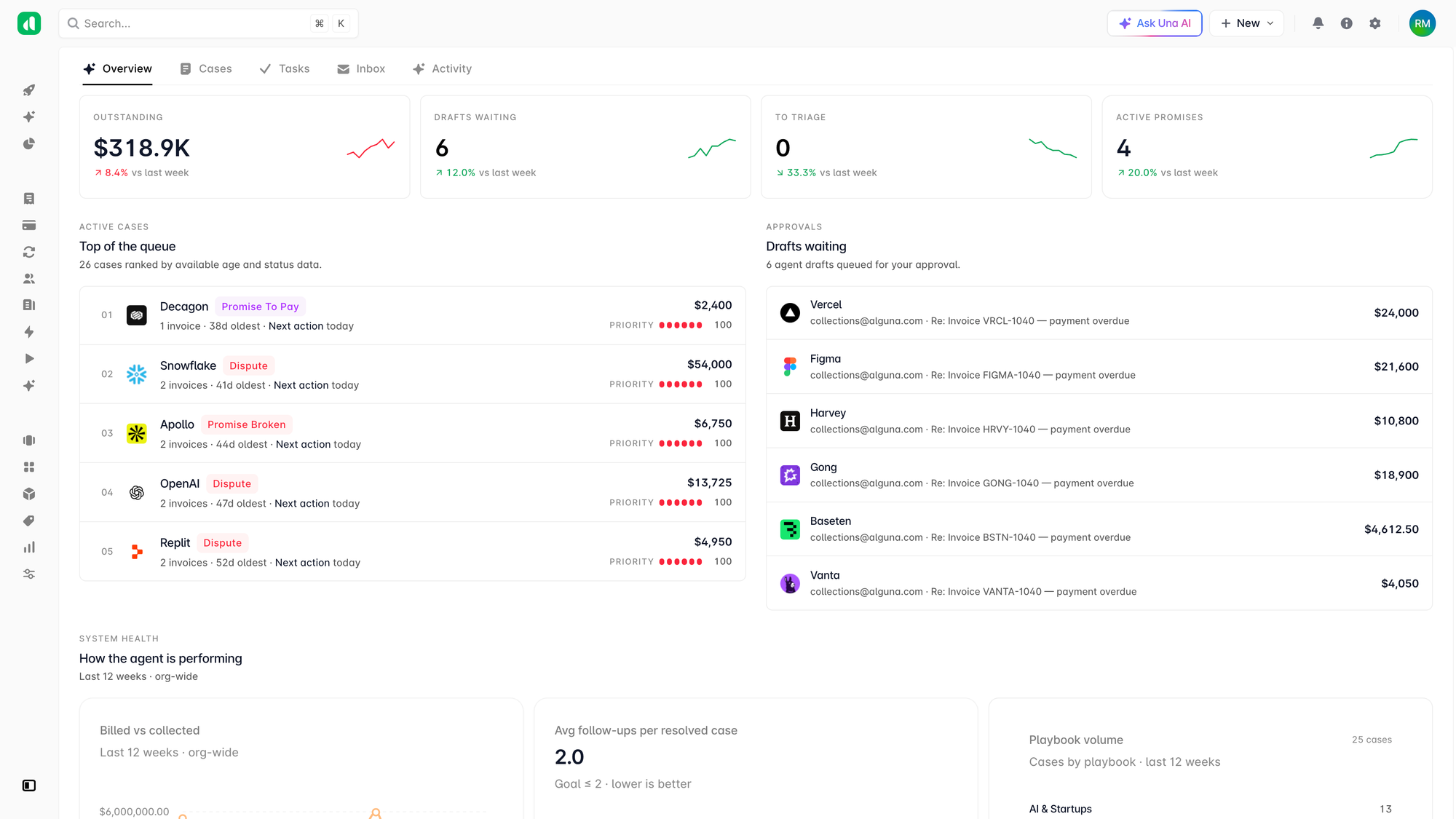
At Alguna, we built an end-to-end revenue management platform for the AI era, designed to handle complex pricing and high-volume billing.
Receivables are one module in that platform, and they share data directly with quoting, billing, and revenue automation, so there is no re-keying and no reconciliation gap between a closed deal and an accurate invoice.
Our accounts receivable product centers on three things:
- A live AR dashboard. Real-time visibility into current, overdue, and at-risk invoices, filtered by aging bucket, customer segment, or sales rep, and synced to your CRM and billing.
- Automated collections and dunning. Configurable reminders, smart retry logic for failed payments, and escalation workflows that run without manual chasing.
- Auto-reconciliation. Payments matched to invoices instantly and synced to QuickBooks, Xero, NetSuite, and your ERP, so month-end close is faster and your data stays current.
For teams that want to go further, our accounts receivable AI agent acts as an always-on collections specialist, working from the Control Tower with an autonomy ladder of monitor, suggest, and act modes so it only does as much as you are comfortable with.
The next era for SaaS accounts receivable
For most of SaaS history, accounts receivable was a backlog of unpaid invoices, reminder emails piling up, and a quarterly scramble to close the gap. It worked because nothing better existed.
That's no longer true.
What's changing is the shift from reactive to predictive.
Instead of chasing payments after they're late, AI AR agents now monitor the full receivables pipeline in real time: flagging accounts likely to slip, adapting dunning to how each customer actually behaves, routing failed payments intelligently, and reconciling as cash arrives. The work that used to consume a finance team's week increasingly runs in the background.
Why it matters comes down to cash and focus. Lower DSO means revenue you've already earned actually reaches your account instead of sitting in limbo. Fewer manual touch points means your team spends time on the accounts that need judgment, not the ones a system could have handled.
And more predictable collection means you can plan against real cash flow rather than hopeful projections.
Frequently asked questions about SaaS accounts receivable
Why do SaaS companies need dedicated AR software?
Software revenue combines subscriptions, usage, and per-deal pricing, which makes invoices a moving target. Generic AR tools built for fixed, one-time invoices struggle with that complexity, while a platform built for SaaS meters usage in real time and applies your pricing logic automatically.
How does accounts receivable SaaS reduce DSO?
It removes the delays that inflate DSO: it invoices the moment a billing event fires, follows up automatically as invoices age, and applies cash as soon as it lands so your aging data reflects reality. Faster, more accurate collections shorten the gap between billing and payment.
Can AR software handle usage-based and hybrid billing?
The right one can. Look for a platform that meters any billable metric in real time and calculates charges automatically, without engineering involvement. This is exactly where legacy AR tools tend to fall short.