Your finance team didn't sign up to chase invoices. But here they are, spending hours every week on payment reminders, manual reconciliation, and aging reports that are already out of date by the time they're pulled.
Meanwhile, cash that should be in your account isn't.
AI is changing that. Finance teams using AI in accounts receivable are collecting faster, forecasting more accurately, and cutting the manual work that's been dragging AR down for decades.
This guide breaks down what AI in AR actually means, the use cases worth prioritizing, and how to get started (without a six-month implementation).
What is AI in accounts receivable?
Modern AI-powered AR platforms like Alguna are built specifically for finance teams handling recurring and usage-based revenue, and they typically cover four core capabilities:
| Technology | What it does in AR |
|---|---|
| Machine learning | Learns from historical payment data to predict customer behavior |
| Natural language processing (NLP) | Reads and processes invoices, remittances, and email communications |
| Predictive analytics | Forecasts when invoices will be paid and flags late-payment risk |
| Robotic process automation (RPA) | Automates repetitive tasks like invoice sending and payment matching |
| Generative AI | Drafts collections emails, dispute responses, and customer communications |
Together, these technologies transform AR from a reactive, manual function into a proactive, data-driven one.
5 key use cases: Where AI in accounts receivable delivers the most value
AI can touch almost every part of the AR process, but these are the five areas where it moves the needle most.
1. Predictive AI for collections
Predictive AI in accounts receivable analyzes historical payment patterns, customer profiles, invoice aging, and external signals to score each open invoice by likelihood of late payment.
This means your collections team doesn't have to treat every overdue invoice the same, instead, they can focus energy on the accounts most at risk and take early action before an invoice becomes a problem.
Rather than working an aging report from oldest to newest, your team works the highest risk accounts first.
2. AI in accounts receivable cash flow forecasting
AI in accounts receivable cash flow forecasting takes the guesswork out of predicting when money will arrive. Traditional cash flow forecasts rely on payment terms — i.e., if the invoice is net 30, we expect payment on day 30. But reality doesn't work that way.
AI-powered forecasting models learn from actual payment behavior: which customers consistently pay late, which pay early, and how macro conditions affect payment timing. The result is a far more accurate, dynamic cash flow forecast that your CFO can actually rely on.
A study by Deloitte found that AI-assisted cash flow forecasting can improve forecast accuracy by up to 85% compared to traditional methods.
3. Automated invoice processing and matching
Matching incoming payments to open invoices is one of the most time-consuming tasks in AR. Payments come in with inconsistent remittance data, partial amounts, or references that don't match your invoice numbers.
AI learns your data and handles this matching automatically, flagging exceptions for human review rather than requiring humans to process every transaction.
4. Automated dunning and intelligent collections
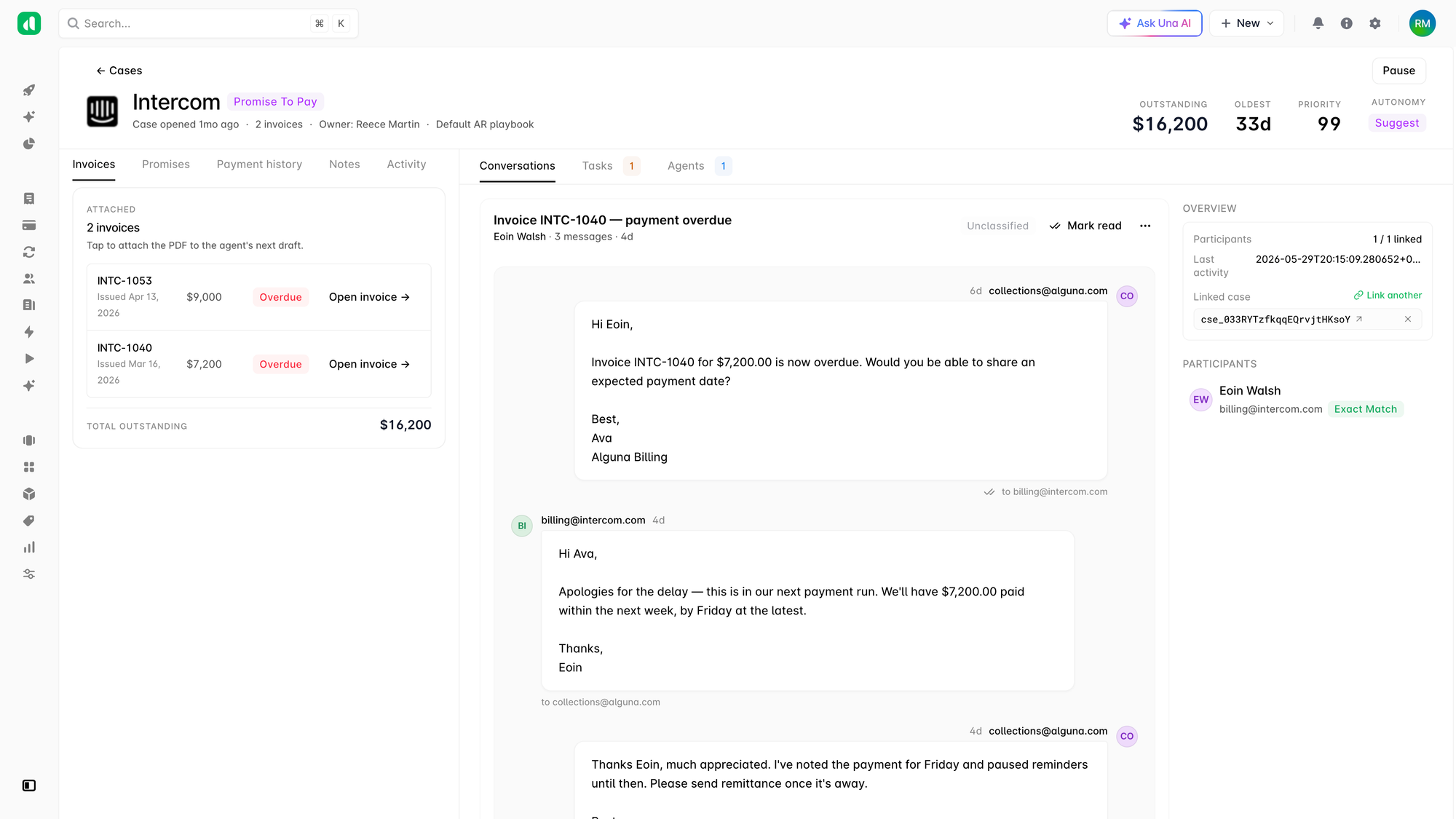
Dunning management, the process of sending payment reminders and escalating communications to customers with overdue invoices, is one of the most time-consuming parts of AR when done manually.
AI-powered dunning automates the entire sequence: timing reminders based on customer behavior, personalizing the message and tone by segment, retrying failed payments based on failure reason, and escalating to formal notices when needed.
The result is a consistent, professional collections process that runs without your team having to manually manage it. Plus, the process will adapt over time as it learns what works for each customer. Instead of sending the same generic reminder to every customer, your team can send contextually relevant messages that are more likely to prompt a response.
5. Dispute detection and resolution
AI can identify patterns in disputes, whether it's a particular product line, a specific billing format, or a subset of customers, helping you address root causes rather than just managing individual disputes reactively.
Best practices for AI in accounts receivable
Getting the most out of AI in AR requires more than just deploying a tool. Here are the practices we see work best.
Start with clean data. AI models are only as good as the data they learn from. Before deploying any AI in your AR process, audit your master data: customer records, invoice history, payment terms, and contact information. Garbage in, garbage out still applies.
Define success metrics upfront. Know what you're optimizing for. Common AR metrics include DSO, collection effectiveness index (CEI), percentage of invoices paid on time, and cash application accuracy. Set a baseline before you deploy AI so you can measure improvement.
Integrate with your existing systems. AI in AR works best when it's connected to your ERP, your billing platform, and your CRM. Siloed tools create data gaps and undermine the model's predictive accuracy.
Keep humans in the loop for exceptions. AI handles the routine, but your team still needs to manage exceptions, complex disputes, and high-value customer relationships. Design your process so AI escalates appropriately rather than trying to automate everything.
Retrain models regularly. Customer behavior changes. Economic conditions shift. An AI model trained on pre-2020 data may not reflect how your customers pay today. Build a cadence for reviewing and updating your models.
Involve your collections and finance teams early. The people who know AR best are your AR specialists. Get them involved in configuring rules, reviewing AI outputs, and providing feedback. This drives adoption and surfaces edge cases your model needs to learn.
How to implement AI in accounts receivable: A step-by-step guide
Ready to move from concept to execution? Here's how to approach an AI implementation in your AR function.
Step 1: Audit your current AR process
Map out every step in your current AR workflow, from invoice generation to cash application. Identify where time is spent, where errors occur, and where visibility is limited. This is your baseline and your roadmap.
Step 2: Identify your highest-impact use case
Don't try to automate everything at once. Start with the single use case that will deliver the most measurable value. For most companies, this is either predictive AI in accounts receivable for collections prioritization or AI in accounts receivable cash flow forecasting — both offer clear ROI and relatively fast time to value.
Step 3: Assess your data readiness
Pull 24 to 36 months of payment history and audit it for completeness. Check that customer records are accurate, that invoice data is consistent, and that payment dates are captured reliably. Address gaps before you begin.
Step 4: Evaluate and select a solution
Look for platforms that offer native AI capabilities with AR-specific models rather than generic AI tools.
Key questions to ask vendors:
- How is the model trained, and on what data?
- How does it handle exceptions and escalations?
- What integrations does it support?
- How does it handle data privacy and security?
- What does the implementation timeline look like?
Step 5: Run a pilot
Implement in a limited scope first. A good pilot involves a subset of customers or a single business unit, runs for 60 to 90 days, and has clear success criteria defined in step two. Use this phase to surface edge cases, gather team feedback, and refine your configuration.
Step 6: Measure, iterate, and expand
After your pilot, compare results against your baseline metrics. If the results support it, expand to your full AR portfolio. Build a regular review cadence — monthly at first — to monitor model performance and capture improvements.
Step 7: Train your team
AI changes workflows, not just tools. Invest in training your AR team on how to interpret AI outputs, when to override recommendations, and how to flag cases the model handles poorly. The goal is a finance team that's more effective, not one that's been replaced.
Common challenges (and how to address them)
Even well-planned AI implementations run into obstacles. Here are the most common ones.
| Challenge | What causes it | How to address it |
|---|---|---|
| Low model accuracy | Incomplete or inconsistent historical data | Invest in data cleaning before go-live |
| Poor user adoption | Team not involved in design | Involve AR specialists early in the process |
| Integration failures | Disconnected systems | Choose solutions with pre-built connectors |
| Regulatory concerns | Data privacy, audit trail | Work with vendors who meet SOC 2 and relevant compliance standards |
| Scope creep | Trying to automate too much at once | Prioritize one use case for the pilot |
What to look for in an AI-powered AR platform
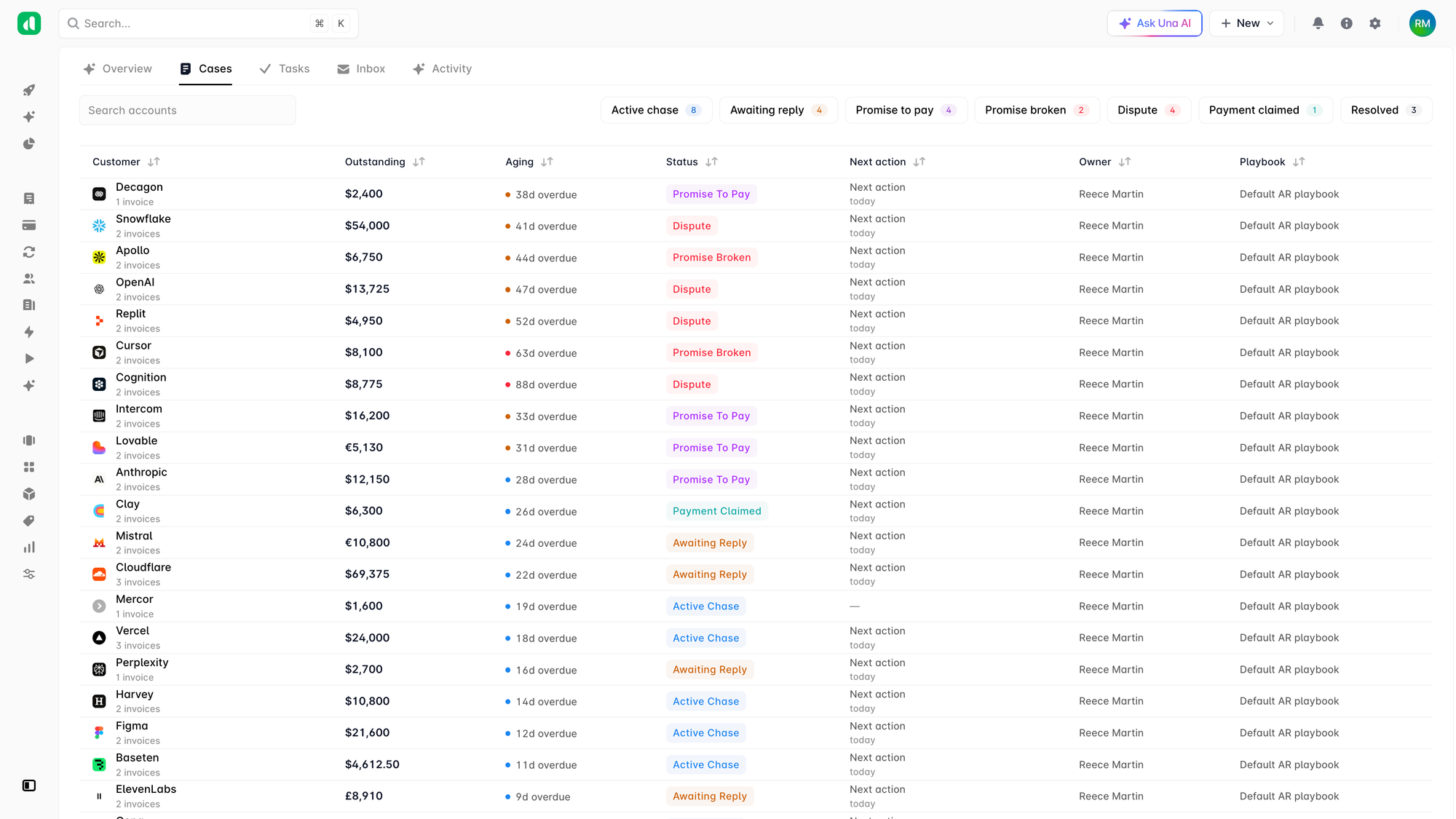
Not all AR automation tools are created equal. When evaluating options, look for:
- Purpose-built AR models, not generic ML tools repurposed for finance
- Real-time payment intelligence that updates as new data comes in
- Configurable workflows that match how your team actually works
- Full audit trails for compliance and dispute resolution
- Native integrations with your ERP and billing systems
See how Evervault and Airspeed (formerly Glyphic) automated their accounts receivable with Alguna, cutting billing admin by 80% and recovering unbilled revenue.
Read case studies
From invoice sent to cash in the bank, faster
AI in accounts receivable is where high-performing finance teams are operating today. Whether you start with predictive AI in accounts receivable to improve collections outcomes or deploy AI in accounts receivable cash flow forecasting to give your CFO better visibility, the impact on cash flow, team efficiency, and customer experience is real and measurable.
The key is to start with a clear problem, clean data, and a defined success metric and continue to build from there.