Healthcare software is one of the fastest-growing corners of the technology economy. The global digital health market is projected to reach 573.5 billion dollars by 2030, up from 199.1 billion dollars in 2025.
Behind that growth sits a wave of healthcare SaaS companies building everything from telehealth platforms to revenue cycle tools.
What do these companies have in common? Most of them hit the same wall as they scale: billing.
Healthcare SaaS billing is harder than billing in almost any other vertical. You're often handling protected health information, selling into slow-moving health systems and payers, and pricing on models that change as your product evolves.
This guide breaks down what healthcare SaaS is, what makes billing for healthcare SaaS companies different, the best practices that keep cash moving, and a step-by-step way to set your billing up. We'll also show you where Alguna fits in.
What is healthcare SaaS?
The category is broad. Common healthcare SaaS examples and products include:
- Telehealth and virtual care platforms
- Practice management and scheduling tools
- Revenue cycle and medical billing software
- Patient engagement and communication apps
- Clinical decision support and analytics
- Care coordination and remote patient monitoring solutions
What links these healthcare SaaS solutions together is the delivery model and, more often than not, access to sensitive data. That single fact shapes everything about how a healthcare SaaS platform has to bill.
The healthcare SaaS market also skews young, from custom SaaS for healthcare startups to enterprise platforms, which means billing systems built for simple flat subscriptions tend to break early.
4 billing challenges we hear from healthcare SaaS companies
We spend a lot of time talking with finance and operations leaders at healthcare SaaS companies, and the same problems surface on almost every call.
They land on both the clinical side and the finance side of the business, which is why billing decisions here are usually made jointly.
Four themes stand out.
- Billing complexity. Insurance billing, claim rejections, and matching electronic remittances such as ERA and EOB to the right invoices create constant manual work, and every manual touchpoint is a place where revenue leaks.
- Disconnected tools. Teams juggle separate systems for electronic medical records, scheduling, billing, and CRM with no unified view, which leads to errors and slow, fragmented reporting.
- Revenue recognition gaps. It's hard to track what's been earned versus what's actually been collected, especially when revenue arrives as a mix of insurance reimbursements and patient co-pays.
- Compliance and admin overhead. Clinical staff lose hours to documentation and billing admin that pull them away from patient care.
The thread running through all four is revenue leakage, the gap between what you've earned and what you actually collect. For most healthcare SaaS companies, closing that gap is worth more than chasing new logos.
What makes billing for healthcare SaaS companies different?
Three things separate healthcare SaaS billing from standard B2B SaaS billing: compliance, pricing complexity, and the buyer.
Compliance requirements for healthcare SaaS companies
Most SaaS healthcare companies that touch protected health information count as a business associate under HIPAA, which means they need a signed business associate agreement with each covered entity they serve, per HHS guidance. For billing, that has real consequences.
Invoices, usage records, and payment data can intersect with PHI, so audit trails, access controls, and clean records are a baseline, not a nice-to-have. Healthcare SaaS for compliance is its own discipline, and SaaS automation solutions for healthcare compliance increasingly build these controls into the billing layer rather than bolting them on later.
Pricing complexity
Healthcare SaaS rarely fits a single flat price. You might charge per provider or per seat, per patient, per claim or transaction processed, or on a hybrid model that blends a platform fee with usage.
The rise of AI in SaaS for healthcare is pushing more companies toward usage-based and outcome-based models, which only adds to the billing load.
It pays to get your value metric right early, and to understand how enterprise SaaS pricing models and per-seat pricing behave as you scale.
Here's how the common models compare:
The buyer
Selling into hospitals, clinics, and payers means long procurement cycles, purchase orders, and net 30 to net 60 terms as standard. That's a big reason healthcare SaaS companies see cash stuck in receivables. It also means contracts matter. Strong contract management, often handled with CLM tools for finance, keeps the terms you negotiated flowing cleanly into billing instead of getting lost in a spreadsheet.
10 healthcare SaaS billing best practices
Once you understand why it's hard, the fixes are mostly about removing manual work and recovering revenue you've already earned. Here's what works for healthcare SaaS companies at scale:
- Tie billing to a clear value metric. Pick the unit your customers associate with value, whether that's a provider, a patient, or a claim, and bill on it consistently.
- Build compliance into billing from day one. Audit logs, role-based access, and clean records protect you and make the next audit painless.
- Unify your revenue cycle in one view. Pulling quoting, billing, collections, and revenue recognition into a single source of truth removes the gaps between disconnected tools, which is exactly where revenue tends to leak.
- Support flexible, hybrid pricing. Your system should handle subscription, usage, and hybrid charges on one invoice without engineering work. See our take on flexible billing in the AI era.
- Automate dunning to cut involuntary churn. Payment failures account for as much as 40 percent of total churn in subscription businesses, and 27 percent of subscribers cancel immediately after a failed payment, according to The Kaplan Group. Smart retries and reminders, sometimes called intelligent collections, recover that revenue quietly.
- Offer multiple payment methods. ACH, cards, wire, and offline options reduce friction for health systems that all pay a little differently.
- Automate reconciliation and financial reporting. Syncing payments straight into your accounting system, including financial reporting software with QBO integration, closes the books faster and removes manual errors.
- Track earned versus collected. Healthcare revenue arrives in pieces, so reconcile what you've recognized against what's actually landed in the bank, and make revenue recognition part of your monthly close rather than a year-end scramble.
- Watch your receivables in real time. A live view of what's owed helps you act before invoices age, which is the simplest way to improve cash flow. For deeper tactics, see our B2B collections best practices and how AI in accounts receivable speeds things up.
- Keep your financial data clean. Beyond day-to-day cash, clean and auditable billing data and ongoing accounts receivable optimization make it far easier to prepare a healthcare SaaS company for acquisition or your next raise.
Using Alguna for healthcare SaaS billing
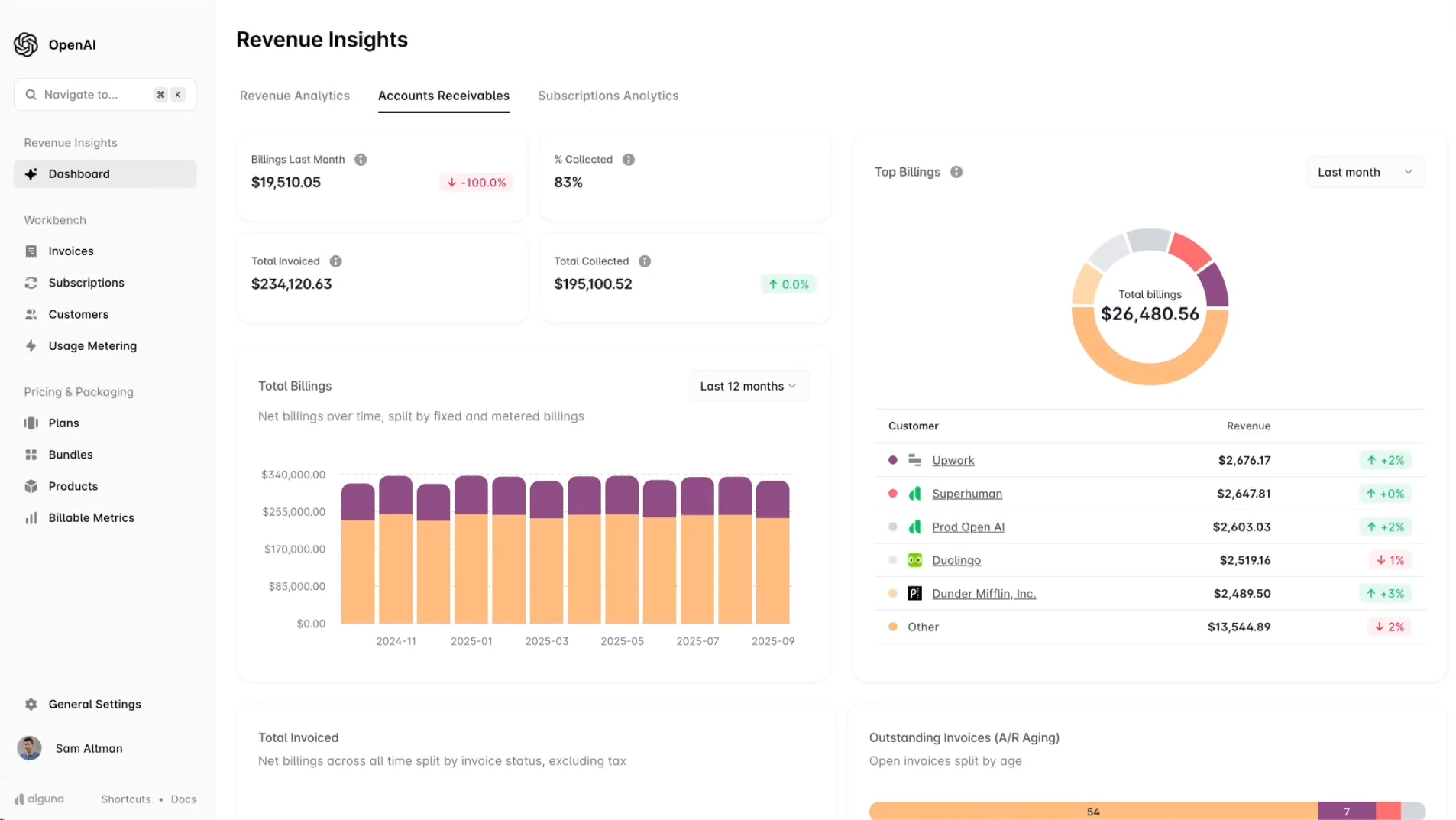
Alguna was designed for exactly the kind of complexity that healthcare SaaS companies face. As an end-to-end platform that connects quoting, billing, invoicing, payment collection, and revenue recognition, so SaaS companies in healthcare can run their whole revenue cycle as a single source of truth instead of stitching together disconnected tools.
For the billing models healthcare SaaS companies actually use, we meter usage in real time and apply your pricing logic automatically, whether you bill per seat, per patient, per transaction, or on a hybrid model.
Our invoicing and payment collection module gives you a real-time AR dashboard synced to your CRM and billing, automated reminders and smart retries, support for ACH, SEPA, wire, cards, and offline payments, and auto-reconciliation to QuickBooks, Xero, NetSuite, and your ERP. Built-in revenue recognition keeps earned and collected revenue reconciled as you go.
Our accounts receivable AI agent makes sure that none of your revenue goes uncollected, and chases payments on your team's behalf so they can focus on strategic projects.
To be clear on scope, Alguna handles how you bill and collect from your own customers, and it works alongside your clinical, claims, and revenue cycle management systems rather than replacing them. That's where a surprising amount of revenue leakage hides: in usage and hybrid invoices that aren't metered accurately, in failed payments that never get retried, and in cash that never gets reconciled.
Here's a quick checklist of what to look for in a healthcare SaaS billing platform, and how we map to it:
Frequently asked questions about billing for healthcare SaaS companies
What makes billing for healthcare SaaS companies different?
Three factors: compliance with HIPAA and the need for clean audit trails, pricing complexity across per-seat, per-patient, usage, and hybrid models, and slow-paying institutional buyers with long procurement cycles.
What are the best SaaS tools for healthcare operations management (billing)?
Alguna is one of the best SaaS tools for healthcare operations management when it comes to billing as the platform can handle complex pricing models with ease.
What are the best CLM tools for finance SaaS healthcare?
The "best" tools depends on the needs of you finance department. Alguna's CPQ includes, contract templates, clause libraries, and e-signature workflows.
What pricing models do healthcare SaaS companies use?
The most common are per-seat or per-provider, per-patient, usage-based, hybrid, and negotiated enterprise contracts. Many healthcare SaaS platforms run several of these at once.
How do healthcare SaaS companies reduce late payments?
By automating invoicing and dunning, offering multiple payment methods, syncing reconciliation to their accounting system, and watching receivables in real time so they can act before invoices age.
What is revenue leakage in healthcare SaaS?
Revenue leakage is the gap between the revenue a healthcare SaaS company earns and what it actually collects. It builds up through manual billing, failed payments, mis-metered usage, and payments that never get reconciled, and it's usually recoverable with better automation and visibility.
Get healthcare SaaS billing right
If you're scaling a healthcare SaaS company and your billing is starting to creak, we can help. Book a demo to see how Alguna handles healthcare SaaS billing end to end.