Every SaaS and AI company hits the same wall eventually. The pricing model that worked at $1M ARR starts creaking, and by the time you're mixing seats, usage, and credits across a few hundred contracts, your finance team is spending more time reconciling spreadsheets than closing the books.
What you have on your hands is a systems problem.
Because the companies pulling ahead right now aren't the ones with the simplest pricing. They're the ones whose revenue stack, pricing, quoting, billing, collections, and revenue recognition, can absorb that complexity without breaking.
AI revenue automation is what makes that possible. Used well, it doesn't just cut down on manual work. It turns pricing flexibility into a genuine growth lever instead of an operational tax.
In this guide, we'll break down what AI revenue automation actually looks like in practice, where it shows up across the revenue cycle, and a practical path to building it, so pricing changes accelerate growth instead of slowing your finance team down.
What is AI revenue automation?
It includes recommending or configuring pricing, generating and approving quotes, rating usage data, matching payments, predicting late invoices, and applying revenue recognition rules to complex or changing contracts.
AI revenue automation is a step beyond "traditional" revenue automation, which mostly relies on predefined rules and templates.
AI-based systems can interpret unstructured inputs (a contract clause, a support ticket, a payment history pattern), adapt to exceptions, and make judgment calls that would otherwise land on a finance analyst's desk.
AI revenue automation covers the following:
- Pricing and packaging: Recommending price points, tiers, or discount guardrails based on deal and usage data
- CPQ and quoting: Configuring complex, multi-element quotes and flagging non-standard terms for review
- Billing and usage metering: Rating usage events and catching anomalies before they hit an invoice
- Invoicing and collections: Predicting payment risk, prioritizing outreach, and automating dunning sequences
- Revenue recognition: Reading contract terms, detecting amendments, and updating recognition schedules automatically
Where AI shows up across the revenue cycle
AI revenue automation isn't confined to one system. Here's how it typically breaks down across the quote-to-cash cycle.
How to get started with AI revenue automation
Where to actually begin can be the toughest question to answer. Do you start with pricing and quoting? Or do you hand billing over to an AI-driven engine first? Or tackle collections because that's where the manual hours are piling up right now?
Trying to automate everything at once is usually how these projects stall out before they deliver anything.
The good news is that getting started doesn't require a full rip and replace of your finance stack.
But what it does require is a clear-eyed look at where your current process breaks down, a realistic pilot, and a platform that can grow with you as you automate more of the quote-to-cash cycle.
Most teams that get this right start small, prove the value on one workflow, and expand from there.
- Map your current revenue workflow: Document how a deal moves from quote to cash today, including every handoff between sales, finance, and engineering.
- Identify repetitive, rule-based tasks: Look for tasks that follow a pattern but still require manual execution: matching payments, updating recognition schedules, or re-keying contract terms into a billing system.
- Evaluate platforms by workflow, not just feature list: Compare how each platform actually handles your pricing model, whether that's a dedicated CPQ implementation, a billing engine, or an end-to-end quote-to-cash system.
- Pilot on a defined segment: Roll out AI automation to a subset of accounts or a single product line before switching your entire revenue operation over.
- Train your team and set governance: Make sure finance and RevOps understand what the system automates, what it escalates, and who owns the exceptions.
- Track outcomes and iterate: Revisit the goals you set at the start. Adjust thresholds, escalation rules, and scope based on what the data shows after the first full billing cycle.
How Alguna approaches AI revenue automation
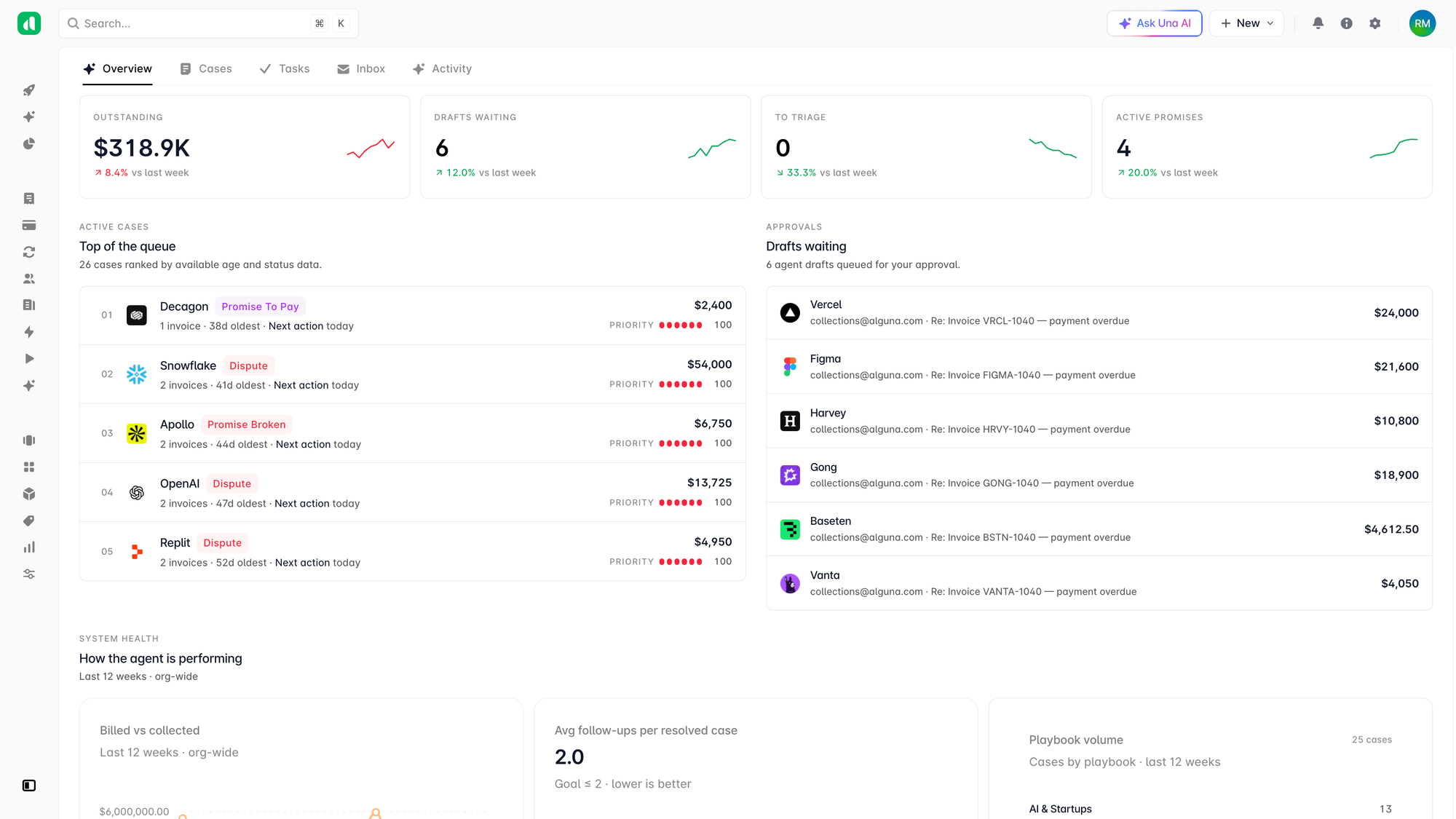
Alguna is a venture backed AI revenue automation platform for AI, SaaS, and fintech companies. Pricing, quoting, billing, and revenue recognition run on the same data, making sure everyone's looking at the same numbers.
The platform is built modularly, meaning you don't have to rip our your entire revenue stack to get started. For example, if CPQ is your biggest pain point, Alguna's no-code CPQ can be implemented in weeks and get you up and running, making use of Contracts AI to speed up the quoting process.
It supports complex pricing structures out of the box, including tiered, seat-based, usage-based models, outcome-based, and hybrid pricing, without engineering involvement.
On the billing side, usage events are ingested and rated automatically, and the accounts receivable AI agent handles the chasing, so you don't have to worry about payment collections.
On the finance side, automating revenue recognition means contract amendments, renewals, and upsells trigger recalculated schedules and journal entries automatically, in line with ASC 606 and IFRS 15.
This kind of end-to-end approach matters because AI monetization strategies tend to change quickly as products and usage patterns evolve.
Power your growth with AI revenue automation
AI revenue automation isn't a single feature you switch on. It's a shift in how pricing, billing, collections, and revenue recognition work together, so pricing complexity becomes something your revenue stack absorbs rather than something your finance team fights every month.
Start with the workflow causing the most friction today, whether that's SaaS invoicing or your revenue recognition close, and expand from there.
Get that foundation right and every new pricing experiment becomes a growth lever instead of a finance fire drill.
If you're comparing platforms more broadly, our roundup of automated revenue management solutions is a good next stop.