At 50 customers, managing entitlements is easy enough. A few feature flags, a spreadsheet of custom deals, and one engineer who remembers which accounts get what.
At 5,000 customers spread across three plan versions, a self-serve tier, a credit add-on, and a few hundred negotiated contracts, that setup stops working.
Packaging isn’t standing still either. According to ICONIQ’s 2026 State of AI snapshot, 37% of companies building AI products plan to change their AI pricing model in the next 12 months.
Every one of those changes lands on your entitlement model, and every gap between what you sold and what your product allows turns into lost revenue, a support ticket, or a frustrated customer.
This guide covers the best ways to manage software entitlements at scale: what “at scale” actually means, the warning signs that you’ve outgrown your current setup, 9 practices that hold up as you grow, and a step-by-step plan for getting there.
If you’re new to the topic, start with our primer on software entitlements and how they differ from licenses, then come back here.
What does managing software entitlements at scale mean?
A software entitlement is the record of what a customer can use in your product based on what they bought: which features are on, how many seats they have, how much they can consume, and for how long.
Managing entitlements means defining those rights, granting them when a deal closes, enforcing them in the product, and updating them every time the deal changes.
Doing that at scale is a different problem. Scale isn’t only about customer count. It’s about how many things can vary at once, and each one multiplies the work.
| Dimension | Early stage | At scale |
|---|---|---|
| Customers | Dozens of accounts, most on list price | Thousands of accounts across self-serve and sales-led |
| Plans | 2 or 3 plans that rarely change | Several plan versions live at once, with grandfathered customers on each |
| Custom deals | A handful of side agreements | Hundreds of negotiated overrides on seats, limits, and features |
| Pricing models | One model, usually seats or a flat fee | Seats, usage, and credits combined in the same contract |
| Time | Access starts at signing and renews annually | Ramps, mid-term upgrades, co-terming, and future-dated changes |
| Organization | One product and one legal entity | Multiple products, entities, currencies, and regions |
When three or four of those dimensions grow at the same time, entitlements stop being a configuration detail and become core revenue infrastructure.
7 signs your entitlement management won’t scale
Most teams don’t decide to rebuild their entitlement model out of the blue. They notice symptoms first. If any of these sound familiar, you’ve likely outgrown your current approach:
- Changing what’s in a plan requires an engineering ticket and a release
- Sales tracks custom terms in the CRM or a shared spreadsheet that product never sees
- Support can’t answer “what does this customer have?” without asking an engineer
- You have more plan variants than anyone can explain, many created for a single deal
- Customers on a downgraded or expired plan still have premium features switched on
- New customers sign a contract and wait days for the access they paid for
- Finance finds usage or features at quarter-end that were never invoiced
Why entitlement management gets harder as you grow
Every entitlement you give away without billing for it works like an unapproved discount, and discounts are expensive.
In McKinsey’s classic analysis, The power of pricing, a 1% drop in average prices cut operating profits by 8% for a typical S&P 1500 company. Granting Enterprise features to Pro customers, or forgetting to switch off a pilot add-on, chips away at price in exactly that way, one account at a time.
The root cause is rarely a careless team. MGI Research’s revenue leakage series points to contract complexity without the infrastructure to support it, and concludes that leakage comes down to “architecture inadequacy,” not process immaturity. In other words, you can’t hire your way out of an entitlement model that lives in four different places.
Your customers feel it too. Zylo’s 2026 SaaS Management Index found that 78% of IT leaders faced unexpected charges tied to consumption-based or AI pricing in the past 12 months. Buyers increasingly expect to see exactly what they’re entitled to and how much they’ve used, and they notice when your product and your invoice disagree.
9 best ways to manage software entitlements at scale
These practices build on the fundamentals, like defining entitlements separately from plans and metering anything you limit. They focus on what changes once volume, variety, and pace of change all go up at the same time.
1. Make the system that knows the contract your system of record
At scale, the biggest risk isn’t a wrong entitlement. It’s three slightly different versions of the right one, living in your CRM, your codebase, and your billing tool. Pick one system of record, and make it the one that already holds the subscription, the price, and the contract dates. That’s usually your billing platform, since it already changes state when a customer upgrades, renews, or churns.
It also lets you run one catalog for both sales motions. A self-serve customer who buys through checkout and an enterprise customer who signs a quote should draw from the same entitlement definitions, which is why connecting CPQ and billing matters as much as the entitlement model itself.
2. Version plans instead of editing them
Editing a live plan is fine at 50 customers. At scale, it’s how you accidentally take features away from customers who already paid for them, or hand new features to customers who didn’t. Treat every packaging change as a new plan version. New customers get the new version, existing customers keep theirs until renewal or migration, and you always know which promise applies to whom.
Keep a record of each version’s entitlements and set a policy for retiring old ones, so grandfathering doesn’t turn into permanent sprawl. Tools that support versioned subscriptions make this far easier than a folder of plan names ending in “v2_final.”
3. Handle custom deals as overrides, not new plans
Enterprise deals almost always include something off the menu: 50 extra seats, a higher API limit, or early access to a feature. The scalable approach is to keep the standard plan and record the exception as an override on that customer’s subscription. Creating a new plan for every deal makes reporting harder, breaks upgrade paths, and leaves you with hundreds of near-duplicate plans nobody wants to touch.
Overrides should be structured fields, not free-text notes in a contract PDF. That way they can be enforced in the product, reported on, and reviewed at renewal. If you’re rethinking your tiers anyway, our guide to designing SaaS plans and packages covers how to leave room for this kind of flexibility.
4. Put effective dates on every entitlement
Entitlements aren’t just on or off. They’re on from a date, until a date. Ramp deals add seats each year, downgrades take effect at renewal, and some add-ons expire after a pilot. At scale, any entitlement without a start and end date eventually becomes a support ticket.
Model time explicitly, so access changes on the same day the contract does. This matters most for multi-year ramp deals, where seat counts, prices, and entitlements all step up on a schedule the customer negotiated months earlier.
5. Treat credits and allowances as balances with rules
Usage allowances and prepaid credits behave differently from feature switches. They draw down, reset, roll over, expire, and get topped up. Each of those behaviors needs a written rule that matches the contract, and that rule needs to apply the same way to every customer.
Decide up front what happens when a balance runs out: a hard stop, a grace period, or billed overages. If you sell blocks of usage with a per-unit rate beyond them, see how prepaid blocks with overages work for guidance on sizing the block and the overage rate. And if credits are becoming your main currency, build credit-based pricing logic into your entitlement model from day one rather than bolting it on later.
6. Separate enforcement from packaging
Your product should ask one question, “What can this customer use?”, and act on the answer. It shouldn’t need to know which plan includes which feature. When plan logic is hard-coded into the application, every packaging change becomes an engineering project, and your pricing strategy moves at the speed of your release cycle.
With a clean separation, engineers build the entitlement check once, and product, RevOps, and finance own packaging from then on. A few technical decisions are worth making early:
- How long the product can cache an entitlement answer before checking again
- Whether each feature fails open or fails closed if the entitlement source can’t be reached
- How the product identifies a customer, so it matches the ID in your billing system
- Which events, such as an upgrade, renewal, or top-up, should trigger an immediate refresh
Untangling hard-coded plan logic is often one of the larger pieces of tech debt in your GTM systems, so it’s worth tackling before your next big packaging change.
7. Add governance and an audit trail
When dozens of people can change what customers receive, you need clear rules about who can change what. Not every change carries the same risk, so not every change needs the same approval.
| Change type | Example | Owner | Approval |
|---|---|---|---|
| New entitlement in the catalog | Add an audit log retention setting | Product | Product and RevOps review |
| Change to plan defaults | Raise Pro from 10 to 15 seats | Product or pricing | Pricing committee or finance |
| Custom override on a deal | 50 extra seats for one customer | Sales | Deal desk, within guardrails |
| Credit grant or extension | Extend unused credits by 30 days | Customer success | Finance above a set value |
| Plan retirement or migration | Move legacy plan customers to v3 | Product | Leadership and finance |
Every change should leave a record of who made it, when, and why. That audit trail is what lets finance explain a revenue change, support settle a dispute, and auditors confirm that what you recognized matches what you delivered. Structured approval workflows keep governance from turning into a bottleneck.
8. Reconcile access against invoices continuously
Even with good controls, drift happens. A manual override never gets removed, a downgrade misses one feature, or usage passes a limit that should have triggered an overage. The fix is to compare what customers can access with what they’re billed for, on a regular schedule rather than once a year.
Look for three gaps in particular: access granted but never billed, usage above an allowance with no overage charged, and features still active after a contract ended. Running these checks where your billing and usage data already sit is far easier than rebuilding them in a spreadsheet, which is why we recommend running revenue assurance inside billing. It’s also one of the most direct ways to stop revenue leakage before it reaches the close.
9. Make entitlements visible to every team and every customer
Sales, support, success, and finance all need to answer the same question about a customer, and none of them should have to file a ticket to do it. Give each team a direct view of entitlements, and consider making them available to the AI assistants your teams already use.
Customers need visibility too. Show them what’s included, how much they’ve used, and when they’re approaching a limit. Clear usage dashboards and threshold alerts help prevent surprise invoices and turn limits into upgrade conversations instead of complaints.
Comparing approaches to entitlement management
There’s no single right architecture for every company, but each approach has a ceiling. Here’s how the common options compare as you grow.
| Approach | How it works | Works well when | Where it breaks at scale |
|---|---|---|---|
| Hard-coded in the product | Plan logic lives in application code | You have one or two plans and rarely change them | Every packaging change needs a release, and custom deals become code branches |
| Feature flags | A flagging tool switches features on per account | You’re testing features or rolling them out gradually | Flags aren’t tied to contracts, so access drifts from what was sold and billed |
| Standalone entitlement service | A separate system stores entitlements and syncs with billing | Engineering wants a dedicated access layer | One more system to keep in sync with quotes, subscriptions, and invoices |
| Billing-native entitlements | Entitlements live on plans, subscriptions, and deals in the billing platform | Pricing changes often and deals vary widely | Your billing platform must expose an entitlement check your product can call |
How to scale your entitlement management in 6 steps
If you’re moving from scattered flags and spreadsheets to a setup that holds up, here’s a practical sequence.
- Audit what you’ve actually granted. Pull your 20 to 50 largest contracts and compare what each one promises with what the customer can access today. The gaps you find become your business case.
- Build an entitlement catalog. List every feature, limit, and allowance you sell, and give each one a stable key, a type, a default value, and an owner (see the table below).
- Map plans, versions, and deals to the catalog. Rebuild each plan as a set of catalog entries, then record custom terms as overrides. If you bill across regions or legal entities, share one catalog across your multi-entity subscriptions rather than duplicating it per entity.
- Connect your product with a single check. Replace scattered plan logic with one call that returns a customer’s current entitlements, and agree on caching and failure behavior.
- Set governance before you scale the rollout. Publish who can change what, the approval rules, and how changes get logged.
- Measure and reconcile on a schedule. Track a small set of KPIs monthly and reconcile access against invoices so drift gets caught early.
A simple catalog entry needs only a few fields:
| Field | What it holds | Example |
|---|---|---|
| Name | A label your teams recognize | AI credits |
| Key | A stable ID your product checks | ai_credits |
| Type | On/off, number, text, or credits | Credits |
| Default value | What a plan includes unless overridden | 1,500 per month |
| Unit and period | What’s counted and when it resets | Credits, reset monthly |
| Owner | Who approves changes | Product (pricing) |
And these KPIs tell you whether your entitlement management is keeping up with growth:
| KPI | What it measures | Why it matters at scale |
|---|---|---|
| Entitlement to invoice match rate | Share of accounts where access matches billed items | Catches unbilled features and leftover access |
| Time to ship a packaging change | Days from decision to live in product | Shows whether packaging is still tied to releases |
| Override rate | Share of contracts with custom entitlement terms | Flags plan design that doesn’t fit how you sell |
| Active plan versions | Plan versions with at least one live customer | Keeps grandfathering from turning into sprawl |
| Provisioning lag | Time from signed deal to working access | Measures the customer’s first-day experience |
| Entitlement-related tickets | Support tickets about access or limits | Shows where customers get confused or blocked |
How Alguna helps you manage entitlements at scale
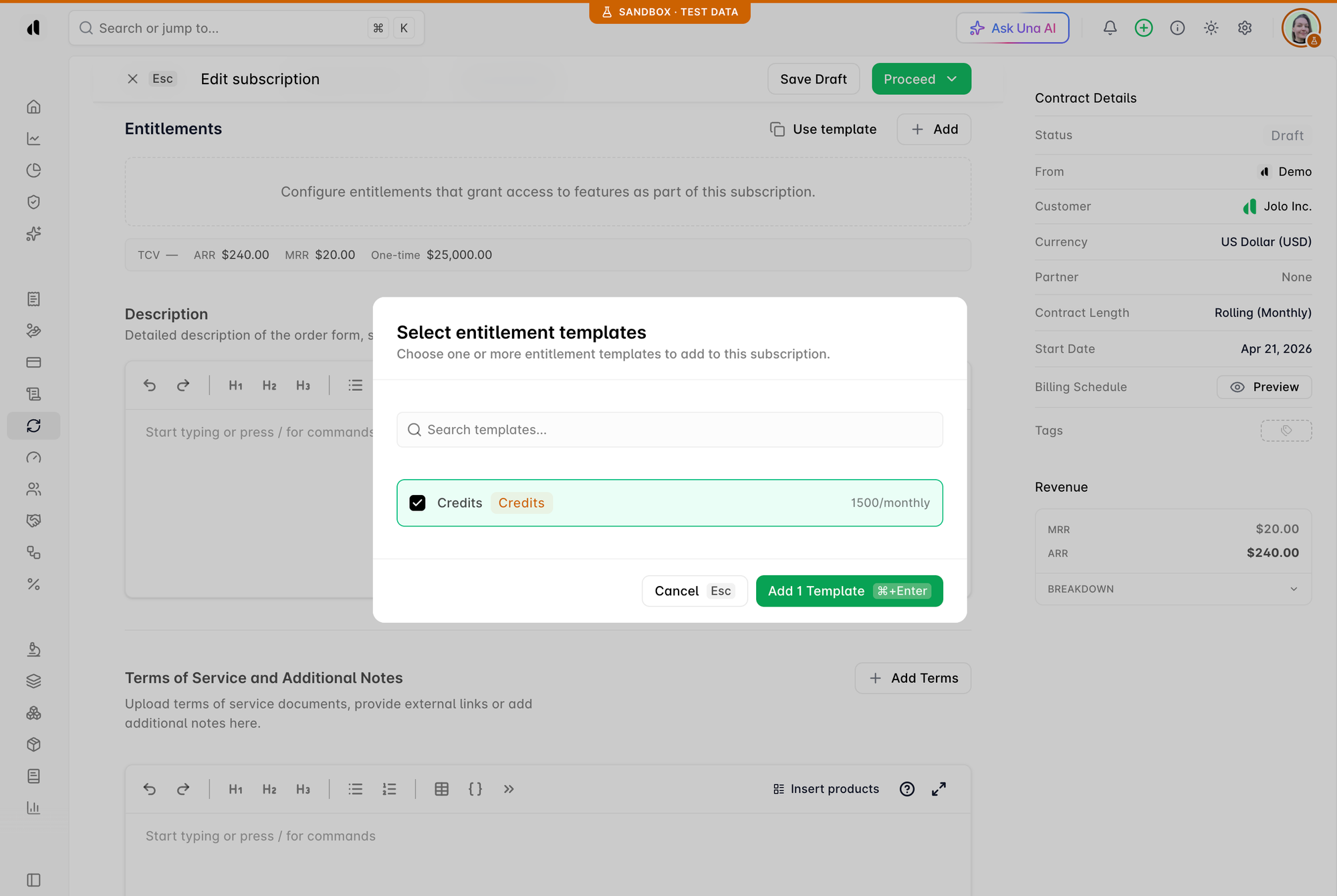
Alguna brings pricing, quoting, billing, and entitlements into one platform, so what a customer can use is decided in the same place as what they pay.
You define each entitlement once, as an on/off feature, a numeric limit, a text setting, or a recurring credit allowance, and attach it where it applies:
- Plans: every customer who subscribes to a plan gets its entitlements automatically
- Subscriptions: upgrades, downgrades, and renewals change entitlements on the same date the subscription changes
- Custom deals: sales can raise a limit or add a feature for one customer without creating a new plan
- Quotes: reps see exactly what a customer will get in each phase of a contract before they send it
- One check for your product: your product asks Alguna what a customer can use and gets the full answer in a single request, using the Alguna ID, your own customer ID, or a Stripe customer ID
Your teams can also ask questions like “Does this customer have SSO?” from AI assistants through Alguna’s MCP server.
Frequently asked questions
When should you move entitlements out of your codebase?
Usually when packaging changes start waiting on engineering, or when custom deals turn into code branches. If you’re launching plans, changing limits, or signing negotiated deals more than once a quarter, it’s time to move plan logic out of the application and into a system your business teams can manage.
How do you grandfather customers without creating plan sprawl?
Version plans rather than cloning them, keep each version’s entitlements on record, and set a sunset policy. For example, you might move grandfathered customers to the current version at their next renewal, with a clear notice period. Tracking how many versions still have live customers shows you when sprawl is building.
Should entitlement checks fail open or fail closed?
It depends on the feature. Core product access usually fails open, using the last known entitlements, so an outage doesn’t lock paying customers out. High-cost features, such as expensive AI usage, often fail closed or fall back to a conservative limit. Decide this for each entitlement type before you need it.
How do you manage entitlements across self-serve and sales-led customers?
Use one catalog for both. Self-serve customers get plan defaults, and sales-led customers get the same plans with structured overrides. Keeping one set of definitions means a customer who starts on a self-serve plan and later signs an enterprise contract moves cleanly between the two. If self-serve buying happens inside your product, an in-product checkout that writes to the same billing system keeps both paths aligned.
Futureproof way you manage entitlements
The best ways to manage software entitlements at scale come down to a few principles: one system of record, versioned plans, structured overrides, time-aware rules, and continuous reconciliation. None of them require a big-bang rebuild.
Start with an audit of your largest contracts, build a catalog, and connect your product to a single entitlement check. Once packaging no longer depends on a release cycle, you can change pricing as fast as your market does, and every customer gets exactly what they paid for.