Most finance teams discover revenue leakage the same way: someone runs a query for a board deck, notices a customer with six months of API calls and no active subscription, and the room goes quiet.
By then the money is mostly gone. You can invoice retroactively, but you'll spend the goodwill you were saving for the renewal, and half the time you'll decide it isn't worth the conversation.
The uncomfortable part is that nothing broke. No system threw an error. The events were metered correctly, stored correctly, and reported correctly.
They just never met a subscription that told the billing engine to charge for them.
That's the shape of most modern usage leakage and it's why revenue assurance has moved from a quarterly audit into the billing system itself.
What revenue assurance in billing actually means
Revenue assurance in billing refers to the controls that confirm every unit of delivered service becomes a correctly rated line item on a correctly issued invoice.
That scoping matters because it tells you where to put the control. A pricing governance problem is solved with approval workflows. A collections problem is solved with dunning management, be it automations or an AI dunning agent.
But unbilled usage can only be caught where usage and entitlements sit side by side, which is in your billing platform, and nowhere else.
Traditional revenue assurance treats billing as the thing being audited. A data team exports usage to the warehouse, exports subscriptions from the billing system, joins them, and looks for rows that don't match. It works, and plenty of good finance teams run exactly this.
But it inherits three problems:
- It's periodic. You find the gap at quarter close, 60 days after it opened.
- It's a reimplementation. Your warehouse query has to re-derive what "covered by a subscription" means, including proration, plan changes, trials, and grandfathered terms. Every time pricing logic changes in billing, the audit query drifts.
- It has no workflow. The output is a spreadsheet. Whether anyone acts on row 47 is a matter of individual follow-through.
Assurance inside the billing system inverts all three. The check runs against the same subscription and entitlement model that produces invoices, so there's no second implementation to keep in sync, and results can carry state, including who reviewed it, what happened, whether it was recovered.
The 5 control points in the billing lifecycle
Leakage isn't one isolated problem. In reality, it's five control points that fail, and each one fails differently.
Mapping your own stack against these is the fastest way to find out which control you're missing.
| # | Control point | What fails | What catches it |
|---|---|---|---|
| 1 | Contract → catalog | The deal is signed with terms the catalog can't express, so someone approximates | Quote-to-cash on one data model; no re-keying between CRM and billing |
| 2 | Metering integrity | Events dropped, double-counted, or attributed to the wrong customer | Ingestion monitoring, volume anomaly alerts, idempotent event keys |
| 3 | Subscription coverage | Usage flows with no subscription entitling it — the largest gap in usage-based models | Continuous detection of metered usage without matching coverage |
| 4 | Rating and invoicing | Correct usage, wrong price: stale rate cards, unapplied minimums, missed overage tiers | Invoice-level variance checks against contracted terms |
| 5 | Collection and recognition | Invoiced but never collected, or collected but recognized wrong | , dunning automation, revenue recognition tied to billing events |
Points 1, 4 and 5 are well-served by mature tooling as most billing platforms do something here, and most finance teams have a process.
Point 3 is the one that tends to have no owner.
It sits between RevOps (who assume billing handles it), billing operators (who assume sales configured it), and sales (who assumed the subscription was created when the deal closed).
That's also where the money is. Points 1 and 4 produce wrong invoices, which customers usually notice and dispute. Point 3 produces no invoice at all, which nobody notices, least of all the customer benefiting from it.
Why usage-based billing raises the stakes
In a pure seat-based model, coverage gaps are self-limiting. Provisioning is the control: if there's no subscription, there's usually no access, and the customer calls you when their login stops working.
Usage-based billing severs that link. Metering runs off product telemetry, and product telemetry doesn't check contract status before recording an event. A customer whose subscription lapsed last month keeps calling the API, and your system dutifully records every call. The usage is real, the delivery cost is real, the data is sitting in your event store, it just has no path to an actual invoice.
Four things make this structurally worse than it sounds:
Silent accrual. Nothing alerts. A missing subscription looks exactly like a customer who isn't using the product, because both produce zero revenue. There's no error state to monitor.
Compounding. A misconfigured plan overcharges once and gets fixed on the next invoice. Uncovered usage accrues every day it stays uncovered.
Scale asymmetry. These gaps hide in the middle of the customer base. Your top 20 accounts get reviewed manually. Account 400 of 1,200 does not, and with hundreds or thousands of accounts, per-account eyeballs stop being a strategy.
Recovery decays. Unbilled usage found within the current period is a routine true-up. Found nine months later, it's a negotiation you'll probably lose — or won't start.
Industry estimates put SaaS revenue leakage at 4–10% of revenue annually, with enterprises reaching 20%. Whatever your real number, the recoverable portion is concentrated in the gaps you find early. Detection latency, not detection accuracy, is usually the binding constraint.
How Alguna's Revenue Assurance fits into usage-based billing models
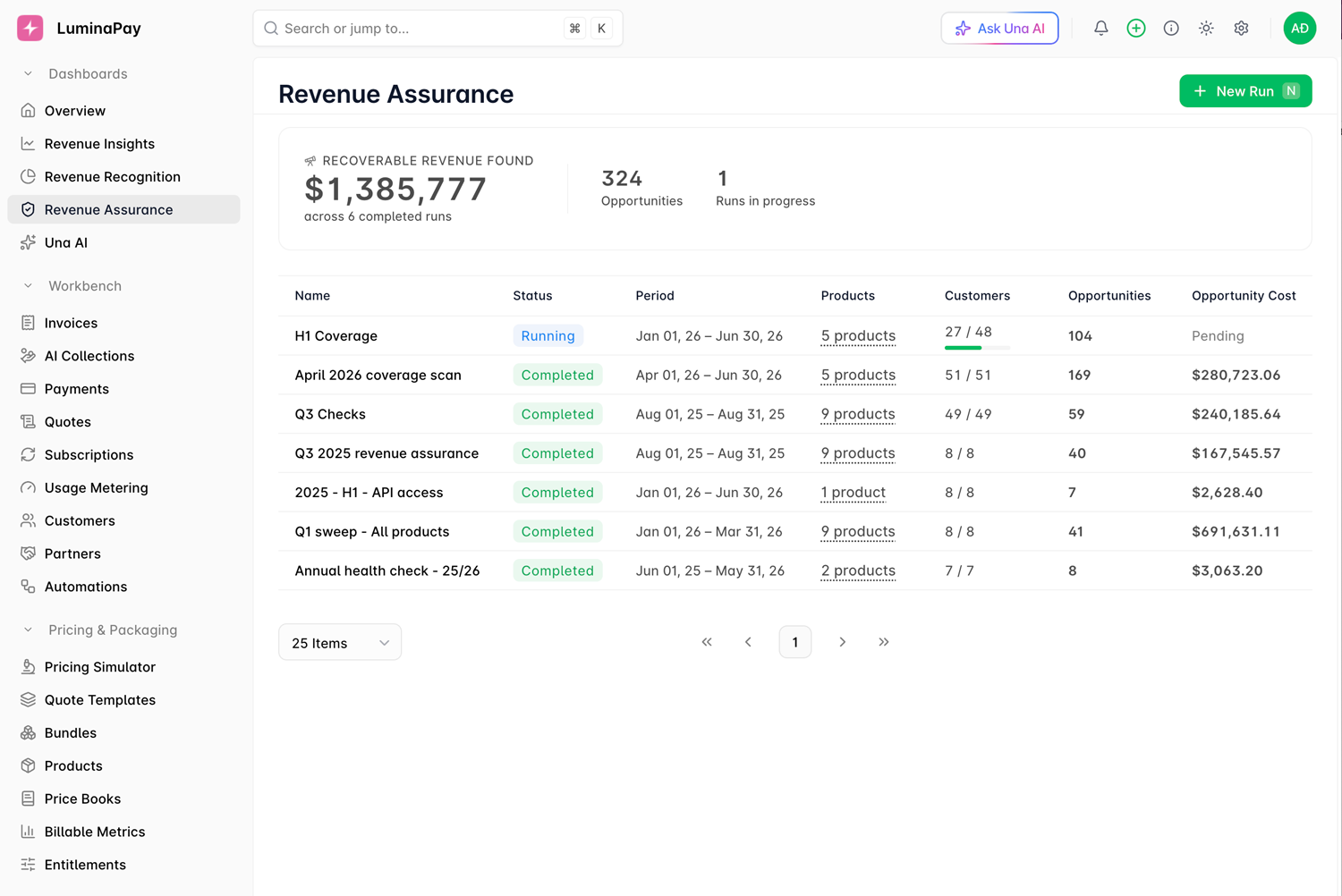
We built Revenue Assurance to close control point 3 without the warehouse round-trip. Because in Alguna, the metered events and the subscription model already live in the same platform.
What is Revenue Assurance in Alguna?
Revenue Assurance in Alguna is a usage detection tool that sweeps your customer base to detect:
- Usage that isn't covered by an active subscription
- Usage that isn't tied to a specific customer account
This instantly surfacing revenue leakage and upsell opportunities hiding in your usage data.
How it works
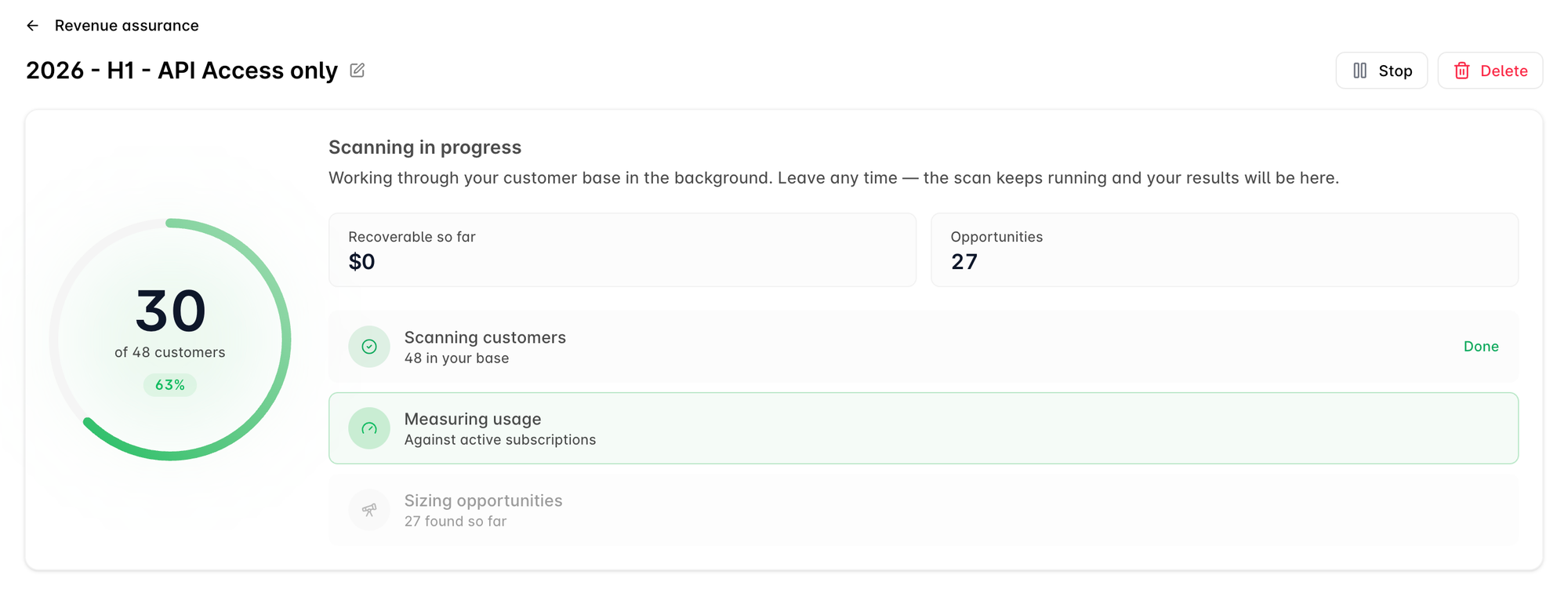
You launch a detection run across a set of products and a time window. Alguna processes your customer base in the background and streams opportunities back as it finds them, so a scan across thousands of accounts doesn't block on a single long query.
Next, we detect the two most common leakage patterns:
- Orphaned usage: A customer is actively metering a product with no active subscription behind it
- Unmapped coverage: A subscription lapsed and usage kept flowing or a customer is using a product that isn't on their current plan.
Each finding becomes an opportunity: the customer, the product, the period analyzed, and the usage quantity behind it.
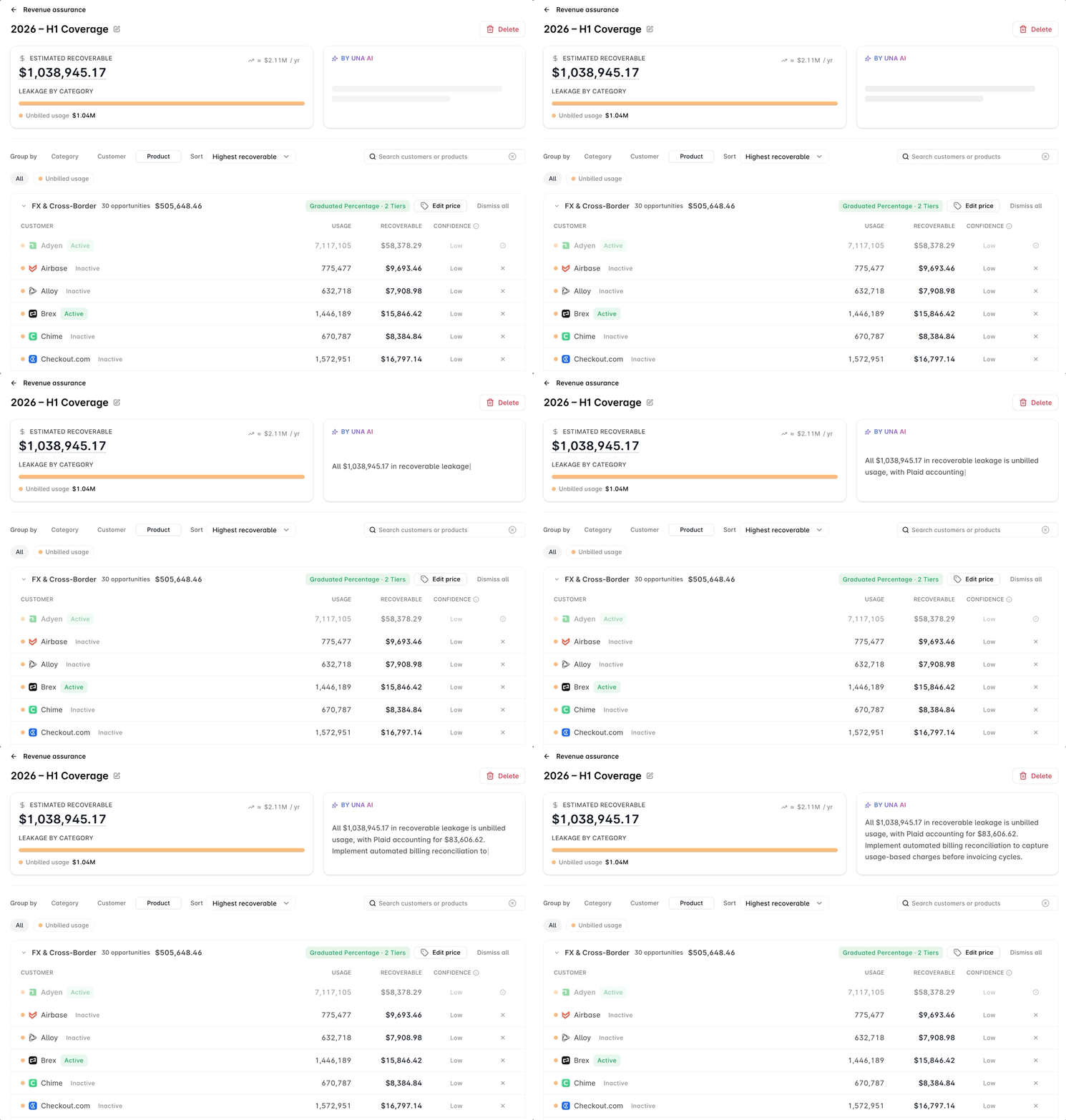
When a run completes, Alguna applies each product's configured default price to the detected usage and precomputes the opportunity cost, per customer and in aggregate, so a finished run arrives already quantified rather than waiting on manual input.
Where a product has no default price, or where the recoverable rate differs from list, you can set a price per product and Alguna recomputes that product's costs against it.
The number you get is what this usage would have billed under a real pricing model from your own catalog, not an estimate from a rate you typed into a spreadsheet.
Turning findings into recovered revenue
Every opportunity carries workflow state: open → acknowledged → resolved, with dismissed for known exceptions like trial usage or a deliberate goodwill allowance.
This is the part that separates assurance from analysis: the same gap can't surface, get ignored, and quietly resurface next quarter with nobody accountable.
Export any run to CSV to route findings to the team that closes them: sales for expansion conversations, CS for plan corrections, billing for true-up invoices. Access is gated by two permissions — View Revenue Assurance and Manage Revenue Assurance — so scan results and pricing configuration can be scoped separately from the rest of your billing surface.
Because usage data gets backfilled and subscriptions change, you can duplicate a past run to re-scan the same window against current data and see what shifted.
How to evaluate revenue assurance in a billing platform
If you're comparing approaches, building it in the warehouse, buying a standalone assurance tool, or using what your billing platform provides, these are the questions that separate them:
Does it read the same subscription model that generates invoices?
If the check re-derives coverage rules in a second system, it will drift from billing logic and produce false positives that erode trust in the tool.
Does it quantify findings in your own pricing?
A list of accounts with uncovered usage is a research project. A ranked list with dollar values is a work queue.
Does it carry state?
Detection without a resolution workflow reintroduces the spreadsheet problem, findings with no owner and no record of what happened.
Can it re-run against corrected data?
Backfills and retroactive subscription changes are normal. A one-shot report is stale the moment usage lands late.
Does it cover the whole base, not just the accounts you'd have checked anyway?
The value is in the middle of the distribution, not the top 20 logos.
How fast does the first result arrive?
Any assurance program you have to schedule a project around will run once and then not again. The ones that last are the ones that run in an afternoon.
Preventing usage leakage without engineering
Finding usage revenue gaps typically falls on engineering, whether it's a script monitoring API end points or spot checks against raw log files. It ends up both causing friction and being a costly exercise.
At the same time, revenue times know that the fastest available source of new ARR can be found in the usage you're already delivering and not invoicing. No acquisition cost, no new product, no negotiation over whether the value exists, the customer has already consumed it.
If you're metering usage in Alguna, Revenue Assurance is in your dashboard now, with no setup or new integrations required. Simply log in, pick your highest-volume metered product, scan the last two quarters, and see what the number is.