At this very minute, roughly 40 percent of invoices in the US alone are overdue.
The finance teams that recover that cash fastest aren't actually working harder. So what's their secret? They've stopped chasing invoices by hand and handed the repetitive parts to AI-powered AR collections software.
The right AR collections software tracks every open invoice, follows up on your cadence, reads what customers write back, and tells you exactly where your money is, so your team spends its time on the accounts that actually need (human) attention.
In this guide, we compare seven AR collection software platforms worth evaluating in 2026: Alguna, Fazeshift, Stuut, Paraglide, Upflow, Zenskar, and Tabs. We'll walk through what each one does well, where it falls short, and how to pick the right fit for your business.
What is AR collections software?
It covers invoice tracking, payment reminders, follow-up on overdue accounts, cash application, and reporting on metrics like days sales outstanding (DSO).
Some people call it AR collection management software or AR collection tracking software. The job is the same: get invoices paid sooner with less manual effort.
It sits alongside, and often overlaps with, broader accounts receivable software. The difference is emphasis. General AR software manages the full receivables ledger. AR collections software focuses on the collections motion specifically: who owes you, how overdue they are, what you've said to them, and what happens next.
Here's what a modern AR collections software process usually looks like once it's set up:
- Invoice tracking. Every open invoice lands in one place, sorted by aging bucket, customer, and amount, so nothing slips through the cracks.
- Automated follow-ups. The software sends reminders on a cadence you define, anchored to the invoice date, due date, or last action, instead of someone copy-pasting the same email 40 times a week.
- Reply handling. The better platforms read what customers send back, capture promises to pay, and pause outreach when a dispute comes up.
- Cash application. Incoming payments get matched to the right invoices, so your books stay accurate without manual reconciliation.
- Reporting. Live dashboards show outstanding cash, DSO, and which accounts need attention, so finance leaders can act on real numbers.
The newest wave of AR collections automation software goes further than scheduled reminders. Tools built on autonomous AR agents read replies, understand context, and work your aging with very little hand-holding.
We'll flag which platforms below do that and which are closer to smart automation.
AR collections software compared at a glance
Here's a high-level view before we go deep on each platform.
| Platform | Best for | Strengths | Limitations | Pricing |
|---|---|---|---|---|
| Alguna | Scaling B2B and AI-native companies that want an autonomous AR agent inside a full quote-to-cash platform | AR Agent plus Control Tower, autonomy ladder with hard guardrails, CPQ, flexible billing, revenue recognition, SOC 2 and GDPR compliant | Newer platform with a smaller ecosystem than legacy incumbents, custom pricing means a demo conversation to get a number | Custom, no revenue cut |
| Fazeshift | Mid-market and enterprise finance teams wanting multi-agent AR automation across ERP, CRM, and email | Eight specialized AI agents, high cash application accuracy, SOC 2 Type II, strong NetSuite and Salesforce integrations | Built for larger, complex AR operations, pricing isn't public, the multi-agent setup needs upfront scoping | Custom, contact sales |
| Stuut | Mid-market and enterprise teams that want autonomous collections across email, SMS, and voice with fast deployment | Agentic outreach across multiple channels, cash application, deduction and dispute resolution, deploys in days | Young company founded in 2024, enterprise governance controls still maturing, outcomes are largely vendor-reported | Custom, contact sales |
| Paraglide | High-volume B2B finance teams that want AI agents handling two-way billing conversations in the inbox, including in multiple languages | Conversational agents that reply to billing queries and chase invoices, promise-to-pay capture, multilingual outreach, ERP and billing integrations | Early-stage and focused on the communication layer, so it complements rather than replaces billing or cash application depth | Custom, contact sales |
| Upflow | Mid-sized and scaling B2B teams that want a collections-first layer on top of their existing accounting stack | Strong collections analytics and DSO visibility, personalized reminders, promise-to-pay tracking, one-click integrations | Not a billing platform, so it layers on top of your ERP rather than replacing it, lighter on autonomous agent behavior | Free analytics tier, paid automation plans are custom |
| Zenskar | Usage-based and hybrid B2B SaaS teams wanting billing, AR, and revenue recognition in one platform | No-code pricing builder, decoupled usage metering, 100-plus integrations, receivables and revenue recognition built in | Collections is one module of a broader billing platform, some learning curve, less agentic than dedicated AR tools | Custom, third-party listings cite around $15,000 per year |
| Tabs | Subscription and usage B2B SaaS teams wanting contract-to-cash automation with lighter-touch collections | Automated billing from executed contracts, collections context and payment links, ASC 606 revenue recognition | Collections surfaces context and reminders rather than running end-to-end autonomously, younger ecosystem | Custom, third-party listings cite figures from around $1,500 per month |
The 7 best AR collections software platforms in 2026
The market splits into three broad camps. Collections-first tools like Upflow layer intelligence on top of your existing billing. Autonomous AR agents like Fazeshift, Stuut, and Paraglide do the collections legwork themselves. Full revenue platforms like Alguna, Zenskar, and Tabs cover billing and collections in one connected system. The right choice depends on where you sit and what you actually need automated.
1. Alguna
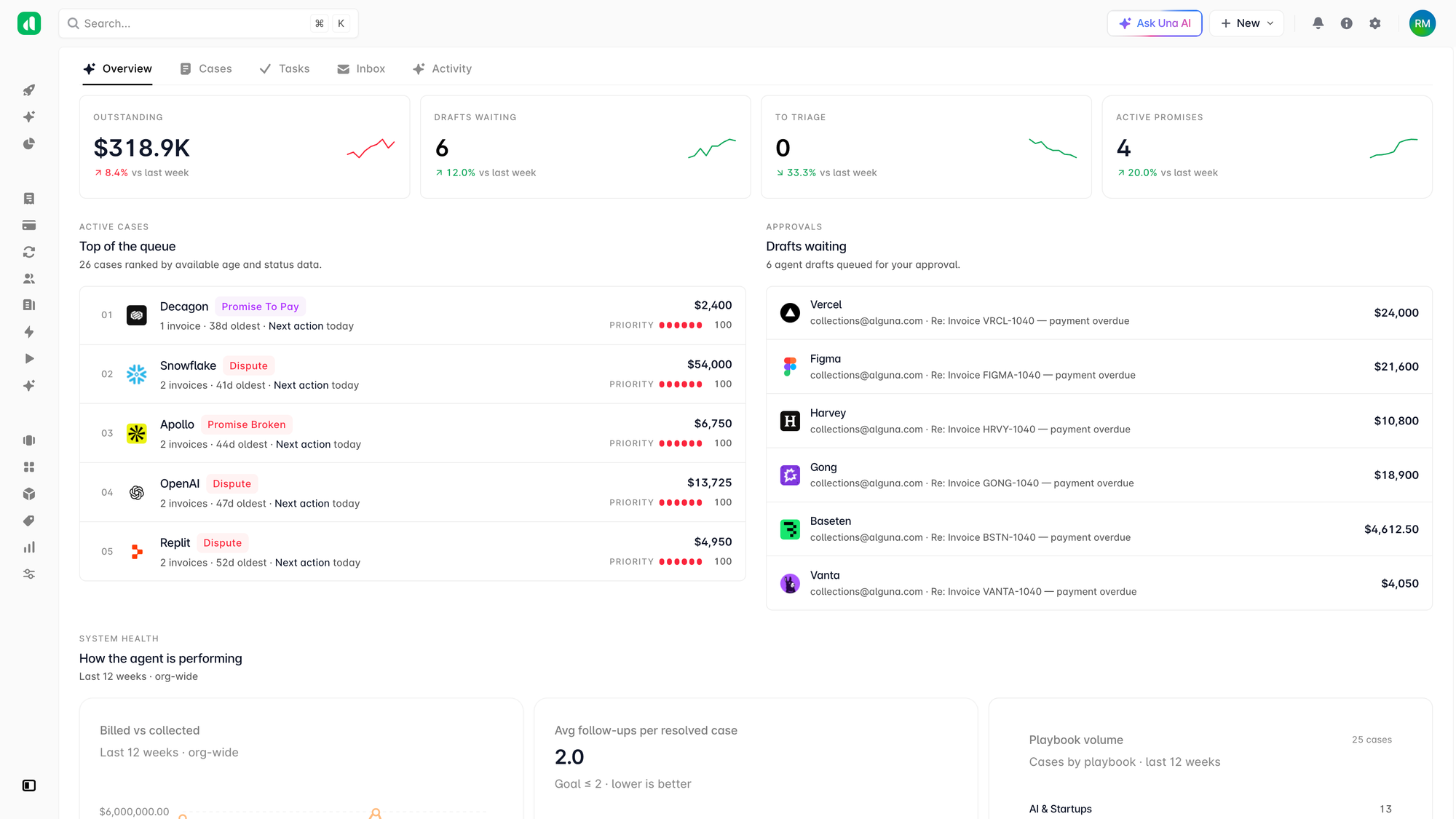
Alguna is an end-to-end revenue management platform headquartered in New York and London. Offering a dedicated AR collections agent, the platform that was purpose-built for the AI era to handle complex pricing models and high-volume billing.
Backed by Y Combinator and Mango Capital, it covers the full commercial lifecycle, from quoting and contract management through invoicing, collections, and revenue recognition, in a single, unified platform.
What sets Alguna apart in this category is the AR agent, an AI collections agent that works your aging like a tireless specialist. It opens a case for every overdue account, drafts and sends follow-ups on your cadence, reads customer replies, captures promises to pay, pauses itself on disputes, and escalates the edge cases to your team, all from a purpose-built workspace called Control Tower.
The result is a collections process that runs largely on its own, with people reviewing exceptions rather than doing the legwork.
Key features
- AR agent. An AI collections agent that autonomously drafts and sends invoices and reminders, reads inbound replies, captures promises to pay, pauses on disputes, retries failed payments, and reconciles cash to your ledger, without manual input on the routine work.
- Control Tower workspace. A single command center with five views: Overview for live KPIs, Cases for every overdue account, Tasks for drafts awaiting approval, Inbox for classified inbound email, and Activity for a full audit log.
- Autonomy ladder. Run the agent in Monitor, Suggest, or Act mode, with amount thresholds and hard-coded guardrails that block legal threats, discounts, credit-note promises, and admissions of fault, so you get automation with real oversight.
- Cadences and playbooks. Define multi-step follow-up sequences anchored to invoice sent, due date, last action, or promise date, with per-step templates and configurable sender personas that stay warm early and get appropriately firm on aged balances.
- Cash application and dispute handling. Inbound replies are classified in real time for intent, disputes pause outreach with an agent note explaining why, and payments reconcile back to the ledger.
- Full quote-to-cash coverage. AI contract extraction, CPQ, usage-based billing and other flexible models, and audit-ready revenue recognition, all feeding the same data so there's no gap between what you sold and what you invoiced.
- Integrations. Native connections with Salesforce, HubSpot, Stripe, and your general ledger, with multi-currency support across USD, EUR, GBP, and more.
Pros
- The only platform here with a true AI AR agent that reads replies, captures promises, and handles disputes end-to-end
- Control Tower gives finance teams one real-time command center for the entire AR motion
- The autonomy ladder lets you start cautious and increase agent independence as trust builds
- Hard-coded guardrails protect against legal and financial risk without careful configuration
- Covers the full revenue lifecycle, not just collections, and handles billing models most AR tools can't
- SOC 2 and GDPR compliant, with hands-on onboarding and migration support
"Alguna ticked every box I needed. Most importantly, it gave me a clear overview of revenue movements."
— Adam Liska, Co-founder and CEO at Airspeed (formerly Glyphic)
Cons
- Newer platform with a smaller ecosystem than decades-old incumbents
- Pricing is custom, so you'll need a demo conversation to get a number, on the plus side, Alguna never takes a revenue cut
Best for
- Companies that want AI-driven collections, not just scheduled reminders
- Finance teams looking to consolidate quoting, billing, and collections into one workflow
- Founders and CFOs who need real-time revenue visibility and a clear picture of outstanding cash
- Teams that want to reduce DSO without adding AR headcount
Pricing
Custom pricing based on business size and requirements. Alguna never takes a cut of your revenue.
See how Alguna reduces DSO and automates collections end to end. Book a demo and we'll walk you through the AR Agent and Control Tower with your use case in mind.
2. Fazeshift
Fazeshift is an AI-native AR platform built for mid-market and enterprise finance teams. Where most tools give you one automation layer, Fazeshift breaks the workflow into eight purpose-built agents, each tuned for a specific task: cash application, collections, contract review, credit assessment, billing, payment dispute resolution, onboarding, and a self-service payment portal.
The contract review agent reads sales contracts, extracts billing terms, and sets up invoicing in your ERP, which makes Fazeshift a strong fit for teams that want automation reaching from contract intake all the way through to cash posting.
Key features
- Specialized AI agents. Purpose-built agents for cash application, collections, contract review, credit, billing, payment disputes, onboarding, and a payment portal, with the vendor reporting 99 percent cash application accuracy.
- Collections automation. Personalized outreach adapts to each customer's payment history, with auto-escalation for slow payers.
- Dispute handling. A dedicated agent monitors the inbox, flags disputes, shares invoice copies, and routes exceptions for human review.
- Integrations and security. Native connections with Salesforce, NetSuite, and SAP, plus SOC 2 Type II certification.
Pros
- The most granular multi-agent AR automation of any platform in this guide
- Vendor reports strong outcomes, including a 20 percent AR balance reduction and 60 percent fewer billing disputes
- SOC 2 Type II certification makes it viable for regulated industries
- Works with your existing systems rather than requiring a rip-and-replace
Cons
- Built for mid-market and enterprise, so it's less suited to lean SaaS teams or startups
- Pricing isn't public and likely reflects enterprise-tier investment
- The eight-agent model takes some upfront scoping to configure
Best for
- Mid-market and enterprise companies with dedicated AR teams
- Finance operations that need automation from contract intake to cash posting
- Businesses with high invoice volumes and complex payment scenarios
Pricing
Not publicly listed. Contact Fazeshift for a quote based on your invoice volume and feature needs.
3. Stuut
Stuut is an AI-native AR platform founded in 2024. Newer to the market, the core pitch is an AI colleague that takes ownership of collections, payments, cash application, deductions, and credit, rather than adding another dashboard for your team to click through.
What stands out is the outreach. Stuut engages customers before invoices are even due, finds the right billing contacts, and communicates across email, SMS, and voice, adapting to each customer's payment habits over time.
It also matches incoming payments to invoices in your ERP and resolves deductions and disputes end-to-end with an audit trail.
Key features
- Proactive multi-channel outreach. Agents reach out before due dates across email, SMS, and voice, and personalize based on each customer's history.
- Cash application. Payments are matched to the correct invoices in your ERP, with click-to-pay to make settling easy for customers.
- Deduction and dispute resolution. Agents identify, investigate, and resolve deductions and disputes, gathering documentation and keeping context across interactions.
- Fast deployment. Stuut says it deploys in days rather than months and begins collecting immediately.
- ERP integrations. Connects with common ERP platforms to keep records in sync with minimal disruption.
Pros
- Genuinely agentic collections that run across email, SMS, and voice
- Covers collections, payments, cash application, and deductions in one system
- Fast time to value, with a claimed deployment measured in days
- Vendor reports strong results, including 40 percent more revenue collected and 37 percent faster DSO
Cons
- Young company, so track record and enterprise governance controls are still developing
- Reported outcomes are vendor-supplied rather than independently verified
- Pricing isn't public
Best for
- Mid-market and enterprise teams that want autonomous collections execution
- Finance teams where manual reconciliation and deductions are the main bottleneck
- Businesses that want fast deployment without a long implementation
Pricing
Not publicly listed. Contact Stuut for a quote.
4. Paraglide
Paraglide is an agentic AI platform for accounts receivable that deploys AI agents that hold two-way billing conversations in your finance inbox, replying to customer queries and chasing payment in personal, contextual threads at scale.
The agents answer billing questions, send documents, collect PO numbers, capture promise-to-pay dates, and follow up when customers go quiet, then hand off to your team when a case needs human judgment.
Key features
- Two-way inbox agents. A billing support agent replies to customer invoice queries and sends documents, while a collection agent runs personalized reminders and follow-ups based on account behavior and overdue status.
- Promise-to-pay and PO capture. Agents capture promise-to-pay dates, collect purchase order numbers, log payment confirmations, and update records automatically.
- Multilingual outreach. Agents communicate with customers in effectively any language, around the clock and across time zones.
- Full context. Paraglide connects to your CRM, ERP, billing system, email inbox, and ticketing tool to understand customers, invoices, and payment context, and can take action in the connected systems.
- Integrations and partnerships. Native connections to common ERP, billing, and accounting tools, including partnerships with Chargebee and AccountsIQ.
Pros
- Genuinely conversational AI that handles the two-way dialogue most AR tools ignore
- Multilingual communication is a real differentiator for international teams
- Strong founding team and investors, with early customers including Choco, Ardoq, and Spiideo
- Vendor reports a 34 percent average DSO reduction and fast time to value
Cons
- Early-stage company, so track record and enterprise reliability are still being established
- Focused on the communication and inbox layer rather than billing or deep cash application
- Less suited to companies with complex usage-based billing, and pricing isn't public
Best for
- High-volume B2B finance teams where the inbox is the main collections bottleneck
- International businesses that need multilingual AR communication at scale
- Teams already on an ERP or billing platform that want to automate the collections conversation
Pricing
Not publicly listed. Contact Paraglide for a quote.
5. Upflow
Upflow is an accounts receivable platform for B2B companies that describes its approach as financial relationship management. Instead of treating collections as aggressive debt recovery, it treats each follow-up as a customer touchpoint. It works as an intelligence layer on top of your existing accounting stack, turning static billing data into live collection workflows and real-time cash metrics.
It's a good fit for mid-sized and scaling B2B teams, typically in the $10 million to $500 million revenue range, that want tighter control over collections and DSO without replacing their billing system.
Key features
- Collections analytics. Live dashboards track cash collection performance, aging balance, DSO, and at-risk accounts in real time, with a free analytics tier so you can prove value before paying.
- Personalized reminders. Automated email sequences adapt to the size and type of account, the recipient's role, and how late the invoice is.
- Promise-to-pay tracking. Captures payment commitments and keeps sales teams in the loop with collaborative timelines.
- Payments. Combines collections with payment collection so customers can settle directly.
- One-click integrations. Connects with QuickBooks, Xero, Chargebee, Stripe Billing, and NetSuite.
Pros
- Strong collections analytics and DSO visibility, with a genuinely useful free tier
- Relationship-first reminders help preserve the commercial relationship
- Fast to connect to an existing accounting stack
- Well-suited to finance-led teams that want control without a migration
Cons
- Not a billing platform, so it complements rather than replaces your ERP
- Lighter on autonomous agent behavior than the AI-native tools above
- Companies with very complex billing may outgrow the automation depth
Best for
- Mid-sized and scaling B2B companies that want a collections-first layer
- Finance teams that need better DSO visibility fast
- Businesses happy with their billing setup that just need to modernize collections
Pricing
A free analytics plan is available. Paid automation plans are custom, on monthly or annual terms. Confirm current pricing on Upflow's website.
6. Zenskar
Zenskar is a quote-to-cash platform built for complex subscription and usage-based pricing. It automates billing, receivables, revenue recognition, and usage metering on one platform, with a no-code pricing builder and an API-first design that suits finance and engineering teams alike.
Collections is one part of a broader billing platform here rather than a standalone product. That's the trade-off: you get receivables inside the same system that runs your billing and revenue recognition, so there's no handoff between them, but the collections layer is less agentic than a dedicated AI AR tool.
Key features
- Flexible billing engine. Handles subscription, usage-based, and hybrid models with a no-code pricing builder and metering decoupled from pricing.
- AR automation. Automates invoicing, collections, and reconciliation from a single source of truth.
- Revenue recognition. Configurable, audit-ready revenue recognition workflows built into the same platform.
- Usage metering. Real-time and batched ingestion with several methods so you can match how your data flows.
- Integrations. More than 100 native integrations, including Salesforce, Stripe, NetSuite, SAP, Xero, and QuickBooks.
Pros
- Billing, AR, and revenue recognition live in one connected platform
- Genuinely flexible pricing engine for usage and hybrid models
- Broad integration coverage and a responsive support reputation
- All features included regardless of plan, with unlimited implementation support
Cons
- Collections is a module of a larger platform rather than a dedicated collections product
- Some learning curve during initial setup
- Less autonomous on the collections side than agent-first tools
Best for
- Usage-based and hybrid B2B SaaS teams that want billing and AR together
- Finance teams replacing spreadsheets and developer-dependent billing
- Companies that need revenue recognition alongside receivables
Pricing
Custom, with all features included on every plan. Third-party listings cite figures from around $15,000 per year. A free trial is available. Verify current pricing directly.
7. Tabs
Tabs is an AI-powered revenue automation platform that runs the B2B contract-to-cash process. It generates invoices directly from executed contracts, which removes manual data entry, and layers collections management, ASC 606 revenue recognition, and real-time reporting on top. Its AI acts as a set of virtual team members handling invoices, collections, and reconciliations.
On collections specifically, Tabs is strong at surfacing which accounts need attention and why, tying a past-due invoice back to renewal timing or a disputed line item back to the contract. It gives you context, not just reminders.
It's lighter on fully autonomous collections execution than Alguna, Stuut, or Fazeshift, so it fits teams that want smart, context-rich collections inside a billing platform rather than an agent running the whole motion alone.
Key features
- Contract-to-cash billing. AI ingests executed contracts and generates invoices automatically, so what you bill ties back to what you signed.
- Collections management. Automated reminders and embedded payment links, with context that explains why each account needs attention.
- Revenue recognition. ASC 606-compliant revenue recognition built from contract and billing data.
- Real-time reporting. Live visibility into ARR, cash flow, AR balances, and renewals.
- Integrations. Native connections with QuickBooks, NetSuite, and Sage Intacct, plus developer-friendly APIs.
Pros
- Automated billing straight from contracts removes reconciliation headaches
- Collections context ties invoices back to contract terms and renewals
- Handles subscription, usage, and hybrid billing out of the box
- Revenue recognition and reporting are built in
Cons
- Collections surfaces context and reminders rather than running end-to-end autonomously
- Younger ecosystem than long-established AR suites
- Best value comes from adopting Tabs as the full billing platform
Best for
- Subscription and usage B2B SaaS teams wanting contract-to-cash automation
- Finance teams with high volumes of custom contracts
- Companies that want billing, collections, and revenue recognition connected
Pricing
Custom. Third-party listings cite figures from around $1,500 per month. Verify current pricing on the Tabs website before deciding.
How to evaluate AR collections software
Choosing the right tool isn't about the longest feature list. Here's what actually moves the needle.
Real AI versus scheduled reminders. A lot of platforms use "AI" to describe what is functionally a timed reminder sequence. The distinction matters. Does the tool read customer replies and respond to them? Does it capture promises to pay and pause outreach accordingly? Does it handle disputes without a human stepping in? Ask every vendor to demo exactly how their platform handles a customer reply.
Cash application depth. Matching incoming payments to open invoices is where a lot of manual time disappears. Ask how the platform handles partial payments, consolidated remittances, and parent-child account hierarchies. This is the heart of any serious cash application workflow.
Controls and guardrails. If the platform uses AI agents for outreach, you need to know how much control you keep. Look for configurable autonomy levels, approval thresholds tied to invoice amounts, and hard guardrails that stop the agent from making legal threats, offering discounts, or admitting fault. Alguna's autonomy ladder is a useful model to benchmark against.
Billing model fit. If you run usage-based, hybrid, or custom pricing, plenty of AR tools will struggle. Make sure the platform can ingest your usage data, generate accurate invoices from it, and handle mid-period changes.
Integrations that fit your stack. Your AR software has to connect to your CRM, billing system, and ERP without manual exports. Check for native integrations, not Zapier workarounds, with the systems you already run. If you're on Salesforce and NetSuite, or QuickBooks Online, or Sage Intacct, confirm those specific connectors exist and how deep they go.
Implementation and migration. The biggest risk in switching financial software is the migration. Ask how long it takes, who does the heavy lifting, and what data migration involves. A hands-on process cuts risk, so ask for references from teams that moved from a setup like yours.
For a deeper look at agent-led collections specifically, our guide to intelligent collections breaks down what separates genuine automation from dressed-up reminders.
Frequently asked questions about AR collections software
How does AI-driven AR collection software match payments to invoices?
AI-driven AR collection software matches payments to invoices by reading incoming remittance data, parsing amounts and references, and reconciling each payment against your open invoices in the ERP, including partial payments and consolidated remittances.
The stronger platforms post the matched cash to the ledger automatically and flag only the exceptions that need a human, which is what turns cash application from a daily chore into a background process.
Which AR collection software integrates with Salesforce and NetSuite?
If you need AR collection software that integrates with Salesforce and NetSuite, Alguna, Fazeshift, and Zenskar all connect to both, and Upflow integrates with NetSuite.
Alguna offers native Salesforce and general ledger connections alongside its AR Agent, so collections data stays in sync with your CRM and accounting records without manual exports. Always confirm the depth of each connector, since a native two-way sync is very different from a one-directional feed.
Can you automate collection letters with AR software?
Yes. Every platform in this guide can automate collection letters and reminders on a cadence you define. The difference is what happens after the letter goes out.
Basic tools send the next scheduled message regardless of context, while agent-based tools like Alguna and Stuut read the reply, capture a promise to pay, pause on a dispute, and adjust the next step based on what the customer actually said.
What's the best AR collection software for multiple subsidiaries?
For the best AR collection software for multiple subsidiaries, look for multi-entity and multi-currency support, consolidated reporting across entities, and cash application that handles parent-child account hierarchies.
Alguna supports multi-currency collections across a connected revenue platform, and enterprise-focused tools like Fazeshift are built for parent-child hierarchies and multi-entity operations. Confirm during the demo that each subsidiary can run its own cadences and personas while rolling up into one view.
What's the best payment collection and AR software for QuickBooks Online users?
For QuickBooks Online users, the best payment collection and AR software is one that offers a native, two-way QuickBooks integration so invoices and payments stay in sync. Alguna, Upflow, Zenskar, and Tabs all integrate with QuickBooks.
What's the best payment collection and AR software for Sage Intacct users?
For Sage Intacct users, look for AR software with a proven Sage Intacct connector that syncs invoices, payments, and cash application. Fazeshift and Tabs both integrate with Sage Intacct, and Fazeshift's contract agent can set up invoicing directly in it. Ask each vendor how the connector handles cash posting back to Sage Intacct, since that's where reconciliation work usually piles up.
What's the difference between AR collections software and billing software?
Billing software generates and sends invoices. AR collections software manages what happens after the invoice is sent: tracking payments, following up on overdue accounts, and reconciling cash.
Some platforms, like Alguna and Zenskar, cover both in one workflow, which removes the data handoff between billing and collections that causes most accuracy problems. If you want the full picture, see our roundup of accounts receivable AI software and our primer on the accounts receivable AI agent.
Stop letting earned cash sit overdue
The gap between the finance teams that get paid on time and the ones that don't isn't about effort anymore. It's about tooling. The right AR collections software removes the manual chase, closes the cracks that swallow revenue, and gives your team the visibility to act on real numbers instead of guesswork.
Of the seven platforms here, Alguna is the most complete option for scaling B2B and AI-native companies: an end-to-end platform that connects quoting, billing, and collections, with a genuine AI AR agent that works autonomously inside the guardrails you set. If you're evaluating the market, it's worth making it your first conversation.
If you want to see how Alguna can reduce your DSO, automate collections, and give your finance team a single source of truth for revenue, we'd love to show you.