Getting paid should be easy. You delivered the product or services, you sent the invoice, and now you wait.
But in practice, waiting is where a lot of finance teams lose sleep, and more importantly, cash. Across North America alone, close to 40 percent of B2B invoices are paid late and around 5 percent are written off as bad debt entirely. That is real money sitting in someone else's account instead of yours.
Now, it's important to flag that AI does not replace your receivables team. What it does is remove the repetitive work that can (and should) be handled by AR automation or AR agents. Because chasing overdue accounts, matching payments to invoices, and updating the ledger by hand eats hours your team could spend on higher-value projects.
The cost adds up fast. The Kaplan Group puts the average annual cost of late payments at 39,406 dollars per company, with 10 percent of businesses losing more than 100,000 dollars a year.
This is exactly where artificial intelligence and intelligent collections have started to change the math. In this guide, we walk through how AI improves accounts receivable processes, what the technology actually does at each step, the best practices worth adopting, and a practical way to get started.
If your goal is to protect and improve cash flow, this is one of the highest-leverage places to start.
What does it mean for AI to improve accounts receivable processes?
Accounts receivable, or AR, is the money your customers owe you for goods or services you have already delivered. The AR process covers everything from issuing an invoice, to following up on payment, to applying cash once it lands, to reconciling your books.
Traditionally, most of that work has been manual and reactive. Someone runs an aging report, notices an invoice is 30 days overdue, sends a reminder, and hopes for a reply. AI in accounts receivable means using machine learning, predictive modeling, and automation to handle these steps proactively instead. Rather than treating every open invoice the same, the system learns from your payment history, scores risk, drafts contextual follow-ups, and reconciles cash with far less human effort.
Finance teams are adopting these tools quickly. In a recent McKinsey survey of CFOs, 44 percent said they used generative AI across more than five use cases in 2025, up from 7 percent the year before. Receivables, with its high volume of repetitive tasks and clear payoff, is one of the first places that investment tends to land.
The shift is easiest to see when you compare the two approaches side by side.
How AI improves accounts receivable processes, step by step
AI can touch almost every part of the receivables workflow, but a handful of areas deliver the most value. Here is where it moves the needle, and what each improvement means for your business.
For a wider view of how AI is reshaping the receivables function, we go deeper elsewhere, but these are the core mechanisms.
1. Predictive payment risk scoring
Instead of treating every overdue invoice the same, AI analyzes past payment patterns, invoice aging, and account signals to score each open invoice by the likelihood it will be paid late.
Your team can then work the accounts most likely to slip, and act before the due date rather than after. This is one of the clearest levers for keeping days sales outstanding under control.
2. Intelligent, automated collections
AI-powered collections go beyond a fixed reminder schedule. The system tailors the timing, channel, and tone of each follow-up to how a specific customer tends to behave, then sends it automatically.
Some platforms take this further with smarter, context-aware collections that read replies and adjust the next step. Layer in AI-driven dunning for failed payments, and a large share of routine chasing disappears.
3. Faster cash application and reconciliation
Matching payments to open invoices is one of the most tedious parts of receivables, especially at volume. AI automates the work of matching payments to open invoices, handles partial payments and remittance data, and syncs the result to your ledger. The payoff is a cleaner close and fewer reconciliation gaps.
4. Earlier dispute detection
Disputes are silent DSO killers. An invoice sits unpaid, nobody flags it, and weeks pass before anyone realizes there was a problem with a line item. AI can spot the signals of a likely dispute in customer replies and payment behavior, then route the issue to the right person before it stalls the whole invoice.
5. More reliable cash flow forecasting
Because AI predicts when invoices will actually be paid rather than when they are technically due, forecasts get sharper. That visibility across the full invoice-to-cash cycle lets finance plan with more confidence and avoid the scramble when a large payment lands late.
Best practices for using AI in accounts receivable
Adopting AI in receivables is less about the technology and more about how you roll it out. These practices help you get value quickly without creating new headaches.
- Start with clean, connected data. AI is only as good as the data feeding it. Make sure your invoices, payments, and customer records live in systems that talk to each other before you automate on top of them.
- Keep a human in the loop. Let AI handle scoring, drafting, and matching, but keep people in charge of exceptions, high-value accounts, and anything sensitive. The goal is to remove busywork, not judgment.
- Prioritize by impact. Point automation at your biggest bottlenecks first, whether that is collections, cash application, or disputes. Early wins build trust in the system.
- Integrate with billing and your ERP. Receivables should not be an island. When AR shares data directly with billing and your accounting system, you avoid re-keying and reconciliation gaps.
- Measure against the metrics that matter. Track DSO, overdue balances, and time spent per collector so you can prove the improvement. Our guide to practical ways to bring DSO down is a good starting point.
- Roll out incrementally. Pilot one workflow, learn from it, then expand. A staged rollout beats a big-bang launch that nobody trusts.
- Choose a platform built for your billing model. If you run usage-based or hybrid pricing, generic AR tools tend to struggle. Combine AI with collections best practices for B2B teams and a platform that fits how you actually bill.
How to add AI to your accounts receivable process
If you are ready to move from theory to practice, here is a straightforward path from your current process to an AI-assisted one.
- Map your current AR process. Write down every step from invoice creation to cash application. You cannot improve what you have not made visible.
- Find your biggest bottlenecks. Look for where invoices stall, where your team spends the most manual hours, and where errors creep in. These are your first automation targets.
- Clean and connect your data. Consolidate customer, invoice, and payment records, and make sure your CRM, billing, and accounting systems share data cleanly.
- Choose the right AI-powered AR platform. Evaluate tools on predictive scoring, automated collections, auto-reconciliation, and fit with your pricing model. If you want a fully autonomous option, look at what an autonomous AR agent can take off your team's plate.
- Configure workflows and rules. Set your reminder cadences, retry logic, escalation paths, and the thresholds where a human should step in.
- Pilot, measure, and expand. Start with one workflow, track the results against your baseline, and roll the approach out across the rest of your receivables once it proves itself.
How Alguna's AI agents improve accounts receivable processes
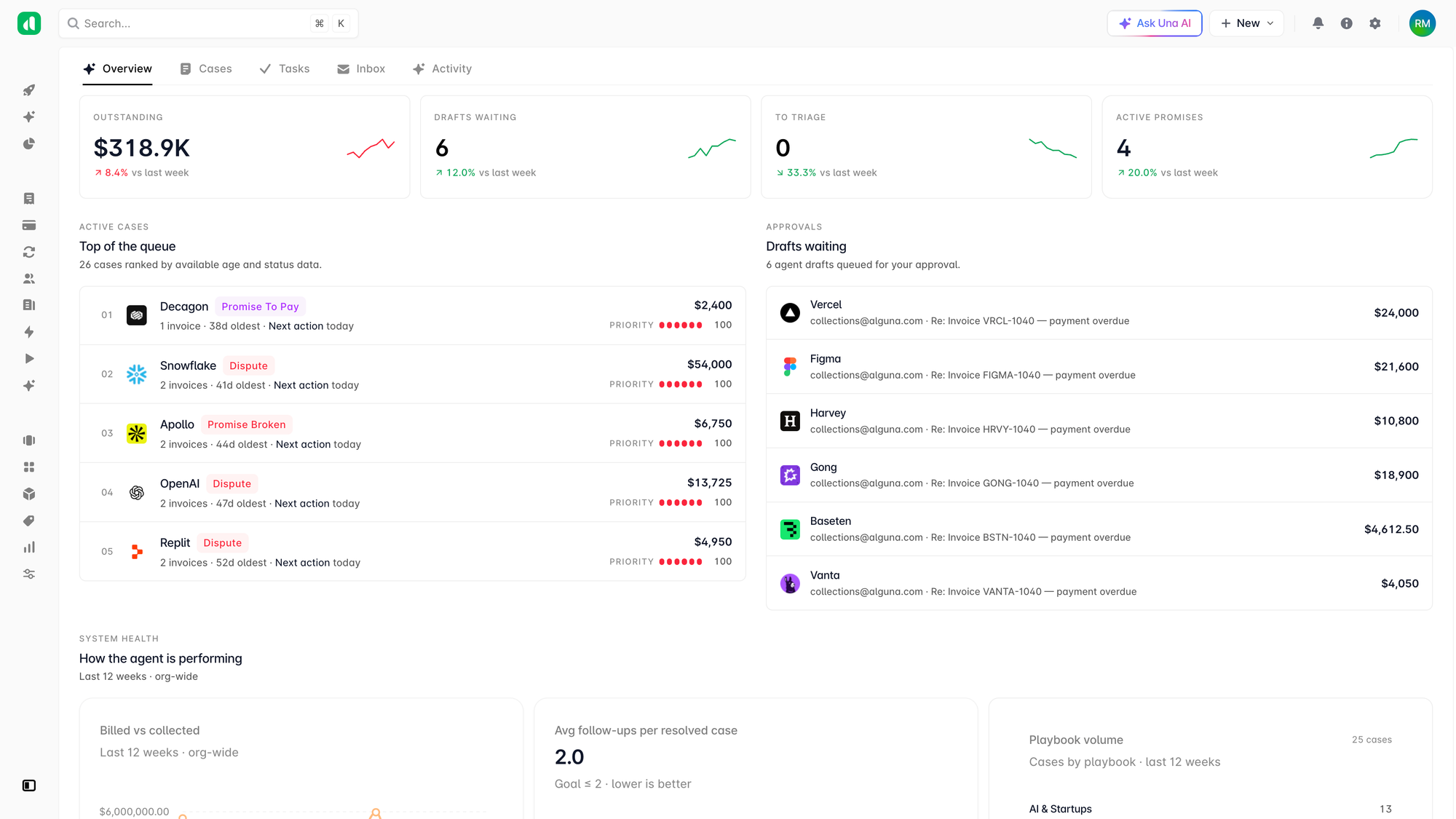
At Alguna, we built an end-to-end revenue automation platform for the AI era, designed to handle complex pricing and high-volume billing.
Receivables are one module in that platform, and they share data directly with quoting, billing, and revenue recognition, so there is no re-keying and no reconciliation gap between a closed deal and an accurate invoice.
Our accounts receivable product centers on a few core capabilities:
- A live AR dashboard with real-time visibility into current, overdue, and at-risk invoices, filtered by aging bucket, customer segment, or sales rep, and synced to your CRM and billing.
- Automated collections and dunning, with configurable reminders, smart retry logic for failed payments, and escalation workflows that run without manual chasing.
- Multi-method payments across ACH, SEPA, wire, cards, wallets, and offline logging, with smart routing rules based on amount, region, and preferred currency.
- Auto-reconciliation that matches payments to invoices instantly and syncs results to QuickBooks, Xero, Stripe, NetSuite, and your ERP, reducing errors at month-end close.
Because it is purpose-built for usage-based, hybrid, and subscription models, Alguna handles the billing complexity that trips up generic AR tools, and it applies your pricing logic automatically without engineering involvement.
Building future proof AR processes with agents
AI does not replace your receivables team. It removes the repetitive work that keeps them from doing their best work. By predicting risk, automating collections, applying cash faster, and forecasting more accurately, AI turns AR from a reactive, manual function into a proactive one that protects cash flow instead of leaking it.
The best way to start is small: pick one bottleneck, connect your data, and let the system prove its value before you scale. When you are ready to see what that looks like in practice, book a demo with Alguna and we will walk you through it.