If you're reading this, there's a good chance Zenskar is already on your shortlist, or already in your stack, and something isn't quite fitting.
Maybe your team has outgrown its support tier, maybe you need CPQ and billing in one place instead of two systems, or maybe you're simply doing your due diligence before you sign a multi-year contract.
All three reasons are common (and all three are good ones).
In this guide, we'll define what Zenskar does, compare it against seven alternatives (starting with Alguna, which we built specifically to combine CPQ, billing, and revenue recognition in one platform), and walk through how to evaluate a switch without disrupting your customers.
What is Zenskar? (And why teams look for alternatives)
Zenskar is a billing and revenue recognition platform built for companies running usage-based or hybrid pricing models.
It's aimed at fast-growing technology companies that want to run consumption-based pricing without building a custom metering system in-house.
It's a capable product for what it does, but a few gaps come up often enough to send teams looking elsewhere:
- No native CPQ: Zenskar handles billing and revenue recognition after a deal closes, but quoting itself happens in a separate tool. This means sales and finance still hand off data between systems.
- Growing pains as pricing gets more complex: Once a company adds multiple entities or a hybrid pricing model with CPQ requirements, the setup that worked at seed stage sometimes needs replacing rather than upgrading.
- Steep learning curve: Customers report a steep learning curve when getting started, especially if you're new to usage-based or hybrid billing models.
- Slow onboarding: Onboarding tends to slow down due to technical complexity, especially i you're configuring a highly variable pricing structure.
Zenskar vs the alternatives at a glance
| Platform | Best for | Strengths | Limitations | Pricing |
|---|---|---|---|---|
| Alguna | SaaS, AI, and fintech companies that want CPQ, billing, and revenue recognition in one system | Hybrid pricing, no-code billing rules, built-in CPQ and e-signature, fast implementation | Newer platform, so its library of pre-built integrations is still growing | Free starter tier. Paid plans start from $699/month. Custom enterprise pricing. |
| Chargebee | Mid-market SaaS teams that want an established platform with a large partner ecosystem | Mature product, strong support, wide integration library | Revenue-share pricing gets expensive at scale, invoice customization is limited | From $0 + 0.8% of billing value, or $99/month + 0.65% |
| Maxio | B2B SaaS finance teams focused on metrics reporting and revenue recognition | Strong financial reporting, established SaaS customer base | Reporting customization is limited, setup takes real effort | $599/month up to $100,000 in monthly billings, custom above that |
| Zuora | Large enterprises with complex, multi-entity monetization needs | Supports 50+ pricing models, deep enterprise functionality | Steep learning curve, 30-90 day implementation, resource-intensive to maintain | Custom quote, enterprise-oriented |
| Stripe Billing | Developer-led teams already built on Stripe for payments | Fast to implement, excellent documentation, deeply reliable payment rails | Usage-based billing depends on a separate meters product, limited invoice branding | 0.7% of billing volume, or from $620/month on annual plans |
| Orb | High-growth infrastructure and AI companies with complex usage pricing | High-throughput event ingestion, custom SQL metrics, hybrid billing support | Younger platform, still building out its feature set | Custom quote, based on billings issued and events ingested |
| Metronome | Engineering-led teams that want SQL-level control over usage metrics | Deep metering flexibility, native cloud marketplace integrations | Pricing changes typically require engineering involvement | From 0.8% of billing volume plus $0.04 per 1,000 events |
Pricing reflects publicly listed rates at the time of writing and can change. Always confirm current pricing directly with each vendor.
7 best Zenskar alternatives, ranked
1. Alguna
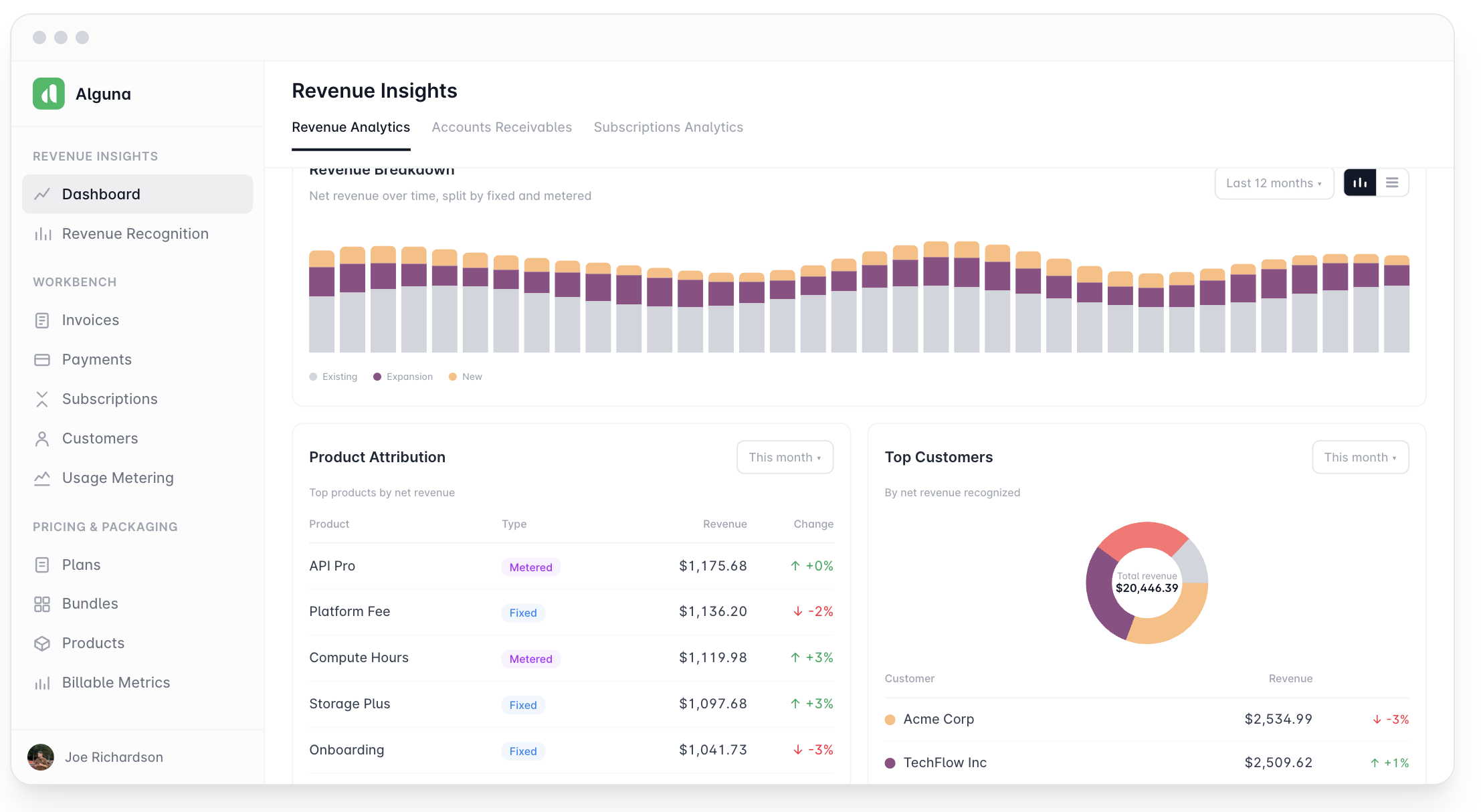
Alguna is an AI-native revenue management platform that manages your quote-to-cash flows end-to-end.
Unlike tools that bolt CPQ onto a billing engine (or vice versa), Alguna was built as a unified platform from the ground up, so a quote a sales rep sends actually matches what finance bills and how revenue gets recognized. That matters most for companies whose pricing doesn't fit neatly into a single seat-based or usage-based bucket.
Customers switching from spreadsheets or a patchwork of tools tend to notice the difference fast.
As Adam Liska, Co-founder and CEO of Airspeed, put it, "Alguna ticked every box I needed. Most importantly, it gave me a clear overview of revenue movements."
Read the case study to see how Alguna set Airspeed up to go from Seed to Series A.
Key features:
- Real-time usage metering paired with no-code billing rules, so finance teams can configure recurring, usage-based, and hybrid plans, overage charges, and grandfathering rules without opening a ticket with engineering
- No-code CPQ that lets sales build and send quotes, complete with e-signature and contract management, in minutes rather than days
- Invoicing that supports consolidated or split billing for customers on multiple plans
- Revenue recognition that connects directly to QuickBooks, Xero, and NetSuite so books stay accurate without manual reconciliation
- Native multi-entity billing, which matters for companies operating across regions or subsidiaries
- SOC 2 and GDPR compliant
Pros:
- No-code billing configuration means finance doesn't need to wait on developer time for every pricing change
- CPQ, billing, and revenue recognition run on one data model, so quotes and invoices stay in sync
- Customers report fast onboarding, going live in weeks rather than months
- A free starter tier and a 30-day trial make it realistic to test before committing
Cons:
- As a newer entrant, its pre-built integration catalog is smaller than legacy platforms like Zuora
Best for:
- AI, SaaS, and fintech companies running hybrid or usage-based pricing
- Teams that want CPQ and billing unified instead of stitched together with middleware
- Multi-entity businesses that need consolidated billing and revenue recognition out of the box
Pricing: Alguna's Starter tier is free, covering up to 10 monthly invoices with fixed and usage-based billing. The Growth tier starts at $699 per month. Enterprise Scale is custom-priced and includes multi-entity billing, ERP integrations, and automated revenue recognition.
2. Chargebee
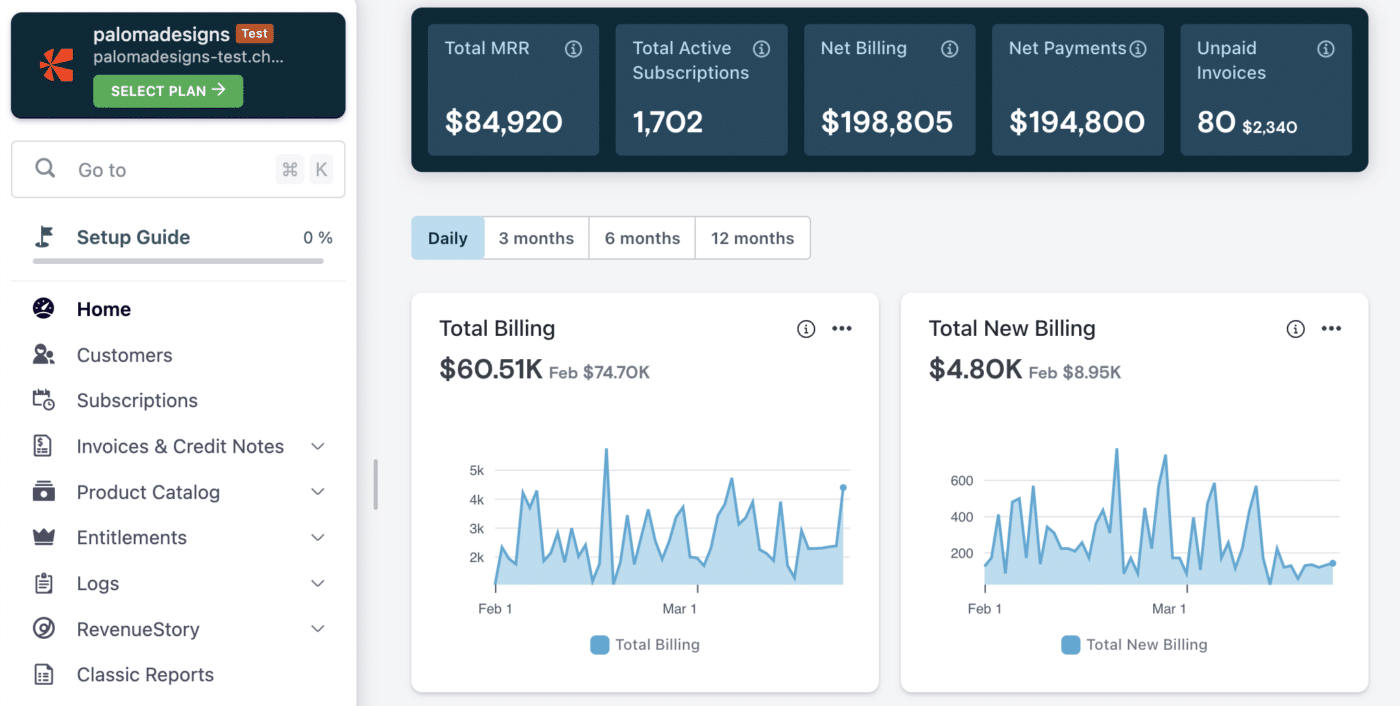
Chargebee is one of the most established names in subscription billing, and it's a reasonable first stop if you want a platform with a long track record and a wide integration ecosystem.
It splits its product into separate modules for billing, CPQ, revenue recognition, and growth experimentation, which gives you flexibility but also means the full quote-to-cash experience is assembled from several purchased pieces rather than one native flow.
Key features:
- Core billing that handles price books, invoicing, usage ingestion, and real-time usage limits, with pricing tables and basic experimentation tools included
- An Enterprise Plus tier with multi-entity management, account hierarchies up to 30 levels deep, and support for up to 500 million monthly usage events
- A separate CPQ Lite tier, free for the first 50 quotes
- RevRec, a paid add-on that handles point-in-time and ratable revenue recognition
Pros:
- Mature, widely adopted platform with a large partner and integration network
- Reviewers consistently cite an easy-to-use interface, even for non-technical teams
- Strong customer support response times, according to G2 reviews
Cons:
- Its revenue-share pricing model (0.65 to 0.8 percent of billing value) gets expensive as billing volume scales
- Invoice template and checkout customization is more limited than some competitors
- Some reviewers report inconsistent performance with specific integrations, including Salesforce and HubSpot
Best for:
- Mid-market SaaS companies that want an established vendor with proven scale
- Teams that prefer buying modular products (billing, CPQ, revenue recognition) separately as needs grow
Pricing: Chargebee's Flow plan starts free with a 0.8 percent fee on monthly billing value, or $99 per month plus 0.65 percent if you commit monthly. Enterprise Plus is custom-priced.
3. Maxio
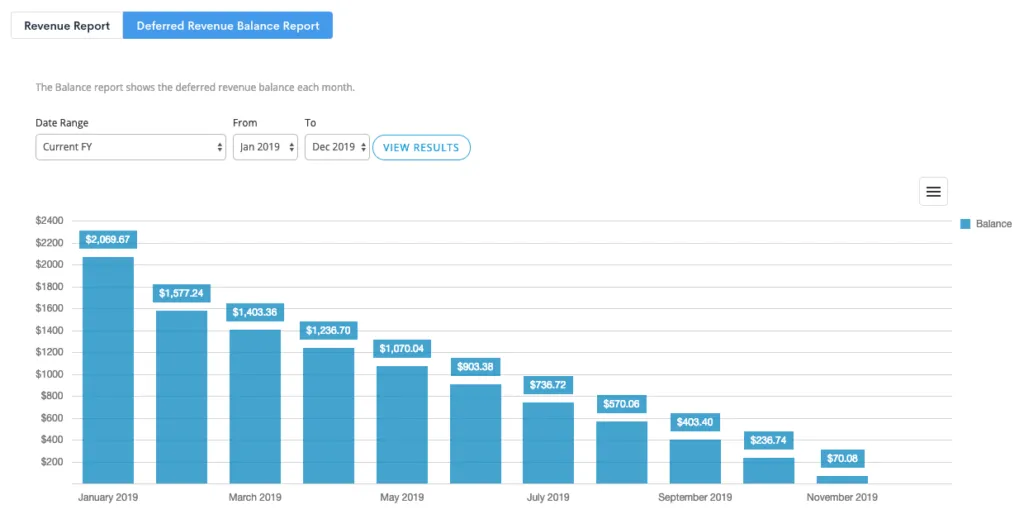
Maxio (formerly SaaSOptics and Chargify) is built specifically for B2B SaaS finance teams that need tight financial reporting alongside billing. It's a good fit if your CFO's office cares as much about accounts receivable visibility and revenue recognition accuracy as your product team cares about pricing flexibility.
Key features:
- Usage-based billing, subscription management, and recurring billing in one platform
- Finance-oriented tools like collections and dunning workflows, DSO reporting, and support for over 20 payment gateways
- Multi-entity support and consolidated invoicing for companies with more than one legal entity
- Accounting connections to QuickBooks, Xero, and NetSuite
Pros:
- Automated invoicing reduces manual finance work significantly, according to user reviews
- Strong integrations with CRM and general ledger systems
- Responsive customer support, with some reviewers citing 24-hour turnaround
Cons:
- Reporting customization is limited, and some teams rely on frequent manual exports
- A few users report syncing delays with QuickBooks Online and slower report loading
- Initial configuration takes real effort, and several reviewers describe onboarding as overwhelming at first
Best for:
- B2B SaaS companies with monthly billings under $100,000 looking for finance-first tooling
- Finance teams that prioritize accounts receivable and revenue recognition reporting
Pricing: Maxio's Grow plan is $599 per month for companies billing up to $100,000 monthly. The Scale plan, for companies above that threshold, is custom-priced.
4. Zuora
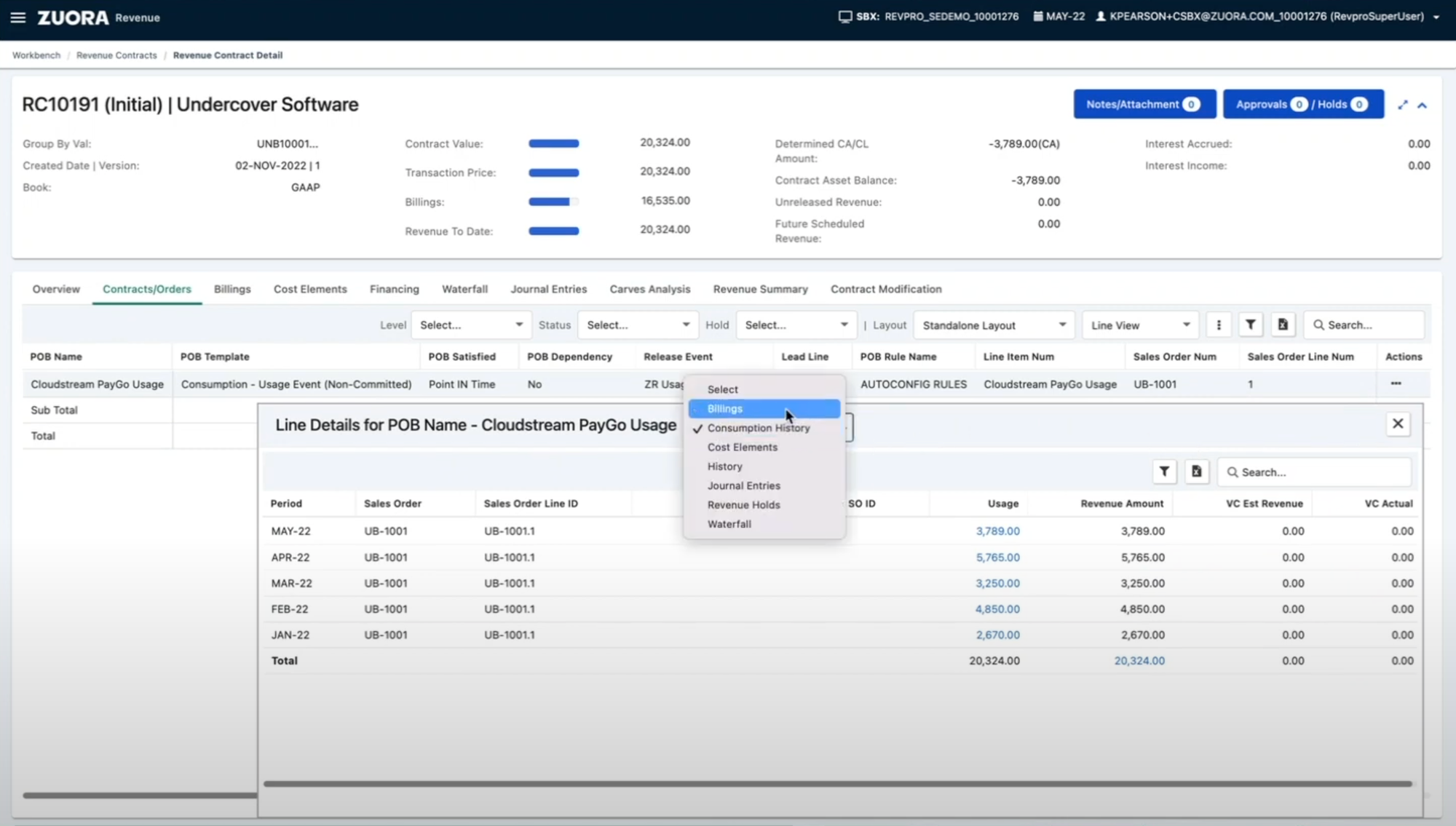
Zuora is the enterprise incumbent in this category, and it shows in both directions: it supports more than 50 pricing models and serves customers like Zoom, Box, and Dell, but it's also the platform most reviewers describe as complex to implement and maintain.
Key features:
- Catalog and pricing management that lets you define pricing once and deploy it across CPQ, e-commerce, self-service, and partner portals
- Support for flat-fee, tiered, usage-based, and multi-attribute pricing, plus feature-level entitlements
- Global price lists with multi-currency support
- More than 60 pre-built connectors, including Salesforce, NetSuite, and Snowflake
- Revenue recognition compliant with ASC 606 and IFRS 15, embedded in the catalog itself
Pros:
- Extremely broad pricing model support, suited to complex, multi-product enterprises
- Deep Salesforce integration, which reviewers highlight as a strength for sales-to-billing handoff
Cons:
- Reviewers consistently describe a steep learning curve and an interface that isn't intuitive for new users
- Implementation typically runs 30 to 90 days and requires dedicated billing or RevOps expertise to maintain
- Its enterprise focus means it's often more platform than smaller teams need
Best for:
- Large enterprises with multi-entity, multi-product monetization needs
- Organizations with a dedicated RevOps or billing operations team to manage the platform
Pricing: Zuora doesn't publish standard tiers, quoting custom pricing based on scale and complexity.
5. Stripe Billing
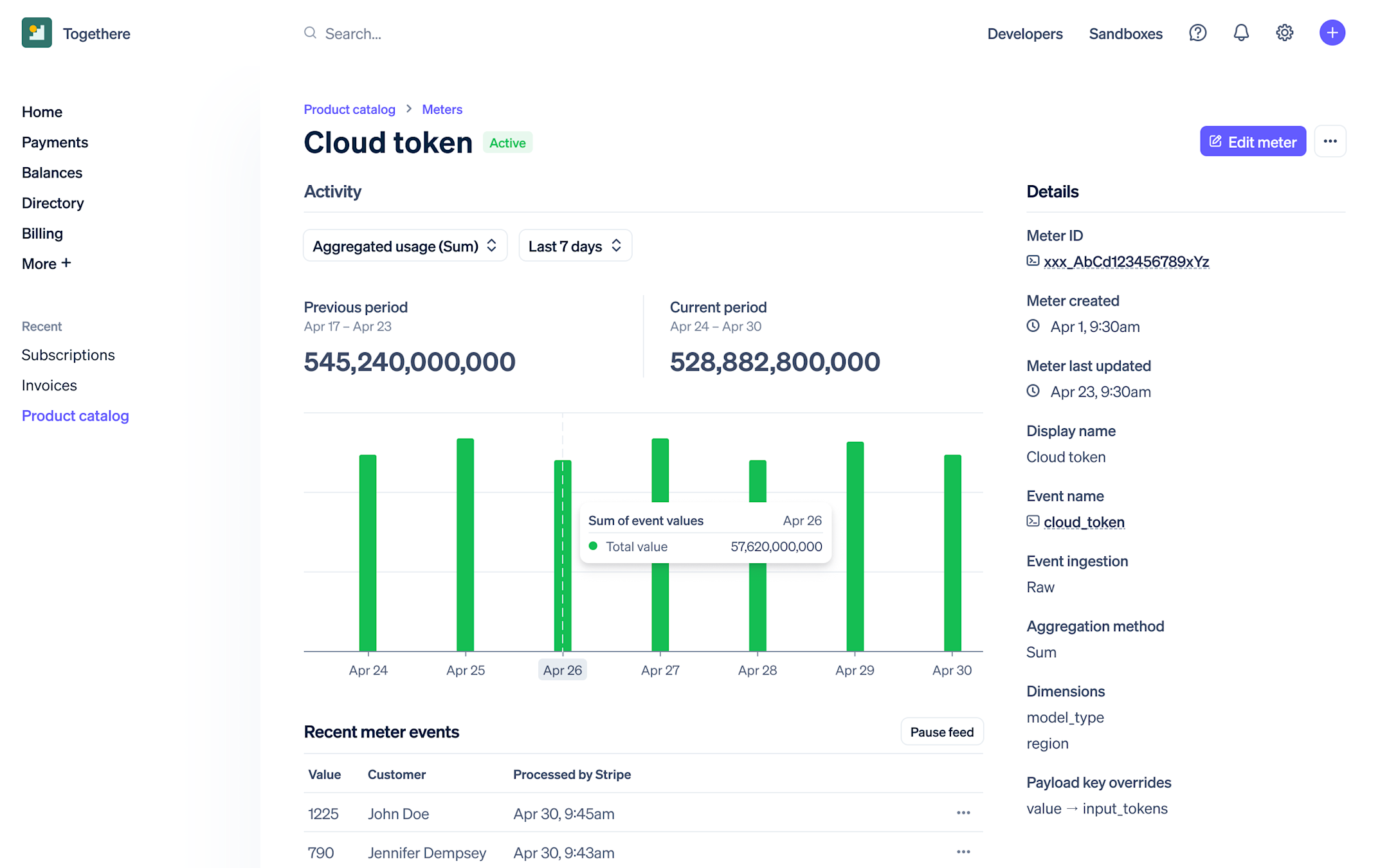
If your company is already processing payments through Stripe, Stripe Billing is the path of least resistance. It's not a dedicated automated billing platform in the way Zenskar or Alguna, but its documentation and developer experience are hard to beat, and it now integrates with Metronome (acquired by Stripe) for more advanced usage billing needs.
Key features:
- Subscription management through its dashboard, payment links, or a custom integration
- Smart retries that use machine learning to time failed payment recovery
- A customer portal and automatic dunning emails
- Invoice auto-reconciliation for ACH and wire payments
- Basic usage metering through its Meters API, covering up to 100 million events monthly before more advanced usage billing requires pairing with Metronome
Pros:
- Fast to implement for teams already using Stripe for payments
- Reviewers frequently praise the API and documentation quality, calling out significant saved engineering time
- Reliable, well-tested payment infrastructure at global scale
Cons:
- High fees, especially for international transactions, are a common complaint in reviews
- Some users report account restrictions or holds with limited human support to resolve them
- Invoice branding and customization are more limited than dedicated billing platforms
Best for:
- Developer-led teams already built on Stripe's payment infrastructure
- Early-stage companies that want to launch billing quickly without a dedicated billing team
Pricing: Stripe Billing charges 0.7 percent of billing volume on a pay-as-you-go basis, or starts at $620 per month on an annual plan covering up to $100,000 in monthly volume, with additional volume billed at 0.67 percent.
6. Orb (Acquired by Adyen)
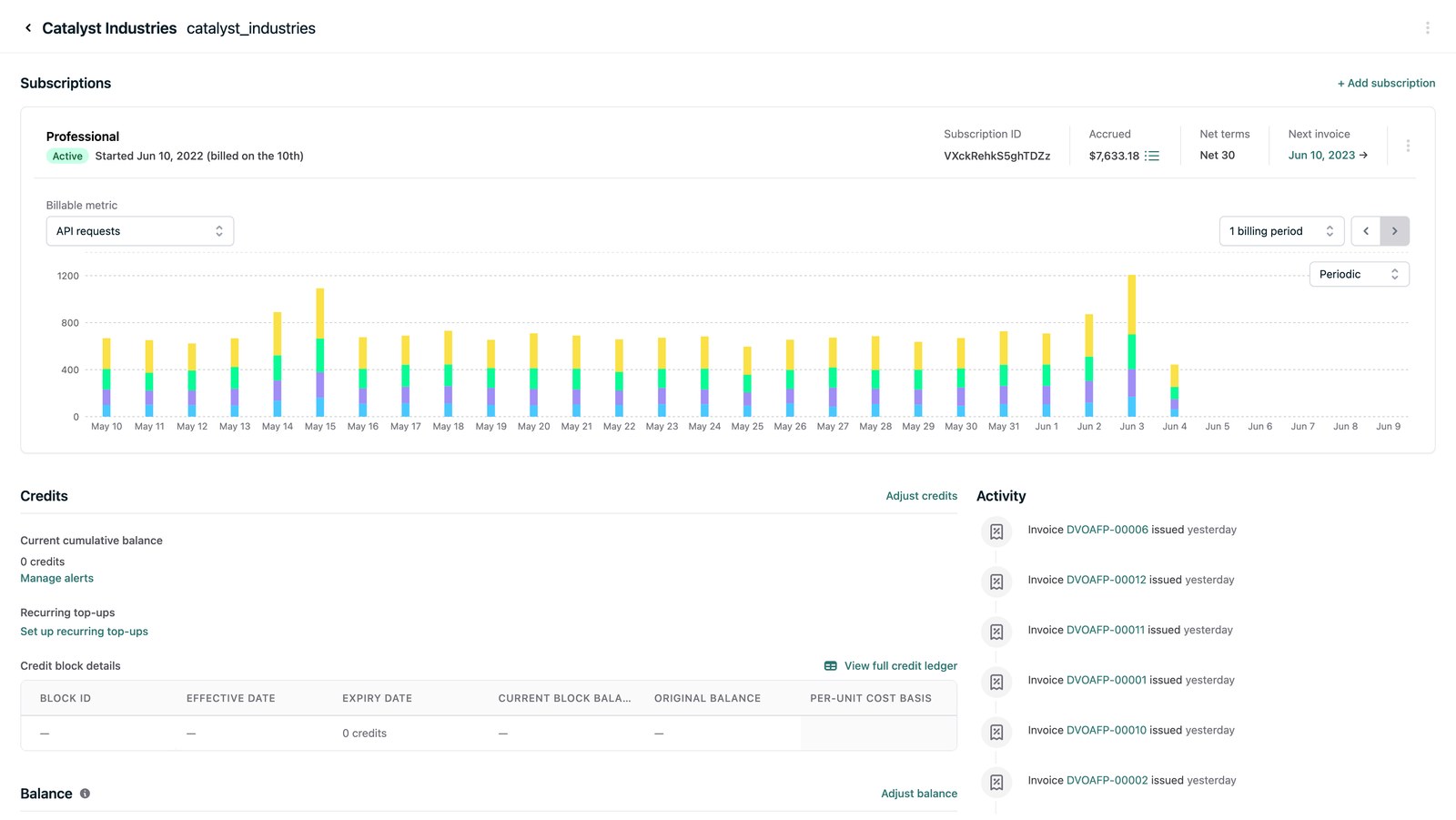
Orb is a newer entrant built specifically for companies where usage-based and hybrid billing is core to the business, not an afterthought. Customers like Vercel, Replit, and Supabase point to its focus on infrastructure and AI companies with high-volume, complex usage patterns.
Key features:
- Real-time event ingestion at high throughput
- Custom SQL metrics for defining exactly how usage translates into charges
- Hybrid billing combinations and automated price versioning for mid-contract changes
- Threshold-based alerting to catch billing anomalies before they become invoices
- Data warehouse exports to Snowflake and Redshift, plus Salesforce and NetSuite integrations, on higher tiers
Pros:
- Built to handle high-volume, complex usage-based pricing at scale
- Reviewers highlight fast, responsive support during implementation
- Flexible enough to model unusual or highly custom pricing logic via SQL
Cons:
- As a younger platform, some users note feature gaps compared to more established vendors
- Public review volume is still small, so it's worth requesting current customer references directly
Best for:
- High-growth infrastructure, developer tools, and AI companies with usage-heavy pricing
- Technical teams comfortable defining billing logic in SQL
Pricing: Orb's Core, Advanced, and Enterprise tiers are all custom-quoted, priced based on total billings issued and events ingested rather than flat fees.
7. Metronome (Acquired by Stripe)
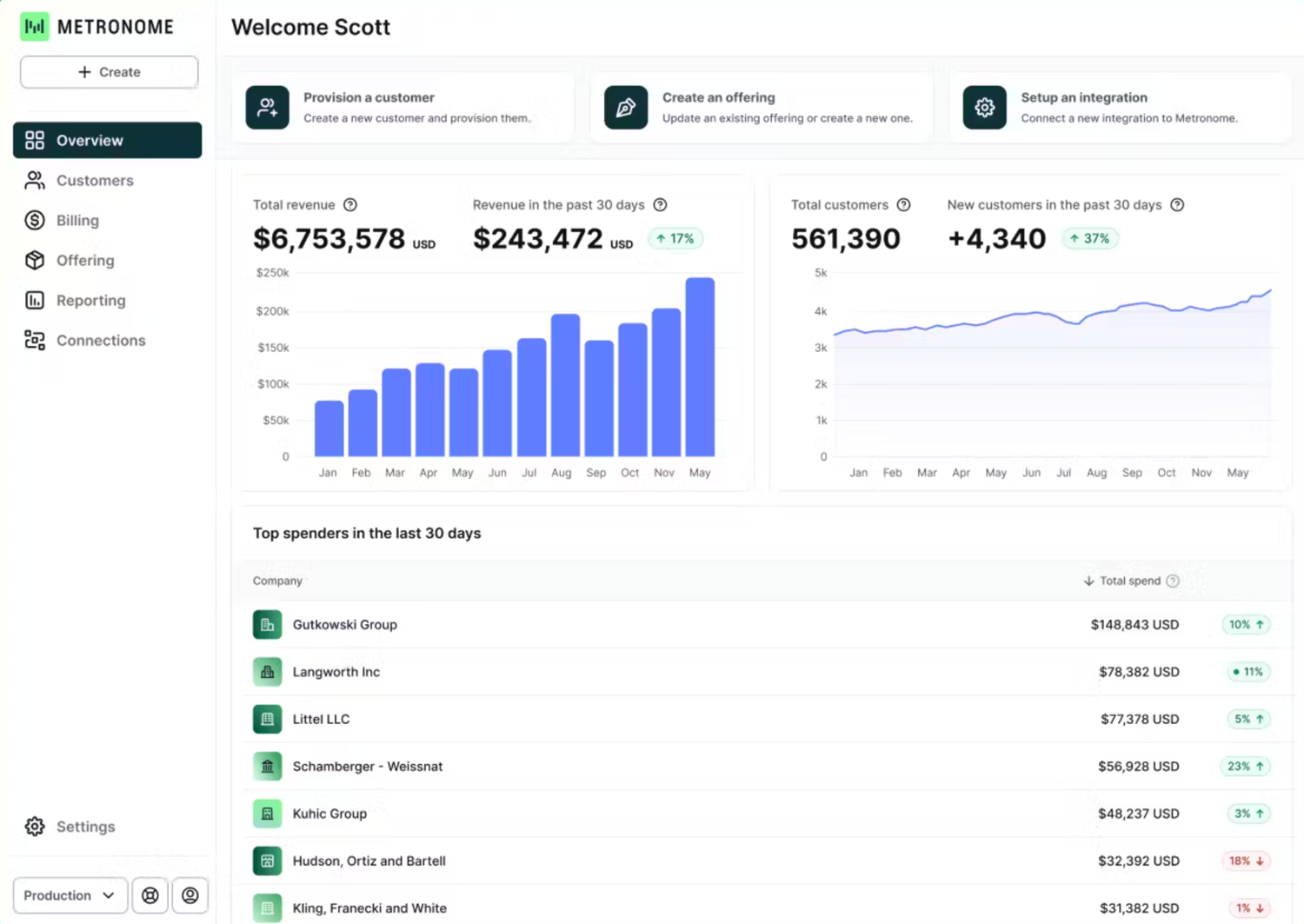
Metronome is another usage-based billing platform aimed at engineering-led teams, particularly those selling through cloud marketplaces. It gives developers granular, SQL-level control over how usage events become billable metrics, which is powerful if your team has the engineering bandwidth to own it.
Key features:
- Billing logic defined directly in SQL, including filtering test traffic and applying custom conditions without pre-aggregating data upstream
- Centralized rate cards that apply pricing updates across all customers from one place, with layered overrides for enterprise discounts
- Native integrations with AWS, Azure, and GCP marketplaces that reduce reconciliation work for companies selling through those channels
Pros:
- Deep flexibility for engineering teams that want precise control over usage metrics
- Strong native support for cloud marketplace billing and reconciliation
- Centralized rate cards simplify applying pricing changes across a large customer base
Cons:
- Pricing changes are tied to engineering workflows, so finance and product teams can't iterate independently
- Limited retroactive reprocessing makes correcting historical invoices harder
- Lacks request-level credit enforcement or feature gating, so a separate entitlements layer is often needed
Best for:
- Engineering-led teams with complex, multi-dimensional usage pricing
- Companies selling primarily through AWS, Azure, or GCP marketplaces
Pricing: Metronome's Starter plan charges 0.8 percent of billing volume plus $0.04 per 1,000 events ingested. Its Custom plan adds enterprise integrations, data warehouse exports, and a dedicated account manager, priced individually.
How to evaluate a billing platform switch
Choosing a new billing platform is a bigger decision than most software purchases, because billing touches sales, product, finance, and every customer relationship at once.
A few things are worth checking carefully before you commit:
- Map your actual pricing complexity first. If you run flat subscriptions today but plan to add usage-based or hybrid pricing, confirm the platform supports that natively rather than through a workaround.
- Ask who owns pricing changes. Some platforms, like Metronome, tie pricing updates to engineering work. Others, like Alguna, let finance and revenue teams configure changes without a developer ticket. Know which model fits your team.
- Check revenue recognition compliance up front. If you're audited or plan to raise capital, ASC 606 and IFRS 15 support shouldn't be an afterthought or a separate paid module.
- Understand the real cost at your scale. Percentage-of-revenue pricing, common with Chargebee, Stripe Billing, and Metronome, can look cheap early and get expensive fast as billing volume grows. Model your costs at two times and five times your current volume, not just today's numbers.
- Test the sales-to-cash handoff, not just billing. If you also need CPQ software, check whether quotes flow directly into invoices or require manual re-entry between systems.
Frequently asked questions
What is Zenskar used for?
Zenskar is a billing and revenue recognition platform built for usage-based and hybrid pricing. It captures usage data, generates invoices, and automates revenue recognition compliant with ASC 606 and IFRS 15.
Why do companies look for Zenskar alternatives?
Common reasons include wanting CPQ and billing in one system rather than separate tools, needing more transparent or predictable pricing, wanting a larger integration library, or needing more support at enterprise scale.
Which Zenskar alternative is best for AI companies?
Alguna, Orb, and Metronome are all built with usage-heavy, AI-native pricing models in mind. Alguna stands out if you also need CPQ and revenue recognition unified with billing rather than purchased separately.
Is Alguna cheaper than Zenskar?
Alguna publishes transparent pricing, starting with a free tier and a Growth plan that starts at $699 per month, while Zenskar quotes custom pricing across all three of its tiers. Because Zenskar doesn't publish rates, a direct comparison depends on your specific usage and support needs, so it's worth requesting quotes from both.
Can I switch billing platforms without disrupting existing invoices?
Yes, with the right migration plan. Most established vendors, including Alguna, run parallel billing cycles or a phased cutover so existing subscriptions, invoices, and payment methods migrate without gaps. Ask any vendor you're evaluating for their specific migration process before signing.
What should I prioritize when comparing usage-based billing software?
Beyond core metering and invoicing, prioritize how pricing changes get made (engineering-dependent or not), revenue recognition compliance, and how well the platform connects to your CRM and accounting stack. Our guide to usage-based billing software breaks this down in more detail.
The right platform handles things in the background
The best test of a billing platform isn't how it looks in a demo. It's whether your finance team stops thinking about it three months after go-live, because invoices go out correctly, revenue recognizes itself, and sales quotes match what actually gets billed.
Zenskar does that well for usage-heavy, engineering-supported teams. Alguna does it for companies that want CPQ, billing, and revenue recognition working as one system instead of three, with no-code configuration that doesn't route every pricing change through a developer queue.
As Juan Burgos, co-founder and CEO of Haven AI, put it: "Once I sign up a customer and we get them deployed, everything's on autopilot. I don't have to think about it anymore."
That's the outcome worth optimizing for, regardless of which platform you choose.