• Alguna if sales negotiates deals alongside self-serve, or finance needs quotes, approvals, invoicing and revenue recognition on the same record as usage and credits.
• Stripe Billing if you sell simple self-serve plans and Stripe's invoices are enough.
• Schematic if you are staying on Stripe and mainly want plans, entitlements and usage limits out of your code.
• Metronome if very high event volume is your hardest problem and you are committed to Stripe.
• Orb if you want SQL-defined metrics and your deals are mostly standard.
• Lago if self-hosting is a hard requirement and you want a mature open-source option.
• Flexprice if you want an open-core engine for usage and credit pricing, and have engineers to run it.
Autumn is a good way to get pricing live fast on top of Stripe.
But once you scale and your revenue workflows mature, billing has to cover contracts, invoices, metering, credits, and revenue reporting as well as feature access.
When that time comes, there's a bunch of Autumn billing alternatives that fit the, well, bill.
The short answer: if you sell self-serve plans only and Stripe already does everything else for you, Autumn may be all you need.
If sales also negotiates deals, finance needs invoices it can approve and revenue it can recognise, or your usage volume is climbing fast, look at a platform that owns the whole path from quote to cash.
That is the gap Alguna was built for, and this guide compares it with the other common alternatives.
What Autumn billing is, in plain words
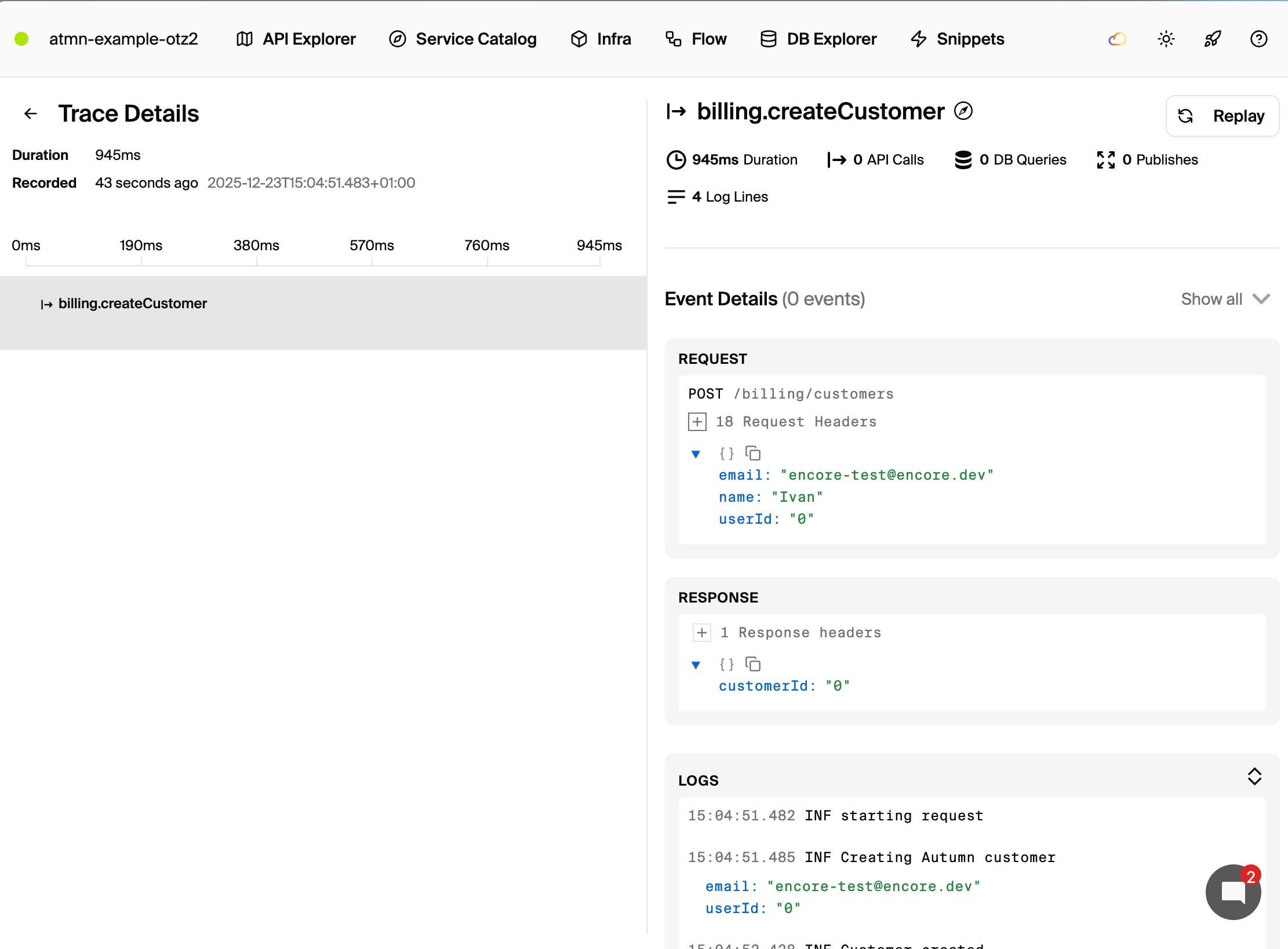
Autumn is an open-source billing layer that sits between your app and Stripe.
Your product asks Autumn two questions: is this customer allowed to do this? and what did they just use? Autumn keeps track of plans, entitlements and usage, and Stripe still charges the card and sends the invoice.
For a small product team that is a real win. You skip writing your own entitlement tables, usage counters and Stripe webhook handlers.
Why teams start looking for an alternative
Autumn is young, so the public record is still small: a handful of Product Hunt reviews, a Show HN launch thread and a few comparison write-ups.
But the good bews is this, they tell a consistent story.
What reviewers like
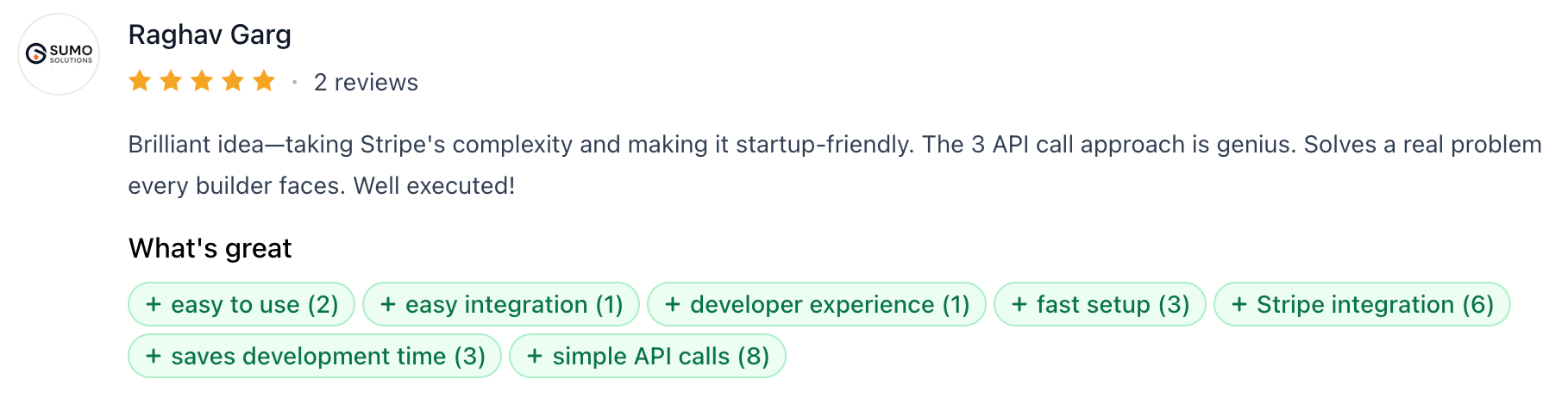
Reviewers on Product Hunt mostly praise speed. Teams describe going live with usage tracking and credit-based pricing in days, without writing their own Stripe webhook handling.
The founders frame it the same way in the Show HN launch: a layer that saves you from building usage limits, grandfathering and webhooks yourself, not a replacement for Stripe.
Where reviewers see limits
- Questions about high volume. The same discussion asked whether the platform could keep up with thousands of billing events per minute for high-traffic apps (BigGo).
- Built for self-serve plans. Comparison guides describe Autumn as optimised for self-serve, plan-driven billing and less suited to sales-led or enterprise deals.
- Payment recovery is a separate job. Easier charging means more charges that can fail, and recovering them sits outside Autumn (Subrevival).
- Stripe is the only processor. Commenters on the launch questioned the dependence on Stripe as the sole payment provider. That matters if you want a second processor or sell where Stripe is limited.
Note: Some of these comments date from mid-2025, and Autumn has shipped since, so check its current docs. Read vendor comparisons, this one included, with the same care.
The gaps that send teams shopping
Those comments match the usual reasons a plan-and-feature billing layer stops being enough:
- Sales starts closing custom deals. A negotiated discount, a ramp, a minimum commit or a mid-term amendment has to live somewhere. In an app-plus-Stripe setup, that somewhere is often a spreadsheet.
- Finance needs more than card receipts. Approval before an invoice goes out, credit notes, net-30 terms, dunning, tax and an accounting sync all sit with Stripe or with you.
- Revenue has to be recognised. Auditors want a revenue schedule per contract, not a payments export.
- Usage grows by orders of magnitude. Metering that was fine at launch has to keep up with far higher volumes, without rating errors on the invoice.
- Pricing gets more complicated. Prepaid credits that burn down across products, customer-specific rate cards and price changes that apply on a future date are hard to bolt onto a plan-and-feature model.
The rest of this guide covers what to look for, how the main alternatives compare, and a deeper look at what developers get from each.
What to look for in an Autumn alternative
Judge every option on two lists. The first is what finance, RevOps and founders feel day to day. The second is what your engineers will live with for years.
For finance, RevOps and founders
- One record per customer. The quote, the contract, the subscription and the invoice should be the same deal, not four copies kept in sync by hand.
- Sales-led and self-serve in one system. A customer who starts on a card plan and later signs an enterprise contract should not move between billing tools.
- Invoices you control. Approval before sending, credit notes, payment terms, multiple currencies and your own branding.
- Collections that run without you. Reminders, retries and escalation, so overdue invoices do not depend on someone remembering to chase.
- Revenue recognition. Deferred and recognised revenue per contract, in line with ASC 606 and IFRS 15.
- Your existing stack stays. CRM (HubSpot, Salesforce), accounting (QuickBooks, Xero, NetSuite), tax and your payment processor.
- Safe pricing changes. A new price or a mid-term upgrade you can preview before it touches a live invoice.
For developers
- Usage ingestion that scales. Batch endpoints, idempotency keys, backfills, and a way to pull usage from your warehouse instead of building a pipeline.
- Flexible metrics. Filters and aggregations (count, sum, max, unique count) defined as configuration, not code.
- Credits with a real-time gate. Check a balance and reserve credit before an expensive job runs, then settle what was actually used.
- Pricing models beyond flat and per-unit. Graduated tiers, prepaid commits with overage, percentages, matrix pricing by event properties, formulas.
- Rate cards. One shared price list that many plans and contracts point at, with dated changes and full history.
- Entitlements your app can read. Feature flags, quotas and credit allocations that come from the contract, so there is no second source of truth.
- A typed, versioned API. SDKs in your languages, webhooks, a sandbox, and an API that will not break when the vendor ships.
- AI-ready access. An MCP server so assistants and agents can read and act on billing under the same permissions as your team.
Autumn billing alternatives: Overview
Alguna is built to cover quoting, metering, credits, invoicing, collections and revenue recognition on one record per customer.
Most of the others are strongest at one or two of those stages.
| Platform | Best fit | Usage metering | Credits and prepaid | Open source |
|---|---|---|---|---|
| Alguna | B2B companies running self-serve and sales-led motions together | Events API (batches of 100, idempotent), CSV, nightly pulls from BigQuery or ClickHouse; metrics with filters and six aggregations | Unit and monetary credit grants, wallets, real-time check, reserve and settle | No |
| Stripe Billing | Teams already on Stripe Payments with simple pricing | Meters API for basic usage; Stripe points new advanced usage integrations to Metronome | Billing credits | No |
| Metronome | High-volume usage businesses, often AI infrastructure | Built for very high event volumes | Prepaid commits and credits | No |
| Orb | Usage-heavy SaaS and API companies that want SQL control | Ingestion via API or S3; custom SQL metrics | Prepaid credits with a ledger | No |
| Lago | Teams that want to self-host metering and billing | Real-time and batch ingestion, custom aggregations, idempotency by transaction_id |
Wallets, credit grants, top-ups | Yes, AGPLv3 |
| Flexprice | AI and SaaS teams that want an open-core engine for usage and credit pricing | Real-time metering from your app, or streamed from a warehouse or analytics pipeline | Prepaid and promotional credit grants, wallets, automatic top-ups, expiry | Open core: AGPLv3, with commercial enterprise features |
| Schematic | Product-led teams on Stripe that want plans, entitlements and limits out of the codebase | track events with quantities and idempotency keys; usage synced to Stripe |
Credit burndown, with balances returned on flag checks | No |
Vendor capabilities change often. The summaries above reflect each company's public materials as of November 2026, so check current docs before you decide.
Alguna: One revenue record for RevOps, all the infrastructure for developers
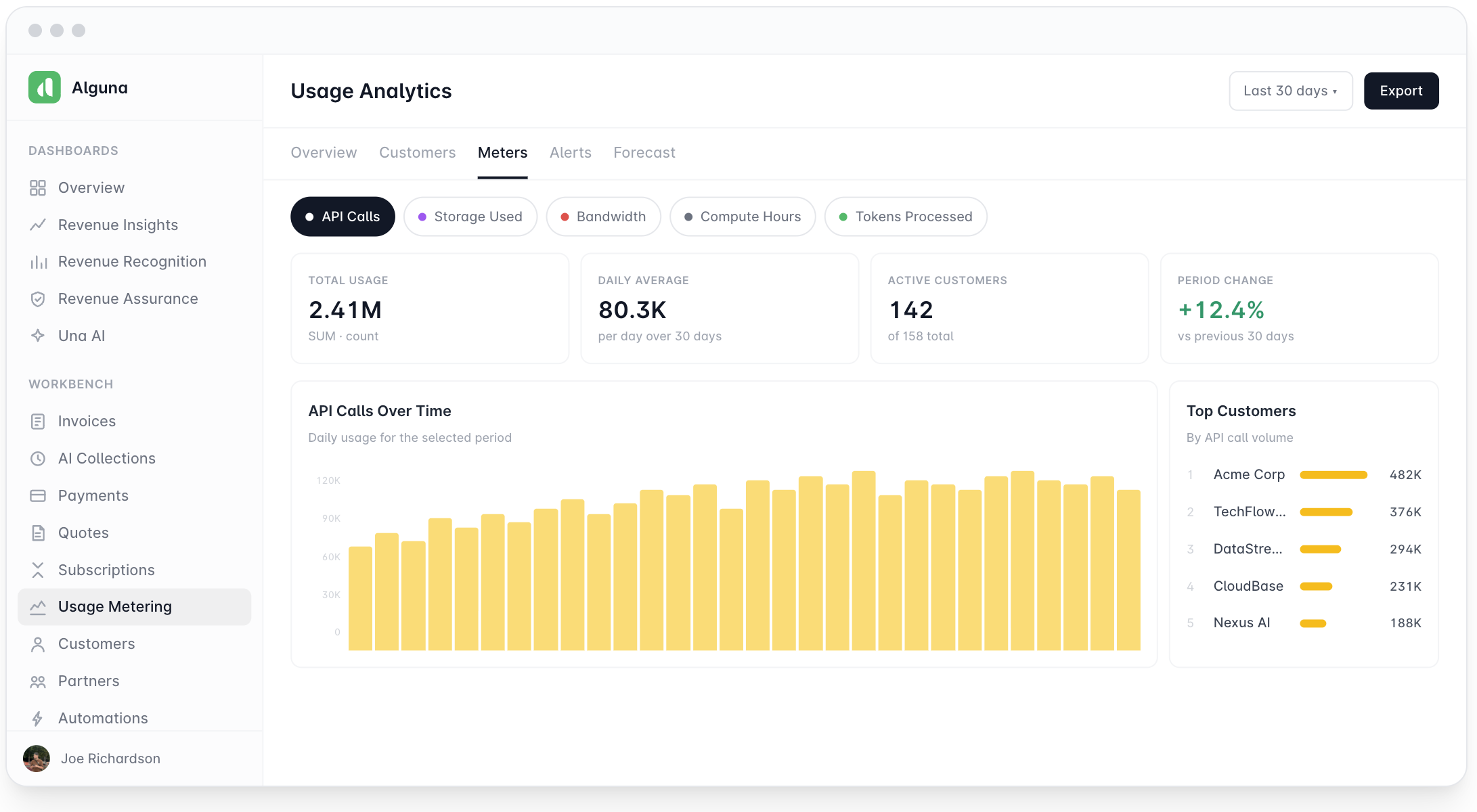
Alguna is an AI-native quote-to-revenue platform for fintech, SaaS, and AI-native companies. Where Autumn answers "can this customer use this feature?", Alguna answers that and everything after it: what the customer agreed to, what they owe, whether they paid, and what you can recognise as revenue.
Everything reads from one record per customer, the versioned agreement. Think of it as the living contract: every amendment, usage event, entitlement, invoice and payment hangs off it. An activated quote becomes the billing schedule, so nobody retypes a deal from a PDF into a billing tool.
Alguna is not a payment processor. It decides what a customer owes and when, and a processor such as Stripe moves the money. You keep your CRM, your accounting system and your processor.
What changes for finance and RevOps
- Quotes that turn into subscriptions. Reps build an order form with negotiated prices, terms and discounts. It routes for approval based on discount size, products or modified terms, then the customer signs it electronically. The signed quote is the subscription.
- Safe mid-term changes. Every upgrade, amendment or correction is a new version of the subscription, drafted and previewed (including proration) before it is published. The old version stays as history.
- Invoices with a sign-off step. Invoices move through draft, approval and scheduled states before they are issued, so a person can check a large or unusual invoice first. Credit notes and refunds correct an invoice without rewriting history.
- Collections that keep going. Event-driven dunning retries failed payments and sends reminders. Agentic Collections works each unpaid invoice as a case: it chases, reads replies, tracks promises to pay and escalates to a person when needed.
- Revenue recognition built in. The subscription that produced the invoice also produces the revenue schedule, in line with ASC 606 and IFRS 15. No export to a separate rev rec tool.
- Revenue assurance. Alguna finds metered usage that should have been billed but was not, and puts a number on it.
- Self-serve without a second system. Hosted and embedded checkout create the customer, subscription and invoice. A hosted customer portal lets customers see their plan, pay invoices and update payment methods.
- Your stack stays. HubSpot and Salesforce for CRM; QuickBooks, Xero and NetSuite for accounting; Stripe Tax and Anrok for sales tax; Stripe and ACH for payments. Customers bill in their own currency.
Agents with guardrails
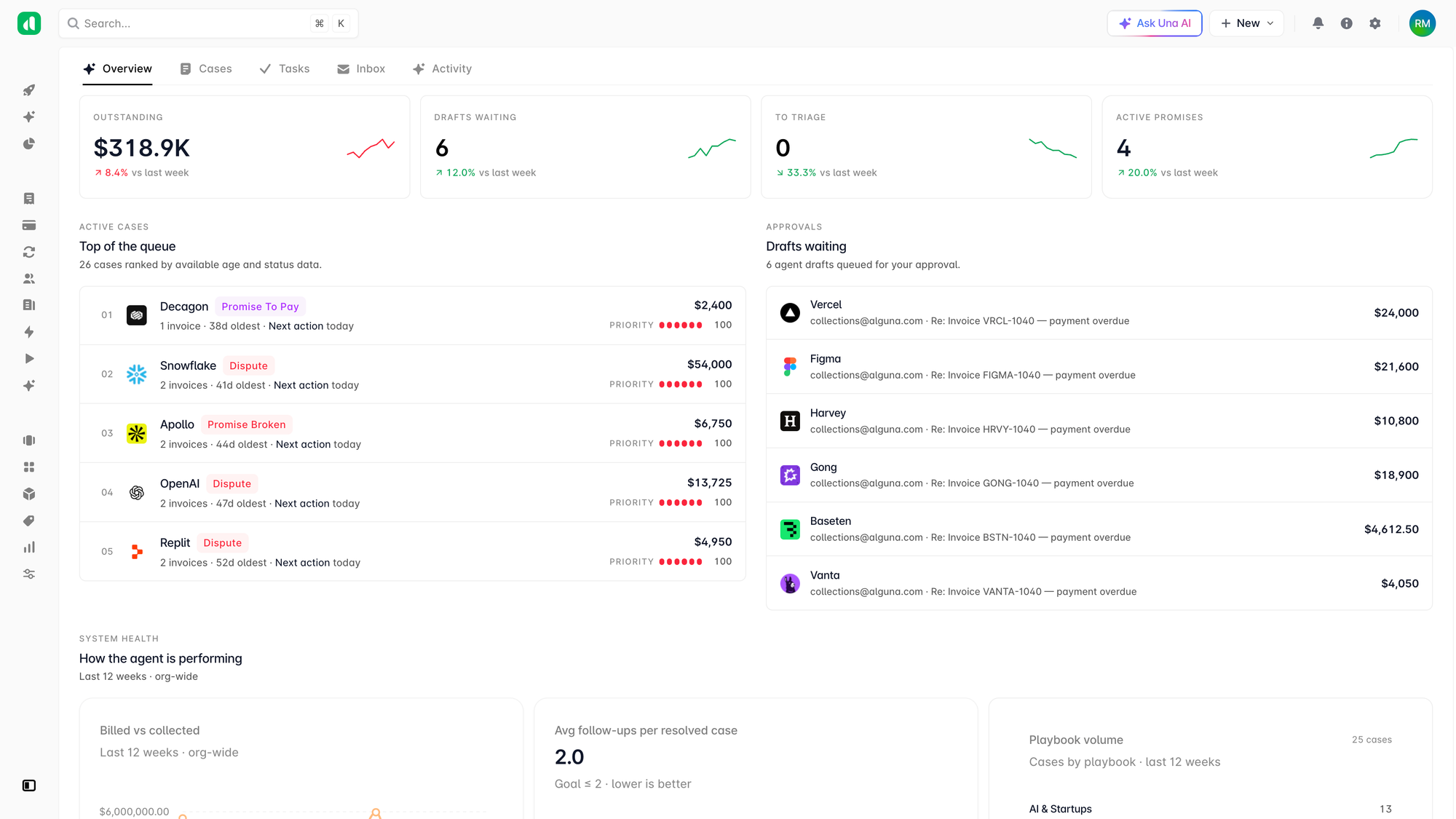
Alguna's agents work on the same customer record under authority you set: collections, invoice checks, revenue assurance, renewals, deal desk, billing support, and Una, an assistant you can ask revenue questions. Agents start in draft mode. Quotes, credit notes, CRM updates and signature requests stay subject to approval, and every action is recorded in an audit history.
The work that disappears: re-keying deals from the CRM, reconciling the contract against the invoice, chasing overdue accounts by hand, and building revenue schedules in a spreadsheet at month end.
For developers: Usage metering and scale
In Autumn, you call track when something billable happens and Autumn decrements a balance. In Alguna, you send raw events and decide in configuration how they become billable quantities. That split is what lets pricing change without a deploy.
Send events your way
POST /events takes an array of up to 100 events per request. Each event carries a unique_id idempotency key, so retries never double-bill.
await alguna.events.ingest({
  events: [
    {
      unique_id: crypto.randomUUID(),
      event_name: "llm_tokens",
      account: "customer_123", // your own ID, mapped as an alias
      timestamp: new Date().toISOString(),
      properties: { model: "orion-pro", region: "eu", tokens: 1840 },
    },
  ],
});
What you get out of the box:
- Partial-failure responses. The response lists the
unique_idof every event that was ingested and every one that failed, so you retry only what failed. - Your own customer IDs. Add aliases to a customer (your user ID, a Stripe ID, a Salesforce ID) and send whichever one you have.
- Backfills. Timestamps decide the billing period, so you can load historical usage in batches when you migrate.
- No pipeline to build. If usage already lands in your warehouse, Alguna can pull it nightly from a BigQuery table or a ClickHouse table or view, incrementally. A CSV upload covers one-off loads.
- Rich properties. Up to 50 flat properties per event for filtering, grouping and pricing.
Metrics as configuration, not code
A billable metric turns an event stream into one number per customer per billing period.
You choose the event name, optional property filters, and one of six aggregations: count, count_unique, sum, average, min or max.
Filters support equality, contains, list membership and numeric comparisons, combined in AND/OR groups. "Sum of tokens where region is EU and model is in (orion-pro, orion-max)" is a metric definition, not a code change. Metrics can be created in the dashboard, through the API or by an AI assistant through the MCP server.
Built for volume
Usage events are stored in ClickHouse, a columnar database designed for aggregating very large event streams quickly.
That is the same class of engine high-volume analytics teams use, and it keeps invoice-time aggregation fast as your event volume grows.
Two safeguards matter at scale:
- Usage without a rate holds the invoice. On a rate card price, an event that matches no rate shows on the draft invoice, and the invoice waits until someone prices that usage or accepts it.
- Revenue assurance looks for metered usage that should have been billed but was not, so leakage shows up as a number rather than a surprise in an audit.
Pricing models that match how you meter
Every price has one of eleven types: fixed, unit, tiered, graduated tiered, two prepaid tiered variants (a committed quantity up front, overage by tiers), three percentage models for payments and fintech, expression (a formula across one or more metrics) and matrix (a rate per combination of event properties, such as model × region).
Prices also carry minimum and maximum spend, discounts and trials, so you are not writing those guardrails yourself.
For developers: Credits, rate cards, entitlements and the API
If you chose Autumn for its check and track calls, the good news is that Alguna has the same shape of API for credits, with reservations, a ledger and contract-driven pricing behind it.
Credits with a real-time gate
Alguna has two prepaid balances.
A credit grant is capacity you give a customer, in money or in metric units: a plan's monthly allowance, a purchased pack, a service credit.
A wallet is money the customer deposited, used to pay invoices in its currency.
For expensive work, such as an agent run, an inference batch or a long job, the gate is a two-step flow:
- Check and reserve.
POST /credits/checkwith the events the work will produce. Alguna prices them, holds the credit and returns areservation_id. Leave outreserveto get a free price quote with no hold. - Do the work. The hold lasts 15 minutes by default and up to 4 hours.
- Settle.
POST /credits/trackwith the events that actually happened. Alguna charges for those and releases the rest.
curl -X POST https://api.alguna.io/credits/check \
  -H "Authorization: Bearer $ALGUNA_API_KEY" \
  -H "Alguna-Version: 2026-04-01" \
  -H "Idempotency-Key: run_88f_reserve" \
  -H "Content-Type: application/json" \
  -d '{
    "account": "cust_abc123",
    "reserve": {},
    "events": [{ "event_name": "agent_step", "unique_id": "run_88f_step1", "properties": { "tokens": 1200 } }]
  }'
Neither call takes a credit amount. You describe the work and the server prices it, so pricing logic never leaks into your client code. Running out of credit is not an error: the response says allowed: false and whether to hard-stop or fall through to metered billing.
Around the gate:
- Recurring allowances with rollover. A plan can grant credits monthly, quarterly, semi-annually or yearly, with optional rollover capped at a number of periods.
- A predictable draw order. When several grants could pay, Alguna draws by priority, then expiring credit first, then oldest.
- A full ledger. Every grant, draw, rollover and expiry is a ledger entry per customer and per subscription.
- Events for your product. Webhooks fire when credits are granted and when a balance hits zero, and the same trigger can send an email or a Slack message without code.
Rate cards
A rate card is one price list that many prices share. Each price points at an entry on the card, and the card decides the rate. Publish new rates once and every plan and contract on the card bills them from the date you choose. Rate cards are available on request.
They are built for price lists that change often, such as per-model token rates by region:
- Matrix rates. A usage entry declares dimensions, such as
modelandregion. Each combination gets its own pricing model: a unit rate, graduated tiers or a percentage. - Dated, immutable phases. A rate change is a new phase with an effective date. Published phases never change, so you have the exact history of what every invoice billed.
- Fed from your system. A source keeps a card in sync with a price list another system owns: fetched from a URL, pushed from your pricing service, or uploaded.
- Followers and pins. A Premium card can follow Standard at +10%, and moves when Standard does. A pin holds one cell at a negotiated rate while the rest of the card follows the feed.
- Concurrency safety. Publishes carry an expected revision, so two people cannot overwrite each other's rates.
Entitlements from the contract
Entitlements tell your app what a customer can do: boolean feature flags, number quotas such as seats, string tiers, and credit_allocation balances.
They live on the plan and the subscription version, so the access your app enforces always matches what sales sold. When the subscription changes, the entitlements change with it.
API, SDKs, webhooks and MCP
- Date-versioned REST API. Every request carries an
Alguna-Versionheader, so new releases do not break your integration. - Official SDKs for TypeScript, Python, Go and Rust, plus the
algunaCLI, all generated from the same OpenAPI spec. - Webhooks for subscription, invoice and credit events.
- A sandbox environment separate from production.
- Embedded checkout as an npm package: mint a session on your server and mount the component in your app.
- An MCP server so Claude, Cursor, ChatGPT or any MCP client can read and manage billing under the same permissions as your team.
Other Autumn billing alternatives
Each of these is a reasonable choice for a specific kind of company. The question is which stages of quote-to-cash it leaves for you to build or buy separately.
Stripe Billing
The natural next step if you are on Stripe and want to remove a layer. Subscriptions, invoices and payments live in one place, and pricing is a percentage of billing volume.
- Choose it if your pricing is mostly plans and seats, and you sell self-serve.
- Watch out for negotiated contracts, multi-processor setups and a fee that grows with revenue. For advanced usage billing, Stripe now points new integrations to Metronome.
Metronome (Acquired by Stripe)
A usage-based billing platform built for very high event volumes, with contracts, prepaid commits and credits. Stripe agreed to acquire Metronome in December 2025 and completed the deal in January 2026.
- Choose it if metering at very large scale is your hardest problem and you are committed to Stripe.
- Watch out for what sits around billing: quoting, approvals and revenue recognition come from other tools, and the product's direction now follows Stripe's plans.
Orb (Acquired by Adyen)
Usage-based billing aimed at technical teams. Metrics can be written in SQL, and you can simulate a pricing change against historical usage before you ship it.
- Choose it if you want SQL-level control over metrics and your deals are mostly standard.
- Watch out for sales-led motions: there is no native CPQ, so quotes and approvals live elsewhere. Pricing is not published.
Lago
Open-source metering and billing under the AGPLv3 licence, with a hosted cloud option. It covers event ingestion, wallets and credit grants, invoices and multiple payment providers.
- Choose it if self-hosting is a hard requirement, or you want to read and change the source.
- Watch out for the cost of running billing infrastructure yourself, the obligations AGPLv3 places on modified versions, and the lack of a quoting workflow.
Flexprice
Open-core monetisation infrastructure for AI and SaaS teams, written in Go. The core (metering, credits, pricing and billing) is under AGPLv3, and a small enterprise edition needs a commercial licence.
It covers real-time usage metering, prepaid and promotional credits with automatic top-ups and expiry, feature entitlements, per-customer plan overrides with plan versioning, and invoicing. It can run on its own or on top of Stripe or Chargebee.
- Choose it if you want an open-source engine for usage and credit pricing, and have engineers to run and extend it.
- Watch out for what self-hosting involves: PostgreSQL, Kafka, ClickHouse and Temporal to operate. Note the AGPLv3 terms too, and that quoting, CRM and accounting are integrations rather than built in.
Schematic
A monetisation layer on top of Stripe Billing, closest to Autumn in shape. Schematic manages plans, entitlements and usage limits, and Stripe keeps payments and invoicing.
Your app sends identify and track events (with quantities, such as tokens, and idempotency keys) and checks feature flags that return the customer's usage, allocation and credit balance. SDKs for TypeScript, Python and Go cache flag checks locally, and React and Vue components cover pricing, checkout and a customer portal.
- Choose it if your product team wants plans, limits and credit burndown managed outside the codebase, and Stripe already handles everything financial.
- Watch out for its dependence on Stripe Billing: invoicing, dunning and tax stay with Stripe, and there is no quoting workflow or revenue recognition. Third-party reviews describe it as focused on entitlements and feature access rather than end-to-end billing operations.
How to choose, and how to migrate off Autumn
Pick the tool that covers the stages you will need in 18 months, not only the ones that hurt today. Billing migrations are expensive, so the second move should be the last.
Your situation | Strongest fit |
|---|---|
Self-serve only, simple plans, happy with Stripe invoices | Stripe Billing |
Sales-led deals alongside self-serve, finance needs approvals and rev rec | Alguna |
Usage-based or credit-based pricing that sales also negotiates | Alguna |
Very high event volume, all-in on Stripe, quoting handled elsewhere | Metronome |
SQL-defined metrics with mostly standard deals | Orb |
Self-hosting is non-negotiable | Lago or Flexprice |
Open-source usage and credit engine, with engineers to run it | Flexprice |
Mapping Autumn concepts to Alguna
Most Autumn setups translate one to one. The main difference is that pricing moves out of your code and into configuration.
In Autumn | In Alguna |
|---|---|
Product or plan | Plan: priced items plus entitlements and contract terms |
Boolean feature |
|
Non-consumable feature (seats, storage) |
|
Consumable feature (API calls, tokens) | Billable metric plus a metered price |
Credit system |
|
| Hosted or embedded checkout session, or a subscription created through the API |
| Read entitlements, or |
|
|
A low-risk migration path
- Import customers from Stripe. Because Autumn runs on Stripe, Alguna can bring in your customers, saved payment methods and subscriptions from the Stripe connection. Add your app's user IDs as aliases so existing event code keeps working.
- Recreate plans and metrics using the mapping above. Alguna's onboarding team audits your current pricing and flags gaps before anything goes live.
- Send usage to both systems for one billing cycle. Keep calling Autumn's
trackand addPOST /eventsalongside it. Compare the totals. - Run a test billing cycle in the sandbox. Check invoice totals, line items, tax, discounts and proration.
- Switch gating. Replace
checkcalls with entitlement reads or/credits/check. - Cut over at a period boundary, then connect your CRM and accounting system so contracts and invoices sync from day one.
FAQ
Is Alguna open source?
No. Alguna is a hosted platform with a separate sandbox environment. If self-hosting is a hard requirement, look at Lago or Flexprice.
Do I have to leave Stripe?
No. Alguna decides what a customer owes and when, and Stripe can keep moving the money. ACH is supported too.
Can Alguna gate features in real time, the way Autumn's check does? Yes. Your app reads entitlements for feature flags and quotas, and calls POST /credits/check to price and reserve credit before expensive work runs.
How does Alguna handle high usage volumes?
Events arrive in idempotent batches of up to 100 per request, or are pulled nightly from BigQuery or ClickHouse. They are stored in ClickHouse and aggregated at invoice time against the metric you defined.
Does it fit AI pricing, such as per-model token rates?
Yes. Matrix pricing rates each model and region combination, rate cards keep a shared token price list current with dated changes, and credits let customers prepay and draw down.
What about sales tax?
Alguna calculates tax through Stripe Tax or Anrok, based on the customer's address, tax IDs and what you sell.
Can my engineers keep pricing in our own system?
Yes, for rate cards: a source can fetch your price list from a URL or accept a push from your pricing service, and publish changes as dated phases.