Enterprise billing evaluations often comes down to two names, and more often than not those two names are Aria Systems vs Zuora.
These two giants tend to show up on the same shortlists, pitch against each other in the same deals, and from a distance they (kind of) look like they do the same thing.
Both bill large enterprises. Both handle subscriptions and usage. Both quote custom and take months (sometimes years) to implement.
Look closer and they're solving different problems.
Aria came out of telecom-grade rating and charging. Zuora came out of subscription management and the commercial layer around it. That difference in origin still shapes almost everything about how each platform behaves, what it's good at, and where it makes your finance team miserable.
In this guide, we'll define what each platform is, compare Aria Systems vs Zuora across the six dimensions that actually decide the deal, look at what public reviews say about both, and make the case for a modern alternative, Alguna.
Let's dive in.
What is Aria Systems?
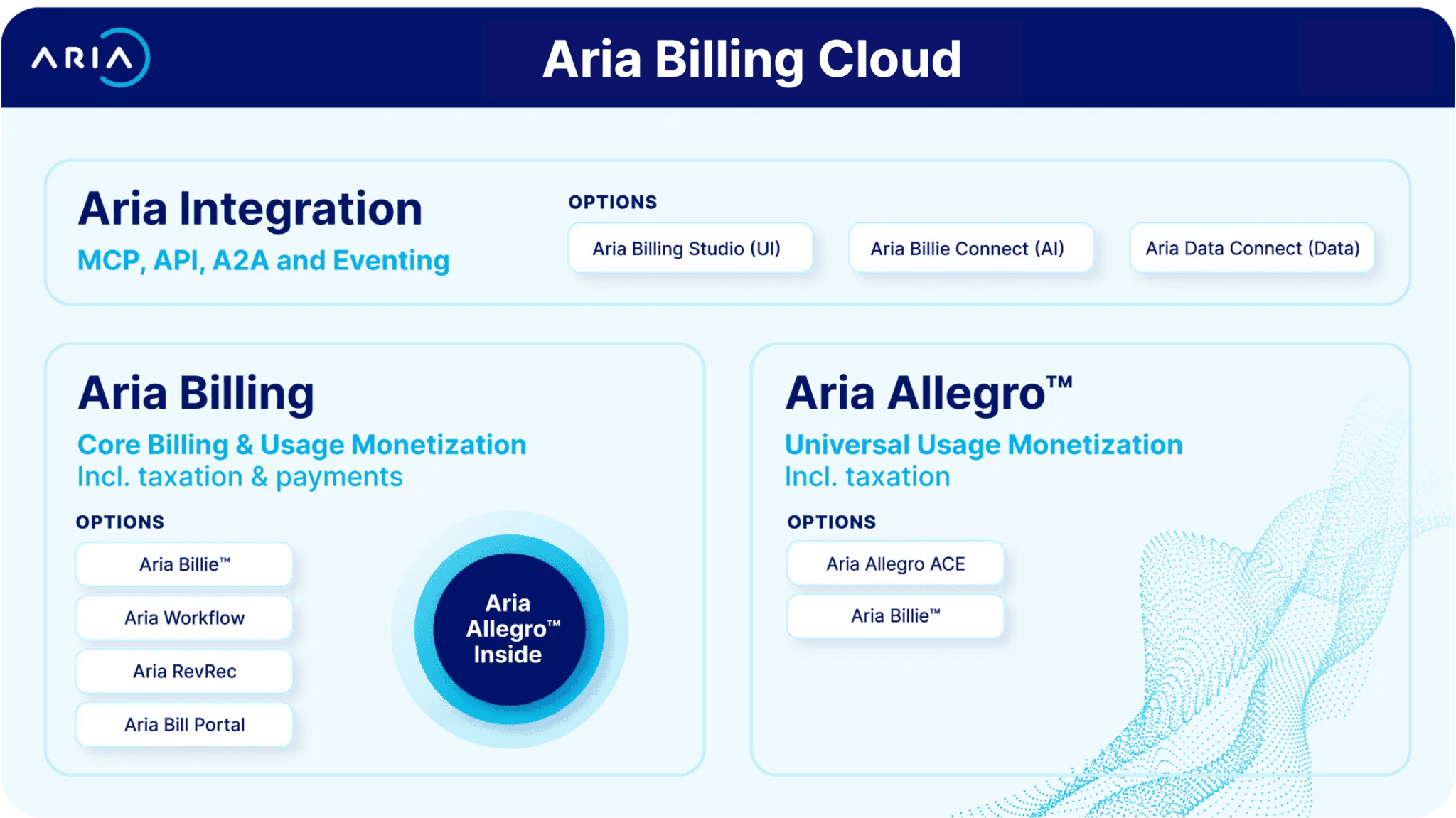
Aria Systems is a billing platform built for large enterprises with high-volume recurring and consumption revenue. Its flagship product is Aria Billing Cloud, and underneath it sits a rating and charging engine called Aria Allegro that converts raw usage activity into billable transactions in real time.
Around that core, Aria offers modules for revenue recognition, workflow, data export, a customer bill portal, and an AI layer called Aria Billie.
The company sells primarily into communications, media, software, IoT, healthcare, and financial services, and names customers including Comcast, Experian, Philips Healthcare, and Telstra.
Two things stand out about Aria Billing Systems specifically.
- In May 2026, Aria launched Allegro as a standalone product that connects to any billing system through open APIs, positioning it as infrastructure for enterprises trying to monetize AI telemetry. The company says it processes many billions of usage events per hour.
- The platform sells in modules, so the version of Aria you're quoted depends heavily on which pieces you buy.
What is Zuora?
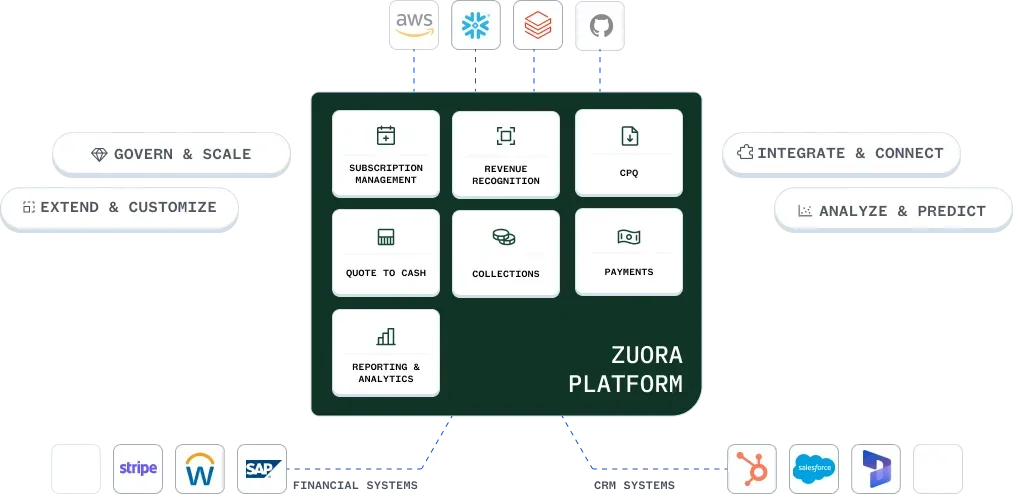
Zuora is a monetization platform built around subscription management, and it's the more widely deployed of the two.
It supports more than 50 pricing models, integrates deeply with Salesforce, and counts Zoom, Box, and Dell among its customers.
Its product line splits into Billing, Revenue, Collect, CPQ, and Analytics, which you assemble depending on what you need.
Aria Systems vs Zuora at a glance
| Aria Systems | Zuora | |
|---|---|---|
| Origin | Telecom-grade rating and charging | Subscription management and the commercial layer around it |
| Best for | Very large enterprises in telecom, media, and IoT rating enormous volumes of usage in real time | Large enterprises with complex subscription contracts, frequent amendments, and multi-entity structures |
| Core engine | Aria Allegro, sold standalone since May 2026, which the company says processes many billions of usage events per hour | Subscription and catalog engine supporting more than 50 pricing models |
| Real-time usage rating | Purpose-built. Pre-authorizes allowances before service delivery and stops overruns in session | Supported, but architected around the subscription lifecycle rather than sub-second authorization |
| Amendments and ramps | Supported, though less central to the architecture | Core strength. Co-terming, ramps, and mid-term changes handled natively |
| CPQ | Not included. Connects to external CPQ tools | Sold as a separate module |
| Revenue recognition | Separately quoted module | Separate module covering ASC 606 and IFRS 15 |
| Implementation | Multi-month services engagement, largely vendor-led | Needs specialist integrators. Zuora's Milo agent, launched July 2026, claims weeks rather than months |
| Partner ecosystem | Smaller pool of independent integrators, so you lean on the vendor | Large, so experienced help is easier to hire |
| Public review data | 1 Gartner Peer Insights review at 4.0/5, posted in 2021, plus 2 GetApp reviews at 4.5/5 | 311 G2 reviews at 3.9/5 and 21 Gartner Peer Insights ratings at 4.2/5 |
| Common criticisms | Almost no public evidence to evaluate against, and modules quoted separately make cost hard to model | Steep learning curve, custom reporting requires ZOQL or a data warehouse, slow support response times |
| Ownership | Independent | Private since February 2025, held by Silver Lake and GIC |
| Pricing | Nothing published. Modules quoted separately, with Allegro sold in Standard, Premium, and ACE editions | Nothing published. Third-party data puts median annual contracts near $170,000, ranging from roughly $27,000 to $697,000 |
Pricing reflects publicly available data at the time of writing and can change. Always confirm current pricing directly with each vendor.
Compare Zuora vs Aria Systems for enterprise billing: 6 areas that matter
Feature matrices in this category are close to useless, because both platforms will tick almost every box. What separates them is architecture and consequence.
Here's where we'd focus if you need to compare zuora vs aria systems for enterprise billing in a way that survives contact with your actual requirements.
1. Usage rating versus contract complexity
This will be the fork in the road for many finance teams, and most of the other differences follow from it.
Aria's architecture starts at the meter. Allegro was built to mediate and rate enormous volumes of raw events with real-time authorization, meaning it can check an allowance before a service is delivered, watch consumption in session, and stop an overrun at the moment it happens rather than discovering it on an invoice 30 days later.
Zuora's architecture starts at the contract. Its strength is the commercial layer: the product catalog, the amendment logic for mid-term changes, co-terming, ramps, and the way a subscription evolves across renewals and upsells.
2. Implementation weight
Neither of these is a platform you switch on. Both typically need a partner, a discovery phase, data mapping, and a parallel run.
Zuora requires specialized system integrators rather than being plug and play, with extended internal onboarding compared to simpler alternatives.
Aria implementations carry similar weight for a similar reason. Standing up a telecom-grade rating engine with a full enterprise catalog is a services engagement, not a configuration weekend. The difference is that Aria's smaller public footprint means a smaller pool of independent integrators who've done it before, so you're more dependent on the vendor's own services team.
Either way, budget accordingly. Vendr's procurement data for Zuora puts implementation somewhere between 15 and 75 percent of annual platform fees depending on complexity, and that's a line item most evaluation spreadsheets under-model badly. Assume something similar for Aria until a vendor tells you otherwise in writing.
3. Aria Systems reviews vs Zuora reviews
Zuora has strong public review volume while Aria doesn't.
In terms of Zuora's reviews, the platform holds 3.9 out of 5 across 311 reviews on G2 and 4.2 out of 5 across 21 ratings on Gartner Peer Insights. The themes repeat enough to be reliable:
- Reviewers praise:
- Automation capabilities
- Breadth of billing management (especially the Salesforce integration), and they
- Reviewers criticize:
- Steep learning curve
- Unintuitive administrative interface
- Custom reporting that demands knowledge of Zuora Object Query Language or an external warehouse
- Slow support ticket turnaround
As for Aria, Aria Billing Cloud carries 4.0 out of 5 from a single verified review on Gartner Peer Insights, and that lone review was posted in December 2021.
The Aria Platform listing on GetApp shows 4.5 out of 5 across 2 reviews, with reviewers highlighting multi-currency support, customizable invoices, payment processing, and dunning management. While those are positive scores, three data points, one of them close to five years old, cannot tell you anything about consistency, support responsiveness, or what breaks in year two.
4. Cost and how it's structured
Neither platform publishes pricing, so both evaluations start with a discovery call and a custom quote.
For Zuora, third-party procurement data gives you a useful anchor. Vendr's marketplace data puts the median annual contract around $170,000 across 149 tracked purchases, with a range from roughly $27,000 to nearly $697,000. Cost drivers are platform edition, transaction volume, module selection, and deployment model.
Vendr notes buyers have historically negotiated 20 to 35 percent below initial quotes through multi-year commitments and annual prepayment.
For Aria, there's no equivalent public benchmark. The company publishes no pricing at all, and named modules including revenue recognition, the bill portal, and the AI layer are quoted separately. Allegro is sold in Standard, Premium, and ACE editions, all custom-priced. The practical consequence is that a line-item comparison takes more work, because two Aria quotes for the same company can differ substantially depending on which modules got scoped in.
Ask for the full module list in writing early, so you're not discovering a capability you assumed was included during contract review.
5. Ecosystem and where your revenue team lives
If your go-to-market runs on Salesforce, Zuora has the more mature path. Its Salesforce integration is the single most consistently praised thing in its reviews, and its partner network means you can hire people who've already done the implementation.
Aria integrates with CRM and CPQ software too, but the surrounding ecosystem is smaller. For a company with a lean RevOps team, that difference shows up as a longer search for help when something breaks at 6pm on a close day.
6. The gap neither one closes
Neither Aria nor Zuora unifies quoting with billing on a single data model. Zuora sells a CPQ module, and Aria connects to CPQ tools, but in both cases the quote your rep builds and the invoice your finance team issues live in structures that have to be kept in sync.
That's why the phrase "the invoice doesn't match what we sold them" is so common in this category, and why so many finance teams end up running a spreadsheet as the real source of truth between the two systems.
If your evaluation started because quotes and invoices drift apart, choosing between two platforms that both leave that seam open doesn't fix the root cause.
Alguna: The modern alternative to Aria Systems and Zuora
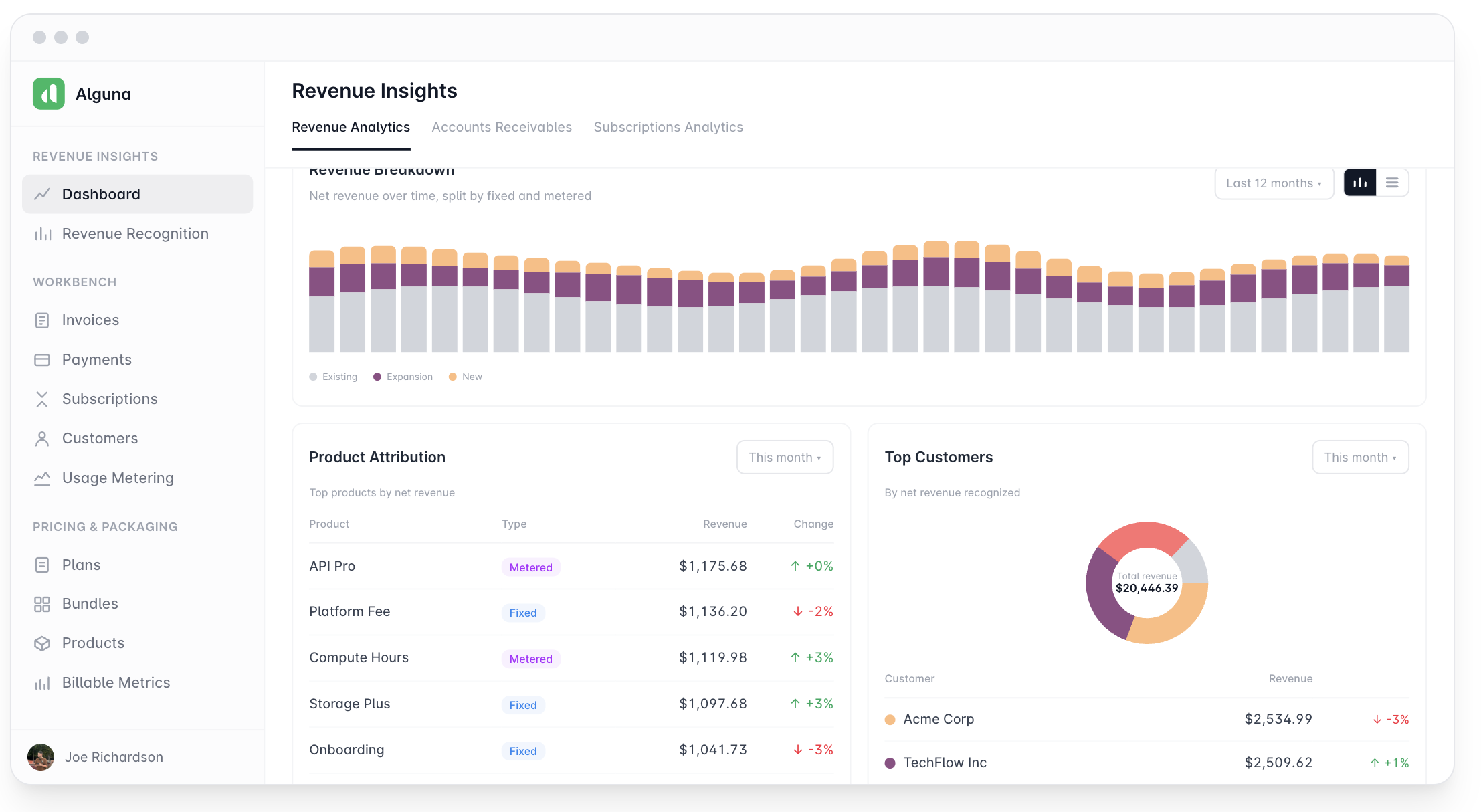
Alguna is an AI-native revenue management platform that covers pricing, quoting, and billing for AI, SaaS, and fintech companies running hybrid pricing models.
Rather than treating CPQ as a separate system that hands off to billing, Alguna runs quoting, billing, and revenue recognition in one unified platform, so the quote a rep sends and the invoice finance issues can't drift apart.
This means no middleware, no reconciliation between two catalogs, no spreadsheet sitting between them as the real source of truth.
- Adam Liska, co-founder and CEO of Airspeed
Key features:
- Real-time usage metering paired with no-code billing rules, so finance can configure recurring, usage-based, and hybrid plans, overage charges, and grandfathering rules without filing an engineering ticket
- A no-code CPQ module with e-signature and contract management, so sales can build, send, and close a quote without routing it through a separate quoting tool
- Invoicing that supports consolidated or split billing for customers sitting on multiple plans across multiple entities
- Automated revenue recognition connecting directly to QuickBooks, Xero, and NetSuite, so the books stay accurate without manual reconciliation
- Native multi-entity billing for companies operating across regions or subsidiaries, included rather than sold as a separate module
- Unlimited event ingestion and unlimited team seats on every tier, including the free one
Best for:
- Enterprise AI, SaaS, and fintech companies running hybrid or usage-based pricing
- Teams that want CPQ and billing unified instead of stitched together with middleware
- Multi-entity businesses needing consolidated billing and revenue recognition without add-on modules
Pricing: Alguna's enterprise plan is custom-priced and adds multi-entity billing, enterprise ERP integrations, automated revenue recognition, and priority support.
Aria Systems vs Zuora vs Alguna: Overview
| Platform | Best for | Strengths | Limitations | Pricing |
|---|---|---|---|---|
| Aria Systems | Very large enterprises in telecom, media, and IoT rating enormous volumes of usage in real time | Real-time rating and charging at extreme scale, deep enterprise catalog, standalone Allegro engine, long track record | Multi-month implementations, no built-in CPQ, modules quoted separately, small independent partner ecosystem, almost no public review data | Custom quote throughout, with Allegro sold in Standard, Premium, and ACE editions |
| Zuora | Large enterprises with complex subscription contracts, amendments, and multi-entity structures | 50+ pricing models, mature Salesforce integration, large partner ecosystem, far more public review data, active AI roadmap | Steep learning curve, custom reporting needs ZOQL or a data warehouse, specialist integrators required, CPQ and revenue recognition priced separately | Custom quote, with third-party data putting median annual contracts around $170,000 |
| Alguna | SaaS, AI, and fintech companies that want CPQ, billing, and revenue recognition on one data model | Hybrid pricing, no-code billing rules, CPQ and e-signature built in, fast implementation, transparent published pricing, unlimited event ingestion and seats on every tier | Newer platform, so the library of pre-built integrations is still growing, and it isn't built for telecom-scale mediation of raw network events | Free starter tier, then $699/month, with custom enterprise pricing |
How to evaluate enterprise billing software
Billing touches sales, product, finance, and every customer relationship at once, which makes it a heavier decision than most software purchases.
A few things are worth checking carefully.
Start with your pricing roadmap, not your current pricing. The platform that fits today's model is the wrong benchmark. Write down the pricing you expect to sell in 18 months, including any outcome-based or agent-based components, and evaluate against that. Given how fast pricing metrics are shifting, this is the highest-leverage question in the process.
Ask who can change a price. This separates platforms more than any feature list. In some systems, a new pricing model is a configuration task a finance lead completes in an afternoon. In others, it's an engineering ticket or a statement of work. Ask each vendor to walk through, live, how they'd add a hybrid plan with a usage tier and a negotiated overage rate.
Bring your ugliest account to the demo. Feature lists are written for clean cases. Take your most awkward real customer, the franchise group with 40 locations, the reseller with negotiated rates per region, the parent that pays for some child charges but not others, and ask the vendor to model it live. How many objects does it take to represent? What happens at invoice time? How much is configuration versus a workaround someone has to remember every month? This one exercise separates platforms faster than anything else on this list.
Model the real cost at your scale. Enterprise custom quotes hide the modules, and percentage-of-billing pricing looks cheap in year one and expensive in year three. Build a three-year total cost model including license, implementation services, integration work, and the internal headcount needed to run the system, then compare those numbers rather than the sticker.
Check revenue recognition is included, not extra. If you're audited or planning to raise, ASC 606 and IFRS 15 support shouldn't be a separately quoted module you discover late in the cycle. Our guide to SaaS revenue recognition software covers what good looks like here.
Test the sales-to-cash handoff end to end. Ask to see a quote created in the demo turn into an invoice and then into recognized revenue, with nobody re-entering data. If the vendor switches systems mid-demo, that switch becomes a permanent part of your process. If quoting is part of the problem, our roundup of CPQ software is a useful companion.
Ask how you'd catch a billing error. Every platform will bill correctly in the demo. The question is what happens when a meter drops events or a plan gets misconfigured, and whether you find out from the system or from an angry customer. Our guide to revenue assurance in billing covers the controls worth asking about.
Plan the migration before you sign. Ask for the specific process: parallel billing runs, data mapping, how historical invoices and subscriptions transfer, and who from the vendor is accountable during cutover.
Get customer references at your size. For any vendor with thin public review data, references are your only real signal. Ask specifically for a customer with similar pricing complexity and similar revenue scale, and ask them what they'd do differently.
Frequently asked questions
What's the main difference between Aria Systems and Zuora?
Aria is built around a real-time rating and charging engine designed for enormous volumes of usage events, which reflects its telecom heritage. Zuora is built around subscription and contract management, with strength in product catalogs, amendments, and its Salesforce integration. Both bill large enterprises, but Aria optimizes for usage throughput while Zuora optimizes for commercial complexity.
Which is better for usage-based pricing?
For raw volume and real-time authorization, Aria's Allegro engine is the more specialized tool, and Aria says it processes many billions of usage events per hour. For usage combined with complex contract terms, ramps, and amendments, Zuora's subscription model handles the surrounding commercial logic more naturally. Most companies need both capabilities, which is why the honest answer depends on where your complexity concentrates.
How much do Aria Systems and Zuora cost?
Neither publishes list pricing. Aria quotes everything custom, with named modules priced separately and its Allegro engine sold in Standard, Premium, and ACE editions. For Zuora, third-party procurement data puts median annual contracts around $170,000, ranging from roughly $27,000 to nearly $697,000 depending on edition, transaction volume, and modules. Add implementation services to both, which commonly run a substantial fraction of annual platform fees.
What do aria systems reviews say?
Public review data is unusually thin for a platform of Aria's age. Aria Billing Cloud has one verified review on Gartner Peer Insights rated 4.0 out of 5, and the Aria Platform listing on GetApp shows 4.5 out of 5 across two reviews, with reviewers praising multi-currency support, customizable invoices, payment processing, and dunning management. With sample sizes that small, direct customer references are a far better signal than review scores.
How do aria billing systems handle account hierarchies?
Aria supports parent and child account structures natively. The question worth pressing on isn't whether hierarchies are supported, because every enterprise platform will say yes, but how much manual work a complicated one costs you each billing cycle. In the evaluations we sit in on, franchise, multi-location, and reseller structures are where enterprise billing platforms most often need workarounds, regardless of vendor. If your business has hundreds of child accounts with mixed payment responsibility, model that exact structure live in the demo rather than accepting a checkbox.
Is Zuora still a good choice after going private?
The take-private itself doesn't change the product, and Zuora has shipped significant AI functionality since. What changes is disclosure. You no longer get quarterly public financials, so ask directly about roadmap commitments, support staffing, and contractual protections if the ownership structure shifts again.
Do we need either platform, or is there a lighter option?
Plenty of companies buy enterprise billing for capabilities they never use. If your complexity lives in contract structure rather than raw usage volume, a modern unified platform will usually cost less, deploy faster, and require less specialist headcount than a telecom-grade rating engine or a full enterprise subscription suite.
Can we switch billing platforms without disrupting existing invoices? Yes, with a proper migration plan. Credible vendors run parallel billing cycles or a phased cutover so subscriptions, invoices, and payment methods transfer without gaps. Ask any vendor for their documented migration process, who owns it on their side, and how long the parallel run lasts before you sign anything.
The right answer depends on where your complexity actually lives
If you take one thing from this comparison, make it this: Aria Systems vs Zuora is not a question about which platform is better. It's a question about which kind of hard problem you have.
If your problem is rating enormous volumes of usage in real time, with authorization before delivery and no tolerance for latency, Aria was built for exactly that and has been solving it for a long time.
If your problem is commercial complexity, contracts that amend constantly, a Salesforce-centric revenue team, and a need for the deepest partner ecosystem in the category, Zuora is the more natural fit and gives you far more public evidence to evaluate.
But there's a third possibility worth taking seriously, because we hear it most weeks from teams midway through evaluations exactly like this one. Sometimes the pain that started the search isn't rating throughput or catalog depth at all. It's the gap between what sales sold and what finance can bill, and no amount of enterprise horsepower closes that gap when quoting lives in a separate system from billing.