• You run usage-based, hybrid, or outcome-based pricing that simpler tools can't model
• You need native ASC 606 and IFRS 15 revenue recognition that stays audit-ready
• You bill internationally and want multi-currency and multi-entity support built in
• You want an AI AR agent to run collections within guardrails, not just send invoices
• You'd rather pay a flat monthly fee than a percentage of revenue as you scale
Choose Salesbricks if:
• You're an early to growth-stage team moving on from raw Stripe links
• Most of your revenue comes from a fast, self-serve buyer checkout
• You're happy standardizing on Stripe as your payment rail
• Your main friction is in the deal flow itself, not finance or collections
Most revenue teams don't lose money on the deals they don't win. They lose it on the deals they do win, quietly, in the gaps between the contract and the cash landing in the bank.
If you're comparing Alguna and Salesbricks, you're already trying to close that gap. Both promise to unify the messy middle of selling software and AI services, where a verbal yes turns into a signed contract, an invoice, and eventually money in the bank.
But they're built for different teams, with different priorities. This guide compares them honestly, feature by feature, so you can pick the one that fits how you sell today and where you're heading next.
Alguna vs Salesbricks at a glance
| Platform | Best for | Strengths | Limitations | Pricing |
|---|---|---|---|---|
| Alguna | Scaling SaaS, AI, and fintech teams that want CPQ, billing, revenue recognition, and AI collections in one system | AI-native quote-to-cash, AI AR agent with an autonomy ladder, native ASC 606 and IFRS 15, multi-currency and multi-entity, native Salesforce and HubSpot, SOC 2 | Newer than legacy suites, built for finance-led revenue ops more than pure self-serve checkout, pricing is custom so a demo is required | Flat monthly fee, no revenue share. Starts around 699 dollars per month, tailored by volume and modules |
| Salesbricks | Early to growth-stage B2B SaaS teams that want fast, self-serve checkout and unified quote, sign, and pay on top of Stripe | Quick setup, clean buyer checkout, reusable Bricks pricing model, approval workflows and discount guardrails, entitlements that keep systems aligned | Stripe-centric payment rail, Salesforce integration described as still maturing, complex revenue recognition may need complementary tooling, no AI collections agent | Tiered plans billed annually (Startup, Growth, Enterprise), with multi-currency and approvals on higher tiers; Enterprise is custom |
Alguna: AI-native quote-to-cash with intelligent collections
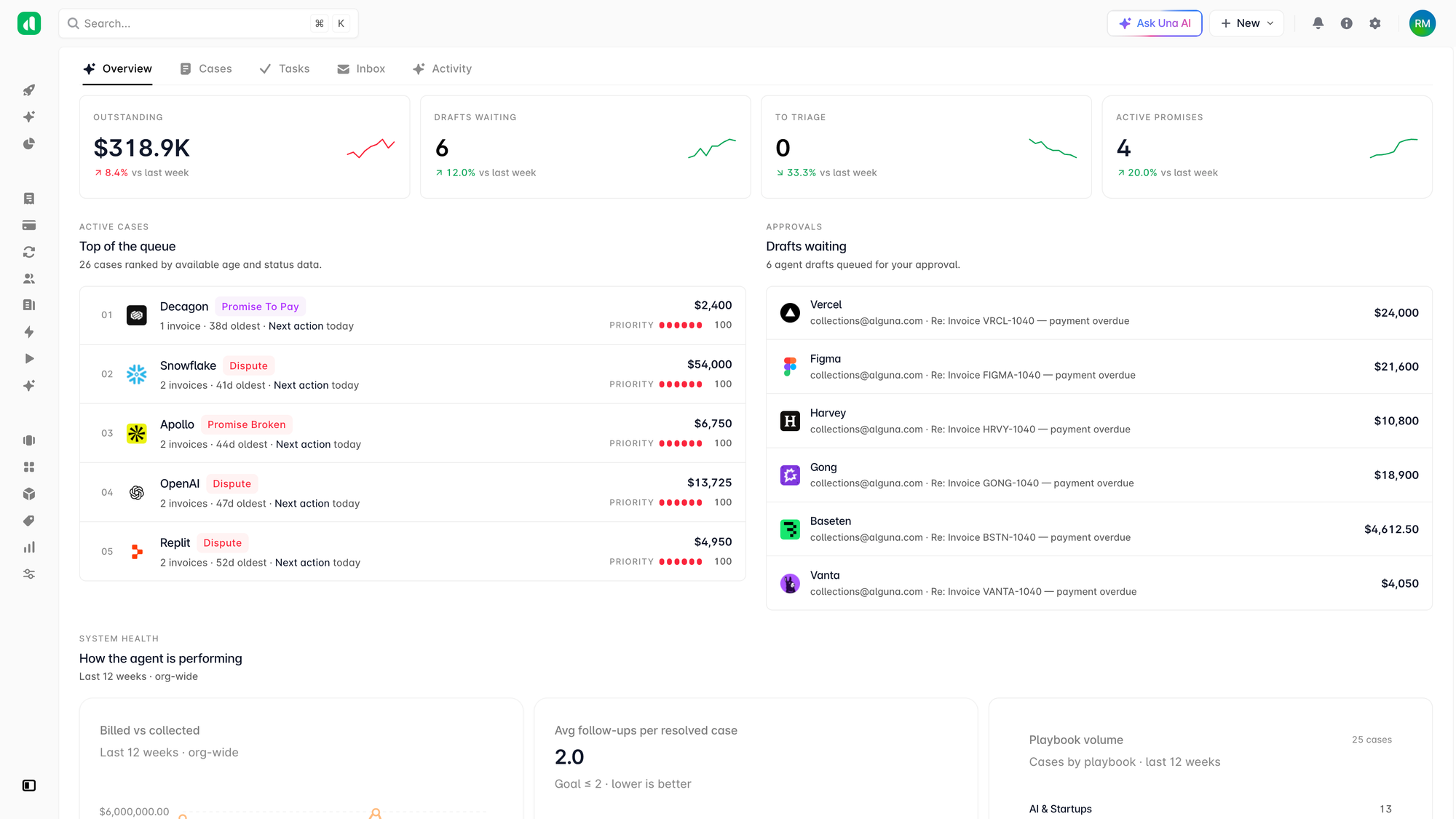
Alguna is an AI-native quote-to-cash platform headquartered in San Francisco. Founded in 2023 and backed by Y Combinator, Alguna was designed by experienced fintech operators who helped build multi billion dollar companies.
Alguna is purpose-built for the AI era and ideal for scaling SaaS, AI, and fintech companies that have outgrown a patchwork of point tools and want CPQ, usage metering, billing, invoicing, payments, and revenue recognition in one place, with a single source of truth for their revenue workflows.
💚 Alguna is built modularly, this means you can choose to use the CPQ, billing engine, accounts receivable agent, or revenue recognition based on your needs.
What sets Alguna apart is its AI AR agent. Where most platforms stop at sending an invoice, Alguna can monitor receivables, draft and send outreach within hard-coded guardrails, capture promises to pay, and flag disputes, so your finance team supervises collections rather than running them by hand. It's the difference between a billing tool and a system that actually helps you get paid.
- Adam Liska, Co-founder and CEO at Airspeed (formerly Glyphic AI)
Key features
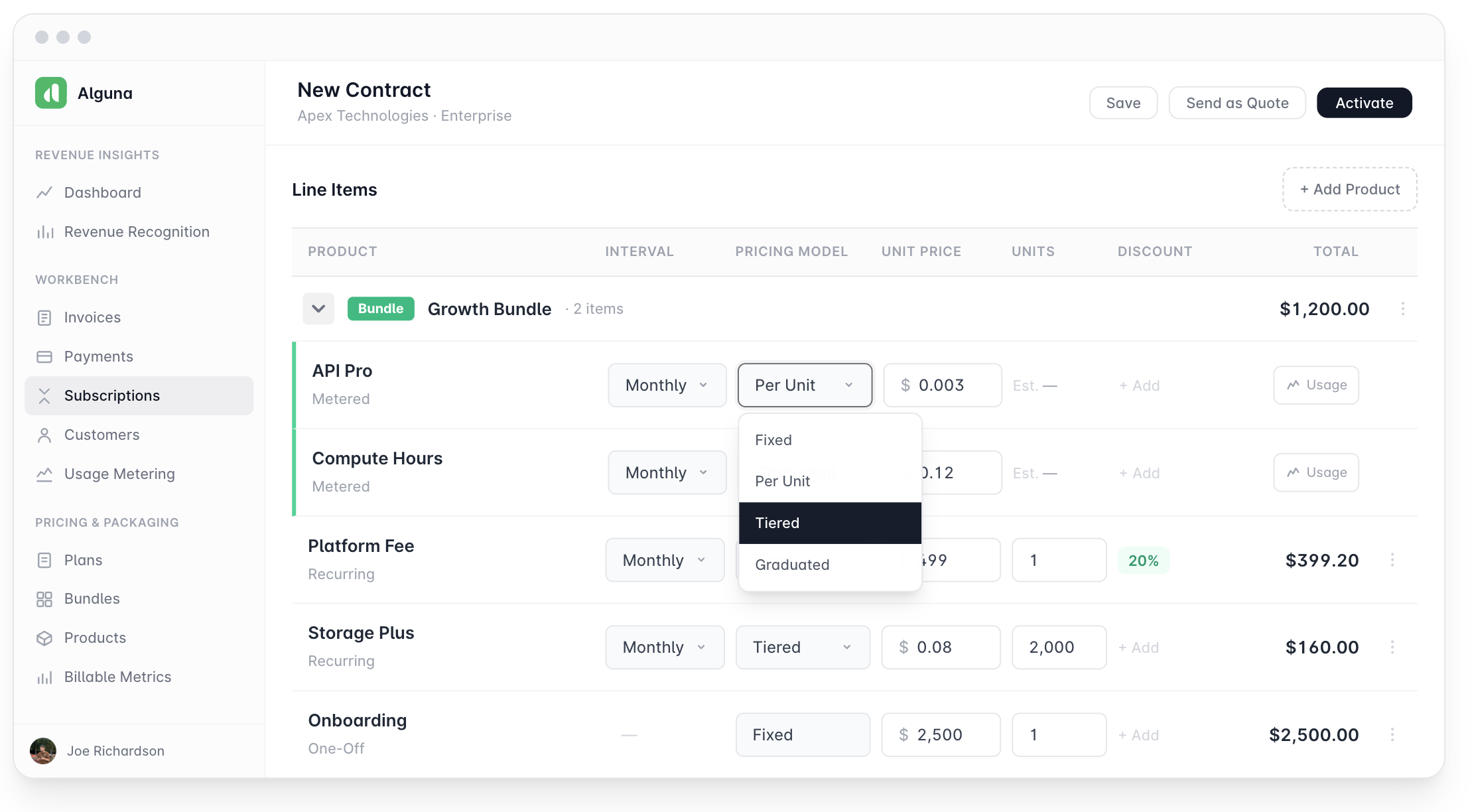
- No-code CPQ and contract generation with embedded e-signature, so the offer your team configures is the offer that gets signed, billed, and recognized without anyone re-keying it downstream.
- An AI AR agent with a monitor, suggest, and act autonomy ladder, promise-to-pay capture, dispute detection, configurable personas, playbooks and cadences, and approval thresholds, all bounded by hard-coded guardrails.
- Real-time usage metering for tokens, API calls, GPU hours, and other consumption signals, feeding directly into usage-based and hybrid pricing models common in AI companies.
- Native ASC 606 and IFRS 15 revenue recognition that stays audit-ready as contracts change, paired with the Control Tower workspace as a real-time command center for the full AR motion.
- Multi-currency and multi-entity support with tax handling, plus native Salesforce and HubSpot integration and no-code connectors to your finance, engineering, and data warehouse tools, all under SOC 2 compliance.
Pros
- Covers the full revenue lifecycle, not just quoting or just collections
- Alguna's AI AR agent reduces the manual chasing that drains finance teams
- Handles complex consumption, outcome-based, and hybrid pricing that simpler tools can't
- Transparent pricing keep costs predictable as you scale
- Native revenue recognition removes a separate finance workbook from the stack
- Most teams go live in weeks, not months (with the heavy lifting handled by Alguna's onboarding team)
Cons
- A newer platform than legacy enterprise suites with decades of history
- Built for teams with complex SaaS and AI pricing models, not a good fit for early stage startups
- Pricing is tailored, so you'll need a demo to get an exact number
Best for
- Scaling SaaS, AI, and fintech companies whose quote-to-cash workflow is fragmenting across multiple tools
- Finance and RevOps teams running usage-based, hybrid, or outcome-based pricing
- Teams that want intelligent collections under human supervision
- Companies expanding internationally that need multi-currency, multi-entity, and audit-ready revenue recognition
Pricing
Alguna charges a flat monthly fee and takes no revenue cut, which keeps your platform cost steady even as you scale. Pricing starts at $699 dollars per month and is tailored to the modules you need.
Salesbricks: Quote-to-cash for teams on Stripe
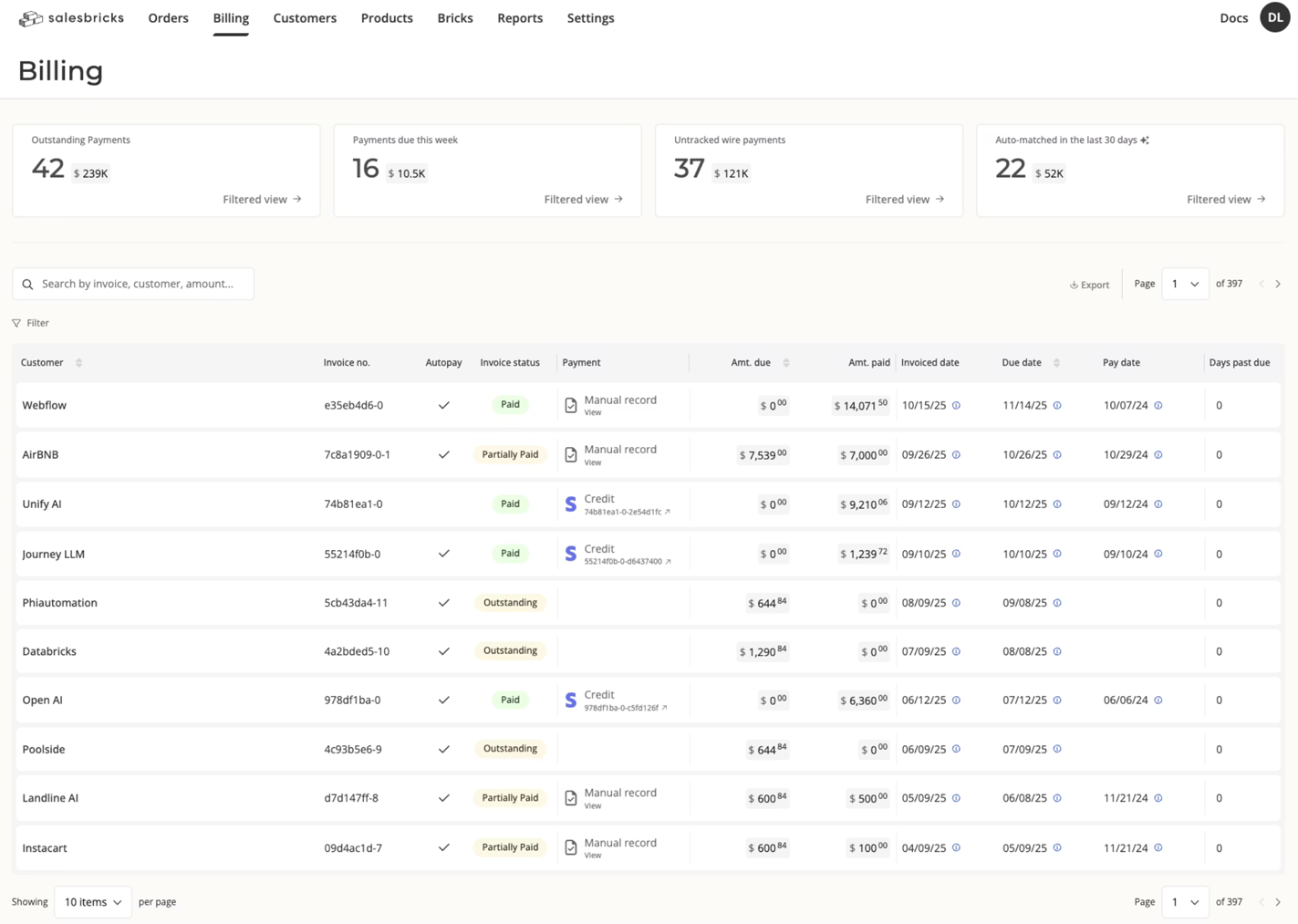
Salesbricks is a unified quote-to-cash platform for B2B SaaS, founded in 2021 and based in San Mateo, California. It brings quoting, signing, billing, and provisioning under one roof, with a strong emphasis on the buyer's checkout experience. Reps can build a bespoke checkout URL for each customer, and the buyer can review, sign, and pay in one smooth flow.
Its defining idea is the Brick. Instead of cloning a plan for every custom deal, you assemble offers from reusable, monetizable pieces (seats, features, usage blocks, platform fees) and price them per customer. That keeps your catalog clean as you grow.
Salesbricks is built to sit on top of Stripe, which acts as the payment rail and billing logic layer, so it's a natural fit for teams that have outgrown raw Stripe links but aren't ready for an enterprise suite.
Key features
- A unified buyer checkout that combines a custom offer, e-signature, and payment in a single link, removing the DocuSign hop and the "final version" email chain.
- The Brick pricing model, which lets you configure discounts, free periods, ramping entitlements, and custom billing schedules from reusable components rather than one-off plans.
- Salesbricks approvals and discount guardrails, where approval workflows route automatically based on discount thresholds and deal size, and rules-based pricing keeps every quote within policy and creates a clean audit trail for finance and RevOps.
- Automatic entitlement generation from every transaction, so product, billing, and finance operate from the same source of truth when pricing changes, a contract upgrades, or a usage limit is reached.
- Real-time revenue analytics and a unified customer view covering what was bought, whether it was paid, the renewal date, and account growth, with CRM and accounting integrations.
Pros
- One of the fastest setups on the market, often live in days
- A polished, self-serve buyer experience that shortens time to signature and payment
- The Brick model keeps pricing tidy without cloning plans for every deal
- Approval workflows and guardrails reduce discount variance without a dedicated CPQ specialist
Cons
- Built around Stripe as the payment rail, which limits flexibility for teams wanting multiple payment providers
- Its Salesforce integration has been described by third parties as still maturing
- Finance-heavy needs like complex revenue recognition may require complementary tooling
- No AI collections agent, so chasing receivables stays a manual or rules-only process
Best for
- Early to growth-stage SaaS teams moving from raw Stripe links to a real quote-to-cash flow
- Sales-led teams that want a fast, self-serve buyer checkout
- Companies whose main friction is in the deal flow itself rather than finance and collections
- Teams comfortable standardizing on Stripe as their payment processor
Pricing
Salesbricks uses tiered plans billed annually, commonly described as Startup, Growth, and Enterprise tiers. Features like multi-currency pricing and approval workflows sit on the higher-paid tiers, and the Enterprise tier is custom.
How to evaluate quote-to-cash software
A head-to-head feature checklist only gets you so far. The better question is which revenue architecture fits how you sell. Here are the dimensions that tend to decide it.
Pricing model and total cost of ownership. Look past the sticker price. Some billing-integrated platforms charge a percentage of revenue, and at scale a revenue share compounds into a meaningful number. Alguna's flat monthly fee keeps costs predictable, which is the same predictability argument that comes up when teams compare flat-fee against revenue-share pricing.
Sales motion. If most of your revenue comes from self-serve checkout, Salesbricks plays to its strengths. If you're running negotiated, usage-based, or hybrid deals where finance needs tight control over recognition and collections, a finance-led platform fits better.
Integrations. Check how each tool connects to your CRM and data stack, and whether the integration is native or still being built out. This is where the depth of a Salesforce or HubSpot connection, and access to your data warehouse, can quietly make or break a rollout.
Compliance and revenue recognition. If auditors are in your future, native ASC 606 and IFRS 15 support matters. Confirm whether recognition is built in or whether you'll need a separate finance tool to handle it.
Payment flexibility. Ask whether the platform locks you into a single processor or supports multiple and emerging payment providers, especially if you sell internationally.
Collections. Getting paid is its own discipline. A platform with an AI AR agent can monitor receivables and run outreach within guardrails, which is very different from a tool that only sends the invoice and waits.
Frequently asked questions
What is Salesbricks, and who is it for?
Salesbricks is a unified quote-to-cash platform for B2B SaaS that combines quoting, e-signature, billing, and provisioning into a single self-serve checkout. It's aimed at early to growth-stage teams that have outgrown raw Stripe links and want a faster, cleaner buyer experience without an enterprise implementation.
What is Salesbricks funding history?
Salesbricks funding has come primarily from early-stage rounds. The company was founded in 2021 and has raised seed and pre-seed capital from investors including Surface Ventures and Long Journey Ventures. Some funding trackers, such as PitchBook, put its total raised in the region of 18 million dollars across a broader investor list. Figures vary by source, so treat the exact total as approximate.
How does the Salesbricks Salesforce CPQ integration work?
Salesbricks is not built on Salesforce, so it isn't a Salesforce CPQ add-on. It positions itself as a lighter alternative to Salesforce CPQ and connects to Salesforce CRM through its integrations. Independent reviews have noted that the Salesbricks Salesforce CPQ integration is still maturing, so if a deep, native Salesforce connection is a hard requirement, confirm the current depth with their team. Alguna, by comparison, offers native Salesforce integration.
Does Salesbricks have a HubSpot CPQ integration?
Salesbricks connects to CRMs as part of its integration layer, and a Salesbricks HubSpot CPQ integration would run through that connector rather than a HubSpot-native build. If HubSpot is your system of record, ask Salesbricks to confirm whether the connection is native two-way sync or API-based. Alguna offers native HubSpot integration out of the box.
What are Salesbricks multi-currency billing features?
Salesbricks multi-currency billing features are available on its higher-paid tiers, where multi-currency pricing is included alongside approval workflows. If you sell across regions today, confirm which tier unlocks the currency coverage you need. Alguna includes multi-currency and multi-entity support with tax handling as part of its core global-ready architecture.
How does Salesbricks handle ASC 606 and IFRS 15 compliance?
Salesbricks automates billing and tracks revenue across the deal lifecycle, but on Salesbricks ASC 606 IFRS 15 compliance specifically, independent reviews note that finance-heavy needs like complex revenue recognition may require complementary tooling. If audit-ready recognition is central to your evaluation, ask for a detailed walkthrough. Alguna provides native ASC 606 and IFRS 15 revenue recognition that stays audit-ready as contracts change.
How strong are Salesbricks data warehouses and analytics capabilities?
On Salesbricks data warehouses analytics capabilities, the platform offers real-time revenue analytics and a unified customer view covering purchases, payment status, renewal dates, and account growth. Direct export to external data warehouses is less prominently documented, so if your finance and data teams rely on a warehouse like Snowflake or BigQuery, confirm the export path. Alguna, which is API-first, supports CRM and data warehouse integrations alongside its real-time revenue insights.
How does Salesbricks support MRR alignment across systems?Salesbricks MRR alignment across systems comes from automatic entitlement generation. Every transaction updates entitlements instantly, so product, billing, and finance work from the same source of truth, and metrics like MRR and ARR update in real time rather than being stitched together from separate tools. Alguna takes a similar single-source-of-truth approach across CPQ, billing, and revenue recognition, surfaced through in a revenue dashboard.
Does Salesbricks support multi-PSP and emerging PSPs?
On Salesbricks multi-PSP emerging PSPs, the platform is built around Stripe as its payment rail and billing logic layer, so it's effectively Stripe-centric rather than designed for routing across multiple or newer payment service providers. If supporting several PSPs matters to you, raise it directly with each vendor. Alguna is vendor agnostic.
Which platform handles collections better?
Salesbricks focuses on the front end of the deal, from configuration through checkout, and doesn't include an AI collections agent. Alguna offers an AI AR agent that can monitor receivables, draft and send outreach within guardrails, capture promises to pay, and flag disputes, so your finance team supervises collections instead of running them manually.
The right tool is the one that matches how you sell
Salesbricks and Alguna both fix the messy middle of selling software, but they aren't interchangeable. If your priority is a fast, self-serve buyer checkout and you're happy building on Stripe, Salesbricks is a clean, quick-to-launch choice for an early or growth-stage team.
If your revenue motion is more complex, with usage-based or hybrid pricing, international billing, audit-ready revenue recognition, and the need to actually collect what you've billed, Alguna covers the full lifecycle in one system and adds an AI AR agent that takes the manual chasing off your team's plate. For finance-led revenue operations at scale, that breadth is the difference between a tool that sends invoices and a platform that protects your revenue.
See how Alguna handles your quote-to-cash workflow
Chasing payments, reconciling invoices, and managing billing complexity by hand drains your finance team and your cash flow. Alguna is built to take that off your plate.