Choose Turnstile if your revenue is mostly sales-led. Custom deals, negotiated terms, amendments, and a finance lead who wants the invoice to follow the signed quote without a spreadsheet in between. It's early, but it's built for exactly that motion.
Choose Alguna if your pricing is hybrid and your contracts are complicated. Usage plus platform fees plus commitments, ramps, and grandfathered legacy plans, with CPQ, billing, and revenue recognition on one data model and pricing published up front.
Most SaaS companies start billing on Stripe because it's the most straightforward way to do it. Payments run through it, the API is excellent, subscriptions take an afternoon to stand up, and for the first hundred self-serve customers nothing breaks.
Then sales closes a deal with a ramp, a custom overage rate, an annual commitment billed quarterly, and a mid-term upsell in month seven, and someone in finance quietly opens a spreadsheet. That spreadsheet is where most billing evaluations begin.
Alongside companies like Alguna and Sequence, Turnstile is one of the newer answers to that problem.
In this guide, we'll define what each platform is, compare Turnstile vs Stripe for SaaS billing across the decisions that actually settle the deal, break down features, pros, cons, and pricing for both, introduce a third option worth having on the list, and walk through how to run the evaluation properly.
What is Turnstile?
Turnstile is a quote-to-cash platform for early to growth-stage B2B SaaS companies that came out of stealth in February 2026.
The product is organized as four applications on a shared quote-to-cash system of record: quoting, account management, billing, and reporting. Practically, that means a rep configures pricing and sends a quote with e-signature, the accepted quote becomes a subscription with the negotiated terms attached, invoices generate on whatever schedule the contract specifies, and ARR, MRR, and revenue recognition read from the same records rather than from a parallel model.
It's worth being clear-eyed about stage here: a company that launched in early 2026 has a short track record, and public review data is thin at the time of writing.
What is Stripe Billing?
Stripe Billing is the recurring revenue layer on top of Stripe's payments platform. It handles subscriptions, usage-based pricing, invoicing, dunning and payment recovery, a hosted customer portal, and multi-phase subscription schedules, and it inherits everything good about Stripe's developer experience: excellent documentation, a stable API, and an enormous ecosystem of prebuilt integrations.
For product-led SaaS, it is very hard to beat. Plans are objects, prices are objects, the webhooks are reliable, and your engineers already know how it works.
The consistent criticism is that percentage fees stack up, the cost structure is hard to model, and support can be slow when something goes wrong at the account level.
Turnstile vs Stripe at a glance
| Turnstile | Stripe Billing | |
|---|---|---|
| What it is | Quote-to-cash platform covering quoting, subscriptions, billing, and reporting | Recurring billing layer on top of Stripe's payments platform |
| Built for | Sales-led B2B SaaS with negotiated, non-standard deals | Product-led and self-serve SaaS with standardized plans |
| Quoting and e-signature | Built in, with quotes flowing directly into billing | Quotes exist, but advanced multi-phase quoting is listed as private preview |
| Amendments and mid-term changes | Core to the product | Listed as a private preview feature in Stripe's sales-led B2B documentation |
| Usage-based pricing | Supported, including hybrid models | Supported, with mature metering and high included event volumes |
| Payment processing | Not a processor. Integrates with Stripe for online payments | Native, at standard Stripe processing rates |
| Revenue recognition | Part of the reporting application | Separate paid product, quoted on request |
| Integrations | HubSpot, Salesforce, Attio, Stripe, Anrok, QuickBooks Online, Xero | Very large ecosystem across CRM, accounting, tax, and analytics |
| Implementation | Self-serve, with the company claiming setup in under a day | Fast for standard subscriptions, longer once you build custom deal logic yourself |
| Engineering dependency | Low. Configured by finance and RevOps | Higher. Non-standard logic usually means custom code |
| Track record | Launched February 2026, so limited public review data | Long track record, 4.4/5 across 142 G2 reviews |
| Pricing | $100 per month plus 0.6% of billing volume, self-serve, with custom pricing at higher volumes | 0.7% of billing volume pay-as-you-go, or annual plans from $620 per month with a 0.67% marginal rate. Payment processing and one-off invoicing priced separately |
Pricing and review data reflect publicly available sources at the time of writing and can change. Confirm current figures directly with each vendor.
Turnstile vs Stripe: 4 areas that drive the decision
Feature grids in this category are close to useless, because both platforms will tick most boxes at some level of abstraction.
Here's where the real difference lives.
1. Where your deals get their shape
Stripe Billing assumes the price is decided before the customer arrives. You define products and prices, the customer picks one, and the subscription follows the catalog. That model is clean, fast, and completely appropriate for self-serve revenue. When a deal deviates, you handle the deviation in code: ad-hoc prices, custom subscription schedules, logic your engineers maintain, and a growing amount of institutional knowledge about why account 4172 is special.
Turnstile assumes the price is decided during the negotiation. The quote is the source of truth, the signed terms become the billing terms, and the reason the product exists is to stop the drift between what sales sold and what finance can invoice.
If it's nine or 10, Stripe is doing its job and a quote-to-cash platform is solving a problem you don't have yet. If it's three, you're already paying for the gap in manual work, you just haven't put it on a line item.
2. Who does the work when pricing changes
On Stripe, the answer usually involves engineering. That's not a criticism of the product, it's a consequence of the design. Stripe gives you superb primitives and expects you to compose them. If you have engineers who enjoy this and capacity to spare, that flexibility is a feature. If your engineering roadmap is full and pricing changes queue behind product work, it becomes the reason your pricing stops evolving.
On Turnstile, the answer is meant to be configuration in the interface by whoever owns pricing. That's the entire pitch, and it's a meaningful difference in operating cost that won't appear anywhere in your license comparison.
Then ask who does it and how long it takes.
3. The real cost of the platform
Turnstile publishes $100 per month plus 0.6 percent of billing volume for its self-serve plan, with custom pricing for larger volumes. Turnstile's rate stacks on top of Stripe processing rather than replacing them, because Turnstile is not a payment processor.
Stripe Billing publishes 0.7 percent of billing volume pay-as-you-go, covering transactions processed both on and off Stripe, with annual plans starting at $620 per month that bring the marginal rate to 0.67 percent. One-off invoices sit outside Stripe Billing and are priced through Stripe Invoicing, and payment processing is charged separately again at standard card rates.
Also check what sits outside the base rate. Stripe Revenue Recognition is a separate paid product with pricing quoted on request, and it has no prebuilt ERP connectors, so exports to NetSuite or Sage Intacct run through CSV or API. If audit-ready ASC 606 reporting is a requirement rather than a nice-to-have, price it in from the start.
4. Maturity versus fit
Stripe has a decade of production billing behind it, hundreds of public reviews, and an ecosystem where any consultant you hire has already worked with it.
Turnstile launched in February 2026. Its architecture fits sales-led billing better than a payments-first platform does, and it has real funding and real customers, but you're buying an early product and you should evaluate it that way: ask for references at your revenue scale, ask what happens at renewal and at audit, and ask about their support model in writing.
Turnstile: Overview
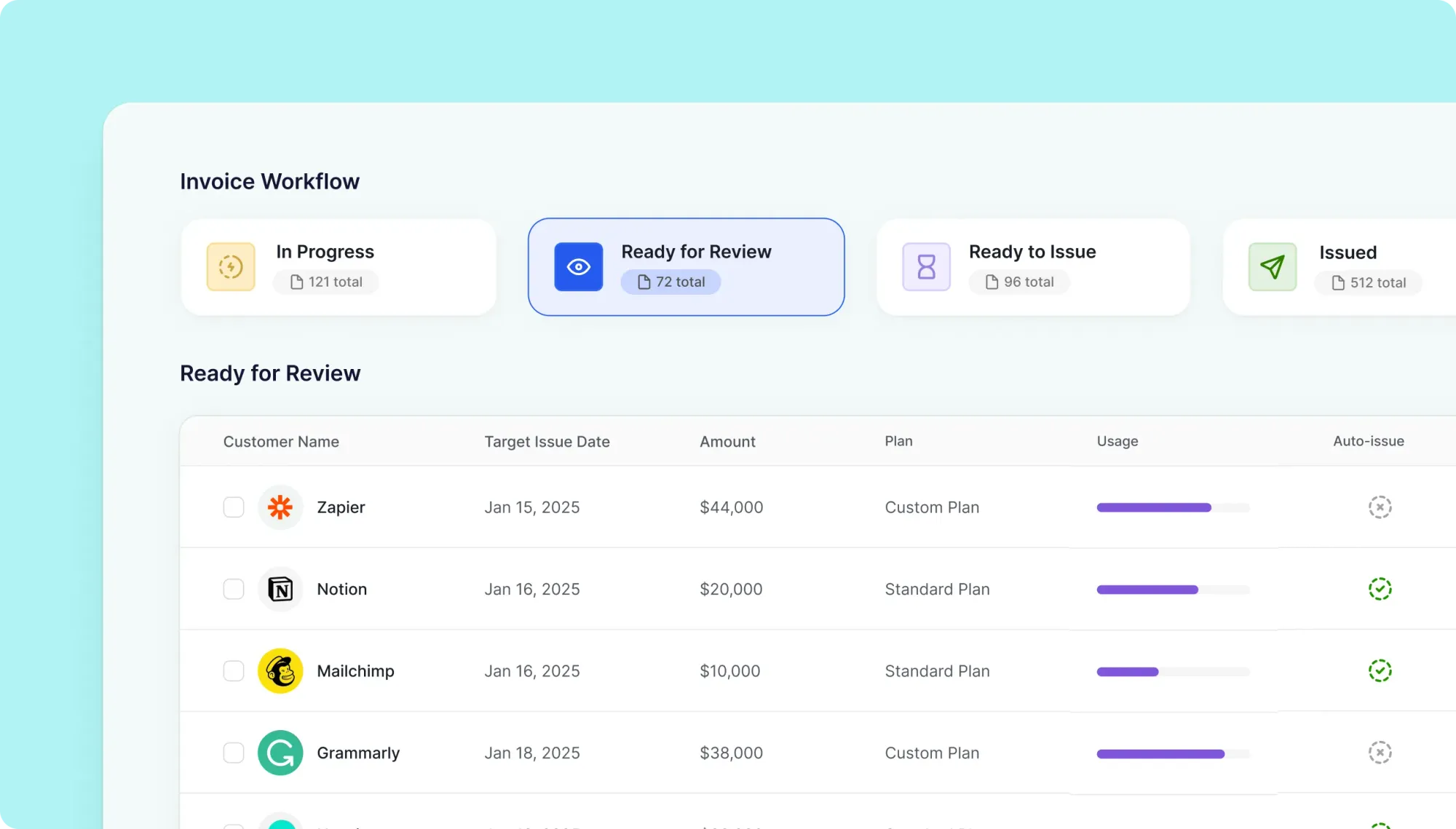
Turnstile is the more purpose-built of the two for companies whose revenue arrives through a sales process. The design assumption is that no two deals are identical, so the quote carries the commercial terms and everything downstream reads from that record instead of from a static catalog.
For a founder-led or small finance team, the appeal is that the whole path from quote to recognized revenue lives in one place instead of across Docusign, a pricing spreadsheet, and an invoicing tool.
Key features:
- Quoting with e-signature built in. Reps configure flat-fee, usage-based, tiered, and multi-year pricing, apply approved discounts, and send for signature, with the accepted quote becoming the billing record rather than a PDF someone re-keys.
- Subscription and account management. Upgrades, downgrades, mid-cycle amendments, and renewals are tracked as changes to a live contract, which is the specific thing that breaks in catalog-first billing systems.
- Billing on contract-specific schedules. Invoices generate on whatever cadence the deal specifies, including annual commitments billed quarterly and usage trued up in arrears.
- Reporting on the same records. ARR, MRR, and revenue recognition read from the quote-to-cash system of record, so finance and sales aren't reconciling two versions of the same number.
Pros:
- Purpose-built for sales-led deals rather than adapted from a self-serve model
- Quoting, billing, and reporting share one data model, so the invoice follows the signed quote
- Self-serve setup with no implementation project or partner required
- Native CRM integrations with HubSpot, Salesforce, and Attio
Cons:
- Launched in February 2026, so there's little public review data to evaluate against
- Not a payment processor, so its fee sits on top of your existing processing costs
- The integration library is still short compared with established platforms
- No published support for multi-entity billing, which matters if you invoice from several legal entities
- Vendor efficiency claims have not yet been validated by a large public customer base
Best for:
- Early to growth-stage B2B SaaS companies with a sales-led motion
- Companies whose deals routinely include custom terms, ramps, or negotiated rates
- Organizations already running Stripe for payments who want a commercial layer above it
Pricing: $100 per month plus 0.6 percent of billing volume on the self-serve plan, which includes access to all features. Custom pricing is available for higher volumes or non-standard requirements.
Stripe Billing: Overview
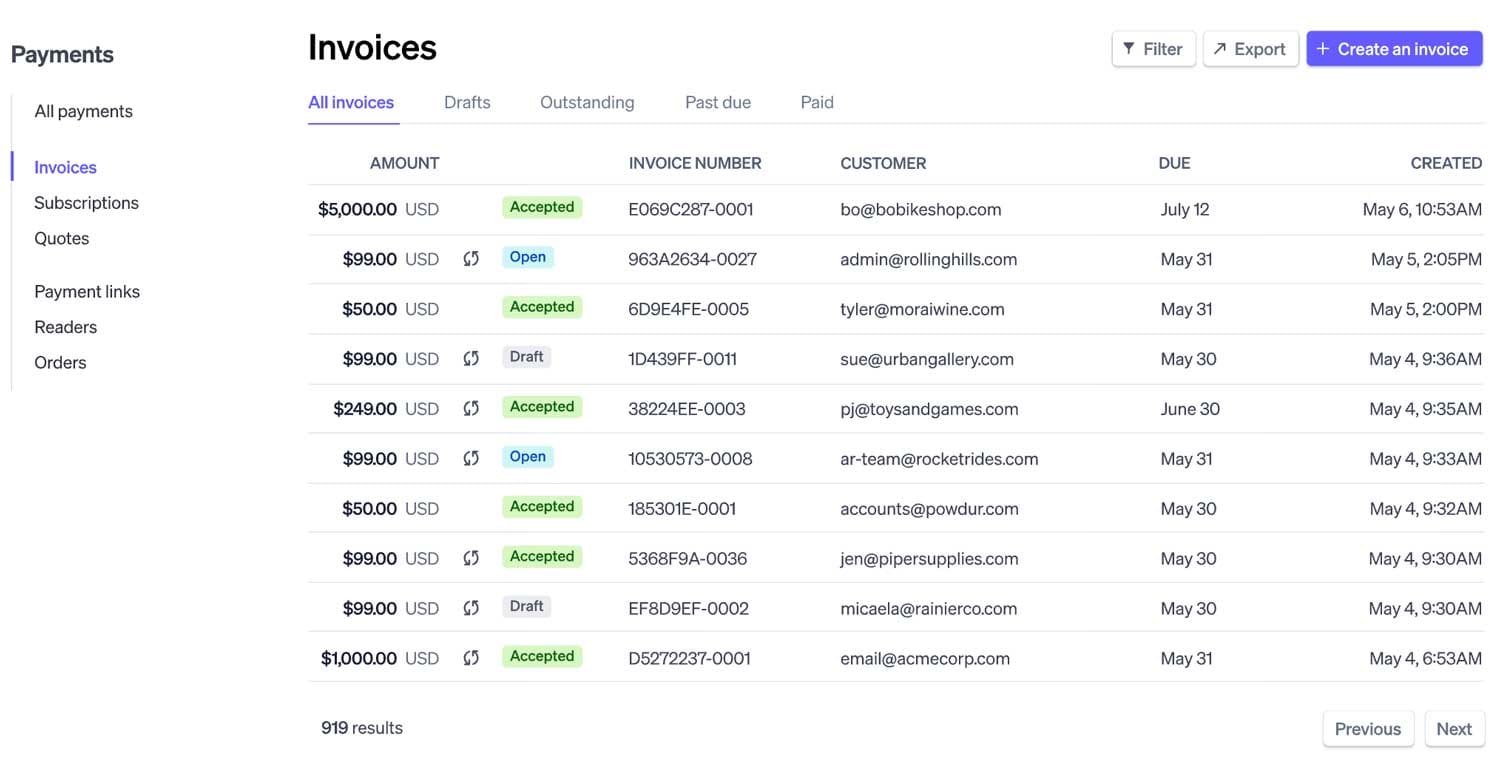
Stripe Billing fits if your pricing is standardized and your customers self-serve. It does the job with less friction than anything else in the category, and the fact that billing sits directly on the payments rails removes an entire class of reconciliation problems. The API is the best in the category, the documentation is genuinely excellent, and your engineers almost certainly already know it.
The strain shows up when revenue shifts from self-serve to sales-led. Stripe's B2B contract capabilities are improving quickly, but several of the ones a negotiated deal depends on, including amendments, multi-phase quotes, prebilling, and price migrations, appear in Stripe's documentation as private preview rather than generally available.
In the meantime, teams bridge the gap with custom code, and that code becomes something you own forever. It's why so many companies end up searching for Stripe Billing alternatives around the time they hire their first enterprise account executive.
Key features:
- Subscriptions and multi-phase schedules. Model recurring plans, trials, discounts, prorations, and ramps that change price over defined phases, all through a well-documented API and dashboard.
- Usage-based billing and metering. Ingest usage events at very high volume and price them, with metering included in the base billing rate rather than sold separately.
- Invoicing, dunning, and recovery. Hosted invoice pages, automated retries, and email reminders for failed and past-due payments, which is one of the most consistently praised parts of the product.
- Customer portal. A no-code hosted portal where customers update payment methods, download invoices, and manage subscriptions, embeddable in your own app.
- Ecosystem and reporting. Deep integrations across accounting, tax, and analytics tools, plus Sigma for SQL access and a separately sold Revenue Recognition product for ASC 606 and IFRS 15.
Pros:
- Best-in-class API and documentation, with engineers who likely already know it
- Billing sits on the same platform as payments, removing reconciliation between the two
- Rated 4.4 out of 5 across 142 G2 reviews, so there's abundant public evidence to evaluate
- Enormous integration ecosystem and easy access to experienced contractors
- Fast to launch for standard subscription and usage models
Cons:
- Several sales-led B2B capabilities, including amendments and multi-phase quotes, are listed as private preview
- Non-standard deal logic typically requires engineering rather than configuration
- Fees stack across Billing, Invoicing, and payment processing, which reviewers consistently flag as hard to model
- Revenue recognition is a separate paid product with no prebuilt ERP connectors
- Reviewers report slow support response times, particularly on account-level issues
Best for:
- Early-stage product-led SaaS companies with standardized, self-serve pricing
- Teams with engineering capacity to own custom billing logic
- Companies already processing payments on Stripe that want the simplest possible stack
Pricing: 0.7 percent of billing volume on the pay-as-you-go plan, covering transactions processed on and off Stripe. Annual plans paid monthly start at $620 per month and reduce the marginal rate to 0.67 percent. One-off invoices are priced through Stripe Invoicing at 0.4 percent per paid invoice on Starter and 0.5 percent on Plus. Payment processing is charged separately at standard rates, and Revenue Recognition is quoted on request.
Alguna: The third option worth shortlisting
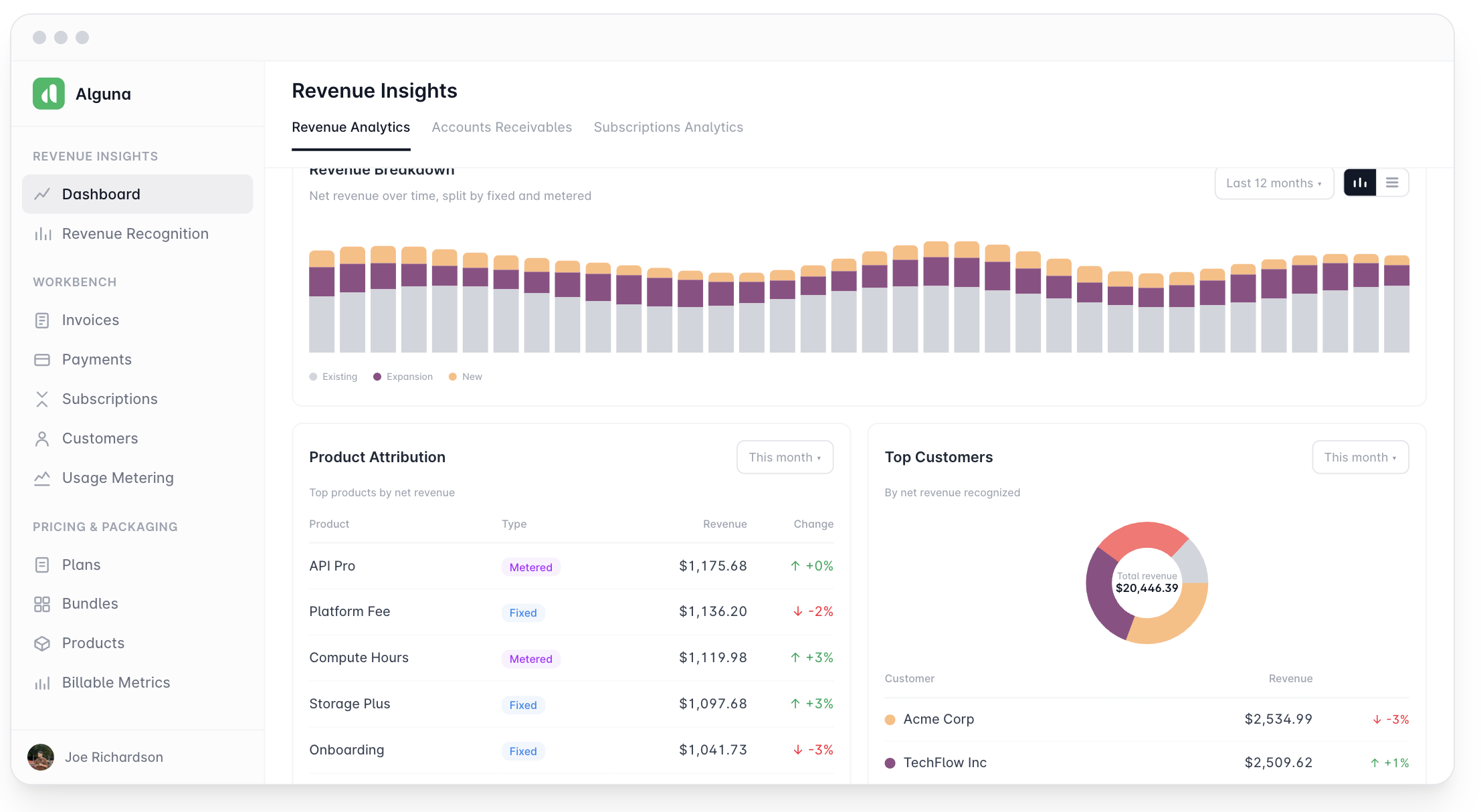
Alguna is an AI-native revenue management platform that manages your quote-to-cash workflow end to end. Backed by Y Combinator, Alguna launched in 2023 and is purpose-built for the AI era. Today, SaaS, AI, and fintech companies run usage-based and hybrid billing models on Alguna's platform.
Adam Liska, co-founder and CEO of Airspeed, put the difference plainly: "Alguna ticked every box I needed. Most importantly, it gave me a clear overview of revenue movements, something Stripe just couldn't provide."
Key features:
- No-code billing rules over real-time metering. Usage streams in continuously and finance decides how it prices in the interface rather than in code. Recurring, usage-based billing, and hybrid plans, tiered overage charges, minimum commitments, and grandfathering rules for customers on legacy pricing are all configuration.
- CPQ, e-signature, and contract management built in. Sales builds the quote with ramps, negotiated overage rates, and custom discounts, sends it for signature, and closes without leaving the system. Because the quote is assembled from the same catalog that bills it, the signed terms become the billing terms automatically.
- Consolidated or split invoicing across entities. A customer on several plans across several of your legal entities can receive one consolidated invoice or separate invoices per entity, without duplicate customer records or a second instance to maintain.
- Revenue recognition derived from the contract. Performance obligations come from the contract itself, so revenue schedules follow ramps, mid-term changes, and usage true-ups. Direct connections to QuickBooks, Xero, and NetSuite push recognized revenue into the books, and the audit trail runs from contract clause to invoice line.
Pros:
- Quoting, billing, and revenue recognition share one data model, so what was sold and what gets billed can't drift apart
- Pricing changes are configuration for whoever owns pricing rather than a ticket in the engineering queue
- Pricing is published, including a free tier, so you can evaluate without entering a sales cycle
- Unlimited event ingestion and seats on every plan, so costs don't move when usage spikes
- Multi-entity billing and consolidated invoicing are part of the platform rather than an enterprise-only bolt-on
- White-glove migration is included from the Growth plan, which matters when you're moving live subscriptions
Cons:
- Newer than Stripe, so the library of prebuilt integrations is still growing
- Not built for telecom-scale mediation of raw network events, where a dedicated rating engine is the right tool
- Not a payment processor, so your existing processing fees still apply on top
- The free tier caps at 10 monthly invoices, so most teams move to a paid plan quickly
- CPQ and e-signature start on Growth, and automated revenue recognition and multi-entity billing sit on Enterprise Scale
- Flat monthly pricing can cost more than a percentage of volume if your billing volume is still small
Best for:
- SaaS, AI, and fintech companies running hybrid pricing that mixes platform fees, usage, and commitments
- Teams at the inflection point who want quoting, billing, and revenue recognition in one place rather than a patchwork of tools
- Finance and RevOps leads who want to own pricing changes without depending on engineering
Pricing: Paid plans start from $699 per month. Enterprise is custom.
Turnstile vs Stripe vs Alguna: Overview
| Platform | Best for | Strengths | Limitations | Pricing |
|---|---|---|---|---|
| Turnstile | Early to growth-stage B2B SaaS selling custom deals through a sales team | Quoting, billing, and reporting on one record, self-serve setup, published pricing | Launched February 2026 with little public review data, not a payment processor, shorter integration library, no published multi-entity billing | $100 per month plus 0.6% of billing volume, custom above that |
| Stripe Billing | Product-led SaaS with standardized plans and engineering capacity | Best-in-class API and docs, billing on the same rails as payments, mature metering, huge ecosystem, 4.4/5 across 142 G2 reviews | Key sales-led features in private preview, custom deals need engineering, fees stack across products, revenue recognition sold separately | 0.7% of billing volume, or annual plans from $620 per month at 0.67% |
| Alguna | SaaS, AI, and fintech companies that want CPQ, billing, and revenue recognition on one data model | Hybrid pricing, no-code billing rules, CPQ and e-signature built in, multi-entity billing, unlimited event ingestion and seats on every tier, published pricing | Not a good fit for very early-stage companies, integration ecosystem not as mature as legacy vendors | Piad plans from $699 per month, with custom enterprise pricing |
How to evaluate SaaS billing software
Billing touches sales, product, finance, and every customer relationship at once, which makes it a heavier decision than most software purchases.
A few checks are worth doing properly.
Start with your pricing roadmap, not your current pricing. The platform that fits today's model is the wrong benchmark. Write down what you expect to sell in 18 months, including any usage, credit, or outcome-based components, and evaluate against that instead.
Bring your ugliest contract to the demo. Feature lists are written for clean cases. Take your most awkward real deal, the one with a ramp, a negotiated overage rate, an annual commitment billed quarterly, and a mid-term amendment, and ask each vendor to model it live. How many objects does it take? What happens at invoice time? How much is configuration versus a workaround someone has to remember every month?
Ask who can change a price, and time it. In some systems a new pricing model is an afternoon's configuration for a finance lead. In others it's an engineering ticket that waits behind product work. This single question separates platforms faster than any feature matrix.
Model total cost across three years, including engineering. Percentage-of-volume pricing scales with your success, so run the math at 3x your current volume, not today's. Then add the internal cost: hours spent on manual invoicing, reconciliation, and maintaining custom billing code. That last number is the one evaluation spreadsheets consistently miss.
Check whether revenue recognition is included or extra. If you're audited or planning to raise, ASC 606 and IFRS 15 support shouldn't be a surprise line item late in the cycle.
Our guide to SaaS revenue recognition software covers what good looks like.
Test the quote-to-invoice handoff end to end. Ask to see a quote created in the demo become an invoice and then recognized revenue, with nobody re-entering data. If the vendor switches systems mid-demo, that switch becomes a permanent part of your process.
If quoting is the weak link, our roundup of CPQ software is a useful companion.
Confirm feature availability in writing. Where a capability is in preview, beta, or on the roadmap, get the current status and your access confirmed by email before you sign. This is the single most common source of post-purchase disappointment in billing.
Plan the migration before you commit. Ask for the specific process: parallel billing runs, data mapping, how historical invoices and subscriptions transfer, and who is accountable during cutover.
Frequently asked questions
What's the main difference between Turnstile and Stripe for SaaS billing?
Stripe Billing is a recurring billing layer built on payments infrastructure, designed around a product catalog and best suited to standardized, self-serve pricing.
Turnstile is a quote-to-cash platform built around the negotiated deal, where the signed quote carries the commercial terms into billing. Stripe assumes the price is set before the customer arrives, Turnstile assumes it's set during the negotiation.
Is Turnstile a replacement for Stripe?
Not for payments. Turnstile integrates with Stripe for online payment processing, so most teams using it are running both. What Turnstile replaces is the quoting, contract, and billing logic layer, along with the spreadsheets that usually sit around it. Budget for both costs rather than treating the two rates as substitutes.
How much do Turnstile and Stripe Billing cost?
Turnstile publishes $100 per month plus 0.6 percent of billing volume on its self-serve plan, with custom pricing above that. Stripe Billing publishes 0.7 percent of billing volume pay-as-you-go, or annual plans from $620 per month at a 0.67 percent marginal rate, with payment processing, one-off invoicing, and revenue recognition priced separately.
Can Stripe Billing handle enterprise contracts with ramps and amendments?
Partly today, and more over time. Stripe supports multi-phase subscription schedules that model ramps, but its documentation lists amendments, advanced multi-phase quotes, prebilling, and price migrations as private preview features. Many teams bridge the gap with custom code. If those capabilities are central to your deals, confirm your account's access directly with Stripe before committing.
Do we need a quote-to-cash platform at all, or can we stay on Stripe?
If nearly all your deals bill exactly as your published plans do, stay on Stripe and revisit when that stops being true. The trigger to look is usually a specific pattern: finance maintaining a spreadsheet between the CRM and the billing system, invoices that need manual edits before they go out, or a pricing change waiting on engineering.
Our guide to billing automation covers what to automate first.
What about hybrid pricing that mixes subscriptions with usage?
Both platforms support usage-based components, and Stripe's metering in particular is mature and high-volume. The harder part is usually the commercial wrapper around usage: minimum commitments, tiered overages, credits drawn down over a contract term, and true-ups at renewal. With hybrid pricing now the most common model among B2B software companies, this is worth testing explicitly in the demo rather than assuming.
How long does it take to switch billing platforms?
Weeks rather than months for modern platforms, assuming a clean migration plan with parallel billing runs. The variable isn't the software, it's the state of your existing data: how many active subscriptions, how many bespoke arrangements, and how much of your current logic lives in code or in someone's head rather than in a system.
The right answer depends on how your revenue actually arrives
Turnstile vs Stripe for SaaS billing is not a question about which product is better built. Both are good at what they were designed for. It's a question about where your revenue comes from.
If customers arrive through your product, pick a plan, and rarely negotiate, Stripe Billing is the right tool and adding a quote-to-cash layer would be solving a problem you don't yet have.
If customers arrive through your sales team and every deal has something bespoke in it, Turnstile is built specifically for that.
If you want to see how Alguna handles your specific pricing model, ramps, overages, commitments, and all, book a demo with our team. We'll work through your actual contracts rather than a generic script, and we'll tell you honestly if staying on Stripe is the right call for where you are.