For most of the last decade, the question for SaaS teams was simple: how many people will log in? Today, the question revenue teams care about is how much value a customer actually consumes, whether that is API calls, tokens, transactions, compute, or credits.
At the center of that shift sits the ability to (accurately) bill for that value. This is why so many companies are switching to usage based billing software.
This isn't a trend. 38% of software companies have adopted hybrid pricing models that blend traditional subscription pricing with usage or outcome-based components.
The momentum is strongest among AI-native companies, where flat per-seat pricing rarely matches the cost or the value of the product.
In this guide, we break down what a usage based billing system is, the benefits it delivers for both customers and the business, the best practices that separate clean implementations from messy ones, and a step-by-step approach to rolling one out.
We also flag the trade-offs, so you can plan for them instead of being surprised by them.
What is a usage based billing system?
For example, instead of one fixed fee, the charge scales with a measurable unit of value, for example $0.10 per 1,000 API calls or a set rate per transaction processed.
It helps to separate two ideas that often get blurred.
- Usage based pricing is the strategy, the decision about what to charge for and how much.
- The billing system is the machinery that meters, rates, invoices, and collects on that strategy.
You can have a brilliant pricing model on paper, but without a system that can measure usage in real time and bill it accurately, the model leaks revenue and frustrates customers.
For a fuller picture of the strategy side, our guide to how usage-based pricing works covers the common models and examples.
How usage based billing compares to other models
Each model has its place. Seat-based pricing still fits products whose value scales with the number of people using them.
Many modern revenue teams land on hybrid billing, pairing a predictable platform or seat fee with a usage charge that captures the upside from heavy users.
7 benefits of usage based billing systems
Here are the benefits that make usage based billing worth the operational lift.
- Price aligns with value. Customers pay in proportion to what they actually use, so light users are not overcharged and heavy users are not underpriced. This fairness lowers friction in deals and reduces the sense that pricing is arbitrary.
- A lower barrier to entry. Customers can start small with little upfront commitment and grow into the product over time. That low entry point is a natural fit for product-led and self-serve motions.
- Automatic expansion and stronger retention. Revenue grows as customers consume more, without a renegotiation. Andreessen Horowitz finds that consumption-driven companies tend to see net dollar retention trend above 100% over time, with the potential to reach 150% at scale, because expansion is built into the model rather than dependent on a sales push.
- More transparency and trust. A good system gives customers a clear, line-item view of what drove their bill. That visibility turns billing from a source of disputes into a record customers can verify and trust.
- It scales with modern cost structures. For AI, API, and infrastructure products, the cost to serve rises with usage. Usage based billing keeps price and cost moving together, which protects margins as volume grows.
- Faster pricing experimentation. When pricing logic lives in a configurable system rather than in code, teams can test new tiers, metrics, and bundles without an engineering project. No-code pricing tools put that control in the hands of finance and revenue teams directly.
- One source of truth from quote to cash. When metering, billing, and revenue recognition share the same data, the invoice always reflects what was quoted and consumed. That consistency is what closes the gaps where revenue quietly leaks.
Best practices for usage based billing
Capturing the benefits above depends on getting a handful of fundamentals right.
- Anchor pricing to a value metric customers understand. Choose a unit that scales with the value customers get, such as API calls or transactions, and avoid obscure metrics that are hard to predict or explain.
- Meter usage in real time and keep it accurate. Late or duplicate events lead to under-billing or over-billing, both of which erode trust. Accurate, real-time metering is the foundation everything else rests on.
- Protect customers from bill shock. Give customers dashboards, usage summaries, and spending alerts so a spike never arrives as a surprise. Predictability builds trust even when the bill itself is variable.
- Offer a hybrid option for predictability. A base fee plus usage charges gives finance and procurement the budgeting certainty they want while still capturing upside from heavy users.
- Keep billing, quoting, and revenue recognition connected. Handoffs between disconnected tools are where errors and delays creep in. A unified system removes the data lag between a closed deal and an accurate invoice.
- Choose a system non-engineers can run. Pricing changes should not wait in the engineering backlog. Look for metered billing software that lets your team configure rates, tiers, and credits without writing code.
How to implement a usage based billing system in 6 steps
A usage based rollout is as much a change-management exercise as a technical one. These steps keep it manageable.
- Pick your value metric. Decide what unit best represents the value customers receive, and confirm it is something they can understand and roughly anticipate.
- Instrument your product to capture usage. Log every relevant event, an API request, a task run, a unit of data processed, so the system has accurate raw data to bill from.
- Define your rates, tiers, and any base fee. Set per-unit prices and volume thresholds, and decide whether to add a platform or seat fee for a hybrid structure.
- Choose a billing system that can meter and invoice. Managing usage based billing in spreadsheets is error-prone and does not scale. A billing system built for consumption automates the calculation, invoicing, and revenue recognition behind the scenes.
- Run shadow billing to validate accuracy. Before you charge anyone, run the model in parallel against real usage to catch metering errors and edge cases.
- Roll out gradually and communicate clearly. Pilot with new customers, show worked examples of how the bill is calculated, and refine as you go. For a product-specific walkthrough, see our guide to implementing usage-based billing for AI services.
Common challenges to plan for
Usage based billing is not a free lunch. The trade-offs are manageable, but only if you anticipate them.
- Revenue is harder to forecast. Because revenue moves with consumption, planning requires analyzing usage trends rather than reading off a contract. A hybrid base fee softens this.
- Customers can face bill shock. Usage spikes can produce unexpected invoices, which is why transparent dashboards and alerts matter so much.
- Metering and rating add complexity. Tracking usage in real time and applying pricing logic accurately is non-trivial, and it is the part most likely to break without purpose-built tooling.
- Sales and finance need to adapt. Quotas, forecasts, and comp plans built for fixed contracts have to shift toward usage growth, which takes internal alignment.
How Alguna supports usage based billing
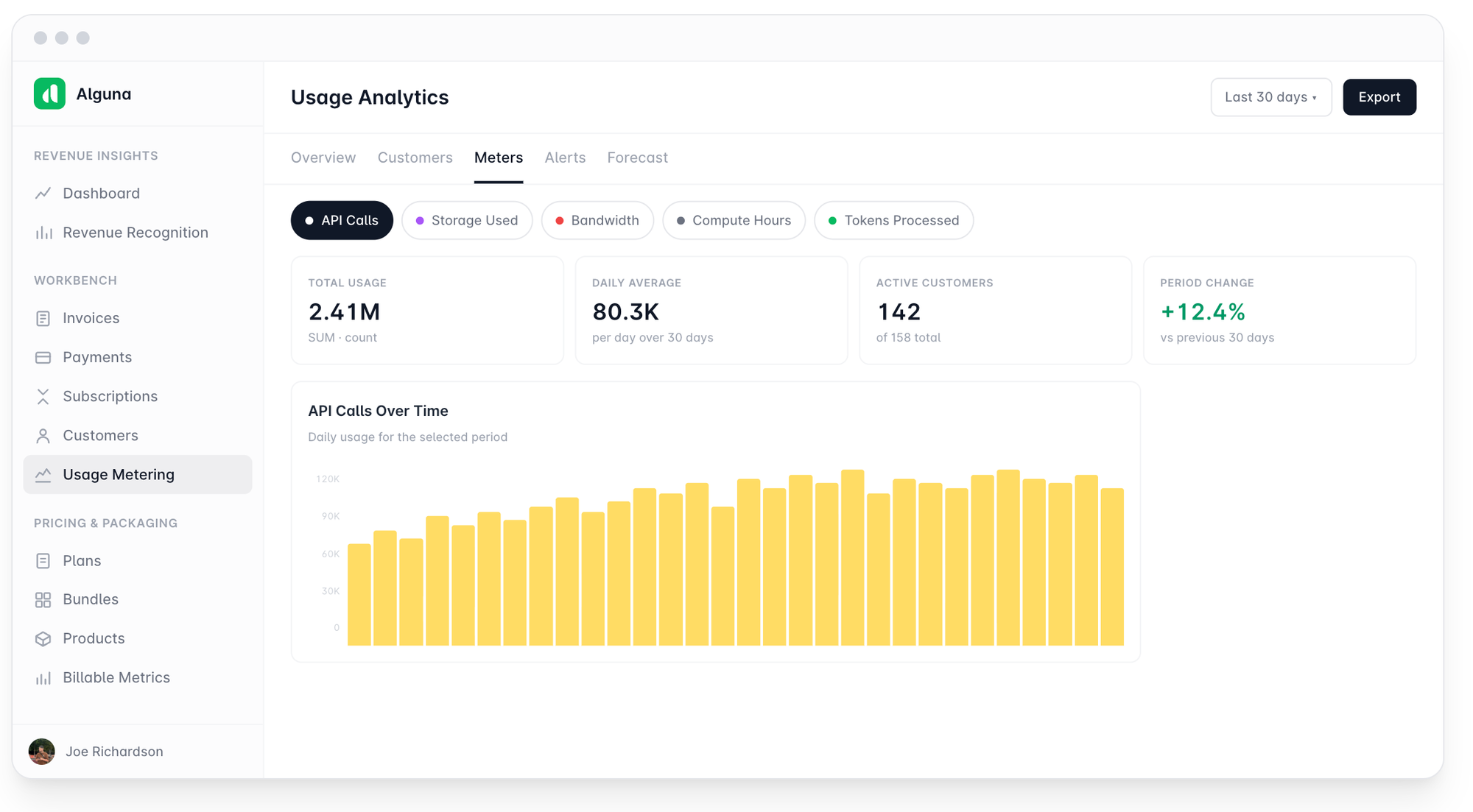
At Alguna, we built an end-to-end quote-to-cash platform for the way modern companies actually price and bill. We unify CPQ, billing, accounts receivable, and revenue recognition in one system, so revenue teams work from a single source of truth instead of stitching tools together.
For usage based models, our platform meters any custom metric you define, from API calls to tokens to feature usage, in real time, then applies your pricing logic and turns those events into accurate invoices. You can build subscription, usage-based, tiered, credit, and hybrid models in one catalog and change them without engineering involvement.
Our configure-price-quote software built for usage-based deals lets reps combine per-seat, tiered, and usage pricing in a single quote that converts directly into a live billing schedule, and our revenue recognition stays compliant with ASC 606 and IFRS 15 automatically.
The result is fewer handoffs, less revenue leakage, and the freedom to experiment with pricing as your product evolves. If you want to see how it would handle your billing model, you can book a demo and we will walk through it with your use case in mind.
Benefits vs trade-offs
Usage based billing systems align what customers pay with the value they receive, lower the barrier to getting started, and let revenue expand automatically as usage grows.
The trade-offs, around forecasting, bill shock, and operational complexity, are real but manageable with the right value metric, transparent reporting, and a system purpose-built for consumption.
As AI continues to decouple value from headcount, that alignment is becoming less of an advantage and more of a baseline expectation.
If you are evaluating how to meter, bill, and recognize revenue for a usage-based or hybrid model, book a demo with Alguna and we will show you how to put it into practice.
Frequently asked questions
What is the difference between usage based pricing and usage based billing?
Pricing is the strategy: what you charge for and how much. Billing is the machinery that meters usage, applies the rates, generates invoices, and collects payment. You need both, but the billing system is what makes a pricing model work in practice.
Is usage based billing only for AI companies?
No. It started in infrastructure and API products and has spread across SaaS, fintech, and beyond. It fits any product where value and cost scale with consumption rather than with the number of users.
Does usage based billing hurt revenue predictability?
Pure usage models are harder to forecast than fixed subscriptions. Most teams address this with a hybrid structure, a stable base fee plus usage charges, which keeps a predictable floor while capturing variable upside.
Can I combine usage based billing with subscriptions?
Yes, and many companies do. A hybrid model pairs a recurring base fee with usage-based charges, giving customers flexibility and giving finance a predictable baseline.
What is the main benefit of a usage based billing system?
Alignment. Price tracks the value customers receive, which lowers adoption friction, builds trust, and lets revenue expand automatically as customers grow their usage.