If you've been exploring usage-based pricing for your SaaS or AI product, you've probably already come across the term "value metric." It's one of those concepts that sounds straightforward until you try to apply it to your own business and realize the answer is far less obvious than it first appeared.
Getting your value metric right is arguably the single most important pricing decision you'll make. It determines how customers understand your product's worth, how your revenue scales with usage, and whether your pricing feels fair or frustrating to the people paying for it.
The question is this: How exactly do you go about aligning pricing with customer usage and value metrics?
At Alguna, we work with revenue teams every day who are navigating this very challenge. In this guide, we'll break down what value metrics are, share real examples from the field, and walk you through a practical framework for defining and refining your own.
Value metric meaning
In pricing terms, it's what you charge for rather than what you charge on.
In traditional subscription pricing, the unit of value is typically a seat or a user. You pay per person who has access, regardless of how much they use the product.
That model works well when every user derives roughly equal value. In the AI era, however, that assumption breaks down fast.
When your infrastructure costs rise with every request, and when a single power user can consume 100 times more than a casual one, flat subscription pricing becomes a revenue trap.
That's exactly why value metrics have become central to how modern software businesses think about SaaS monetization.
The 3 criteria of a "good" value metric
A good value metric has three distinct properties:
- It's quantifiable. You can measure it reliably and report on it accurately.
- It scales with customer value. When customers get more from your product, the metric goes up, and so does your revenue.
- It's intuitive. Customers can understand, predict, and trust their bill.
Value metric pricing: How it differs from traditional models
Value metric pricing isn't a SaaS pricing model in itself. But rather, it's what lies the foundation for effective and scalable usage-based pricing.
The purpose is to clearly connect the price a customer pays to the outcome or usage that creates value for them.
This has a meaningful effect on growth: customers can start small and expand naturally as their usage grows, without requiring manual upsells. It also protects margins, because revenue scales alongside the cost you incur to serve each customer.
Value metrics examples: What are other companies charging for?
One of the most useful ways to understand value metrics examples is to look at how different categories of AI and software companies define their charge metric.
Below are some of the most common patterns we see in the field.
1. Automation value metrics: Hours saved or tasks completed
When a product's primary promise is saving time or automating work, the most natural value metric is the unit of automation itself. That might be the number of tasks processed, workflows triggered, or documents handled.
For example, an AI-powered contract review tool might charge per contract reviewed, because that's the unit of work the customer cares about. They don't particularly care how many tokens the model consumed to produce the summary, they care that the contract was reviewed accurately and quickly.
2. Augmentation value metrics: Quality and accuracy improvements
Some products create value by making existing work better rather than replacing it. Here the metric is often tied to the number of outputs enhanced, requests processed, or recommendations generated. A sales intelligence tool, for instance, might charge per lead enriched or per contact updated.
3. Enhanced access value metrics: Unique data or integrations
When the value comes from access to proprietary data, networks, or integrations that the customer couldn't otherwise access, the value metric is often tied to the volume of that access. API calls, queries run, or data points returned are common charge units in this category.
4. Outcome-based value metrics: Direct business results
The most directly aligned, and most commercially compelling, approach is to charge for the final business result your product delivers. Intercom's Fin AI agent is the standout example here. Rather than charging per conversation started, Intercom charges per successfully resolved support ticket. That alignment between price and outcome helped Fin become an eight-figure business line in less than a year.
Outcome-based pricing is extremely powerful when it works, but it requires that you can reliably measure and attribute outcomes, which isn't always straightforward.
The 3 most common value metric charge types: Overview
| Charge type | What you measure | Best for | Example |
|---|---|---|---|
| Consumption-based | Technical units (tokens, API calls) | Foundational models, developer tools | OpenAI charges per 1M tokens |
| Workflow-based | Tasks or sequences completed | Document processing, image generation | Billing per document summarized |
| Outcome-based | Final business result delivered | Sales tools, support automation | Intercom's Fin charges per resolved ticket |
Best practices for defining your value metric
Choosing the right value metric isn't a one-time decision. It's something you refine as your product and customer base evolve. According to data from a pool of over 2,000 global businesses, the fastest-growing companies were significantly more likely to have changed their pricing three or more times over a two-year period.
That's not indecision; it's iteration.
Here are the practices we recommend when defining and refining your value metric:
| Best practice | What it means in practice |
|---|---|
| Start with customer value, not cost | Interview customers to learn what outcomes matter most before you define any metric |
| Keep it measurable | Choose a metric you can track reliably in your system today, not one you hope to track later |
| Make it intuitive | If a customer needs a glossary to understand their bill, the metric is too complex |
| Align with your cost structure | Your metric should scale roughly with what it costs you to deliver the service |
| Use credits to bridge the gap | Credits translate complex back-end metrics into a single, spendable currency customers can understand |
| Protect margins with guardrails | Set usage caps, automate spend alerts, and apply rate limits to prevent a handful of power users from eroding unit economics |
| Treat the metric as a living decision | Review your value metric every time your product meaningfully evolves |
A note on hybrid pricing
In practice, most companies don't rely on a value metric in isolation. They combine it with a subscription component to create a hybrid model. The subscription provides revenue predictability that finance teams need while the usage-based metric lets revenue scale as customers get more value.
According to research, 61% of companies that don't currently use hybrid pricing say they're considering adopting it within the next 12 months, a clear signal of where the market is heading.
How to define your value metric: A 7-step framework
When we onboard new customers to Alguna's CPQ and billing platform, we help revenue teams work through a structured process for aligning pricing and packaging with customer usage and value metrics.
Here's a simplified version of that framework.
1. Map the value your product delivers
Before you decide what to charge for, get clear on what your product actually does for customers. What problem does it solve? What would it cost them to solve that problem another way?
Talk to your best customers and ask them directly: what part of this product do they rely on most, and what would they miss if it disappeared tomorrow?
2. Identify candidate metrics
From the value map, list every measurable unit that correlates with the value customers receive. For an AI writing tool, that might include words generated, documents created, or publishing workflows completed.
Don't filter yet, just generate the list.
3. Apply the 3-part test
For each candidate, ask: Is it measurable? Does it scale with value? Is it intuitive to the customer? Anything that fails on more than one dimension should be deprioritized.
4. Check alignment with your cost structure
Your value metric should track roughly with the cost it takes you to serve each unit. If customers can consume enormous value with minimal cost to you, an outcome-based metric is relatively safe.
If every unit of value requires significant compute, a consumption or workflow metric may be more appropriate.
5. Consider using credits to simplify
Credits are increasingly popular among AI companies because they solve the complexity problem. Rather than exposing customers to technical metrics they don't understand, you sell credits that customers spend across the product.
This hides back-end complexity, makes hybrid pricing easier to present, and gives customers a single, intuitive unit to budget against.
6. Build in usage guardrails
Usage-based pricing creates uncertainty for customers. Mitigate this by setting usage caps, automating notifications when customers approach their limits, and applying rate limits to prevent a small number of power users from destabilizing your unit economics.
These guardrails protect both the customer relationship and your margins.
7. Monitor, review, and iterate
Once live, monitor usage patterns closely. Are there cohorts of customers whose usage consistently outpaces what they're paying for? Is your metric creating any perverse incentives?
Review your value metric every time your product meaningfully evolves, and treat changes as a normal part of building a pricing strategy rather than a sign that something went wrong.
User value metrics vs. business value metrics: Knowing the difference
It's worth drawing a distinction between user value metrics and business value metrics, because confusing the two is a common source of pricing friction.
A user value metric is what the individual user of your product cares about day-to-day: speed, accuracy, time saved, or ease of use.
A business value metric is what the company paying the bill cares about: revenue generated, costs reduced, deals closed, or churn prevented.
The best best value metrics bridge both. They're meaningful to the individual user, because that drives adoption, and they're meaningful to the budget holder, because that drives renewals and expansions.
When there's a mismatch, you get pricing friction. Users love the product but can't justify the cost to their finance team, or the bill looks fine at the executive level but irritates the people who actually use it every day. Getting this alignment right is part of what makes value metric pricing hard, and why it's worth investing serious thought.
6 common value metric mistakes (and how to avoid them)
Most pricing problems aren't pricing problems at all. They're value metric problems.
Here are the mistakes we see most often, and what to do instead.
1. Choosing a metric your customers don't understand
Tokens, API calls, compute units, these are meaningful to engineers but opaque to the budget holders who approve your invoices. If a customer has to open a support ticket to understand their bill, your metric is working against you.
The fix is straightforward: test your metric with a non-technical customer and ask them to explain their bill back to you. If they can't, simplify, or use credits as a translation layer.
2. Picking a metric that doesn't scale with your costs
A value metric that grows with customer value but not with your cost to serve will erode your margins over time. This is one of the reasons unpredictable compute costs are cited as a top concern by 33% of AI-powered businesses.
If your most active customers cost you ten times more to serve but pay only twice as much, your unit economics are working against you. Always stress-test your metric against your cost model before you ship it.
3. Treating the first metric as permanent
The single most common mistake is assuming you have to get the value metric right first time. You don't. In fact, companies that iterate on their pricing grow faster precisely because they're willing to change it.
Set a review cadence, monitor usage patterns from day one, and treat the first metric as a starting hypothesis rather than a final answer.
4. Measuring what's easy rather than what matters
It's tempting to charge for whatever your system already tracks. But ease of measurement isn't the same as alignment with value. If you charge per login because it's easy to count but logins don't correlate with outcomes your customers care about, you'll create friction at renewal time.
Build measurement for the metric that matters, even if that takes more work upfront.
5. Ignoring the user/buyer split
The person who uses your product every day and the person who signs the renewal are often different people with different priorities. A metric that delights end users can still kill the deal if the budget holder can't see ROI in it.
Make sure your value metric tells a clear story at both levels, and that your reporting makes it easy for champions to justify the spend internally.
6. Setting no guardrails
Usage-based pricing without guardrails creates anxiety for customers and risk for your business. A handful of power users can generate bills that shock them into churning, or consume resources that squeeze your margins.
Usage caps, automated spend alerts, and rate limits aren't just defensive tools; they're a sign that you've thought carefully about the customer experience of your pricing model.
How to approach billing with your value metric in mind
Choosing a value metric is only half the job. The other half is making sure your billing infrastructure can actually support it.
A metric that looks elegant on a whiteboard can become a source of real operational pain if your billing system wasn't built to handle the way usage fluctuates, compounds, or combines with a subscription component.
Here's how to think about billing at each stage of your value metric's lifecycle.
Instrument your product before you launch
Before you can bill for a value metric, you need to track it reliably. That means building usage instrumentation into your product from the start, not retrofitting it later.
Every time a billable event occurs, your system should emit a record: what happened, who triggered it, when, and in what quantity. This event stream becomes the source of truth for every invoice you issue. If your instrumentation is inconsistent or incomplete, billing disputes become inevitable.
Build the metering layer before you need it, not after your first customer questions their bill.
Decide how you'll aggregate usage into a billable period
Raw usage events aren't the same as a bill. You need to decide how events aggregate into a charge.
The most common approaches are:
- Sum-based aggregation: You charge for the total units consumed in a billing period. This works well for consumption-based metrics like API calls or tokens.
- Maximum (high-water mark): You charge based on the peak usage reached during the period. This is common for seat-based or capacity metrics where provisioning costs scale with peak demand.
- Most recent value: You charge based on the state at the end of the period. Useful for metrics that represent a current state rather than cumulative activity, such as the number of active contacts in a CRM.
The right approach depends on your metric type. Getting it wrong creates billing surprises, which are one of the fastest ways to erode customer trust.
Design invoices that explain value, not just cost
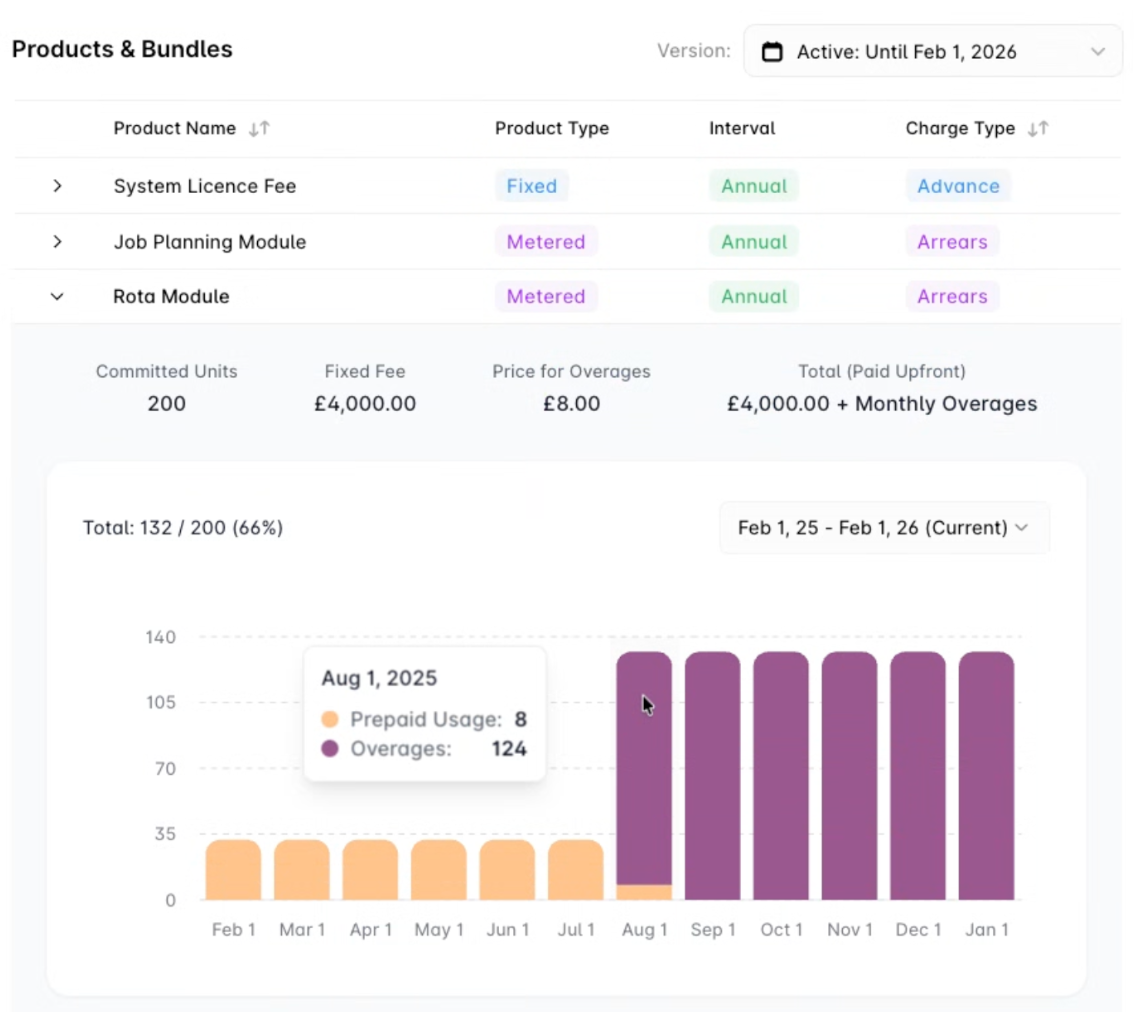
An invoice is a moment of truth in your customer relationship. If it shows a list of cryptic line items your customer can't interpret, it creates anxiety and generates support tickets.
If it shows a clear summary of what they used, what it achieved, and what they owe, it reinforces the value your product delivered.
Practically, this means:
- Label line items in plain language that mirrors the value metric your customer agreed to, not the internal technical name your engineering team uses
- Include a usage summary at the top of the invoice, showing total usage, what was included in the plan, and what triggered additional charges
- Where possible, show a trend. Customers who can see their usage growing over time are more likely to understand an increasing bill and less likely to dispute it
Build in customer-facing usage visibility
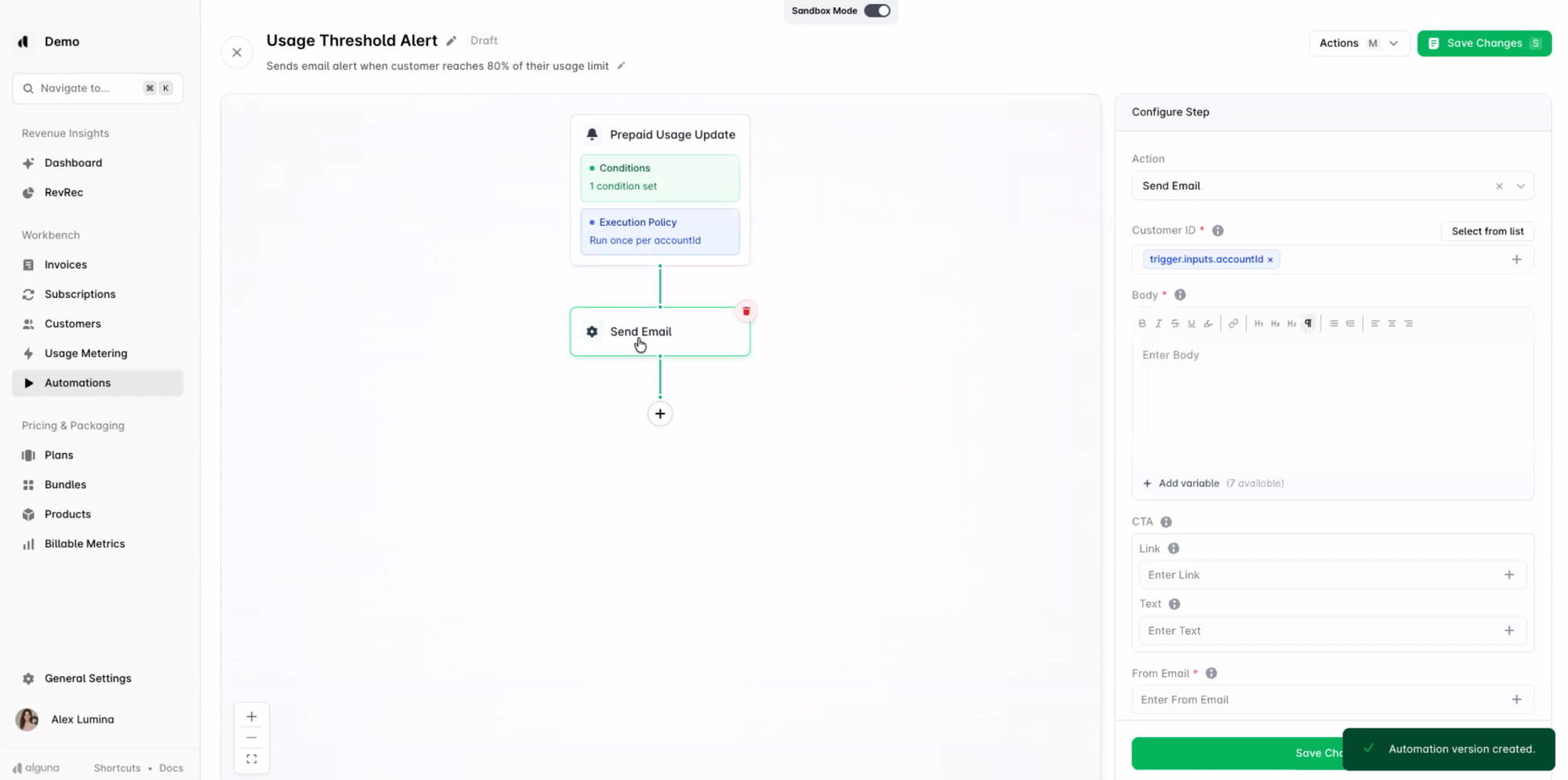
One of the most effective ways to reduce billing friction is to give customers real-time visibility into their own usage before the invoice arrives. A usage dashboard, automated spend alerts, and configurable all serve the same purpose: they replace end-of-month surprise with ongoing awareness.
When customers can see their usage trending toward a threshold, they can make informed decisions about upgrading, throttling, or adjusting their behavior. That's a much healthier dynamic than a large unexpected bill landing in their inbox.
Plan for how your billing model handles edge cases
Every billing system eventually encounters edge cases. What happens when a customer exceeds their plan limit mid-month? Do you hard-stop, charge an overage, or notify and continue? What if a usage event fails partway through? Do you charge for a partial outcome? What's your policy on disputed usage?
These aren't edge cases you can figure out reactively. Document your billing rules before you go live, make them visible to customers in your pricing page and terms of service, and make sure your support team can explain them clearly. Ambiguity in billing rules is a churn driver.
Keep your billing infrastructure flexible enough to evolve
If the fastest-growing companies change their pricing three or more times over two years, their billing infrastructure needs to support that pace of change. Hard-coded billing logic inside your product codebase is a liability. Every pricing iteration becomes an engineering project, which slows down the iteration cycle and diverts resources from product development.
A dedicated billing and revenue platform that can accommodate new metrics, new plan structures, and new charge types without requiring an engineering sprint is one of the most practical investments a scaling software business can make.
Frequently asked questions about value metrics
What is a value metric in SaaS?
A value metric in SaaS is the unit of measurement that determines how much a customer pays based on the value they receive. Rather than charging a flat fee regardless of usage, a SaaS company with a value metric charges more as customers get more from the product. Common examples include seats (for collaboration tools), contacts (for CRMs), or API calls (for developer platforms).
What is the difference between a value metric and a usage metric?
A usage metric measures raw consumption: API calls made, tokens processed, gigabytes stored. A value metric measures outcomes or outputs that directly reflect customer value: deals closed, documents reviewed, support tickets resolved. The best value metrics are usage metrics that also correlate tightly with business value. When the two are misaligned, you get pricing friction.
What is an example of a value metric?
Intercom's Fin AI agent charges per successfully resolved support ticket, which is a strong outcome-based value metric. HubSpot charges per marketing contact, which is a workflow-based value metric tied to the scale of a customer's audience. Both examples tie the price directly to something the customer can connect to business results.
How do I choose the right value metric for my product?
Start by talking to your best customers and asking what outcome they'd miss most if your product disappeared. That outcome is usually a strong signal for your value metric. From there, check that the metric is measurable, that it scales with your costs, and that it's intuitive enough for a non-technical buyer to understand. Our 7-step framework above walks through the full process.
Can I change my value metric after launch?
Yes, and you probably should if the data tells you to. Changing a value metric is a significant pricing change, so it requires clear communication with existing customers and a thoughtful migration path. Grandfathering existing customers on the old metric while moving new customers to the updated one is a common approach that reduces churn risk during the transition.
What are credits and how do they relate to value metrics?
Credits are a simplified unit of currency that sits on top of your underlying value metric. Instead of billing customers directly for tokens, API calls, or other technical units, you sell credits that customers spend across your product. Credits abstract away back-end complexity, make hybrid pricing easier to explain, and give customers a single intuitive unit to budget against. Many AI companies use credits precisely because their underlying infrastructure metrics (like tokens) aren't naturally intuitive for business buyers.
Putting it all together
Defining a value metric is fundamentally an act of empathy. It requires you to understand what your customers actually care about, not what's easy to measure, and then to build a pricing model that feels fair, predictable, and aligned with the results you're helping them achieve.
The companies getting this right aren't just growing faster. They're building stronger customer relationships, because when customers understand what they're paying for and can see the value in every bill, pricing becomes a trust signal rather than a point of friction.
If you're working through your own value metric decisions, Alguna's end-to-end monetization platform is built to support any SaaS or AI pricing model you land on, whether that's consumption-based, workflow-based, outcome-based, or a hybrid of all three. We'd love to show you how it works in practice.