Ask almost any SaaS company what their pricing model is, and you'll get a clean answer. "We're per-seat." "We're usage-based." "We use a platform fee plus consumption."
What you won't hear is how messy it actually is at the enterprise level, or how rarely these tidy labels reflect reality.
Enterprise pricing is almost never one thing.
It's a layered structure that reflects how different customers use the product, what signals value most clearly, and how the vendor needs to capture that value at scale. Companies using hybrid pricing models report a median revenue growth rate of 21%, outperforming both pure subscription and pure usage-based approaches.
This guide doesn't just describe the models in the abstract. We're going to pull apart how some of the biggest names in SaaS and AI are actually pricing their enterprise plans right now, break down the logic behind each structure, and help you figure out what it means for your own product.
Why SaaS enterprise pricing models are more complex than they seem
The "traditional" explanation of SaaS pricing models usually goes: there's flat-rate, per-seat, and usage-based. Pick one. But that framing misses something important about how enterprise deals actually work.
At enterprise scale, no single pricing dimension captures value fully. A per-seat model doesn't account for a customer who processes 10x the data of the next customer on the same contract. A pure usage model creates budget anxiety for finance teams who can't predict monthly spend. A flat rate leaves money on the table from your biggest accounts.
The market has responded accordingly. Flexera's 2025 report on SaaS consumption found that 85% of SaaS leaders have adopted usage-based or hybrid pricing, and 61% of companies were using hybrid models by the end of 2025.
Seat-based pricing as a primary model dropped from 21% to 15% of companies in just 12 months, per Growth Unhinged's 2025 State of B2B Monetization report. Hybrid models, meanwhile, surged from 27% to 41%.
The reasons are structural. First, AI and automation have fundamentally changed what a "user" even means. Second, enterprise buyers are more sophisticated and want pricing that reflects actual value. Third, vendors need commercial structures that can expand with customer growth rather than plateau once seats are filled.
The building blocks: A quick primer on pricing model types
Before we get into the real-world examples, here's a clear summary of the core pricing dimensions and how they actually work at enterprise scale.
| Pricing dimension | How it works | Enterprise benefit | Enterprise risk |
|---|---|---|---|
| Flat platform fee | Fixed monthly or annual charge, regardless of usage or users | Predictable baseline revenue and easy procurement | Doesn't scale with customer growth or value |
| Per-seat (per-user) | Charge for each named user with access | Natural expansion as headcount grows; easy to audit | Creates incentive to limit access; problematic with AI agents |
| Usage-based / consumption | Charge for API calls, tokens, data processed, actions taken | Aligns cost with value; scales naturally with adoption | Unpredictable bills; enterprise finance teams hate surprises |
| Committed spend with overages | Customer commits to a volume at discounted rate; overages at standard rate | Gives finance teams predictability while preserving upside | Requires accurate forecasting and real-time usage monitoring |
| Outcome-based component | Partial charge tied to a measurable business result (deals closed, tickets resolved) | Strong alignment; removes perceived risk from buyer | Attribution is hard; complex to audit; not yet mainstream |
How real enterprise SaaS companies structure their pricing
Let's get into the specifics. We've broken down how four leading SaaS and AI companies price their enterprise plans, and what each structure reveals about their approach to value capture.
What do they all have in common? As expected, they're all running hybrid pricing models.
Salesforce: Seats plus a credit currency plus a negotiated enterprise wrapper
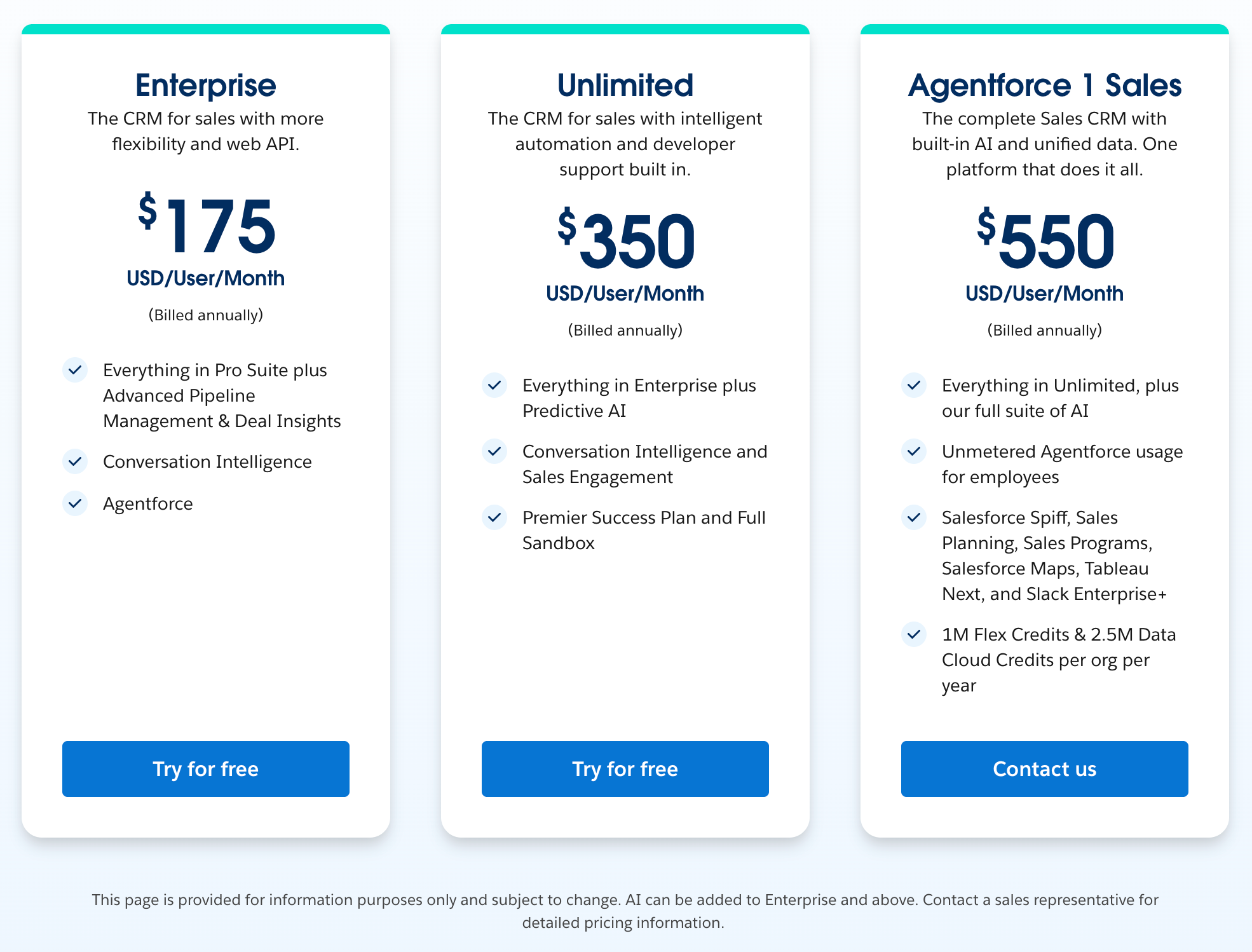
Salesforce is one of the most instructive examples of enterprise pricing complexity, and how a mature vendor responds when a new product category forces a rethink.
At its core, Salesforce has always been per-seat, for example Sales Cloud Enterprise runs at $175 per user per month, with Unlimited at $350. Those are the license fees. But they're rarely the total story.
The real cost picture includes Premier Support (around 30% of license fees), AppExchange add-ons, implementation costs, and data storage. A 50-user Enterprise deployment typically runs $285,000 to $330,000 per year all-in, before you factor in custom development.
Where things get more interesting is Agentforce, Salesforce's AI agent platform. When Salesforce first launched it, they priced it at $2 per conversation, a consumption model that made sense in theory (you pay for what your agents actually do) but created immediate friction in enterprise procurement, where finance teams can't budget for open-ended variable costs.
The response was revealing. According to SaaStr, Salesforce then introduced Flex Credits at $0.10 per action (100,000 credits for $500), before landing on per-user licenses at $125 per month via the Agentic Enterprise License Agreement (AELA). The AELA looks and feels like a classic enterprise deal: a negotiated seat-anchored commitment that bundles AI agent rights. It's what CFOs know how to approve.
Enterprise procurement prefers predictable cost envelopes over perfect value alignment.
Salesforce didn't kill the other models, though. All three now run simultaneously. As of Q3 FY2026, Agentforce hit $540M ARR growing 330% year-over-year. Having multiple on-ramps for different buyer preferences was, in hindsight, the right call.
The key lesson: Salesforce's enterprise pricing is seat-based as the primary commercial wrapper, with an embedded credit currency that meters AI actions within the seat entitlement. Seats give procurement predictability; credits give the vendor control over model costs at scale. It's not one thing or the other.
| Salesforce pricing layer | What it is | Who it's for |
|---|---|---|
| Per-user license (CRM) | $175 to $350/user/month for Sales Cloud Enterprise or Unlimited | All human CRM users |
| Agentforce add-on | $125/user/month for unmetered AI usage for licensed users | Teams deploying AI agents alongside CRM users |
| Flex Credits | $0.10 per AI action (100k credits for $500) for consumption-heavy workloads | Teams with predictable but high-volume agent usage |
| AELA | Negotiated enterprise agreement bundling seats, AI, and Data Cloud | Large-scale enterprise deployments |
| Premier Support | ~30% of net license fees for 24/7 expert access | Any enterprise customer needing elevated SLA |
HubSpot: A platform base fee plus per-seat per-hub plus a credit layer for AI
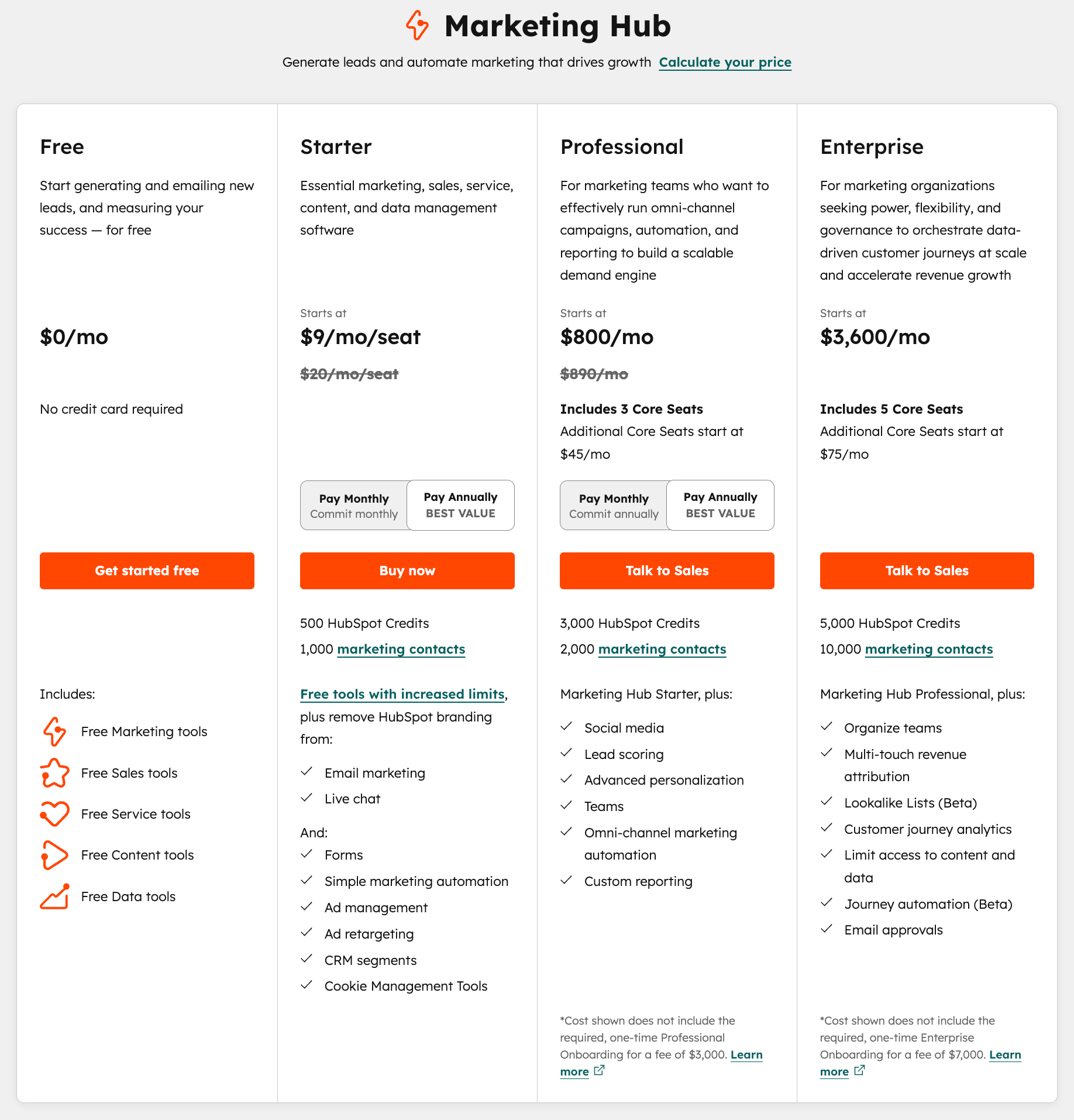
HubSpot made a significant model shift in March 2024, moving away from bundle-based pricing toward a seat-first structure.
The transition reflected a common tension in multi-hub SaaS platforms: how do you price a product that's genuinely modular without creating so much complexity that deals stall?
At enterprise level, HubSpot's Marketing Hub starts at $3,600 per month, which includes 5 core seats and 10,000 marketing contacts. Additional seats cost $75 per month each. Sales Hub Enterprise runs at $150 per user per month, while Service Hub Enterprise starts at $1,500 per month. There's also a mandatory onboarding fee: $7,000 for Marketing Hub Enterprise and $3,500 for Sales or Service Hub Enterprise.
For enterprise teams that want everything, the Enterprise Customer Platform bundle runs $4,300 per month and includes all Enterprise Hubs with 7 seats. Real-world pricing tends to come in 30 to 35% below list after negotiation.
What makes HubSpot's structure genuinely complex is the inter-hub dependency problem. A sales team on Sales Hub Enterprise that wants automated SMS for follow-up sequences cannot simply add it to their subscription — they also need to purchase Marketing Hub Professional (which starts at $890 per month) and then the SMS add-on on top. The modular architecture creates cross-departmental paywalls that aren't always obvious when you sign the initial contract.
The third layer is HubSpot Credits, introduced in 2025 as part of the Breeze AI suite. Credits power AI features including data enrichment and AI agents. At the Enterprise level, customers receive 10,000 credits included. Beyond that, credits are purchased separately. HubSpot auto-upgrades users whose AI usage passes their credit limit without explicit approval, a practice worth flagging in contract negotiations.
Anthropic (Claude): Seat access plus token-based consumption billed separately
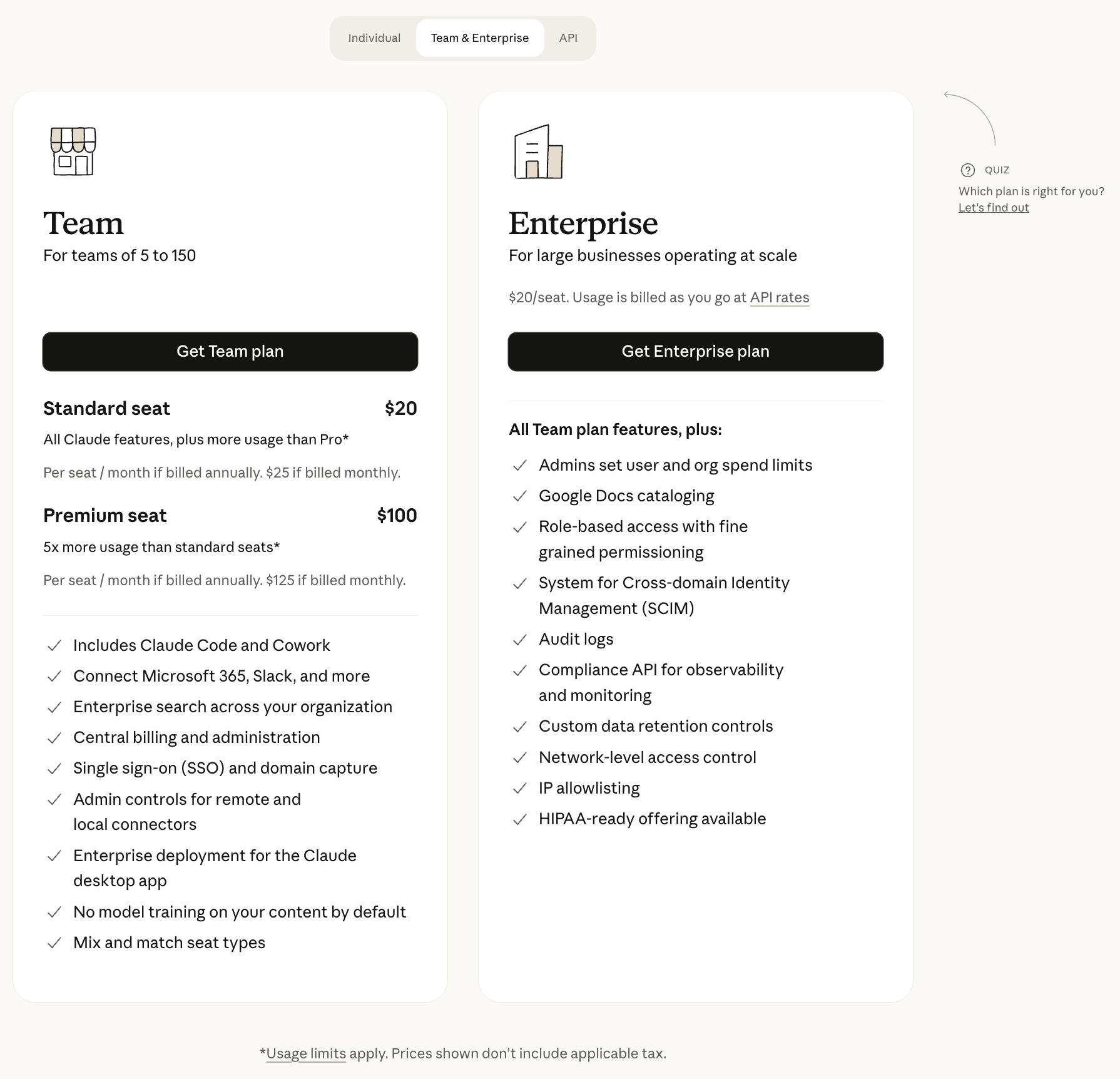
Claude's enterprise pricing model is a useful case study in how AI-native products price differently from traditional SaaS. The commercial structure separates access from usage in a way that most legacy SaaS doesn't.
The Enterprise plan is seat-based at the access layer: a minimum of 20 seats required, billed annually, with the price negotiated through sales. The seat covers access to Claude, Claude Code, Cowork, connectors, SSO, SCIM, audit logs, and compliance controls. But crucially, the seat fee doesn't include a usage allowance. Usage is billed separately at API token rates, on top of the seat fee.
This means the total cost has two independent variables: how many people need access, and how much they actually use the product. Enterprise teams can control both through spend limits and usage caps set by administrators. Under the credit model, organizations pre-purchase credits that draw down with usage. Under the invoiced model, usage is billed monthly in arrears at API rates.
The token pricing itself is model-dependent: Claude Sonnet 4.6 runs at $3 per million input tokens and $15 per million output tokens; Claude Opus 4.5 at $5 input and $25 output. For organizations building AI into their workflows at scale, prompt caching can reduce costs by 70 to 90% on repeated context. Batch processing provides a 50% discount on standard rates.
| Claude Enterprise component | What you pay | Notes |
|---|---|---|
| Enterprise seat | Negotiated per seat, billed annually. Min 20 seats | Covers access, security controls, compliance features, and core products |
| Token usage (Sonnet 4.6) | $3/M input tokens, $15/M output tokens | Billed in addition to seat fee |
| Token usage (Opus 4.5) | $5/M input tokens, $25/M output tokens | Premium model for high-complexity tasks |
| Prompt caching | 70% to 90% cost reduction on repeated context | Significant lever for teams with large, repeated system prompts |
| Batch API | 50% discount on standard rates | For asynchronous workloads that don't require real-time responses |
Snowflake: Pure consumption with committed spend as the enterprise wrapper
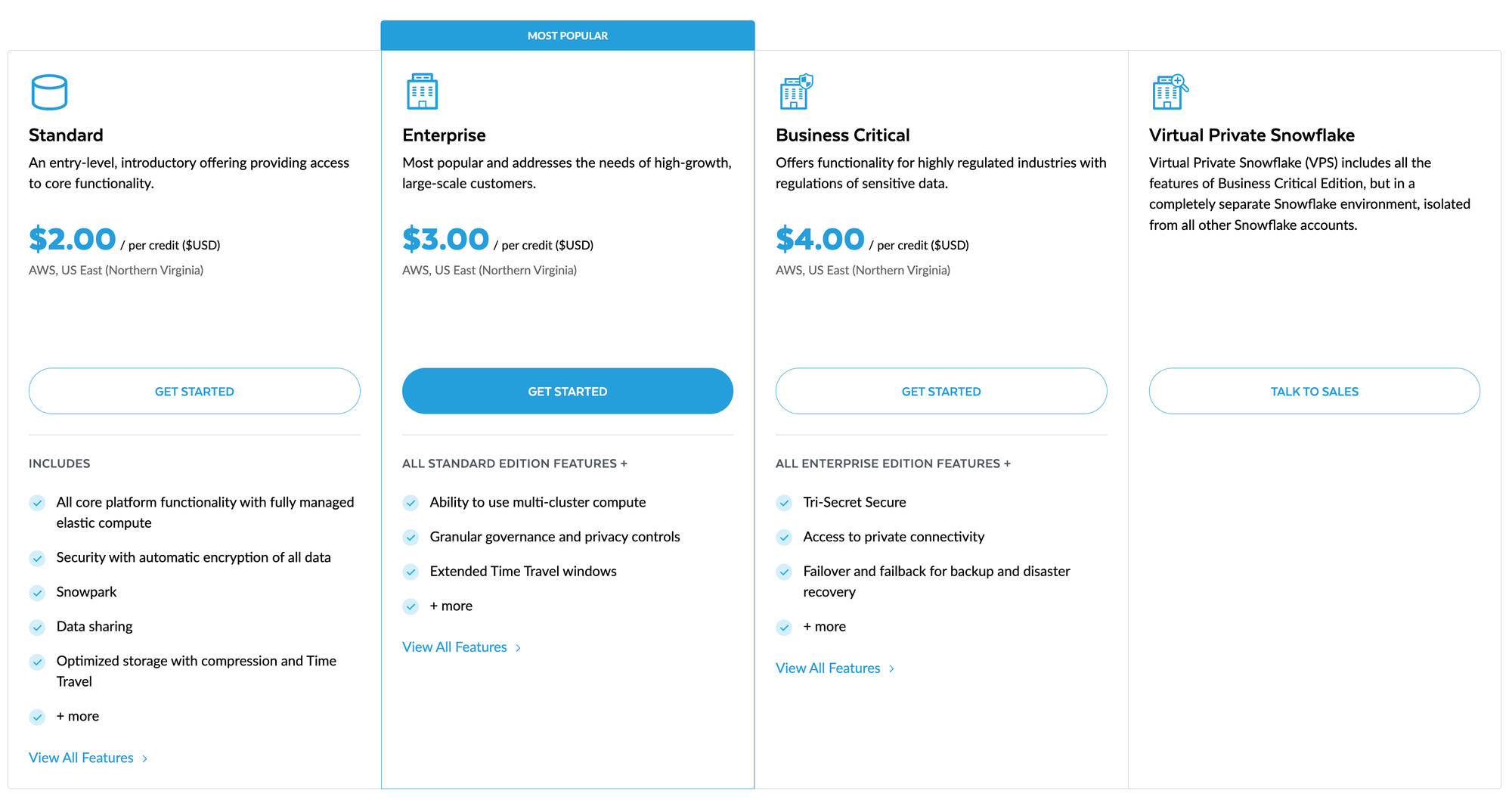
Snowflake is the clearest example of what a consumption-first pricing model looks like in enterprise SaaS. There are no per-user or per-seat fees. You pay for compute, storage, and cloud services — and that's it.
The core unit is the Snowflake credit. Credits are consumed by virtual warehouses (the compute layer that runs queries), with the rate varying by warehouse size. An XSmall warehouse uses 1 credit per hour; a Large uses 8. At Enterprise Edition pricing, each credit costs around $3. Storage is charged separately at $23 per terabyte per month.
For enterprise customers, the commercial structure is typically a committed spend contract: a customer pre-commits to a minimum credit volume annually (usually at a discount of 15 to 40% off on-demand rates), with the option to purchase additional credits if usage exceeds the commitment. This gives Snowflake the predictability of a subscription model while preserving consumption-based billing as the underlying economic engine.
The challenge for enterprise buyers is that Snowflake bills are notoriously hard to predict without good governance. Poorly optimized queries can consume 10x the credits of well-optimized equivalents. Enterprise organizations with complex data pipelines commonly spend $10,000 to $50,000 per month, with costs largely driven by warehouse sizing decisions and auto-suspend settings.
| Snowflake cost component | Pricing basis | Enterprise note |
|---|---|---|
| Compute (virtual warehouses) | Credits per hour, by warehouse size. Enterprise Edition: ~$3/credit | Billed per second, minimum 60 seconds. Primary cost driver |
| Storage | $23/TB/month in most US regions | Compressed data — typical compression reduces actual size 50 to 70% |
| Cloud services | ~10% of compute credits (fair-use threshold) | Metadata, query compilation, authentication — typically absorbed |
| Pre-purchased capacity | 10 to 40% discount vs. on-demand for committed annual spend | Standard for enterprise contracts; enables predictable budgeting |
| Edition (Standard vs. Enterprise) | Enterprise adds ~50% to per-credit cost but unlocks multi-cluster warehouses and 90-day Time Travel | Most enterprise teams need Enterprise edition for concurrency |
The patterns: What these examples have in common
When you look at these four examples alongside each other, a few structural patterns emerge.
1. Every enterprise pricing model has at least two dimensions
None of these vendors is purely per-seat or purely consumption-based. Even Snowflake, the most consumption-pure model, wraps its credits in a committed-spend enterprise agreement that behaves like a subscription. Every model combines a commercial structure that enterprise procurement can budget for with a usage layer that scales with actual adoption.
2. Credits are the new middleware
HubSpot has Breeze Credits. Salesforce has Flex Credits. Microsoft has Copilot Credits. Anthropic charges by token. Snowflake charges by compute credit. What these have in common is they create a metered internal currency that decouples the commercial wrapper (seats, committed spend) from the underlying infrastructure cost (model inference, compute, enrichment lookups). According to SaaStr, credit-based pricing models grew 126% year-over-year in 2025, from 35 to 79 companies in the PricingSaaS 500.
3. Enterprise buyers want predictability, not perfection
The Salesforce Agentforce story is the clearest demonstration of this. The per-conversation model was arguably the most value-aligned approach: you pay exactly for what the agent does. But enterprise procurement rejected it in favor of a seat-based AELA because they could put a number in a spreadsheet. When you're designing enterprise pricing, optimize for what your buyer can approve, not just what makes theoretical sense.
4. Add-ons and cross-product dependencies are where total cost diverges from sticker price
The HubSpot SMS example is a good one. A sales team on Sales Hub Enterprise that wants basic automation functionality ends up spending $1,390 per month (before onboarding fees) because the feature they need lives in a different hub. Snowflake's "fair use" cloud services charge, Microsoft's mandatory M365 prerequisites, and Salesforce's Premier Support add-on all work the same way: they're legitimate products with legitimate rationale, but they consistently push total cost well above the headline number.
Best practices for designing enterprise SaaS pricing
Anchor on the value metric first
Before you decide on a pricing structure, you need to be clear on what the unit of value is in your product. If value scales with users (collaboration tools, CRM), per-seat makes sense.
If it scales with consumption (data platforms, AI infrastructure, APIs), usage-based or hybrid makes more sense. If it scales with a business outcome (leads generated, support tickets resolved, revenue influenced), an outcome component is worth exploring.
The mistake most teams make is anchoring on what's easy to administer or what competitors do, rather than what actually reflects the value exchange.
Build for the buyer, not just the user
In enterprise SaaS, the person using your product is rarely the person approving the contract. Finance teams want predictability. Procurement wants auditability. IT wants governance controls. Legal wants clear liability boundaries. Your pricing model needs to work for all of them, not just the end user who loves the product.
Committed spend with overages is a direct response to this: it gives finance the predictable baseline they need, while still allowing the vendor to capture revenue from heavy usage.
Layer usage-based components on top of a fixed floor
The evidence is clear that pure usage-based models are hard to sell at enterprise level. A floor (platform fee or minimum seat count) gives buyers a number to put in their annual budget, while usage-based components create the expansion revenue that makes the model interesting for the vendor.
Don't bury the add-ons
One of the clearest pricing mistakes in enterprise SaaS is surprise cost expansion. When a customer signs a contract and then discovers 6 months later that the feature they need is behind another paywall, the trust damage is significant.
For expansion to work at enterprise scale, customers need to see the full cost structure upfront, including what's included, what's available as an add-on, and what triggers a tier upgrade.
Build monitoring and spend controls into the product
Usage-based pricing only works if customers can see and control what they're spending. Snowflake, Anthropic, and Salesforce all provide admin-level spend limits and usage dashboards. If your pricing model has a variable component, your product needs to give enterprise admins real-time visibility into that spend. A customer who gets a surprise bill is a churn risk, even if the bill is technically what they contracted for.
Price for expansion, not just acquisition
The best enterprise pricing models are designed so that when a customer gets more value from your product, your revenue grows too. Per-seat models expand when headcount grows. Usage models expand when adoption deepens. Credit models expand when AI features get used more broadly.
Net revenue retention is the engine of enterprise SaaS growth, and your pricing model is what makes it possible.
6 steps to choosing the right enterprise pricing model for your product
There's no universal answer, but there is a clear process. Work through these questions before committing to a structure.
Step 1: Define your value metric clearly
What does "more value" look like for your best customers? More users with access? More data processed? More tasks automated? More revenue influenced? The answer to this question should be the primary axis of your pricing model.
Step 2: Map your expansion motion
How do you expect revenue to grow from an existing customer? If growth comes from headcount, per-seat expands naturally. If it comes from deeper adoption, usage-based or credit-based models capture that expansion. If there's no clear expansion path in your current model, that's the first thing to fix.
Step 3: Understand your buyer's budget process
Enterprise finance teams need to budget 12 months in advance. If your pricing creates significant uncertainty in that calculation, expect slower sales cycles and more procurement friction. The more predictable the cost structure, the faster the deal.
Step 4: Audit your true total cost of ownership
List every dollar a customer might spend with you over the lifetime of the contract, including onboarding, add-ons, integrations, overage charges, and renewal uplifts. If the gap between your headline price and the realistic total cost is large, decide whether you want to close that gap or make it more transparent in the sales process.
Step 5: Test with a hybrid structure
For most enterprise SaaS products, the right model is a base platform fee (or minimum seat commitment) that ensures a revenue floor, plus a usage or credit component that scales with adoption, plus clearly defined add-on modules for expanded functionality. This gives procurement a number to budget for, gives you expansion leverage, and gives customers flexibility.
Step 6: Build the operational infrastructure before you launch
Hybrid and usage-based pricing models require real-time metering, automated billing, and accurate invoice generation across multiple pricing dimensions. Many teams underestimate the operational complexity this introduces. Before you go to market with a new model, make sure your billing infrastructure can support it.
Summary: How the major enterprise pricing structures compare
| Model type | Best for | Expands with | Enterprise risk |
|---|---|---|---|
| Pure per-seat | Collaboration, CRM, productivity tools where user count signals value | Headcount growth | Caps out once seats are filled; AI reduces human-seat demand over time |
| Usage-based / consumption | Data platforms, AI infrastructure, APIs where usage scales with value | Deeper adoption and heavier workloads | Unpredictable bills; harder to budget for |
| Committed spend + overages | Any product with variable underlying costs and enterprise buyers who need predictability | Usage above the commitment threshold | Requires accurate forecasting to commit correctly |
| Platform fee + seat + credits | Multi-product platforms where AI features add a distinct consumption layer (HubSpot, Salesforce) | Both headcount and AI feature adoption | Complexity — buyers need to understand 3+ pricing dimensions to forecast cost |
| Seat + token usage billed separately | AI-native products where the seat covers access but model inference is a real variable cost (Claude, OpenAI) | Model usage per user | Total cost depends on both user count and usage behavior |
Enterprise pricing models require enterprise billing software
There's a gap that most SaaS companies hit when they move upmarket or redesign their pricing: the model they want to offer is more sophisticated than the billing infrastructure they have in place to support it.
A per-seat model with a single annual price is straightforward to administer. But the moment you layer in a platform fee, commitment with usage-based overages, a credit currency, custom contract terms, and annual true-ups (all of which are standard features of modern enterprise deals) you're dealing with a billing problem that spreadsheets and legacy invoicing tools weren't built to handle.
The downstream effects are real and costly. Revenue teams spend hours reconciling usage data against contracted terms at month-end. Finance can't produce accurate ARR or MRR figures because variable charges aren't captured cleanly. Sales makes promises in contracts that ops can't actually bill for.
Customers receive invoices that don't match what they expected, which erodes trust before you even get to the renewal conversation.
So what exactly is needed to handle billing for SaaS enterprise pricing models?
What enterprise billing software actually needs to do
The billing requirements that come with enterprise pricing models are meaningfully different from those of simpler SaaS structures.
Specifically, you need infrastructure that can handle all of the following without manual intervention:
- Multi-dimensional pricing: Billing simultaneously across seats, platform fees, usage volume, and credit drawdown within a single customer contract.
- Real-time usage metering: Capturing consumption data as it happens, not reconciling it at month-end from exported logs.
- Committed spend tracking: Monitoring how much of a committed contract a customer has consumed, and triggering overage billing automatically when they exceed it.
- Contract-level customization: Supporting negotiated terms, custom tiers, volume discounts, and renewal uplifts that differ by account without requiring manual workarounds.
- Automated true-ups: Calculating and billing the difference between contracted minimums and actual usage at the end of a billing period.
- Accurate revenue recognition: Allocating revenue correctly across billing periods, especially for annual prepaid contracts with variable consumption.
This is what separates basic subscription billing tools from purpose-built enterprise billing software. The former are designed for simple, predictable recurring charges. The latter are built for the commercial complexity that enterprise deals actually involve.
The operational cost of getting this wrong
The most common failure mode isn't that companies can't bill at all — it's that they bill inaccurately, slowly, or inconsistently. A usage-based overage that takes three weeks to invoice because someone had to manually pull the data and build a spreadsheet isn't just a revenue delay. It's a signal to your customer that your operations aren't enterprise-grade, which matters in renewal and expansion conversations.
There's also a direct revenue leakage risk, as companies without automated usage billing infrastructure undercharge customers by an average of 8% annually due to metering errors and missed overage triggers. At enterprise deal sizes, that's a material number.
The other cost is speed. Enterprise deals that involve non-standard pricing terms can stall in procurement because the vendor can't produce a clear, accurate quote quickly.
If your billing system can't model the contract structure your sales team is trying to close, you have a problem that sits squarely in the overlap between pricing design and billing infrastructure.
Final thought: Pricing is a product decision
The companies that are doing this well are treating pricing as a product decision. A decision that shapes how customers experience value, how sales teams close deals, and and how revenue grows over time.
The common thread in every example here is that the pricing model evolved with the product.
Remember, Salesforce didn't get Agentforce pricing right the first time, they shipped three versions in 18 months.
HubSpot made a major structural shift in 2024 and is still iterating.
That's not a failure. That's what good pricing looks like: a hypothesis, tested in the market, refined with real customer feedback.