Running an EV charging business is operationally complex. But managing hardware and uptime is only half the story. The other half, the part that determines whether you're actually profitable, is how you bill your B2B clients.
And B2B billing in EV charging is genuinely hard. You're not just processing credit card payments at the charger. You're issuing monthly invoices to corporate fleet operators, settling revenue with site hosts, managing custom contract terms with enterprise accounts, handling reimbursements for employee home charging, and reconciling usage data across dozens or hundreds of charge points.
According to McKinsey, B2B and fleet segments are expected to account for a significant share of EV charging revenue growth through 2030, as more companies electrify their vehicle fleets and workplaces install charging infrastructure.
The problem is that most EV charging platforms are built for B2C payment collection, not for the kind of structured, contract-based B2B billing that enterprise clients expect. And general-purpose billing tools weren't designed with per-kWh usage metering or multi-party revenue sharing in mind.
That gap is exactly what this guide addresses. We've reviewed the best billing software for EV charging companies that need to bill business clients professionally, automate invoicing, and manage the financial complexity that comes with scale. Whether you're billing a fleet of 50 vehicles or managing dozens of site host relationships, the right platform makes the difference between a billing operation that scales and one that breaks under pressure.
What does B2B billing mean for EV charging companies?
B2B billing for EV charging companies refers to the processes and tools used to bill business clients, as opposed to individual drivers paying per session at a charger.
For an EV charging business, B2B billing typically involves:
- Fleet operators: Issuing consolidated monthly invoices to companies for all charging sessions used by their fleet drivers, often across multiple locations and including home charging reimbursements
- Site hosts and property owners: Settling revenue-sharing agreements with landlords, retail sites, or commercial property owners who host your charging infrastructure
- Workplace charging programs: Billing employers for employee charging at workplace sites, often under negotiated contract terms
- Enterprise accounts: Managing custom pricing, volume discounts, and contract terms for large B2B clients, then generating accurate invoices based on actual usage
- Resellers and channel partners: Managing billing downstream for partners who white-label your charging services to their own clients
This is meaningfully different from B2C billing. B2B billing requires formal invoicing (often with purchase order references), support for custom contract terms and negotiated rates, multi-party revenue allocation, and the kind of detailed audit trail that finance teams and procurement departments expect.
As Juan Burgos, Co-founder and CEO at Haven AI, put it: "Once I sign up a customer and we get them deployed, everything's on autopilot — I don't have to think about it anymore." That level of automation is what good B2B billing software delivers: not just payment collection, but a complete, hands-off revenue workflow from contract to cash.
The challenge is finding software that handles the usage-based complexity of EV charging (metered kWh, time-of-use rates, multi-site aggregation) while also supporting the structured, contract-driven nature of B2B sales. That's a combination that eliminates most general-purpose tools, and most EV-specific platforms too.
B2B billing software for EV charging companies: Quick overview
| Platform | Best for | Strengths | Limitations | Pricing |
|---|---|---|---|---|
| Alguna | EV charging companies with complex B2B billing (fleets, site hosts, enterprise) | Usage-based billing, quote-to-cash automation, revenue visibility, multi-party settlement | Requires integration with CPMS for usage data; not a B2C payment tool | Starting at $699/month. No revenue cut. |
| Stripe Billing | Early-stage operators already on Stripe | Fast setup, developer APIs, transaction-based pricing | Limited contract management, weak revenue reporting, not built for complex B2B | 0.5% on recurring + payment fees |
| Chargebee | Growing companies with subscription-based B2B contracts | Subscription lifecycle management, free up to $250K ARR, wide integrations | Usage event caps, RevRec is a paid add-on, limited enterprise contract support | $599/month+ |
| Maxio | Finance-heavy teams needing GAAP-compliant reporting | Built-in RevRec, hybrid billing, serious financial reporting | High onboarding complexity, starts at $5K/year, SaaS-native feel | From $599/month |
| Zuora | Large enterprise operators at serious scale | Deepest billing configurability, native CPQ, multi-entity global billing | Starts ~$75K/year, 3-6 month implementation, overkill for most | From ~$75,000/year |
| Recurly | Growth-stage operators focused on payment recovery | Best dunning management, clean UI, solid usage billing | Limited CPQ, weaker RevRec, less suited for complex multi-party billing | 0.5% on recurring+ |
6 billing software for EV charging: Tried and tested options
1. Alguna
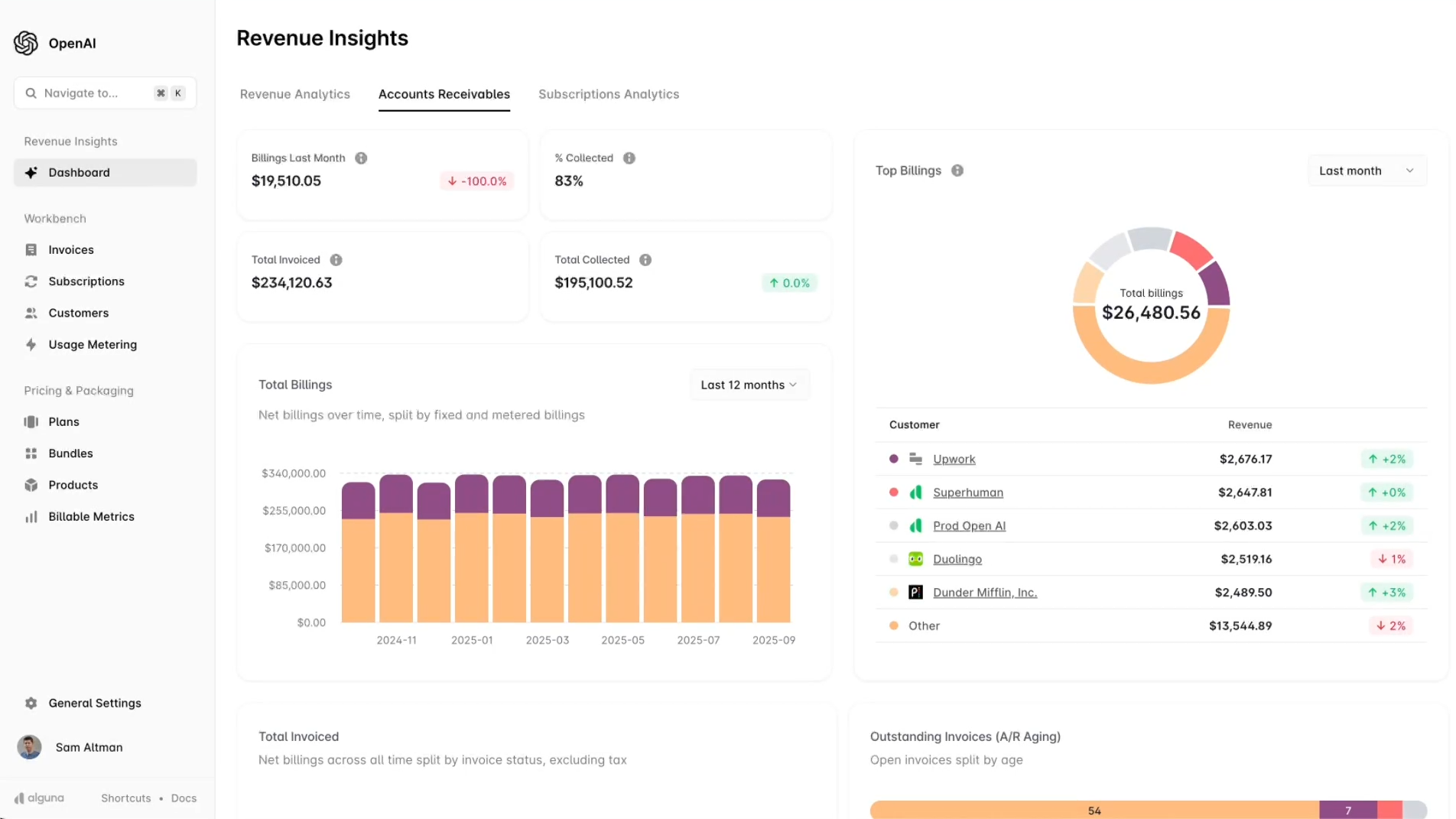
Alguna is an end-to-end quoting, billing, and invoicing platform built for companies with complex, usage-based revenue models, which makes it a natural fit for EV charging businesses billing B2B clients.
Where most billing tools are designed around simple recurring subscriptions, Alguna is built for businesses that need to combine metered usage data, custom contract terms, and automated invoicing for enterprise accounts in a single, unified workflow.
For EV charging companies, this means you can connect your usage data (charging sessions, kWh consumed, tariff rates by location or client tier), configure the contract terms for each B2B client, and have Alguna generate and send accurate invoices automatically. Site host revenue sharing, fleet billing with driver-level breakdowns, and multi-client account management all live in one platform.
Alguna also includes a CPQ (configure, price, quote) workflow, so the journey from quoting a new fleet client through to their first invoice is fully automated.
- Adam Liska, Co-founder and CEO at Glyphic AI
Read the case study
Key features:
- End-to-end quote-to-cash workflow: create quotes, get them signed, and convert them directly into live billing subscriptions without manual re-entry
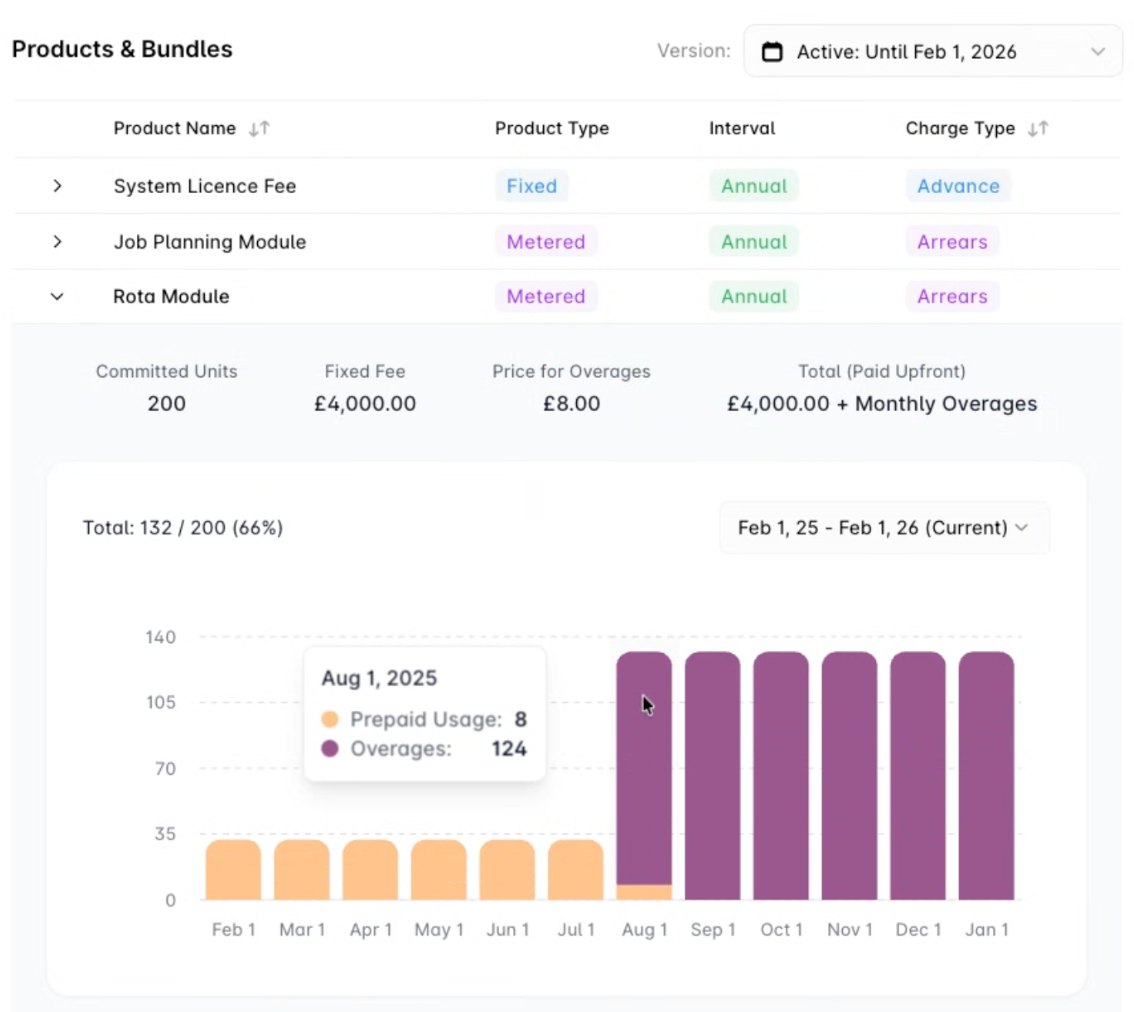
- Usage-based billing engine that ingests metered data and applies custom tariff logic per client, per location, or per billing period
- Automated invoice generation and delivery, with support for custom invoice formats, PO references, and client-specific branding requirements
- Revenue management dashboard with real-time visibility into MRR, outstanding invoices, and revenue movements across your entire client base
- Multi-party revenue sharing and settlement, making it straightforward to manage site host agreements and partner revenue splits alongside customer billing
- Contract and subscription management with support for custom terms, volume discounts, and mid-cycle changes without manual intervention
- Native integrations with CRM, accounting, and payment tools including Stripe, Salesforce, and HubSpot
Pros:
- Built from the ground up for usage-based, complex billin, not retrofitted from a subscription tool
- Quote-to-cash automation reduces the manual work at every stage, from deal close to invoice delivery
- Strong revenue visibility gives finance and ops teams a single source of truth for all B2B revenue
- White-glove onboarding and migration support — "the process turned out to be far smoother than I expected," per Glyphic AI's CEO
Cons:
- Best suited for B2B billing; if you primarily need a B2C payment collection tool at the charger, you'll need a separate CPMS for that layer
- As a specialist platform, it requires integration with your charging management system for usage data ingestion
Best for:
- EV charging companies that bill fleet operators, site hosts, and enterprise accounts on custom contract terms
- CPOs scaling their B2B client base who need to automate invoice generation without growing their finance team in parallel
- Operators who want a single platform for quoting, billing, and revenue reporting across all B2B relationships
- Businesses migrating off Stripe or spreadsheet-based billing who need proper revenue operations infrastructure
Pricing: Starts at $699/month.
Book a personaluzed demo to discuss your specific requirements.
2. Stripe Billing
Stripe Billing is the billing layer built on top of Stripe's payment infrastructure. It's the most widely used billing tool among technology companies globally, and many EV charging businesses reach for it early because of its developer-friendly APIs, fast implementation, and the convenience of having payments and billing in one place.
For B2B billing in EV charging, Stripe Billing can handle the basics: recurring invoices, usage-based charges, and custom pricing per customer. Its metered billing feature allows you to report usage (e.g., kWh consumed per billing period) and have Stripe calculate and invoice accordingly. For early-stage EV charging companies with relatively simple B2B billing needs, it can be a solid starting point.
That said, Stripe Billing is ultimately a payment company's billing product, and it shows. Revenue recognition, multi-party settlement, contract management, and the kind of structured quoting workflow that enterprise B2B sales requires are either absent or require significant custom development to implement. Adam Liska of Glyphic AI described the gap directly: Alguna gave him "a clear overview of revenue movements — something Stripe just couldn't provide."
Key features:
- Metered billing with usage reporting via API, allowing per-kWh or per-session charges to be billed automatically
- Flexible pricing models including flat rate, per-unit, tiered, and volume pricing
- Automated invoice generation and delivery, with customizable invoice templates
- Dunning management for failed payment recovery
- Strong API and webhook infrastructure for building custom billing workflows
- Native integration with Stripe's payment processing and Stripe Tax for automated tax calculation
Pros:
- Fastest implementation of any platform on this list — if you're already using Stripe for payments, billing is a natural extension
- Excellent developer documentation and API flexibility
- Transparent, transaction-based pricing with no monthly platform fees at entry level
- Large ecosystem of integrations with accounting, CRM, and finance tools
Cons:
- Revenue recognition requires additional Stripe add-ons at extra cost
- Limited native support for complex contract management, custom quote-to-cash workflows, or multi-party revenue sharing
- Reporting and revenue analytics are relatively basic — finance teams often need external tools to get meaningful visibility
- Not designed for the structured B2B billing workflows that enterprise EV fleet clients typically require
Best for:
- Early-stage EV charging companies with straightforward recurring B2B billing needs
- Developer-heavy teams who want to build a custom billing system on a solid payments foundation
- Businesses that already use Stripe for payments and want to avoid adding a second vendor early on
- Companies with simple pricing models that don't require complex contract management
Pricing: 0.5% on recurring payments (Starter), plus Stripe's standard payment processing fees (2.9% + 30¢ per transaction). Enterprise pricing available on request. Full pricing details.
3. Chargebee
Chargebee is one of the most recognized subscription billing platforms on the market, widely used by SaaS and recurring revenue companies. It offers a comprehensive feature set for subscription management, automated invoicing, revenue recognition, and dunning — and it has built out usage-based billing capabilities over recent years to serve companies with metered pricing models.
For EV charging companies billing B2B clients, Chargebee is a step up from Stripe in terms of billing management features. It handles subscription lifecycle management well (trials, upgrades, downgrades, contract amendments), includes a self-service customer portal, and supports a wide range of integrations. Chargebee's Starter plan is free up to $250,000 in annual billing, which makes it accessible for earlier-stage operators.
The limitations become visible at scale and complexity. Chargebee's usage metering has a 5,000-event cap at lower tiers, its revenue recognition capabilities require a paid add-on, and its contract management and CPQ functionality is less developed than dedicated quote-to-cash platforms. For EV charging businesses managing complex enterprise fleet contracts or multi-party site host billing, those gaps can become bottlenecks.
Key features:
- Subscription and usage-based billing with support for multiple pricing models including tiered, volume, and per-unit
- Automated invoicing with customizable templates, multi-currency support, and tax management
- Revenue recognition module (Chargebee RevRec) for ASC 606 and IFRS 15 compliance, available as a paid add-on
- Customer self-service portal for B2B clients to manage their own billing details and invoices
- Dunning management with automated payment retry logic
- 30+ payment gateway integrations and pre-built connectors for Salesforce, HubSpot, NetSuite, and QuickBooks
Pros:
- Strong subscription lifecycle management, particularly well-suited to recurring B2B contracts with predictable billing
- Free tier up to $250K ARR makes it accessible without upfront platform cost
- Good integration ecosystem with common CRM and accounting tools
- Well-regarded customer support and extensive documentation
Cons:
- Usage metering has a 5,000-event cap on lower tiers, which can be limiting for high-volume EV charging data
- Revenue recognition is a paid add-on, not included in the base platform
- Advanced reporting requires integration with external BI tools
- Less suited for complex enterprise contracts with custom negotiated terms than dedicated quote-to-cash platforms
Best for:
- Growing EV charging companies with recurring B2B contracts that are primarily subscription-based
- Operators who need solid subscription lifecycle management and automated invoicing without significant custom development
- Teams looking for a free entry point to proper billing infrastructure
- Companies expanding internationally who need multi-currency and multi-jurisdiction tax support
Pricing: Starter plan free up to $250K ARR; Performance plan at $599/month up to $3M ARR; Enterprise plan at custom pricing. Full pricing details.
4. Maxio
Maxio was formed from the merger of Chargify (billing execution) and SaaSOptics (financial reporting), which gives it a distinctive combination of billing automation and financial operations depth. It's primarily positioned for B2B SaaS companies, but its capabilities translate well to EV charging businesses that need to manage complex usage billing alongside serious financial reporting and ASC 606 revenue recognition.
Where Chargebee is strong on subscription lifecycle management and Stripe is strong on payments infrastructure, Maxio is strong on the finance and reporting side. Its SaaS metrics dashboards, revenue recognition automation, and audit-ready reporting are particularly valuable for EV charging companies that have investors or are approaching fundraising or an exit — where clean, GAAP-compliant revenue records matter a great deal.
For B2B billing specifically, Maxio handles both subscription and contract billing (something Chargebee struggles with), manages usage overages, and supports custom pricing per customer. It integrates deeply with Salesforce and HubSpot, making it a good fit for businesses where sales and finance need to stay in sync on contract terms and billing status.
Key features:
- Unified subscription and usage billing with support for hybrid pricing models (e.g., fixed monthly fee plus usage overages per kWh)
- Automated revenue recognition compliant with ASC 606 and IFRS 15, with automatic reallocation for contract changes
- SaaS metrics reporting including MRR, ARR, churn, cohort analysis, and CLV:CAC ratios — directly from billing data
- Collections and dunning automation for failed payments on usage and subscription invoices
- Deep two-way sync with Salesforce, HubSpot, NetSuite, QuickBooks, and Avalara
- Support for high-volume usage metering without the event caps that limit some competitors
Pros:
- Best-in-class financial reporting on this list — finance teams get serious visibility without needing separate BI tools
- Handles both subscription and contract billing, making it more flexible than Chargebee for complex B2B deals
- Revenue recognition is built-in, not a paid add-on
- High-volume usage metering without event caps is valuable for large charging networks
Cons:
- Implementation can be complex and time-consuming, with a steep learning curve for non-finance users
- The platform's origins in SaaS mean some workflows feel less natural for physical infrastructure businesses like EV charging
- Starting price of $5,000 annually makes it less accessible for early-stage operators
- CPQ and quoting functionality is less developed than dedicated quote-to-cash platforms
Best for:
- EV charging companies that have raised institutional funding and need GAAP-compliant revenue records
- Operators managing hybrid pricing models (subscription plus usage) across a significant B2B client base
- Finance and RevOps teams who need serious reporting without building a separate data infrastructure
- Companies preparing for an audit, a fundraising round, or an M&A process
Pricing: Starting from $5,000/year; scales based on feature set and billing volume. Contact Maxio for current pricing details.
5. Zuora
Zuora is the enterprise standard for subscription and usage billing at scale. It's the platform that companies like Zoom, General Motors, and The New York Times use to manage their subscription revenue operations, and it's built to handle the level of complexity — multi-entity global billing, intricate pricing structures, GAAP-compliant revenue recognition, and deep ERP integrations — that only enterprise-grade infrastructure can support.
For very large EV charging companies or utilities with significant B2B client portfolios, Zuora's depth is genuinely impressive. Its usage-based billing capabilities, multi-currency support, and native CPQ module make it possible to manage extremely complex contract structures. Its RevPro module automates revenue recognition across multi-element arrangements — important for EV charging businesses that bundle hardware, maintenance, and energy services into a single contract.
The honest tradeoff is that Zuora is built for scale and complexity — and it comes with the cost, implementation time, and internal resource requirements to match. Contracts typically start around $75,000 per year, and implementation takes 3 to 6 months with dedicated partner support. For most growing EV charging companies, that's more platform than they need. But for enterprise operators who have genuinely outgrown lighter tools, Zuora is the logical destination.
Key features:
- Enterprise-grade subscription and usage billing with support for the most complex pricing structures on the market
- Native CPQ (configure, price, quote) module for managing the full sales-to-billing workflow
- RevPro module for automated, GAAP-compliant revenue recognition across multi-element arrangements
- Multi-currency, multi-entity, and multi-jurisdiction support for global EV charging operations — see our guide to multi-entity subscription billing for context on why this matters
- Deep integration with enterprise ERP systems including SAP, Oracle, and NetSuite
- Zuora Central Platform for building custom billing workflows and integrations via API
Pros:
- The deepest billing configurability on this list — if a billing scenario exists, Zuora can likely handle it
- Native CPQ means the entire quote-to-cash workflow lives in one platform
- Strong multi-entity and multi-currency capabilities for international operations
- Trusted by the world's largest subscription businesses — serious enterprise pedigree
Cons:
- Contracts start around $75,000 per year — not viable for most growing EV charging companies
- Implementation requires 3 to 6 months and dedicated internal or partner resources
- The platform's complexity can make routine billing changes slow and expensive to execute
- Overkill for companies that don't have genuinely enterprise-scale billing complexity
Best for:
- Large-scale EV charging operators or utilities with complex, multi-entity B2B billing requirements
- Companies that have genuinely outgrown Chargebee or Maxio and need enterprise-grade billing infrastructure
- Organizations managing EV charging as part of a broader energy services or mobility bundle
- Publicly traded companies or businesses with institutional investors requiring rigorous revenue governance
Pricing: Contracts typically start around $75,000/year, scaling significantly for enterprise packages. Contact Zuora for pricing.
6. Recurly
Recurly is a subscription management platform that sits between Chargebee and Maxio in terms of complexity and price. It's particularly well-regarded for its dunning management and involuntary churn reduction capabilities — which is to say, it's very good at recovering failed payments and keeping revenue from slipping through the cracks. For EV charging companies billing B2B clients monthly, that reliability in payment collection is genuinely valuable.
Recurly supports usage-based billing, overage charges, and hybrid pricing models, making it applicable to metered EV charging scenarios. Its analytics are solid, and it integrates with the standard accounting and CRM tools. It's a pragmatic choice for operators who want reliable, automated B2B billing without the financial reporting depth of Maxio or the enterprise complexity of Zuora.
One area where Recurly stands out is its revenue recovery tooling. According to Recurly's own research, its platform recovers a significant portion of failed recurring payment transactions through intelligent retry logic — which matters for EV charging businesses issuing high volumes of monthly B2B invoices where payment failures can quietly erode revenue.
Key features:
- Subscription and usage-based billing with support for overages, tiered pricing, and hybrid models
- Industry-leading dunning management with intelligent payment retry logic and automated customer communication
- Revenue analytics including MRR, churn, and lifetime value reporting
- Flexible invoice customization with support for multiple currencies and tax jurisdictions
- Pre-built integrations with Salesforce, NetSuite, QuickBooks, Avalara, and major payment gateways
- Self-service account management portal for B2B clients
Pros:
- Best-in-class dunning and payment recovery among the tools on this list
- Clean, intuitive interface that's easier to navigate than Maxio or Zuora for non-technical users
- Good usage-based billing support for metered EV charging scenarios
- Transparent transaction-based pricing at entry level makes early-stage adoption accessible
Cons:
- Less depth in financial reporting and revenue recognition than Maxio
- Contract management and CPQ functionality is limited compared to Alguna or Zuora
- Less suitable for the most complex multi-party billing scenarios (e.g., three-way splits between CPO, site host, and fleet operator)
- Customer support response times have been flagged as variable in user reviews
Best for:
- EV charging companies with established B2B recurring revenue who want to reduce involuntary churn and payment failures
- Operators at growth stage who need more structure than Stripe Billing but don't yet need the depth of Maxio or Zuora
- Teams that prioritize ease of use and quick implementation over maximum configurability
- Companies managing high volumes of monthly B2B invoices where payment recovery materially impacts revenue
Pricing: Transaction-based pricing starting at 0.5% on recurring payments for the Starter plan; mid-market and enterprise plans available. Full pricing details.
How to evaluate B2B billing software for your EV charging business
Choosing the right ev charging billing software for your B2B operations isn't a feature checklist exercise. It's about matching the platform to your current stage, your billing complexity, and where you're heading.
Here's how to think through it.
1. Start with your billing model, not the platform's feature list
What are you actually billing for? A fleet operator invoiced monthly based on total kWh consumed by their drivers is a very different billing scenario to a site host receiving a monthly revenue share based on a percentage of session revenue. Map your actual billing flows before you evaluate tools. The platforms that look similar on a feature comparison page can behave very differently when you try to model your specific billing logic.
2. Separate B2B invoicing from B2C payment collection
Most EV charging businesses need both: a charge point management system (CPMS) that handles real-time driver payment at the charger, and a B2B billing platform that handles formal invoicing, contract management, and revenue sharing for business clients. These are different tools solving different problems. Don't expect a single platform to do both well — and don't let your CPMS's billing module replace a proper B2B billing system just because it's convenient.
3. Think about the entire quote-to-cash workflow
B2B sales in EV charging rarely start at an invoice. They start with a quote or proposal, move through a contract negotiation, require a signed agreement, and then need to translate into accurate ongoing billing. If you're managing that workflow across separate tools — quoting in a spreadsheet, contracting in DocuSign, billing in Stripe — errors and delays are inevitable. Platforms like Alguna that cover the full quote-to-cash workflow dramatically reduce that manual overhead.
4. Be honest about your revenue recognition requirements
If you have institutional investors, are preparing for a fundraising round, or are moving toward an audit, you need GAAP-compliant revenue recognition built into your billing platform — not bolted on afterward. Maxio and Zuora are the strongest here. Chargebee can handle it with add-ons. Stripe and Recurly require significant additional work. This isn't a nice-to-have; it's a requirement that becomes painful to retrofit later.
5. Assess integration with your charging management system
Your B2B billing platform needs to receive usage data from your CPMS — session records, kWh consumed, timestamps, charger IDs, and driver or vehicle IDs. How that data flows (API, CSV export, webhook) determines how automated your billing can be. Before you commit to a billing platform, verify it can connect to your existing CPMS and that the integration is well-documented.
6. Factor in the total cost of ownership
Transaction-based pricing (like Stripe and Recurly's model) looks cheap early on but scales as your revenue grows. Flat-fee platforms (like Maxio or Zuora) have higher upfront costs but become more cost-efficient at scale. If you're running tiered pricing models, the gap between platforms becomes even more pronounced. Model out the cost of each platform at your current billing volume and at 2 to 3 times that volume — the answer often changes your decision.
7. Talk to the vendor about your specific scenario
EV charging B2B billing is specific enough that a generic sales demo won't tell you what you need to know. Come prepared with your actual billing scenarios — fleet reimbursement logic, site host revenue sharing structure, enterprise contract terms — and ask the vendor to show you exactly how their platform handles them. The answers will separate platforms that technically support your use case from those that genuinely make it easy.
Frequently asked questions about billing software for EV charging companies
Why can't we just use our EV charging platform's built-in billing for B2B clients?
Most EV charging platforms are optimized for real-time B2C payment collection — drivers paying per session at the charger. Their billing modules are designed for that use case, not for issuing formal invoices to fleet operators under custom contract terms, managing site host revenue sharing agreements, or producing GAAP-compliant revenue records. For B2B billing at any meaningful scale or complexity, a dedicated billing platform handles it significantly better.
What's the difference between billing software and payment processing for EV charging?
Payment processing handles the transaction at the charger — authorizing the driver's card or app payment in real time. B2B billing software handles everything that happens after the charging session data is recorded: aggregating usage across a billing period, applying the correct contracted rate, generating a formal invoice, delivering it to the right contact at the client organization, and reconciling the payment when it arrives. These are distinct processes, and they often require distinct tools.
Can billing software handle usage-based pricing for EV charging?
Yes — the best B2B billing platforms all support usage-based pricing, which is the most common model for EV charging (billed per kWh consumed). The key is how you get usage data into the billing platform. Typically, your charging management system records session data, which then needs to flow into your billing platform via API or data export so invoices can be calculated automatically. Alguna, Maxio, and Zuora handle this particularly well.
How does fleet reimbursement billing work in practice?
Fleet reimbursement typically involves collecting home charging session data from drivers (via a home charger or charging app), aggregating it by driver and billing period, and issuing either a reimbursement to the driver or a consolidated invoice to the employer covering all drivers' costs. The billing platform needs to support multi-party data inputs and generate itemized reports the employer's finance team can reconcile against. Usage-based billing tools that support multi-dimensional rating are the best fit for this use case.
What is revenue recognition, and why does it matter for EV charging companies?
Revenue recognition determines when and how you record revenue in your financial statements. For EV charging companies with upfront contract payments, long-term service agreements, or bundled hardware-plus-energy contracts, revenue often needs to be recognized over time rather than at the point of invoicing. ASC 606 (US GAAP) and IFRS 15 govern this. Platforms like Maxio and Zuora automate revenue recognition compliance; others require significant manual work or separate tools.
How do we handle multi-party billing — for example, splitting revenue between our company, a site host, and a fleet operator?
Multi-party billing (sometimes called revenue sharing or settlement) requires your billing platform to support multiple payee accounts and configurable split rules. You define what percentage or amount each party receives from a given revenue stream, and the platform calculates and settles accordingly. Alguna handles this natively as part of its billing model. Zuora can accommodate it with configuration, but it requires more setup work on more general-purpose platforms.
When should we switch from Stripe Billing to a dedicated B2B billing platform?
A few reliable signals: you're spending meaningful time each month manually preparing invoices or reconciling billing data; your enterprise clients are asking for invoice formats, PO references, or contract terms that Stripe can't accommodate; you're managing revenue sharing with site hosts via spreadsheet; or your finance team can't get clear revenue reporting without exporting data to external tools. Any one of these is a sign that you've outgrown Stripe Billing for B2B. All of them together mean the switch is overdue.
How difficult is it to migrate from our current billing system?
Migration complexity depends on how much historical billing data you need to carry over, how many active subscriptions and contracts are in flight, and how customized your current setup is. The best vendors provide dedicated migration support and handle the heavy lifting. Adam Liska, Co-founder and CEO at Glyphic AI, described migrating to Alguna: "Alguna's team made me feel completely at ease: they answered every question, laid out a clear migration plan, and kept me in the loop throughout. The process turned out to be far smoother than I expected, with most of the heavy lifting handled behind the scenes."
Stop letting billing complexity slow you down
The EV charging B2B market is growing fast, and the companies that win won't just be the ones with the best hardware or the biggest network. They'll be the ones with the operational infrastructure to onboard fleet clients smoothly, bill them accurately, share revenue with site hosts automatically, and give their finance teams real-time visibility into what's coming in and when.
Your billing software is your revenue infrastructure. Get it right, and it's invisible, everything just works. Get it wrong, and it becomes a constant source of errors, delays, and manual intervention that costs you time, money, and client trust.
The platforms in this guide represent the best options available in 2025 for EV charging companies with serious B2B billing needs. The right one for your business depends on your stage, your billing complexity, and how much of the quote-to-cash workflow you want to automate.
See how Alguna handles your B2B billing
Alguna is purpose-built for exactly the kind of complex, usage-based B2B billing that EV charging companies need. From quoting fleet clients and managing site host revenue sharing through to automated invoicing and real-time revenue reporting, we handle the full commercial workflow so you don't have to.
"With Alguna, we're more confident in our operations, onboarding customers much faster, and we've even unlocked the ability to support self-service accounts that used to be too labor-intensive to manage," said Adam Liska, Co-founder and CEO at Glyphic AI.