Artificial intelligence (AI) models have moved from research labs into products ranging from digital assistants and content generators to autonomous agents that complete complex workflows on behalf of users.
As these capabilities proliferate, companies need AI pricing models that align revenue with the value AI delivers and the costs of operating large language models.
I workloads scale with data processed, infrastructure consumption and model improvements, so costs grow in ways that are hard to map to a flat fee. In a recent survey of 614 CFOs, 71 % said their company struggled to monetize AI effectively.
Tiered pricing, where different packages of features and usage limits are offered at ascending price points, has emerged as a flexible way to monetize AI models while meeting customer needs.
What is tiered pricing?
Tiered pricing (also called price tiering) is a strategy in which a product or service is packaged at several predefined price points.
Tiered pricing structures package capabilities and usage allowances into multiple price levels, giving customers a clear path to move up as their needs grow. This approach lets companies monetize different customer profiles effectively while still offering predictable, plan-based pricing.
3 common tiered pricing structures
- Standard tiered pricing: The most widely used approach, where each plan unlocks a broader set of features or higher service levels. This follows a classic good–better–best structure.
- Graduated tiered pricing: Sometimes referred to as usage-based tiering, this model lowers the per-unit price as usage increases, with charges calculated progressively across tiers.
- Bulk tiered pricing: Often called volume pricing, where once a usage threshold is reached, a single rate applies to the entire quantity purchased.
Tiered pricing is ideal for AI products with clearly defined user segments, expandable feature sets, and a need to balance revenue predictability with the ability to scale as customers grow.
But of course, there are downsides. Rigid tier boundaries don’t always match real-world AI usage patterns. Customers may feel frustrated if they’re pushed into a higher plan just to access one feature or handle a small spike in usage.
Why tiered pricing makes sense for AI models
Tiered pricing allows vendors to serve diverse customer segments by bundling features and usage allowances at different price points.
Wharton marketing professor Z. John Zhang calls tiered models a necessity: businesses that fail to offer choices “leave money on the table and lose customers.”
By introducing a higher‑priced option for heavy users and keeping a basic tier for light users, companies can increase profits and subsidize cheaper plans.
AI capabilities, which vary widely in sophistication and cost, naturally map to tiers. A basic plan might offer core text generation at a low price, while professional and enterprise tiers unlock additional modalities, longer contexts or analytics.
Research by Simon‑Kucher & Partners shows that well‑designed tiers can increase revenue by 30 % compared with a single price point, and app‑economy data indicates that tiered models can grow revenue 25–40 % over single‑tier approaches.
Benefits of tiered pricing
- Revenue expansion: Multiple price points attract budget‑constrained customers while capturing more value from heavy users. Studies show tiered pricing can lift revenue by 25–40 %.
- Customer segmentation: Different tiers allow companies to tailor packages to casual users versus power users, leading to better retention and marketing insights.
- Increase in perceived value: When customers can compare tiers, premium options seem more worthwhile. Psychological techniques like price anchoring (displaying the highest price first) can boost mid‑tier conversions by 25–60 %.
- Predictable revenue: Subscriptions and predefined usage limits create predictable recurring revenue streams, helping companies forecast AI infrastructure costs and align cash flow.
Pitfalls (and how to avoid them)
- Too many tiers: Research suggests sticking to three to five tiers as excessive choices create decision fatigue and lower conversions. For example, Substack’s multi‑tier rollout in 2024 sparked confusion and backlash because essential content was locked behind higher tiers.
- Unclear value differentiation: Each tier must reflect genuine feature or capacity differences; otherwise, customers won’t pay more.
- Upsell pressure: Tiers that gate core AI functionality can feel predatory. Zylo notes that buyers appreciate clear upgrade paths but dislike feeling forced into higher tiers.
- Shelfware risk: Premium tiers sometimes include features customers never use. Regular usage analytics help ensure that high‑value features remain in the right tier.
Designing effective AI pricing tiers
Building a tiered AI pricing strategy starts with understanding how capabilities drive value and cost.
Start by mapping capabilities along a value spectrum, from basic functionality to advanced features and specialized expertise.
A typical three‑tier structure might look like this:
| Tier | Target users & features | Example AI services | Pricing approach |
|---|---|---|---|
| Essential / Basic | Entry-level users needing core functionality (e.g., simple text generation or basic FAQs). | OpenAI offers ChatGPT Plus with unlimited chats for a flat fee. An AI content platform might include only text generation at $29/month. Claude Instant sells input tokens at lower rates. | Low monthly fee or low per-token rate; often includes limited token allowances or throttled throughput. |
| Standard / Pro | Power users requiring additional modalities or higher usage limits. | Midjourney has Standard and Pro tiers with higher image generation limits; a content platform might bundle text + basic image generation for $79/month. Anthropic’s Claude 2 offers longer context and advanced reasoning at a higher per-token price. | Higher subscription price with larger token quotas; sometimes includes discounted usage rates or priority access. |
| Enterprise / Premium | Large organizations or specialized use cases needing advanced analytics, compliance, and dedicated support. | Midjourney’s Mega plan provides the highest usage allowances. Enterprise tiers may add multi-language support, predictive analytics, and custom models. Seat-based credit pools (e.g., Miro) let organizations share AI credits across users. | Custom pricing—often combining subscription, volume discounts, and usage-based overages; includes SLAs and compliance features. |
Pricing mechanics within tiers
AI vendors can layer different pricing mechanics within each tier, the most common include:
- Volume‑based scaling: Customers receive a quota of tokens, API calls or compute hours per month. OpenAI’s API tiers sell 100 k tokens at $0.002/1000 and 1 M tokens at $0.0015/1000. Volume discounts encourage larger commitments.
- Feature‑based pricing: Higher tiers unlock additional AI competencies. A content platform might price Basic access for text only, Pro for text plus basic image generation, and Enterprise for text plus advanced image and audio features.
- Outcome‑based pricing: Tiers can be structured around outcomes delivered (e.g., lead qualifications vs. full pipeline management). Monetizely’s AI sales assistant example charges $100/month for lead qualification, $250 for qualification plus meeting scheduling, and $500 for complete pipeline management.
- Seat‑based credits: Hybrid models combine per‑seat billing with pooled usage credits. Increasingly popular, seat‑based credits give customers budget predictability while ensuring revenue scales with actual compute costs.
- Packages (Good–Better–Best): Package-based pricing allows non-technical teams to configure tiers like Free, Basic, Plus, and Pro without ongoing engineering involvement. This “good, better, best” structure is widely used in product-led growth because it makes it easy for customers to self-select the plan that fits their needs.
7 best practices for implementing tiered AI pricing
Designing tiered pricing for AI isn’t just about stacking features behind higher price points. Because AI usage scales unpredictably and costs are tied to real consumption, tiers need to be intentional, flexible, and grounded in how customers actually derive value.
The following best practices will help you build tiered AI pricing that’s easy to understand, economically sustainable, and aligned with real-world usage patterns.
- Analyze costs and value drivers
Understand fixed costs (model training, infrastructure) and variable costs (API calls, storage). Determine which capabilities deliver measurable value to users and align them with cost drivers. Reforge’s pricing framework emphasizes defining the value metric, the unit that determines how price scales with usage (e.g., active users, tokens, transactions). - Segment the market
Identify distinct customer personas based on use case, company size, budget and willingness to pay. For example, basic tiers might target hobbyists or small teams, while enterprise tiers serve regulated industries needing SLAs and governance. - Design clear tier structures
Follow the “rule of three” where possible: Basic, Standard and Premium plans simplify decision‑making and cover most segments. Map features and quotas to each tier so that higher tiers offer meaningful value increases. - Test and iterate
A/B test pricing pages and collect feedback. According to Price Intelligently, companies that test pricing strategies see a 25 % revenue uplift. Take historical usage and forecast how new thresholds or tiers affect revenue before rolling them out. - Automate metering and billing
Accurate usage tracking and billing infrastructure are crucial. Platforms like Alguna and Chargebee offer hybrid billing (subscription plus usage/credits) to handle AI’s variable costs. - Communicate value transparently
Explain what’s included at each tier, highlight upgrade benefits and provide calculators or usage dashboards. Transparent unit rates (e.g., per‑token pricing) build trust. - Monitor usage and adjust
Avoid over‑provisioning features that become shelfware. Use analytics to see which features drive upgrades and adjust tiers accordingly. Adaptive models will adjust thresholds and tiers based on observed usage.
Beyond tiered pricing: Hybrid and emerging models
Tiered pricing is not a magic bullet for growth. AI startups are experimenting with hybrid models that blend subscriptions, usage, seats and outcomes to better align with value.
Other pricing approaches include token‑based consumption (common for foundation models like GPT‑5), per‑action pricing (e.g., $2 per conversation handled by an AI agent) and outcome‑based pricing where vendors charge a percentage of the value created.
Some AI companies are even exploring agentic seat pricing, where clients pay per AI agent deployed. Choosing the right combination depends on the AI product’s cost structure, customer preferences and the maturity of the technology.
Seat‑based AI plans are alive and well
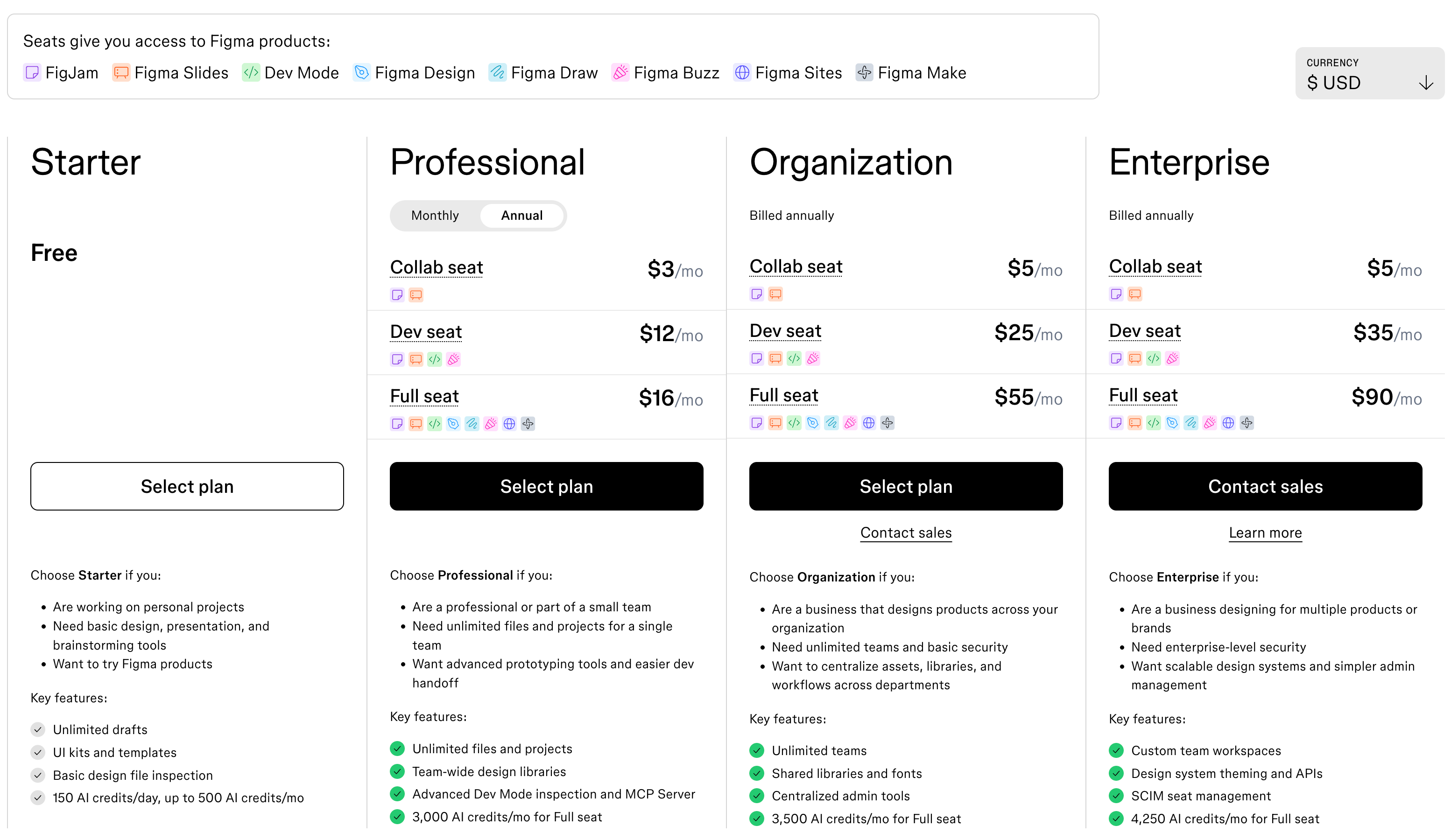
Predictions of the demise of per‑user pricing have been premature.
Growth Unhinged’s 2025 State of B2B Monetization found that seat‑based pricing still accounted for 15 % of B2B software companies, down from 21 % a year earlier. At the same time, hybrid models combining seats with usage components increased from 27 % to 41 %.
They remain a meaningful slice of the pricing landscape as companies like Figma, Miro, and others appreciate the predictable revenue stream while providing users with a familiar pricing structure.
For example, as stated earlier, seat-based plans are now paired with usage and credits to meet customers where they are while at the same time achieving predictable revenue.
The future of tiered pricing is hybrid
Pure tiered pricing works well when usage is predictable. But AI rarely behaves that way. As AI products mature, companies are realizing that static tiers alone can’t capture the full range of how customers consume models, features, and compute.
The result is a shift toward hybrid tiered pricing, where tiers define access and value, while usage-based and seat-based components handle variability (as demonstrated by Figma).
This means plans still communicate clear value (features, limits, governance), but pricing flexes with reality. A base tier might include a fixed number of seats and credits, with overages for excess usage or premium model access. This approach preserves budget predictability for customers while ensuring revenue scales with underlying AI costs.
As the AI market matures, pricing will remain dynamic, and the companies that master these monetization levers will be best positioned to turn breakthrough technology into sustainable profit.