Hybrid pricing has become the go-to approach for SaaS and AI companies that need both predictable recurring revenue and flexible, usage-driven monetization.
As products become more dynamic with API-based, consumption-heavy, and multi-tiered components, pure subscription pricing alone can’t support growth.
That’s where hybrid pricing models come in.
This guide breaks down what hybrid pricing is, why it’s becoming the dominant pricing strategy in modern SaaS monetization, and how to choose the best tools for managing hybrid pricing models without piling complexity onto your finance or RevOps teams.
What is a hybrid pricing strategy?
A hybrid pricing strategy is a monetization approach that combines recurring, predictable charges (such as subscriptions or base fees) with variable, usage-based pricing that scales with how much value a customer actually consumes.
Instead of choosing between flat subscriptions or pure usage-based pricing, hybrid pricing blends both, giving companies stability and flexibility at the same time.
In practice, a hybrid pricing strategy might include:
- A monthly subscription for platform access
- Usage-based fees for API calls, tokens, seats, data volume, or compute
- Credits, commits, or tiered overages layered on top
What makes a hybrid pricing strategy different
A hybrid pricing strategy is more than “subscription + usage.”
What sets it apart is intentional design across multiple dimensions:
- Value alignment: Pricing maps directly to customer outcomes or consumption
- Flexibility: Different customers can be on different pricing models
- Automation: Pricing logic is enforced consistently across quotes, billing, and revenue recognition
- Iterability: Teams can adjust pricing without rebuilding their entire billing system
Without these elements, hybrid pricing quickly becomes operationally painful.
3 reasons hybrid pricing models are gaining popularity
Across B2B SaaS and AI, companies are shifting toward hybrid pricing for three core reasons:
1. Customers expect pay-for-value options
Founders and developers prefer pricing that matches their usage. Hybrid models support the predictability of subscriptions with the fairness of metered usage.
2. Finance teams need stable revenue and growth levers
Hybrid pricing models allow finance teams to balance MRR stability with scalable expansion revenue.
3. AI and API-driven products depend on consumption
AI inference, token usage, API calls, and data volume all vary dramatically. Hybrid pricing ensures high-usage customers pay proportionally.
5 common hybrid pricing models (explained)
Hybrid pricing isn’t a single model, it’s a flexible framework that blends recurring revenue with usage-based monetization in different ways, depending on your product, customer behavior, and growth goals.
Below are five of the most common hybrid pricing models used by modern SaaS, AI, and API-first companies, along with a practical breakdown of how each one works, why teams choose it, and where it’s most effective.
1. Subscription + usage (most common)
This is the flagship hybrid pricing model used across SaaS, AI, infrastructure platforms, and developer tools. Customers pay a predictable recurring subscription fee plus additional charges based on actual consumption.
How it works:
- Subscription covers core access, support, or base platform features.
- Usage fees reflect actual consumption (API calls, messages, compute, seats, storage, tokens, events).
Why companies use it:
- Predictable MRR for finance teams
- Fairness and scalability for customers
- Revenue grows as usage grows
Where it’s used:
AI platforms (token usage), DevTools, data platforms, martech, fintech APIs.
2. Subscription + credits
Instead of charging directly for every unit of usage, companies sell credits that customers consume as they use the product. Credits often roll over, expire, or replenish monthly.
How it works:
- Customer pays a recurring subscription that includes a bundle of credits
- Credits act as a flexible currency (1 credit = 1 API call / 100 tokens / 1 job, etc.)
- If customers need more credits, they can buy top-ups on demand
Why companies use it:
- Customers love predictability without rigid usage limits
- Companies can price multiple usage dimensions in a single unit
- Credits smooth out consumption spikes
Where it’s used:
AI (token bundles), analytics platforms, workflow automation tools, communication APIs.
3. Tiered hybrid pricing
Customers select a subscription tier with a set of included usage, and additional usage is charged at tier-specific or volume-specific rates.
How it works:
- Tier 1 → includes 1,000 units; overage billed at $X
- Tier 2 → includes 10,000 units; discounted overage rate
- Higher tiers = more included usage and sometimes more features
Why companies use it:
- Easy for customers to understand
- Encourages upsells into higher tiers
- Gives companies predictable baseline revenue while handling growth
Where it’s used:
SaaS with PLG motions, AI platforms, productivity software.
4. Base fee + variable units
Customers pay a flat recurring base fee plus pay-as-you-go charges tied to a specific unit of measurement.
How it works:
- Base fee ensures stable recurring revenue
- Variable units track exactly how much the customer consumes
- Billing aligns to value delivered without committing to large usage bundles
Why companies use it:
- Works well for infrastructure-heavy products
- Customers pay only for what they use
- Easy to model and forecast
Where it’s used:
Cloud compute, file storage, video processing, messaging APIs, metered AI compute.
5. Commit + overage
Customers commit to a minimum spend or usage amount, often for a lower rate. If they exceed that commitment, they pay additional overage fees.
How it works:
- Annual or monthly commit sets revenue predictability
- Customer receives discounted usage rates or bundled allowances
- Exceeding usage triggers per-unit overage fees
Why companies use it:
- Strong predictability for finance teams
- Encourages customers to lock in larger commitments
- Flexible enough for variable usage workloads
Where it’s used:
Cloud infrastructure, enterprise SaaS, AI model providers, fintech APIs.
As products evolve, so does the need for hybrid pricing models automation, especially to avoid manual spreadsheets, broken invoices, or messy revenue data.
Why automating hybrid pricing matters
Hybrid pricing sounds simple until you try to operate it at scale. That's when Finance and RevOps teams often struggle with:
- Accurate usage metering
- Multiple pricing models per customer
- Automating bill runs with mixed charges
- Reconciling subscription + variable fees
- Handling commits, minimums, or credit balances
Without dedicated hybrid pricing software, teams end up stitching together homegrown systems, billing tools, and spreadsheets that can’t keep up.
5 best tools for managing hybrid pricing models
| Tool | Hybrid pricing support | Usage metering | Automation level | Best for |
|---|---|---|---|---|
| Alguna | ★★★★★ Full support (subscriptions, usage, credits, commits, hybrid tiers) |
Real-time metering for any type of billable metric, including events, tokens, an credits | End-to-end automation: no-code CPQ → billing → invoicing → rev rec | SaaS, AI, API-first companies needing adaptable hybrid pricing |
| Chargebee | ★★★☆☆ Good for basic hybrid models |
Batch-based; requires external systems for granular usage | Strong subscription automation | Subscription-first SaaS expanding into simple usage billing |
| Maxio | ★★☆☆☆ Limited hybrid pricing support |
Basic metering; not ideal for complex models | Strong financial workflows | Finance-led SaaS teams prioritizing reporting accuracy |
| Stripe Billing | ★★☆☆☆ Supports simple usage + subscriptions |
Robust but developer-driven | Automation depends on custom code | Engineering-led teams building custom pricing infrastructure |
| Zuora | ★★★★☆ Highly configurable |
Strong metering with enterprise control | Enterprise-grade automation | Mature enterprises with deep billing complexity |
How to choose the right hybrid pricing software
Choosing hybrid pricing software isn’t "just" a billing decision. It directly impacts how fast your team can ship new pricing, how accurately you recognize revenue, and how much operational drag sits between sales, finance, and engineering.
When evaluating hybrid pricing software tools, focus on the following criteria:
1. Breadth of pricing model support
Hybrid pricing rarely stays static. As products evolve, teams often need to support multiple hybrid pricing models at once (sometimes even for the same customer).
Look for a system that can handle:
- Subscription + usage, credits, commits, and overages
- Different pricing models per customer, plan, or product line
- Mixed pricing across regions, entities, or contracts
If your tool forces you into a single pricing structure, you’ll end up with workarounds, manual adjustments, or stalled go-to-market plans.
2. Usage metering accuracy
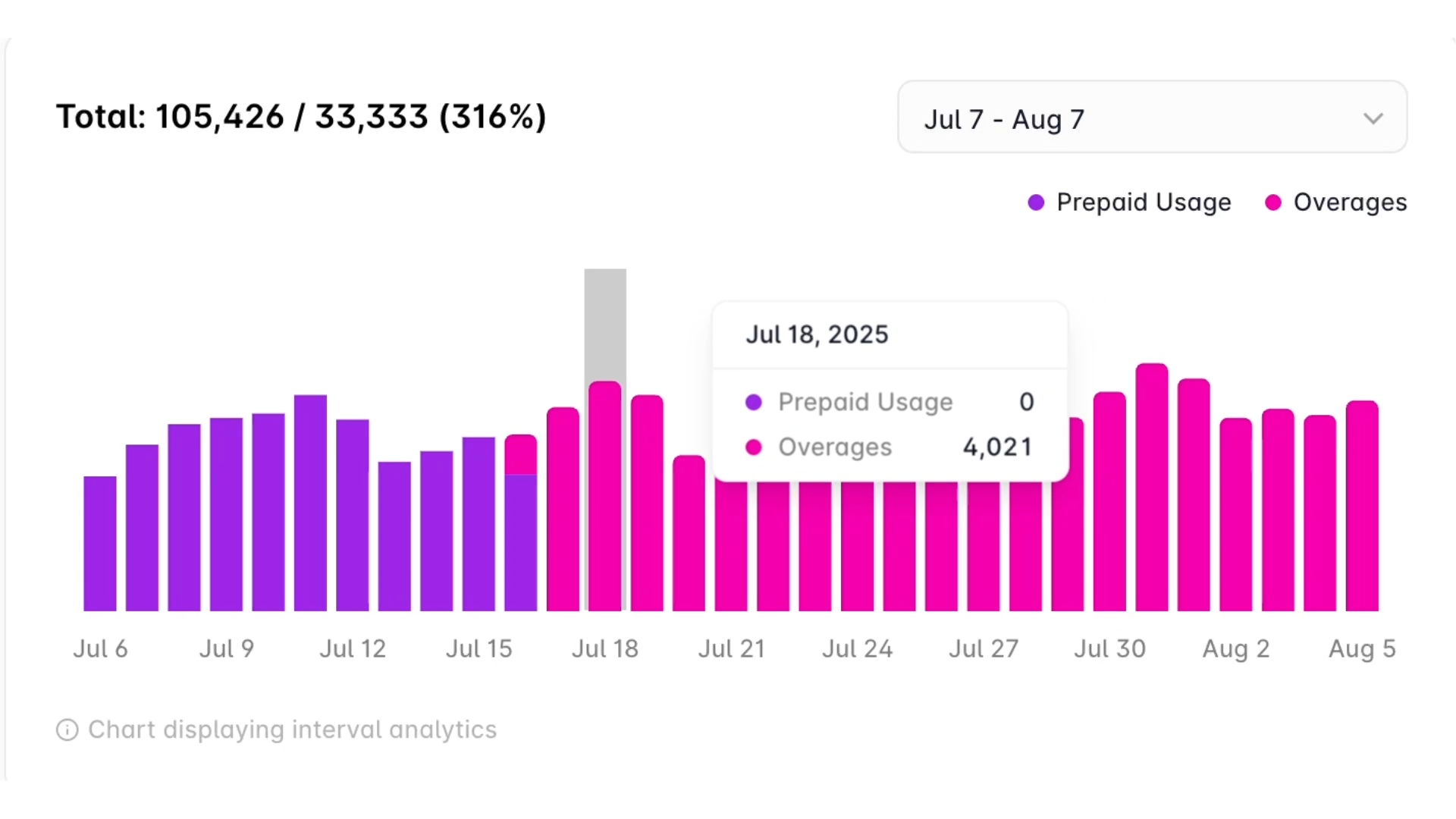
Hybrid pricing only works if usage data is accurate, timely, and auditable. Inaccurate metering leads to billing disputes, lost revenue, and mistrust with customers.
Your platform should be able to:
- Meter usage in real time or near real time
- Handle complex usage dimensions (API calls, tokens, events, credits, seats)
- Support high-volume, variable consumption without manual intervention
This is especially critical for AI and API-first products, where usage patterns can fluctuate dramatically month to month.
3. End-to-end automation (including CPQ)
True hybrid pricing automation goes beyond billing. It should cover the entire quote-to-revenue lifecycle, starting with CPQ.
Look for software that:
- Supports CPQ (Configure, Price, Quote) for hybrid pricing models
- Automatically converts quotes into live billing logic
- Handles invoicing, proration, renewals, and revenue recognition
- Keeps sales, finance, and RevOps aligned on pricing and contracts
Without CPQ built for hybrid pricing, sales teams end up selling deals finance can’t easily operationalize.
4. Low engineering overhead
Hybrid pricing shouldn’t require a permanent engineering project. While APIs are important, pricing operations should primarily live with RevOps and finance—not engineering.
The right tool will:
- Reduce custom billing logic and internal tooling
- Allow non-technical teams to manage pricing changes on the fly
- Eliminate fragile scripts, spreadsheets, and manual reconciliations
If every pricing update requires a sprint, your pricing strategy will always lag behind the market. Or even worse, if you have a dedicated billing engineer, it's really time to rethink your pricing tools.
5. Pricing experimentation speed
Modern pricing is iterative. Teams need to test new models, adjust packaging, and respond quickly to customer behavior.
Prioritize platforms that enable:
- Fast creation and deployment of new pricing models
- Controlled experiments without breaking existing customers
- Rapid iteration without reworking contracts or billing logic
The faster your RevOps team can ship pricing changes, the faster your business can learn and grow.
It should unify CPQ, usage metering, billing automation, and revenue recognition into a single, flexible platform so your pricing strategy can evolve as fast as your product does.
The future of hybrid pricing
Hybrid pricing gives companies the flexibility to match value with revenue, but it only works when the right tooling is in place.
Hybrid pricing is becoming the default for AI, SaaS, and API-first products. The companies winning in 2026 and beyond will be the ones who:
- Use hybrid pricing strategically
- Automate hybrid pricing models end-to-end
- Adopt tools that simplify—not complicate—their revenue operations
As usage-based monetization grows and AI workloads increase, hybrid pricing will only accelerate.
Whether you’re scaling an AI platform or modern SaaS product, investing early in hybrid pricing software will save you countless hours of operational overhead and unlock meaningful revenue growth.
If you want help designing or operationalizing hybrid pricing models, start by evaluating platforms that provide automation, flexible pricing structures, and clean revenue data.