High-growth fintechs don't lose deals because they can't build product. They lose deals because pricing gets complicated, billing gets messy, finance loses confidence in the numbers, and customers lose trust the moment an invoice feels wrong.
A strong billing solution for fintech companies has to do more than generate invoices.
This guide compares six popular billing solutions for fintech companies, you a decision path based on your monetization model, implementation reality, and finance requirements.
Alguna: Best for fintechs that need quote-to-cash plus automated revenue recognition, with strong multi-entity support.
Maxio: Best for subscription-led fintech businesses that need mature invoicing operations, proration, dunning, and revenue recognition.
m3ter: Best for teams that want deep metering and billing computation, including bill lifecycle controls and multi-currency billing logic.
Metronome: Best for modern usage and credit-based pricing with strong APIs and integrations to invoicing, accounting, and revenue workflows.
Togai: Best for API and event-driven fintech products that need real-time metering, rating, and invoices with an engineering-first workflow.
Zenskar: Best for finance-led teams that need flexible contract pricing (including percent pricing), multi-entity structure, and revenue recognition rules.
Why fintech billing breaks when you scale pricing
Fintech revenue is often variable and fee-pressured, especially in payments, which makes accuracy and pricing agility non-negotiable. As a result, it makes fintech billing harder.
Here are three forces that consistently show up in fintech billing failures.
- Revenue pressure increases the cost of billing mistakes
In its 2025 global payments report, McKinsey notes that payments revenue growth slowed to 4 percent in 2024 (down from 12 percent in 2023), and also points to ongoing pricing pressures and regulatory scrutiny that squeeze fee-based models.
When margins compress, revenue leakage and invoice disputes hurt more. - Hybrid pricing is becoming normal, which makes billing a product system
OpenView’s State of Usage-Based Pricing report highlights the shift: it predicts that 61 percent of SaaS companies will have adopted some form of usage-based pricing, and notes that while 15 percent are largely usage-based, 46 percent use a hybrid approach.
Hybrid billing is where many fintech companies end up: subscriptions plus variable usage, plus contract terms.
Teams are iterating pricing frequently, so your billing stack has to move fast
OpenView reports that over 94 percent of B2B SaaS pricing leaders update pricing and packaging at least once per year, with almost 40 percent updating as often as quarterly.
Fintech decision makers feel the same pressure: bundle changes, new rails, new partner models, and new geography launches. A billing platform that cannot keep up becomes a growth constraint.
Comparison overview: Best billing solutions for fintech companies
The table below gives you a side-by-side snapshot of how the leading billing platforms compare across pricing flexibility, fintech-specific capabilities, multi-entity support, and revenue automation depth. Use it as a quick filter before diving into the detailed breakdowns that follow.
Note: “Pricing flexibility” is about whether the system can model hybrid pricing. For example, tiered subscription plus transaction fees plus credits plus custom terms, without you building a billing product internally.
| Platform | Pricing flexibility | Multi entity support | Revenue recognition | Fintech-specific strengths |
|---|---|---|---|---|
| Alguna | Very high (pricing, quoting, usage, invoicing) | Native multi-entity with consolidated revenue workflows | Native automated revenue recognition with audit traceability focus | Transaction fees and interchange guidance, plus contract-driven billing workflows |
| Maxio | Moderate to high (variable usage and multi-attribute rated models) | Multi-entity via “sites” (separate catalogs, customers, gateways) | Native revenue recognition product with compliance framing | Proration, dunning, invoice consolidation, and multi-currency support |
| m3ter | Very high (meters, aggregations, pricing plans) | Account-level hierarchies; multi-entity consolidation not a primary message | Not positioned as a native revenue recognition module | Bills, credits, debits, approvals, locking, multi-currency billing logic |
| Metronome | High (rate cards, credits, usage-native constructs) | Typically integration-led for multi-entity | Integration-led (invoicing and downstream revenue processes) | Usage transparency, dashboards, and credit monitoring for variable usage |
| Togai | High (metering, rule engine, entitlements, pricing models) | Not clearly positioned for multi-entity consolidation in public docs | Not positioned as a native revenue recognition engine | High-throughput event ingestion with idempotency and auditable event logs |
| Zenskar | High (percent pricing and multi-dimensional tiers) | Business entities model plus multi-entity operational support | Native revenue recognition rules with ASC 606 and IFRS 15 guidance | Percent pricing for take-rate models and invoice consolidation narratives |
A quick reality check: if your fintech includes a payments component, you may also end up integrating with separate tax, accounting, and data systems no matter which platform you pick. Several vendors explicitly position themselves as part of a revenue tech stack, not the entire stack.
6 modern fintech billing solutions
Fintech billing is no longer just about sending invoices. It is about orchestrating pricing, usage, contracts, payments, revenue recognition, and compliance across multiple entities and currencies.
Below are six modern fintech billing solutions designed to handle complexity at scale, from API-first metering engines to end-to-end quote-to-revenue platforms.
1. Alguna: Best billing solution for fintech companies with high usage volume or hybrid pricing models
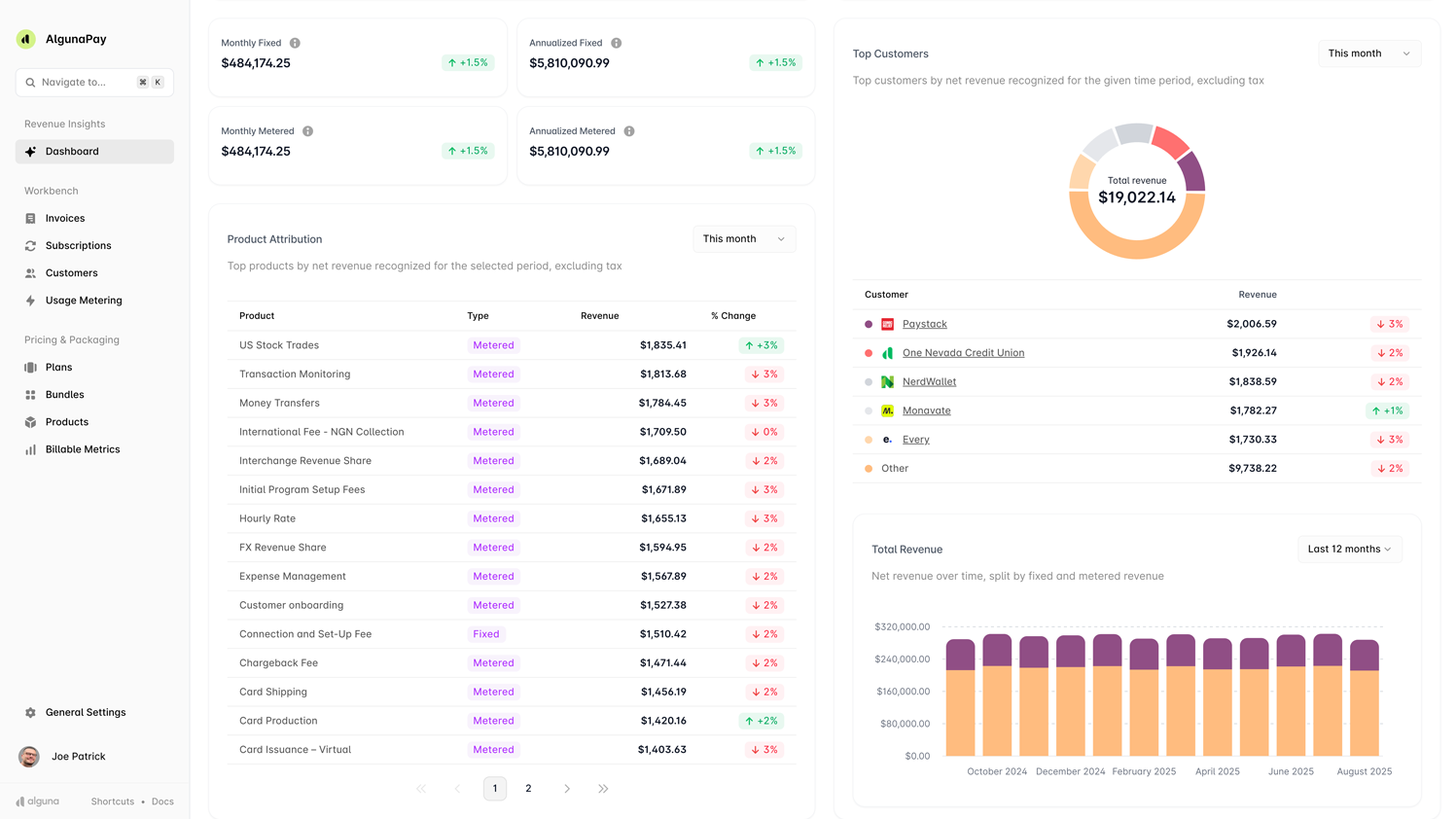
Y Combinator backed Alguna is an AI-native quote-to-revenue platform that brings pricing logic, CPQ, usage metering, billing, collections, and revenue recognition into a single source of truth.
Where most legacy billing tools were designed for static seat-based SaaS, Alguna was purpose-built for modern monetization models—usage, credits, take-rates, interchange++, outcome-based pricing, and hybrid contracts that mix subscriptions with transaction fees.
For fintech operators managing multi-entity structures, multi-currency billing, and complex contract terms, Alguna replaces fragmented workflows with an automated, end-to-end revenue engine designed to scale alongside pricing complexity.
Fintech billing features
- Visual pricing and quoting builder that lets teams move from seats to usage, credits, or hybrid models without engineering tickets.
- Automated billing and collections that consolidate subscriptions, usage and one‑off transactions into a single invoice, with retries and dunning built in.
- Real‑time metering for any billable metric—tokens, API calls or seats—plus native handling of credits, wallets and overages.
- ASC 606/IFRS‑compliant revenue recognition and multi‑entity support across currencies and geographies.
- Deep integrations with Stripe, NetSuite, Xero, QuickBooks and other CRMs/ERPs to centralize billing data.
Best for
Alguna is ideal for fintech companies that combine subscription fees with transaction‑based or usage‑based pricing and need to manage contracts, billing and revenue recognition across multiple entities.
Its no‑code flexibility suits teams iterating on pricing frequently and replacing stitched‑together CPQ and billing workflows.
Pricing
Alguna offers a tiered pricing model starting at roughly $699 per month for SaaS and fintech companies. Alguna never takes a revenue cut.
2. Maxio: Best for subscription‑led fintech companies needing mature finance tooling
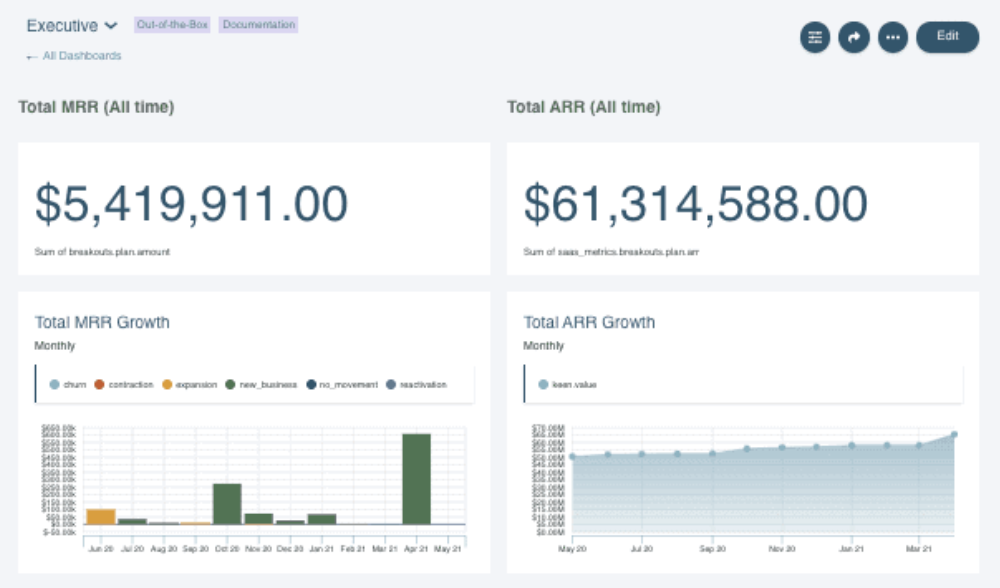
Maxio (formerly SaaSOptics and Chargify) provides an integrated suite that combines quoting, billing, subscription management, revenue recognition, metrics and accounts receivable.
It focuses on mid‑market and enterprise B2B SaaS and fintech companies that need to automate recurring billing, handle usage‑based charges and stay compliant with ASC 606/IFRS standards.
Fintech features and capabilities
- Built‑in CPQ and contract management to create quotes, generate contracts and auto‑approve deals before pushing them to billing.
- Recurring and usage‑based billing with flexible pricing (flat‑rate, tiered, hybrid), proration and dunning management.
- Native revenue recognition engine that automates ASC 606/IFRS‑compliant schedules and syncs journal entries to the general ledger.
- Metrics and reporting modules delivering ARR/MRR, churn, revenue waterfalls and other SaaS metrics.
- Multi‑entity support via “sites” that separate catalogs, customers and payment gateways for different business units.
Best for
Maxio is suited for subscription‑centric fintech SaaS companies that need mature finance operations—especially where revenue recognition, collections and reporting must be automated across multiple entities.
Pricing
Maxio’s Grow plan starts at $599 per month for up to $100 k in monthly billings and includes recurring billing, usage‑based pricing, contract management and revenue recognition.
The Scale plan offers custom pricing for higher volumes and adds advanced revenue recognition, multi‑entity support, accounts receivable management and metering/rating capabilities.
3. m3ter: Best for enterprises needing deep metering and rating
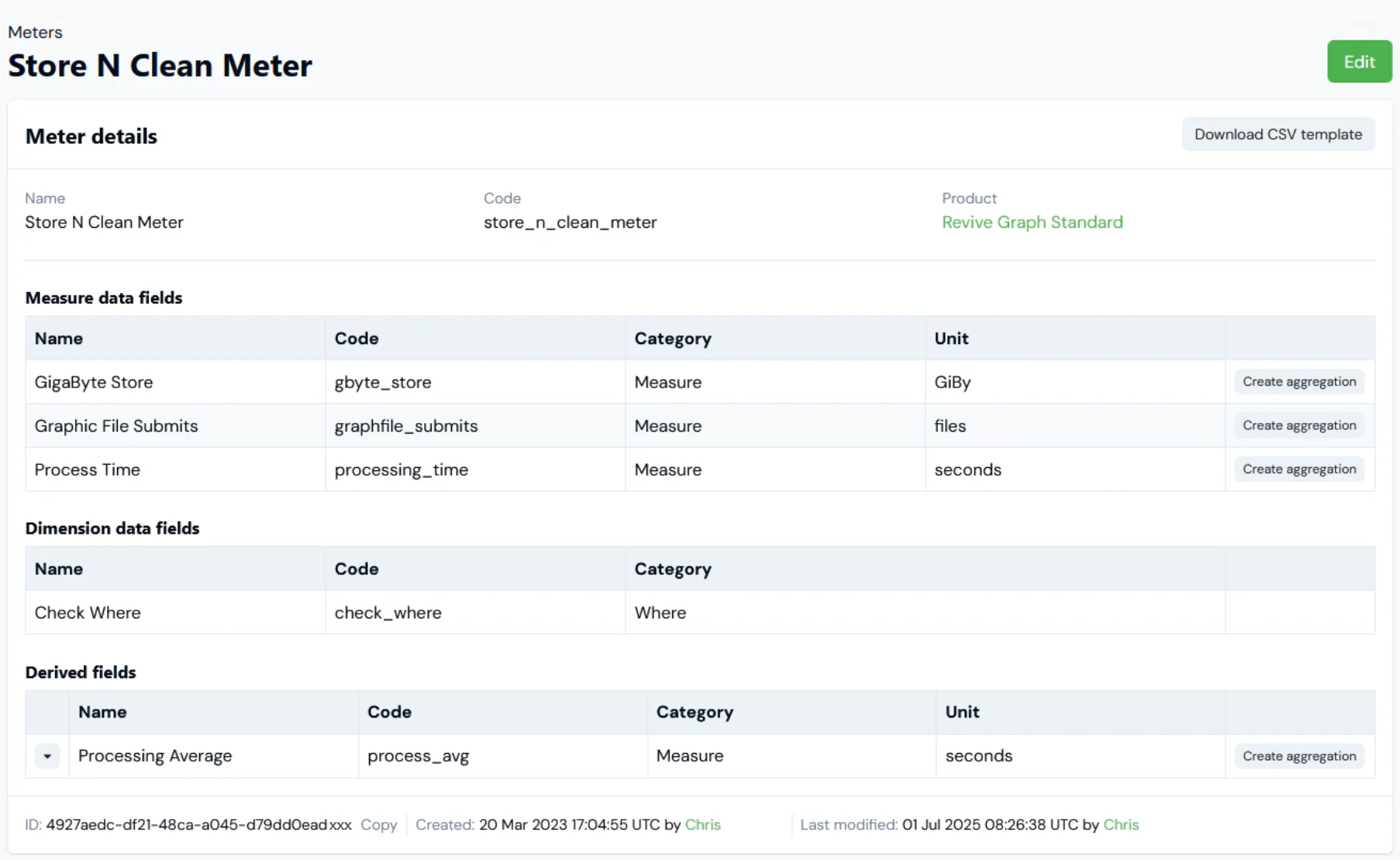
Instead of replacing existing quote‑to‑cash software, European based m3ter layers metering and rating infrastructure on top of solutions like Salesforce and NetSuite to ingest usage data, calculate bills with precision and automate revenue accounting.
Fintech billing capabilities
- Continuous ingestion of unaggregated usage data via APIs or streaming connectors, with flexible aggregation and pricing logic for any charging model.
- Real‑time bill calculations that integrate with Salesforce, NetSuite and other quote‑to‑cash systems.
- Support for complex tiered, threshold and commit‑based pricing, including custom rating formulas.
- Self‑service dashboards for finance and product teams to monitor usage and revenue, reducing billing inquiries.
- Usage analytics and integrations to deliver data to customer portals and BI tools.
Best for
m3ter is suited for mid‑sized to large fintech companies that need granular control over usage metering and rating but want to continue using their existing CRM/ERP stack. It is ideal when revenue leakage, manual close processes or complex pricing experiments are slowing growth.
Pricing
M3ter doesn't have transparent pricing and is usually custom and based on event volumes and integration needs.
4. Metronome: Best for usage and credit‑based pricing with enterprise flexibility
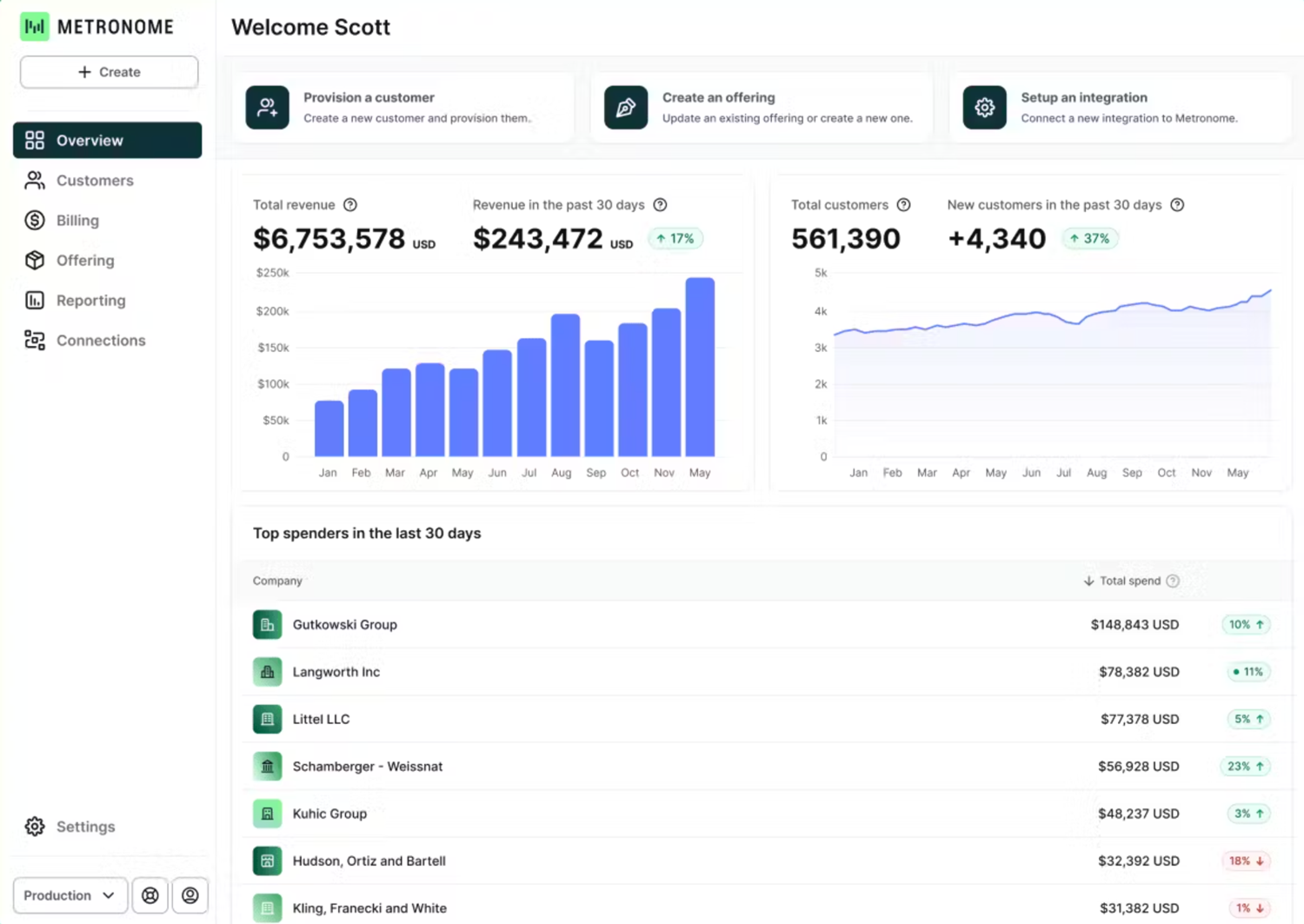
Recently acquired by Stripe, Metronome is an infrastructure for modern monetization. It combines real‑time metering, pricing, billing and reporting to support usage‑based, seat‑based, subscription and hybrid models.
The platform emphasizes transparency with embeddable billing dashboards and real‑time alerts so both customers and finance teams understand consumption.
Fintech billing features
- Real‑time event ingestion with SQL‑based billable metrics and streaming alerts, allowing fintech companies to detect anomalies and manage fraud risk.
- Modular pricing building blocks—rate cards, commits and credit models—that can be combined to support prepaid wallets, usage tiers and custom contracts.
- Native integrations for invoicing with Salesforce, NetSuite and cloud marketplaces (AWS, Azure, GCP) and data exports to warehouses and BI tools.
- Embeddable dashboards and APIs for real‑time usage visibility, spend limits and alerts.
Best for
Metronome suits fintech companies that need to blend self‑serve usage‑based pricing with enterprise contracts and credits. Its real‑time ingestion and modular pricing make it ideal for product‑led growth models, marketplaces and API businesses.
Pricing
Custom across all plans.
Metronome offers a Starter tier that lets teams start for free with real‑time ingestion, multiple pricing models and Stripe integration. A Custom tier adds integrations with Salesforce, NetSuite and cloud marketplaces, data exports, dedicated support and tailored pricing for high‑volume usage.
5. Togai (by Zuora): Best for API‑first fintech infrastructure
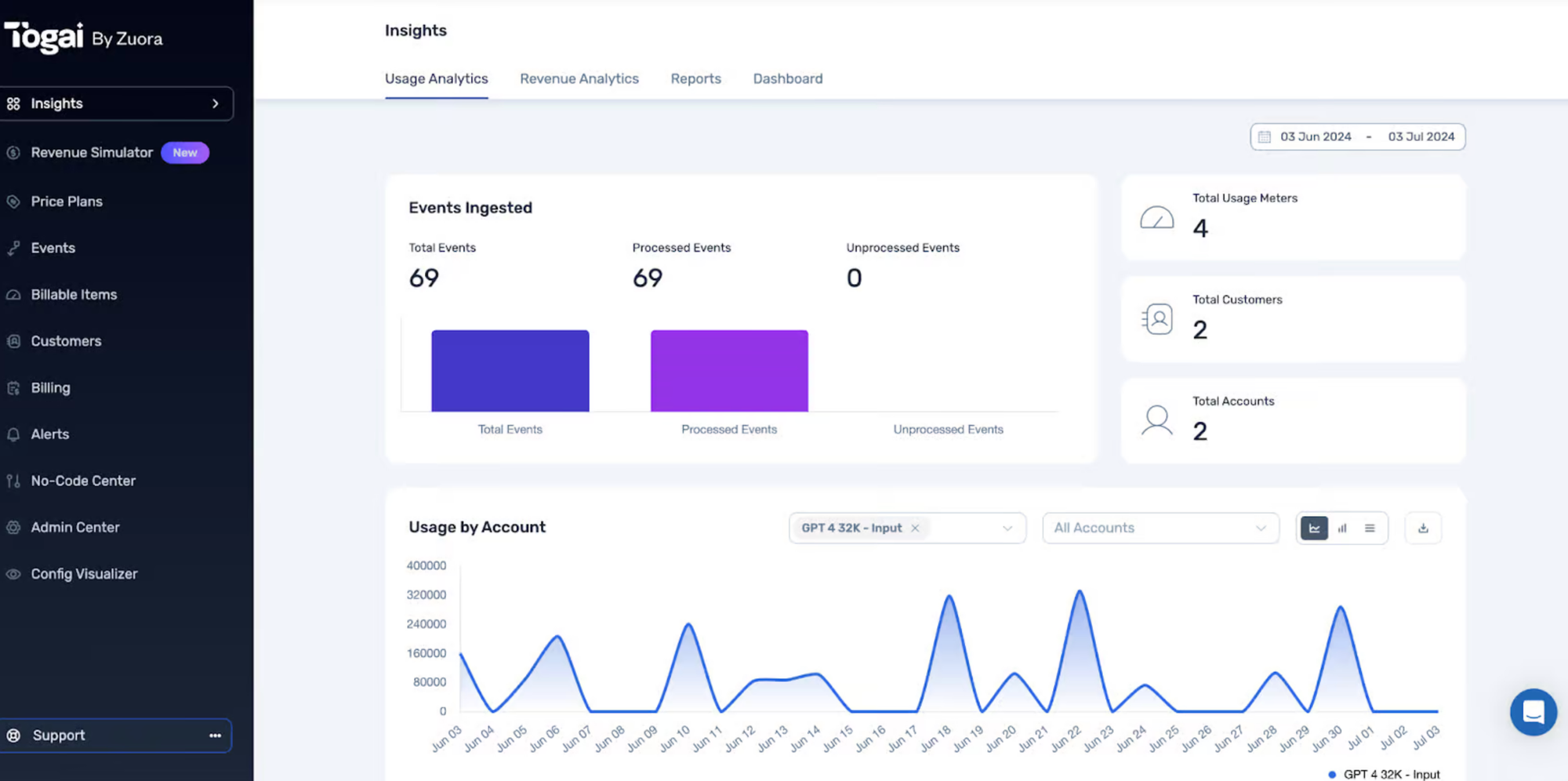
Togai is a usage‑based billing platform designed to handle high‑throughput event ingestion and granular metering. The Zuora-owned platform supports subscriptions, pay‑as‑you‑go, tiered, one‑time purchases, credits, overages, wallets and hybrid models.
It also includes an entitlements engine for gating features and a rules‑based rating engine to translate raw events into billable charges.
Fintech billing capabilities
- Event‑driven ingestion and metering capable of capturing millions of API calls and transactions in real time.
- Flexible pricing configurations covering subscriptions, pay‑as‑you‑go, tiered, one‑time purchases, credits, overages, postpaid/prepaid plans, wallets and hybrid models.
- Rule‑based rating and entitlement management, allowing companies to set limits, allocate credits and gate access by customer segment.
- Usage analytics and billing dashboards to track spend and usage trends across customers.
- API‑first architecture with webhooks and SDKs, making it easy to integrate into fintech infrastructure.
Best for
Togai suits fintech infrastructure platforms and API‑driven services that need to meter high‑volume events and bill for complex combinations of subscriptions, credits and usage.
Pricing
Togai does not publish standard pricing, companies typically work with sales to obtain usage‑based or enterprise quotes.
6. Zenskar: Best for finance‑led teams needing flexible contracts and rev rec rules
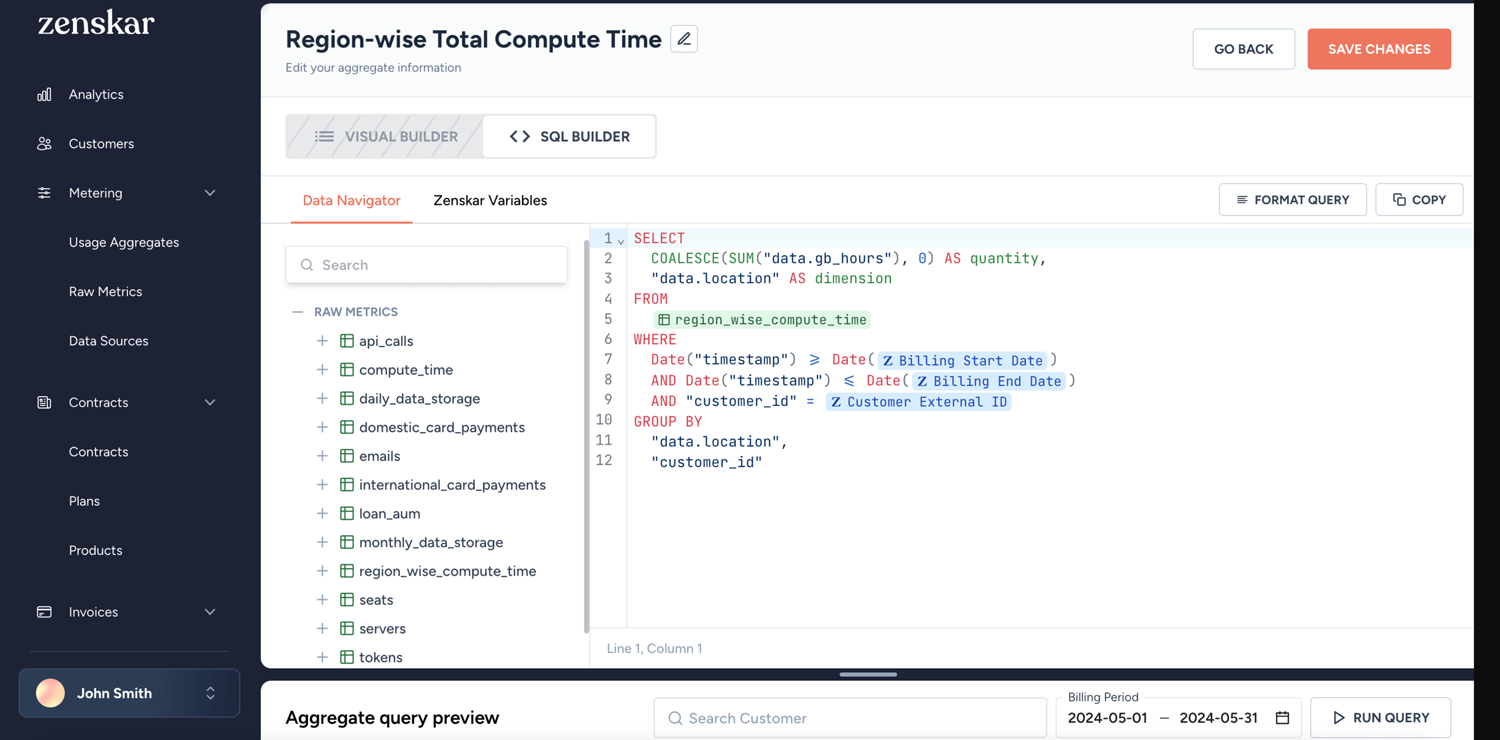
Zenskar is an AI‑driven order‑to‑cash platform that automates billing, collections and revenue recognition without requiring coding. Using a visual builder, users can configure subscriptions, usage‑based models, matrix pricing, volume discounts and overages, and run pricing experiments quickly.
Fintech billing features
- Visual pricing configuration for subscriptions, usage, matrix pricing, volume discounts and overages, enabling rapid pricing experiments.
- Automatic invoice generation, payment reconciliation and journal entries that sync with general ledger systems.
- Extensive integrations with payment gateways (Stripe, Razorpay, Adyen), CRMs (Salesforce, HubSpot) and data warehouses (BigQuery, Snowflake).
- Revenue recognition engine that complies with ASC 606 and IFRS 15 and supports multi‑entity operations.
- Analytics and dashboards with real‑time metrics, AI‑powered insights and customer portal for self‑service subscriptions and payments.
Best for
Zenskar suits finance teams at fintech companies who need to model percentage‑based take‑rates, usage overages and complex contract structures while automating revenue recognition and accounts receivable. Its flexibility makes it a fit for companies graduating from Stripe billing to more sophisticated pricing.
Pricing
Zenskar’s pricing starts around $15 000 per year for the Startup plan, with Mid‑Market ($35 000 per year) and Enterprise ($100 000 per year) flat‑rate tiers. The platform offers a free trial and works with customers on tailored pricing.
Recommendations for fintech decision makers
If you only remember one thing, remember this: pick the platform that matches the part of the workflow that is currently your bottleneck.
If finance needs audit-ready revenue schedules and multi-entity consolidation
Shortlist Alguna and Zenskar first. Both emphasize multi-entity support and revenue recognition capabilities in their product materials and documentation.
If product and engineering need high-scale usage billing and pricing iteration
Shortlist Alguna, Togai, m3ter, and Metronome. These vendors are explicit about metering, event ingestion, rating logic, billing computation, and API reliability.
If you are subscription-led and need mature invoicing operations
Shortlist Alguna and Maxio, especially if proration and dunning automation are core requirements, and if you want an adjacent revenue recognition product from the same vendor.
How to use this recommendation in a real buying process
Don't run six demos. Run two. Pick a primary option and a credible alternative:
- One suite-style option where finance can live.
- One usage-first option where engineering can live.
Then evaluate them against your top three pricing motions (for example: subscription tier, transaction fee, and enterprise custom contract) and insist on a live walkthrough of one messy real-world invoice.
Pick your short list (two vendors), then run a proof of concept
Use one high-stakes customer scenario and require each vendor to walk through:
- A real invoice with both fixed and variable components (ideally: subscription plus transaction fees or usage).
- A mid-cycle pricing change and how it impacts the bill and the rev rec schedule.
- Multi-entity handling if you operate multiple legal entities or currencies.
If you want a default shortlist based on what typically breaks first in fintech
- Choose Alguna or Zenskar if finance and audit readiness are the blockers.
- Choose Alguna, Togai, or Metronome if usage, credits, and pricing iteration speed are the blockers.
- Choose Alguna or Maxio if subscription billing operations, proration, and dunning are the blockers.
Choosing the right fintech billing solution
Fintech monetization is only getting more complex. New pricing models, embedded finance, cross-border expansion, marketplace payouts, AI-driven usag—all of it increases billing and revenue pressure behind the scenes.
The real risk is not picking the “wrong” tool. The real risk is underestimating how fast your pricing will evolve.
The best modern fintech billing solutions do three things well:
- Centralize pricing logic so quotes, invoices, and revenue never drift apart.
- Automate finance workflows so billing does not become a headcount problem.
- Give you flexibility to change pricing without engineering rewrites.
Choose the platform that matches where your pricing is going, not just where it is today.
Ready to modernize your fintech billing?
If your team is juggling hybrid pricing, multi-entity structures, custom contracts, and revenue recognition across currencies, it's time to simplify.
Book a demo with Alguna to see how an AI-native quote-to-revenue platform can unify pricing, quoting, billing, and revenue recognition in one system — without adding engineering overhead.