If you've ever lost sleep over an unpaid invoice, a misquoted contract, or a renewal that quietly slipped through the cracks, you already know what's at stake with B2B billing.
In this day and age, you'd assume most billing is fully automated. It would make sense, right?
Yet, according to a 2023 Forrester report, 60% of finance leaders say manual billing processes are one of their top three operational pain points.
And for SaaS businesses specifically, where pricing can involve usage-based tiers, annual contracts, and mid-cycle upgrades, the complexity compounds fast.
This guide walks you through everything you need to know about B2B billing: what it is, how it works, what separates a good B2B billing process from a great one, and how to build a system that scales with your business.
What is B2B billing?
Unlike B2C (consumer) billing, B2B billing tends to be more complex due to the nature of business relationships and transactions.
Key characteristics include:
- Payment terms: Invoices typically carry net payment terms (e.g., Net 30, Net 60), meaning the buyer has 30 or 60 days to pay, rather than paying immediately at point of sale.
- Invoice-based: Transactions are usually documented through formal invoices rather than instant checkout flows, often requiring purchase order (PO) numbers, tax IDs, or contract references.
- Volume and negotiated pricing: Pricing is often custom, based on contracts, number of seats, usage tiers, or negotiated discounts rather than fixed list prices.
- Recurring billing: Many B2B relationships involve subscriptions, retainers, or usage-based billing that recurs monthly, quarterly, or annually.
- Multi-stakeholder approvals: Payments often require approval from finance teams, procurement departments, or management before being processed.
- Credit and collections: Companies often extend credit to business customers, which introduces the risk of late payment or non-payment, requiring accounts receivable management.
- Tax complexity: B2B transactions may involve VAT, GST, reverse-charge mechanisms, or sales tax exemptions depending on jurisdiction and industry.
Common tools used in B2B billing include ERP systems (like SAP or NetSuite), dedicated billing platforms (like Alguna, Chargebee, or Stripe), and accounting software (like QuickBooks or Xero).
B2B SaaS billing: Why it's a category of its own
B2B SaaS billing is a particularly nuanced discipline. Software-as-a-service companies often deal with pricing models that mix fixed fees, usage-based charges, seat counts, and annual vs. monthly commitments.
Add in free trials, mid-cycle upgrades, prorations, and multi-year contracts, and you have a billing environment that standard accounting software wasn't built for.
According to OpenView's 2024 SaaS Benchmarks Report, more than 60% of SaaS companies now offer some form of usage-based pricing, up from 45% in 2021. That shift makes billing management for B2B SaaS significantly more complex than it was even three years ago.
Billing and revenue management for B2B SaaS has to account for:
- Metered usage tracking (e.g., API calls, seats, storage)
- Subscription changes mid-cycle and the prorations that follow
- Annual contract value (ACV) vs. monthly recurring revenue (MRR) reporting
- Revenue recognition under ASC 606 or IFRS 15
- Dunning management for failed payments
- Multi-currency and multi-entity invoicing
The B2B billing process: How it works end to end
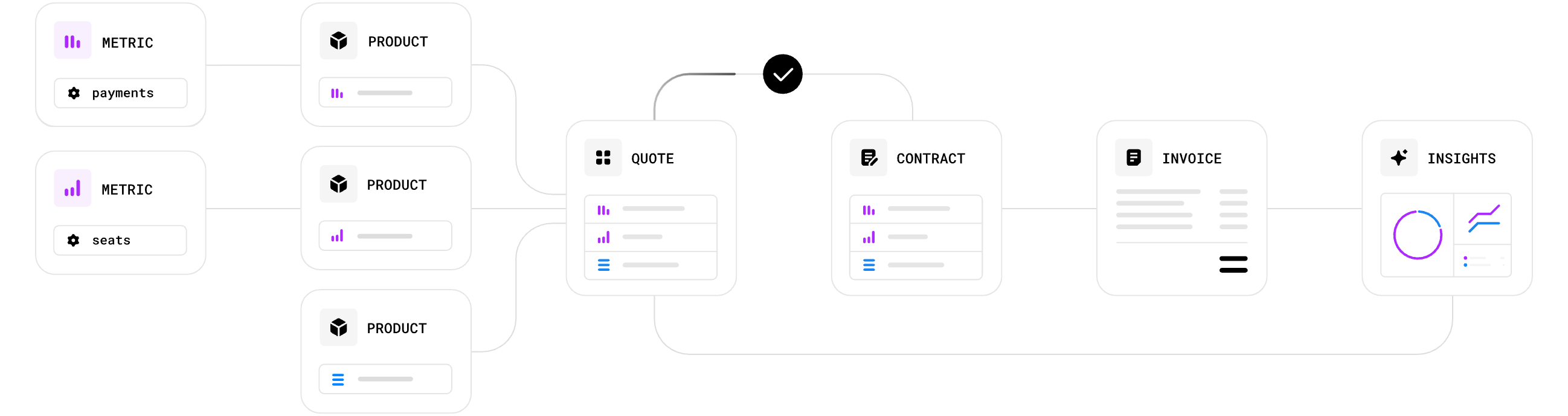
Understanding the B2B billing process helps you identify where your current setup is working, and where it's leaking revenue.
Here's how a well-structured B2B billing process typically flows:
- Quote generation. A sales rep creates a quote based on the prospect's needs. This includes pricing, contract length, and any custom terms.
- Contract creation and signature. The quote becomes a contract, which both parties sign. This may involve legal review, redlines, and approval workflows.
- Order activation. Once signed, the order is activated in your billing system. Subscription start dates, billing cycles, and usage tracking begin.
- Invoice generation. At the agreed billing interval (monthly, quarterly, annually), invoices are generated and sent to the customer's accounts payable team.
- Payment collection. The customer pays via ACH, wire transfer, credit card, or check, depending on what was agreed. Net terms start here.
- Collections follow-up. For overdue invoices, automated reminders and, eventually, manual outreach from the AR team ensures accounts don't go delinquent. This is where B2B billing and collections new processes are making a real difference.
- Reconciliation and reporting. Payments are matched to invoices, revenue is recognized, and financial reports are updated.
- Renewal management. As contract end dates approach, renewal workflows kick off: pricing reviews, customer health checks, and new contract creation.
One of the most common failure points? Step six.
B2B subscription billing: Managing recurring revenue at scale
B2B subscription billing refers to the ongoing, recurring billing relationship between a vendor and a business customer, typically governed by a subscription agreement. It's the backbone of the SaaS revenue model and, when done well, creates predictable, compounding revenue.
The challenge is that B2B subscription billing involves far more than simply charging a card on a set date. Subscriptions change. Customers upgrade, downgrade, pause, or churn. Pricing evolves. Contracts expire.
Each of these events needs to trigger the right billing action at the right time, without manual intervention.
B2B subscription and billing management requires you to handle:
- Recurring invoicing on flexible schedules (monthly, quarterly, annual)
- Proration calculations for mid-cycle changes
- Dunning sequences for failed payments
- Renewal automation and early-warning signals for at-risk accounts
- Cancellation workflows and final invoicing
B2B recurring billing vs. one-time billing
B2B recurring billing is when a business charges another business on a repeating schedule for ongoing access to a product or service. One-time billing, by contrast, is a single transaction tied to a specific deliverable or project milestone.
Most B2B SaaS companies operate on a blend of both: a recurring subscription fee for platform access, plus one-time fees for implementation, professional services, or overages. Your billing platform needs to handle both gracefully, often on the same invoice.
B2B billing: 6 best practices
Getting B2B billing right takes more than good software. It takes clear processes, well-defined ownership, and a commitment to reducing friction for your customers.
Here are the practices that consistently separate high-performing revenue teams from the rest:
1. Automate as much of the billing cycle as possible
Manual billing is slow, error-prone, and doesn't scale. According to Gartner's Finance Function Survey, finance teams that automate their billing and AR processes reduce invoice processing costs by up to 80%.
Automation should cover invoice generation, payment reminders, dunning management, and renewal notifications at a minimum.
High-volume teams automate B2B billing and collections by connecting their CRM, CPQ, and billing platform so that a closed deal automatically triggers contract creation, billing configuration, and the first invoice, with no manual hand-off required.
2. Use a purpose-built B2B billing platform
Consumer-oriented payment tools and basic accounting software aren't designed for the complexity of B2B contracts. A dedicated B2B billing platform should support:
- Custom payment terms and net terms
- Multiple pricing models (flat-rate, tiered, usage-based, seat-based)
- Contract lifecycle management
- Automated dunning and collections
- Revenue recognition and financial reporting
When evaluating the best platforms for managing contracts and renewals, B2B SaaS teams should look for tools that integrate natively with their CRM and accounting systems. Bolt-on integrations create data silos and manual reconciliation work.
3. Align billing with your contracts
One of the most common sources of customer disputes is a discrepancy between what the contract says and what the invoice shows.
To prevent this, your billing configuration should pull directly from your signed contract: pricing, terms, billing frequency, and any custom discounts or credits.
At Alguna, we built our platform around this principle. When a contract is signed, billing is configured automatically based on the contract terms, so there's no room for human error in the hand-off.
4. Establish clear AR ownership
Someone needs to own accounts receivable. In early-stage companies, this often falls to the CFO or a finance generalist.
As you scale, you'll want a dedicated AR function with clear SLAs for follow-up on overdue invoices. The best B2B billing and collections processes combine automated reminders with human escalation for high-value or long-overdue accounts.
5. Give customers flexible payment options
B2B customers have procurement processes. Some can only pay by wire transfer. Others require ACH.
Some have credit card limits that make large invoices impractical. Offering multiple payment methods reduces friction and speeds up collection. Consider also offering early payment discounts (e.g., 2/10 net 30) for customers who pay within 10 days.
6. Track DSO and other billing health metrics
You can't improve what you don't measure. The key metrics every B2B billing team should track include:
| Metric | What it measures | Why it matters |
|---|---|---|
| Days Sales Outstanding (DSO) | Average days to collect after invoicing | Cash flow health signal |
| Invoice error rate | % of invoices requiring correction | Billing accuracy and trust |
| Collections rate | % of invoiced revenue actually collected | Revenue leakage indicator |
| Renewal rate | % of contracts renewed at expiry | Revenue retention and growth |
| Time to invoice | Days from deal close to first invoice sent | Billing process efficiency |
How to set up a scalable B2B billing process
Whether you're building a billing process from scratch or overhauling a broken one, here's a practical step-by-step guide.
Step 1: Audit your current state
Before you implement anything, map what you already have. Where do invoices originate? How are payment terms communicated? Who follows up on overdue accounts? How are renewals tracked?
You need a clear picture of your existing B2B billing process before you can improve it.
Look for these common red flags:
- Invoices created manually in spreadsheets or Word documents
- No standardized payment terms across customers
- Renewals tracked in a shared calendar or spreadsheet
- AR follow-up that depends on one person's memory
- Revenue recognition done manually at month-end
Step 2: Define your pricing and contract models
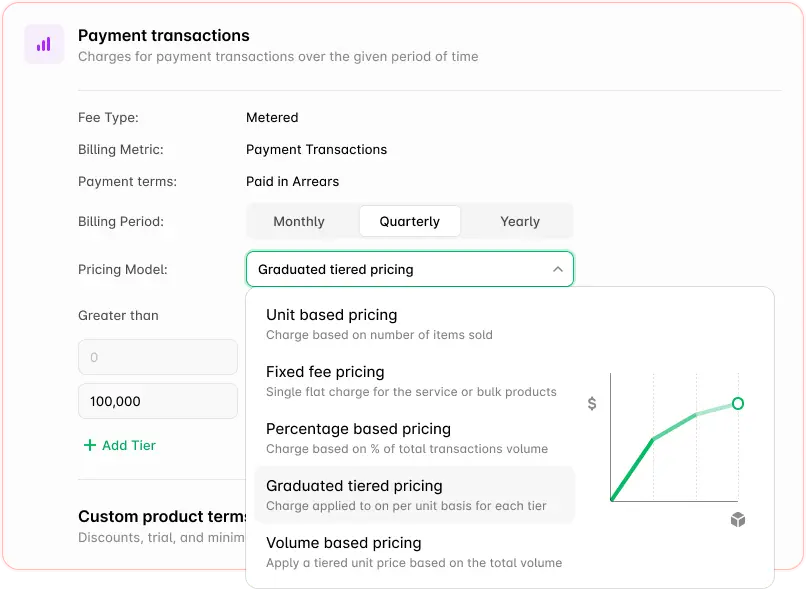
Your billing system can only be as clean as your pricing. Before you configure anything, get alignment on:
- What pricing models you offer (flat-rate, per-seat, usage-based, tiered)
- What your standard payment terms are (net 30, net 60, annual prepay)
- How you handle mid-cycle changes and prorations
- What your renewal process looks like and who owns it
If you're evaluating the best platforms for managing contracts and renewals, B2B SaaS billing complexity is a key factor. Some tools handle simple flat-rate subscriptions well but struggle with metered usage or multi-product bundles.
Step 3: Choose the right B2B billing software
B2B billing software is the engine that powers your revenue operations. When evaluating options, we'd recommend looking for the following capabilities:
- Native CPQ (configure, price, quote) functionality or clean CRM integration
- Support for the pricing models you actually use, including metered billing if relevant
- Automated dunning and collections workflows
- Revenue recognition reporting built in
- Audit trails for every billing action
If you're looking for an invoiced-like product for B2B SaaS billing with metered usage, the market has matured significantly. Platforms that once required significant developer work to handle usage-based billing now offer no-code configuration for most standard use cases.
Step 4: Integrate your billing platform with your tech stack
A billing platform in isolation creates more work, not less. Your billing system should integrate with:
- Your CRM (e.g., Salesforce, HubSpot) so closed deals automatically trigger billing setup
- Your accounting system (e.g., QuickBooks, Xero, NetSuite) for seamless reconciliation
- Your customer success platform so renewal risks and health scores are visible alongside billing data
- Your payment processor to support ACH, card, and wire transfer without manual handling
Step 5: Configure your dunning and collections workflows
Dunning is the process of communicating with customers about overdue payments. A well-structured dunning sequence significantly reduces the time your AR team spends chasing invoices manually.
Here's a simple framework:
| Trigger | Action | Channel |
|---|---|---|
| Invoice sent | Confirmation and payment link delivered | |
| 3 days before due | Friendly payment reminder | Automated email |
| 1 day overdue | Overdue notice with payment link | Automated email |
| 7 days overdue | Personal outreach from AR team | Email + phone |
| 30 days overdue | Escalation to CFO or legal, access review | Email + formal letter |
Step 6: Build renewal workflows into your billing system
Renewals are where B2B subscription billing gets interesting. A contract that auto-renews without any human touchpoint is a missed expansion opportunity. But a renewal that requires entirely manual work from your team doesn't scale either.
We recommend building renewal workflows that trigger 90, 60, and 30 days before contract expiry.
At each stage, your team (or your platform) should:
- Confirm the customer's satisfaction and usage levels
- Review pricing for expansion or adjustment opportunities
- Generate the renewal contract and send for signature
- Confirm the billing configuration for the next term
How to evaluate B2B billing software: What to look for
The market for B2B SaaS billing tools has grown considerably. Here's what to prioritize when you're comparing options.
8 must-have features in B2B billing software
- Flexible pricing model support (flat-rate, usage-based, tiered, hybrid)
- Automated invoicing and payment collection
- Contract and renewal management
- Built-in dunning and AR workflows
- Revenue recognition and reporting (ASC 606/IFRS 15)
- Native CRM and accounting integrations
- Multi-currency support
- Audit logs and SOC 2 compliance
Questions to ask during evaluation
When you're shortlisting B2B billing platform options, here are the questions that tend to separate good fits from bad ones:
- Can the platform handle all of our pricing models natively, or will we need workarounds for anything?
- How does the platform handle mid-cycle subscription changes and prorations?
- What does the dunning sequence look like, and how configurable is it?
- How does revenue recognition work, and can it handle deferred revenue?
- What integrations are available, and are they bi-directional?
- How do teams at our scale typically implement and onboard?
If you're specifically evaluating the best ROI subscription billing tool for B2B SaaS, also ask for references from companies with a similar pricing model to yours.
The complexity of usage-based billing in particular varies enormously between vendors.
The next era of B2B billing
B2B billing is one of those disciplines that's invisible when it works well and painfully obvious when it doesn't.
Customers don't notice a clean, accurate invoice on time. But they absolutely notice when they're overbilled, billed for something they canceled, or chased for payment on an amount they've already settled.
Building a great B2B billing process is an investment in customer trust, operational efficiency, and predictable revenue. It's also one of the highest-leverage things a revenue operations or finance team can do to directly impact cash flow.