• How visual CPQ streamlines complex quotes with real-time pricing and clear product hierarchies.
• What to look for in modern visual CPQ software—and how Alguna compares to other top tools like DealHub and Nue.
The pricing looks different in the proposal than it did in the call. The quote takes days instead of minutes. A simple change triggers a round of Slack messages with finance. By the time the contract goes out, momentum is gone—and confidence with it.
Sound familiar?
That’s why visual CPQ is quickly becoming a must-have for modern SaaS and enterprise sales teams. As SaaS monetization and AI pricing models grows more complex—usage-based models, bundles, add-ons, ramps, and custom terms—traditional CPQ tools and spreadsheets can’t keep up.
In this guide, we’ll break down what visual CPQ really is, how it differs from legacy tools, and why it’s emerging as the default quoting model for high-growth SaaS companies. Plus, we'll list the most popular
If you’re evaluating visual CPQ software, or feeling friction between sales and finance, this is where to start.
What is visual CPQ?
It shows products, bundles, usage, and pricing in real time as deals are configured so sales can quote faster, avoid errors, and sell complex pricing models with confidence.
Traditional CPQ tools are powerful for enforcing pricing logic, but they typically present options in text form, e.g. lengthy lists of features or complex tables of add-ons. By visualizing the product hierarchy and configuration, a visual CPQ makes it far easier to understand complex offerings.
In short, a visual CPQ enhances the CPQ process with an interactive, visual interface that makes configuring and quoting products more intuitive. This helps bridge the gap between what a sales rep configures and what the buyer is expecting.
Legacy CPQ vs visual CPQ
Legacy CPQ was built for a simpler era of pricing for static SKUs, annual subscriptions, and limited customization. It relies on rigid forms, hidden rules, and heavy backend logic. Sales reps often don’t see how pricing works, quotes take longer to produce, and finance ends up fixing errors after the deal is signed.
Visual CPQ flips that model. It makes configuration and pricing visible and interactive as the deal is built. Sales can clearly see product hierarchies, bundles, usage components, and real-time price changes, while guardrails are enforced upfront—not after the fact.
The result:
- Faster quotes
- Fewer pricing errors
- Better alignment between sales and finance
In short, legacy CPQ manages complexity by hiding it. Visual CPQ manages complexity by making it clear.
5 reasons SaaS sales teams need visual CPQ software
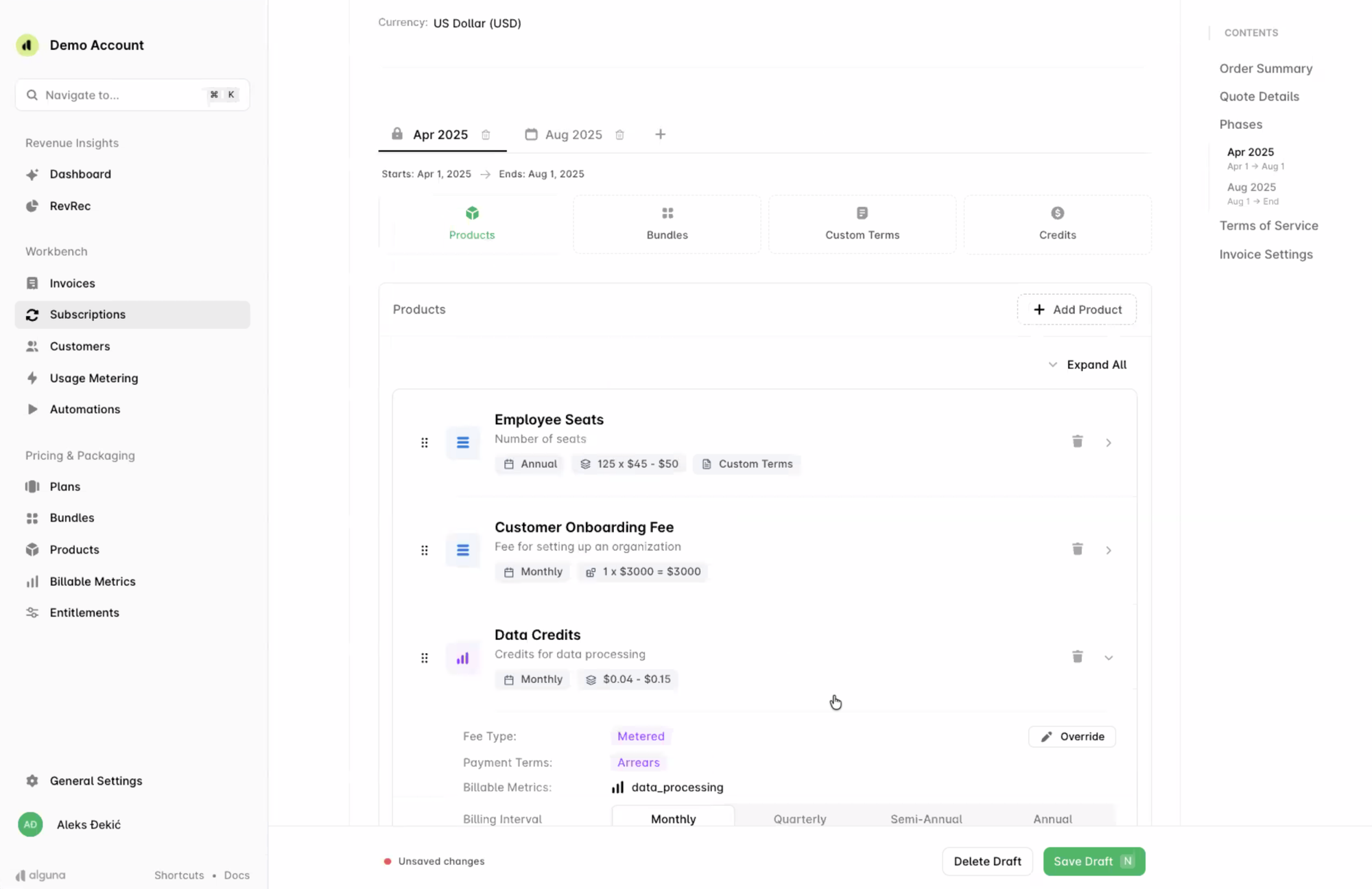
SaaS companies and enterprise tech providers often have extremely configurable offerings: multi-tier subscriptions, feature add-ons, usage-based charges, ramps, discounts, services, and more.
This complexity can slow down sales and introduce errors if managed through spreadsheets or legacy tools. Visual CPQ is what makes this complexity manageable.
1. Clarity in complex configurations
In a SaaS deal, you might bundle a base software subscription with additional modules, integrate professional services, and include usage-based fees (e.g. API calls or data volume).
That’s a lot to communicate.
Visual CPQ tools present the deal structure in a clear, hierarchical view, so reps can visualize product hierarchy and all components of an offer at a glance. Instead of reading through 20 line items and trying to mentally connect which add-on relates to which base package, the rep (and the buyer) see an organized visual map of the solution. This clarity reduces misconfiguration.
By contrast, showing the configuration visually means fewer chances to miss an option or include an incompatible component, since the interface itself guides the user. It’s easier to answer, “Does this quote include X feature?” when you can literally see each component in the CPQ interface.
2. Improved pricing accuracy
Visual CPQ software dramatically cuts down on quoting errors. Error-free configurations through built-in rules are a hallmark of any good CPQ, and when combined with visual guidance the result is highly reliable quotes.
The software can prevent invalid combinations and automatically enforce pricing rules, so the rep isn’t manually calculating anything. Industry research shows that deploying modern CPQ can drop quoting error rates by 20–30%. Visual interfaces amplify this by making it immediately obvious if something is off.
In essence, visual CPQ turns quoting from a manual, error-prone task into an automated, guided process. The impact is tangible: quotes are accurate on the first pass, which means fewer revisions and less back-and-forth with finance or customers.
3. Faster sales cycles
In competitive sales scenarios, speed is critical. Visual CPQ helps reps deliver quotes faster and with more confidence. By automating approvals and calculations, a good CPQ already saves time, no more waiting days for finance to verify pricing or for engineering to validate a configuration.
Visual CPQ adds to speed by streamlining how reps actually build the quote. It’s a more natural, drag-and-drop style experience (versus filling out forms), often with guided selling prompts. This reduces the friction and “thinking time” for reps. The outcome is significantly faster quote turnaround.
Visual CPQ can also shorten cycles by reducing buyer hesitation. When buyers can clearly see what they’re getting, they require less deliberation to sign off. Fewer delays for clarification or re-quotes means deals progress to close faster, directly boosting win rates.
4. Support for modern pricing models
Perhaps the biggest reason SaaS and tech companies are evaluating visual CPQ solutions is the rise of usage-based and hybrid pricing models.
Today, many SaaS deals are no longer straightforward subscriptions. You might have pay-as-you-go elements, tiered pricing that adjusts with volume, prepaid credits or tokens, or hybrid deals (subscription fee + consumption overages).
Quoting these deals manually is a nightmare, and older CPQ systems weren’t built with this flexibility in mind. Legacy CPQ tools struggle to model usage fees or token consumption, often forcing reps into spreadsheet workarounds that lead to errors or delayed quotes.
In contrast, modern visual CPQ software is designed to handle dynamic pricing schemes visually. This means a rep can configure a deal with, say, a base license plus 100,000 API calls per month, and the CPQ will present that structure clearly and calculate the costs in real-time.
The ability to mix subscriptions, usage, and services on one quote is a key feature of advanced CPQ systems like Alguna. Visual CPQ software with a robust pricing engine can accommodate tiered pricing, volume discounts, overage rates, and more, all without custom code.
5. Better alignment between sales and finance
If CPQ isn’t tightly integrated with downstream systems, you risk miscommunications and manual data entry errors when it’s time to invoice the customer.
Visual CPQ solutions often emphasize integration and alignment, ensuring that the configured deal in the CPQ flows seamlessly to contracts, ERP, and billing systems. The visual configuration and CPQ software work in tandem with finance systems so that the quote a rep creates is exactly what gets invoiced, provisioned, and recognized in revenue.
A visual CPQ that integrates with CRM and ERP/billing provides a single source of truth from quote to cash, creating alignment between sales and finance.
Alguna unifies CPQ, billing, and revenue recognition into one platform—so every quote turns seamlessly into a contract and invoice, with no rework or data handoffs.
Sales moves faster, finance trusts the numbers, and deals never get stuck in limbo.
Book your customized demo today
9 key deatures of a visual CPQ tool (what to look for)
Not all visual CPQ platforms are created equal.
If you’re evaluating options, here are nine key features and capabilities that define a strong visual CPQ sales solution – particularly one suited for SaaS and enterprise tech companies.
| Feature | What it means in practice | Why it matters |
|---|---|---|
| Visual product configuration | Sales builds quotes using an interactive, visual interface instead of long forms or SKU lists. | Reduces confusion, prevents misconfiguration, and makes complex deals easier to sell. |
| Visual product hierarchy | Clear representation of plans, bundles, add-ons, usage components, and dependencies. | Sales and buyers can instantly understand what’s included in the deal. |
| Real-time pricing updates | Prices recalculate instantly as quantities, tiers, usage, or discounts change. | Faster quoting and fewer pricing errors during live sales conversations. |
| Support for modern pricing models | Native handling of subscriptions, usage-based pricing, credits, tiers, ramps, and hybrid models. | Essential for SaaS and AI companies with evolving monetization strategies. |
| Embedded guardrails and approvals | Margin floors, discount limits, and approval logic enforced during configuration. | Prevents bad deals before they reach finance. |
| No-code configuration | Sales, RevOps, and finance can manage products, pricing, and rules without engineering. | Enables faster pricing changes and experimentation. |
| Alignment with billing and revenue | Quotes convert directly into contracts, invoices, and revenue schedules. | Eliminates quote-to-cash friction and month-end cleanup. |
| CRM and ERP integrations | Syncs seamlessly with CRM and downstream finance systems. | Ensures a single source of truth across sales and finance. |
| Scalability for enterprise deals | Handles complex, custom contracts without breaking workflows. | Supports growth without adding operational debt. |
3 visual CPQ software for scaling SaaS, AI, and fintech teams
Not all CPQ tools are built for modern pricing or high-growth sales motions. Below are three visual CPQ software options commonly evaluated by SaaS, AI, and fintech teams—ranked based on how well they handle complexity, scale, and alignment between sales and finance.
Visial CPQ comparison overview: Alguna vs DealHub vs Nue
| Criteria | Alguna | DealHub | Nue |
|---|---|---|---|
| Visual CPQ depth | Full visual builder with product hierarchy | Guided selling UI + DealRoom | Salesforce-native UI with no-code configurator |
| Pricing model support | Any pricing model. Subscriptions, usage, hybrid, credits, tiers | Subscriptions + usage (via Subskribe) | Subscriptions + basic usage |
| No-code admin | 100% no-code for all pricing, logic, and workflows | No-code for CPQ, CLM, approvals | No-code for standard setups, some limits on complexity |
| Billing & RevRec | Native billing + revenue recognition | Integrated billing + invoice automation | Basic billing in Salesforce; rev rec requires add-ons |
| Ease of implementation | Weeks (not months); white-glove onboarding | 4–12 weeks depending on scope | Fast for SF users; longer if external integrations needed |
| CRM & ERP integrations | Salesforce, HubSpot + ERP (NetSuite, etc.) | Salesforce, HubSpot, Dynamics + ERP connectors | Salesforce only; other integrations via API/custom setup |
| Best for | SaaS, AI, fintech (startups to mid-market) | Mid-market B2B with complex deals | Salesforce-first SaaS teams (early to mid-stage) |
| Pricing | Paid plans from $699/mo; free tier available | Custom quote, premium pricing | Starts ~$25/user/mo + add-ons |
1. Alguna: Best overall visual CPQ for modern SaaS and AI pricing models
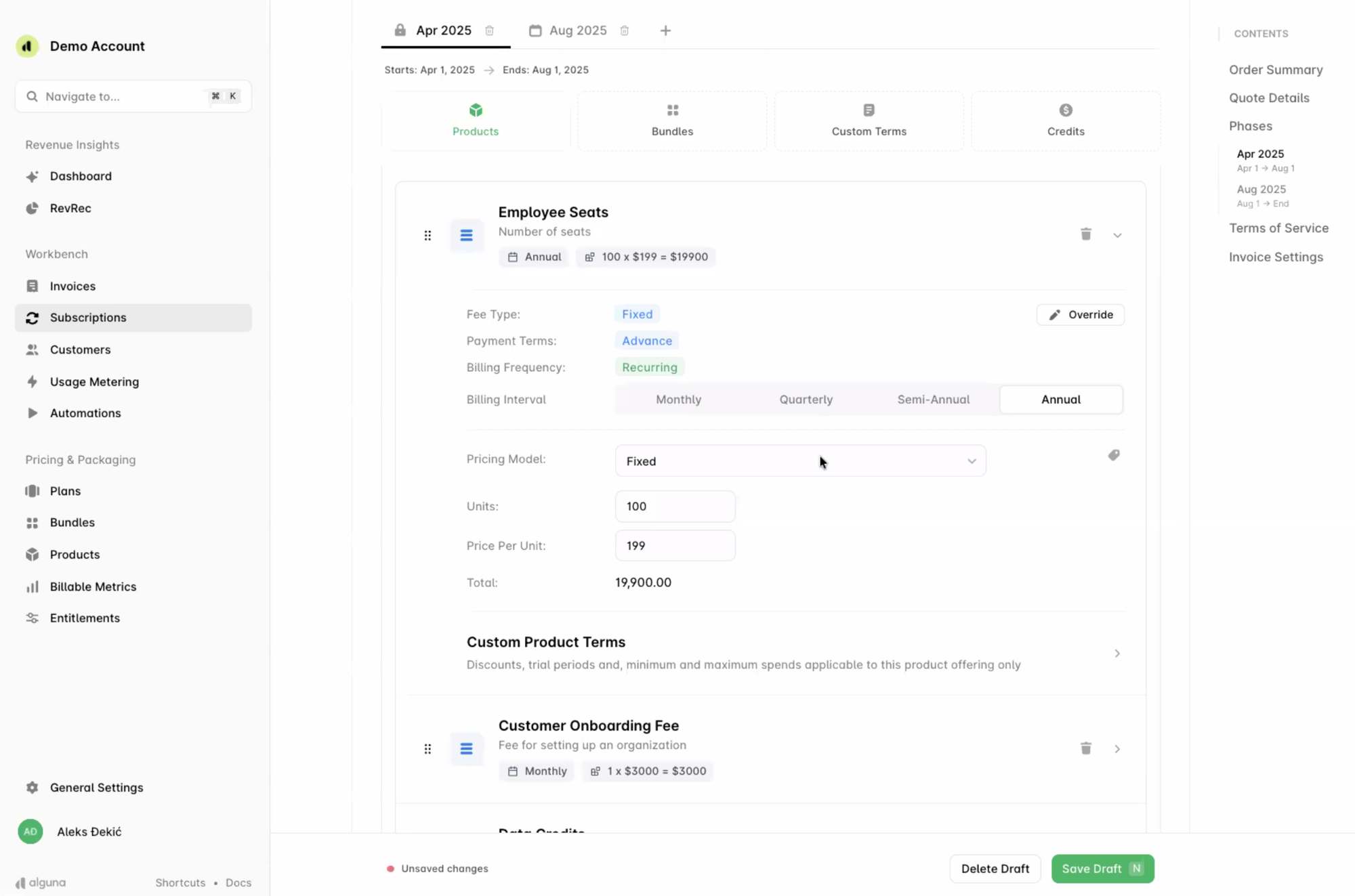
Alguna is a unified quote-to-cash platform that embeds CPQ inside a complete revenue management solution. This means Alguna not only handles configure-price-quote tasks, but also seamlessly manages what happens after the quote, including billing, collections, and revenue recognition, in one system.
The result is that what sales quotes is automatically what finance bills, with no manual data transfers. Alguna is purpose-built for companies selling complex, usage-based, and hybrid pricing models. Unlike legacy CPQ tools that bolt on visual elements, Alguna treats visual CPQ as a core part of a unified revenue system.
Why Alguna ranks #1
- Fully visual CPQ with clear product hierarchies, bundles, usage components, and add-ons
- No-code pricing and configuration for RevOps and finance
- Native support for subscriptions, usage-based pricing, credits, tiers, ramps, and hybrid pricing models
- Combine your SLG and PLG motions effortlessly
- Quotes flow directly into billing and revenue recognition, no data re-entry, no engineering support needed
- Designed for scale across SaaS, AI, and fintech monetization models
Best for:
High-growth SaaS, AI, and fintech teams that need pricing flexibility, sales speed, and clean quote-to-cash alignment.
Pricing:
Plans start at $699/month on a flat-fee basis, including full CPQ and billing functionality. Alguna never takes a revenue cut.
2. Nue: Modern CPQ with strong Salesforce alignment
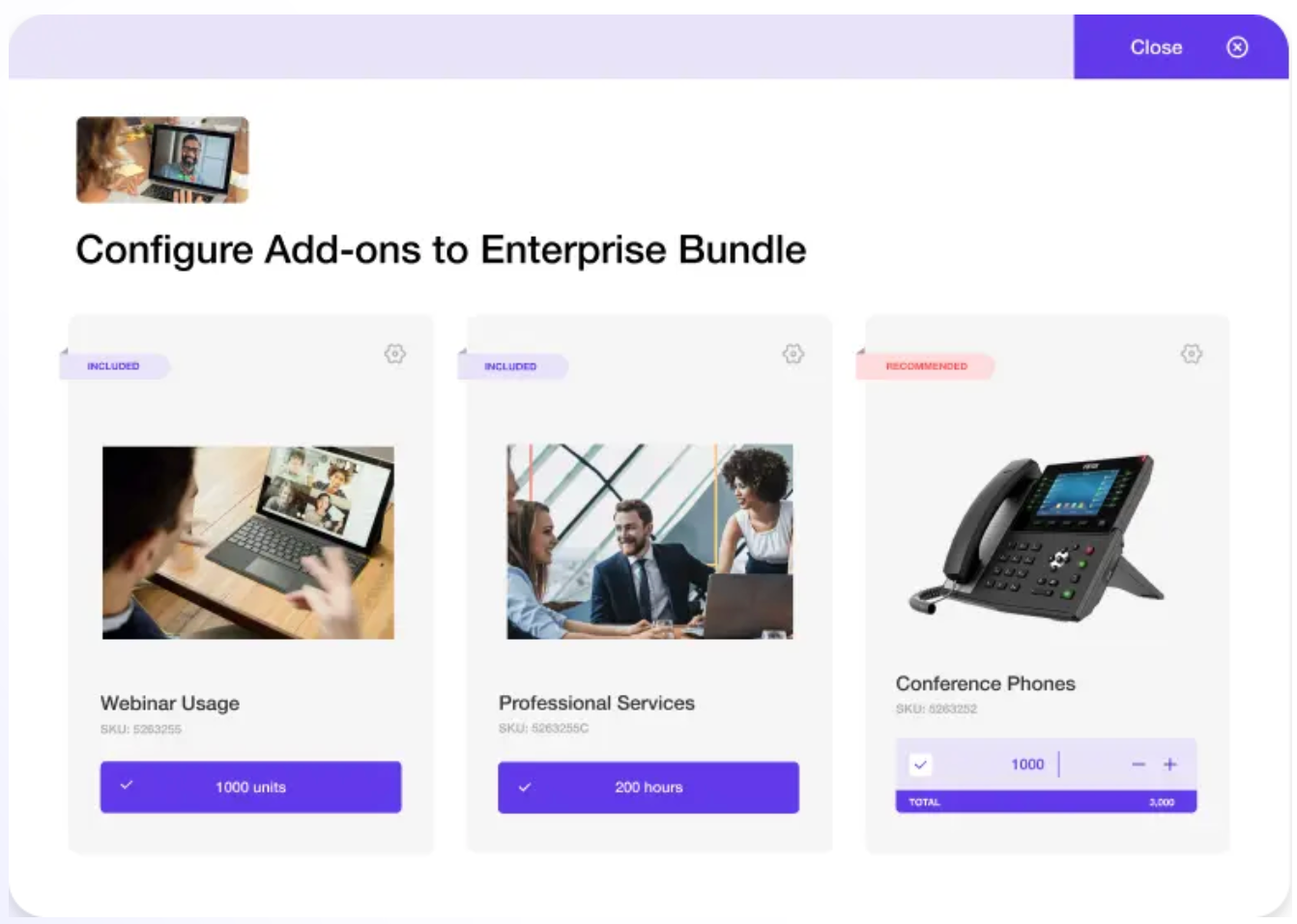
Nue (often styled as Nue.io) is a quote-to-revenue platform built natively on Salesforce. It aims to unify CPQ, subscription billing, and usage tracking directly within the Salesforce CRM environment.
For companies already committed to the Salesforce ecosystem, Nue offers the convenience of managing quotes, orders, and billing without leaving Salesforce. It’s particularly marketed towards SaaS businesses with a mix of sales-led and product-led (self-serve) revenue streams, i.e. those embracing hybrid pricing models.
Strengths
- Native Salesforce integration
- Clean quoting experience for sales
- Supports subscriptions and some hybrid pricing scenarios
- Faster to deploy than legacy enterprise CPQ
Limitations
- Visual configuration is more form-based than truly visual
- Usage-based pricing support is more limited compared to Alguna
- Less depth in downstream billing and revenue workflows
Best for:
Salesforce-first SaaS teams looking for a lighter-weight CPQ with moderate pricing complexity.
Pricing:
Starts ~$25/user/mo + add-ons
3. DealHub: Solid sales experience, limited revenue depth
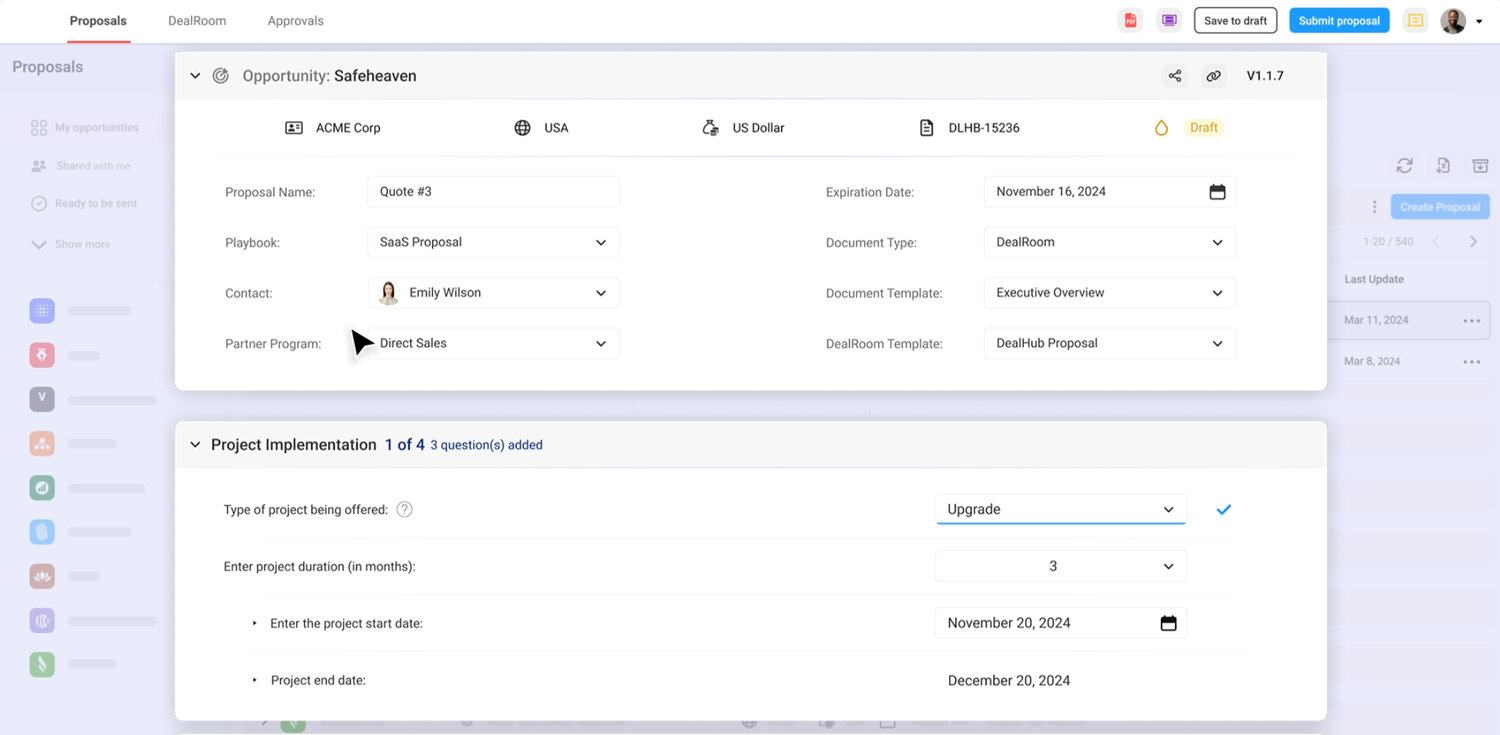
DealHub is a no-code CPQ platform combined with deal management features like contract lifecycle management (CLM) and digital DealRooms. It focuses on streamlining complex B2B deals by equipping sales teams with guided selling tools and a collaborative buyer portal.
In 2025, DealHub expanded into quote-to-revenue by acquiring Subskribe (a subscription billing platform), which bolstered its support for usage-based billing and subscription management.
Strengths
- Clean, sales-friendly UI
- Good for basic bundle configuration and approvals
- Faster to adopt than older CPQ platforms
Limitations
- Limited depth for usage-based or fintech-style pricing
- Billing and revenue workflows typically handled in separate systems
- Less suitable for highly complex or evolving monetization models
Best for:
Mid-market SaaS teams with relatively straightforward pricing and a focus on sales enablement.
Pricing:
DealHub doesn’t publish list pricing publicly. Licenses are typically per sales seat, with additional pricing for admin or RevOps. Expect minimum $10,000 per year.
Move to a visual CPQ and boost sales efficiency
When it comes to complex B2B sales, visual CPQ software can be a game-changer. It transforms the quoting process from a tedious, error-prone chore into a streamlined, interactive experience.
Sales teams can configure sophisticated deals in minutes with confidence that pricing is correct and approved. Buyers gain clarity into what they’re buying, which builds trust and speeds up decisions. Meanwhile, RevOps and finance benefit from clean data and automated workflows all the way through billing.
For SaaS companies navigating usage-based pricing or enterprises juggling countless product combinations, a visual CPQ tool is quickly becoming a must-have to compete effectively. Faster quotes, fewer errors, and more flexibility mean higher win rates and happier customers.
Ready to accelerate your sales cycles and eliminate quoting errors?
It’s time to make the jump to visual CPQ. Book a demo with Alguna today and see how a modern visual CPQ solution can empower your team to close deals faster, with confidence in every quote.