If you're still manually calculating what customers owe based on how much they used your product, you already know the pain.
Spreadsheets that don't match your data.
Invoices sent late.
Revenue that slips through the cracks because someone forgot to log a usage event.
It's not sustainable, and it definitely doesn't scale.
Usage based billing automation changes all of that. It connects your product usage data directly to your billing engine, removes the human bottleneck (and the risk of human error), and makes sure every unit of consumption gets captured, priced, and invoiced accurately, every time.
In this guide, we'll break down what usage based billing automation is, how it works, what to look for in a solution, and how teams are using AI to take it even further.
What is usage based billing automation?
Unlike flat-rate or seat-based billing, where the invoice is the same every month regardless of consumption, usage-based billing is dynamic. The price changes with the customer's behavior. That creates complexity, because you need to:
- Collect and store accurate usage data in real time
- Apply the right pricing rules (tiered, volume, overage, etc.) to that data
- Generate accurate invoices at the right time
- Handle exceptions, credits, and adjustments without breaking anything
Do that manually across dozens, hundreds, or thousands of customers and you'll quickly find yourself buried. Automation handles all of it programmatically, so your team can focus on growth instead of spreadsheets.
This is also closely related to quoting and revenue operations, because the accuracy of your billing flows directly affects how confidently you can forecast, renew, and expand accounts.
How does usage based billing automation work?
At a high level, automating usage-based billing involves four core steps: data collection, data processing, pricing calculation, and invoice generation.
Here's how each one works:
1. Usage data collection
Everything starts with capturing usage events. These are the raw signals your product emits: API calls made, gigabytes stored, messages sent, seats activated, transactions processed, and so on.
Your billing automation system needs to ingest these events in real time (or near-real time) from your product infrastructure. That typically happens via webhooks, event streaming tools like Kafka or Segment, or direct API integrations.
The data gets stored in a metering layer purpose-built for high-volume event handling.
2. Usage aggregation and processing
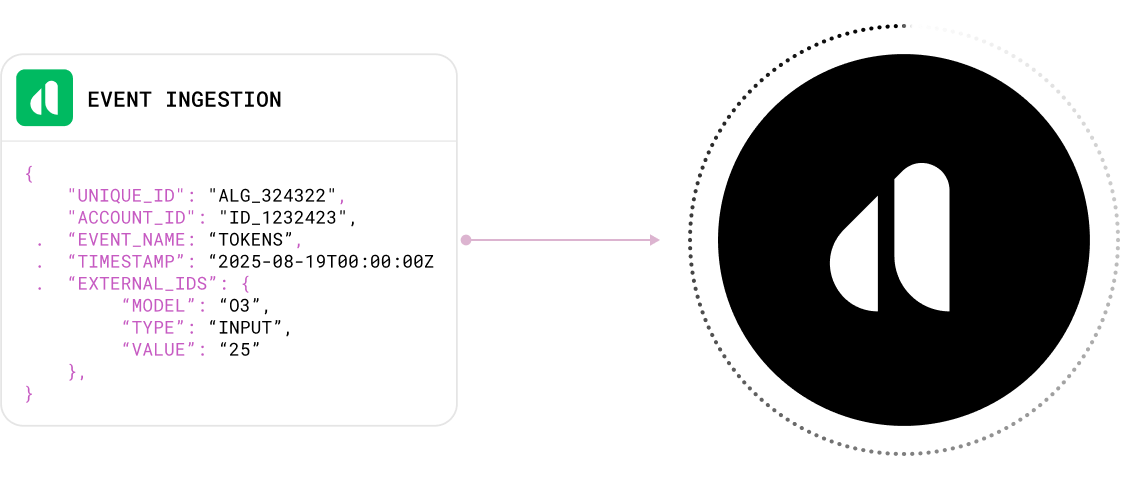
Raw events need to be transformed into billable quantities. This is where your system aggregates the data, grouping it by customer, product, subscription period, and pricing dimension.
For example, if a customer makes 14,000 API calls in a month, the system needs to aggregate those events into a single billable count, apply any free-tier thresholds, and pass the net quantity to the pricing engine.
3. Pricing calculation
Once you have the aggregated usage, the system applies your pricing logic. This is where things get interesting, because usage-based pricing models vary significantly:
- Pay-as-you-go: The customer is charged a fixed rate per unit
- Tiered pricing: The rate changes as consumption crosses defined thresholds
- Volume pricing: The rate for all units is based on total volume reached
- Overage billing: The customer has a base commitment, and pays extra beyond it
- Hybrid models: A flat base fee plus variable usage charges on top
Modern automated usage billing SaaS platforms handles all of these without requiring manual configuration every time a customer's usage changes.
4. Invoice generation and delivery
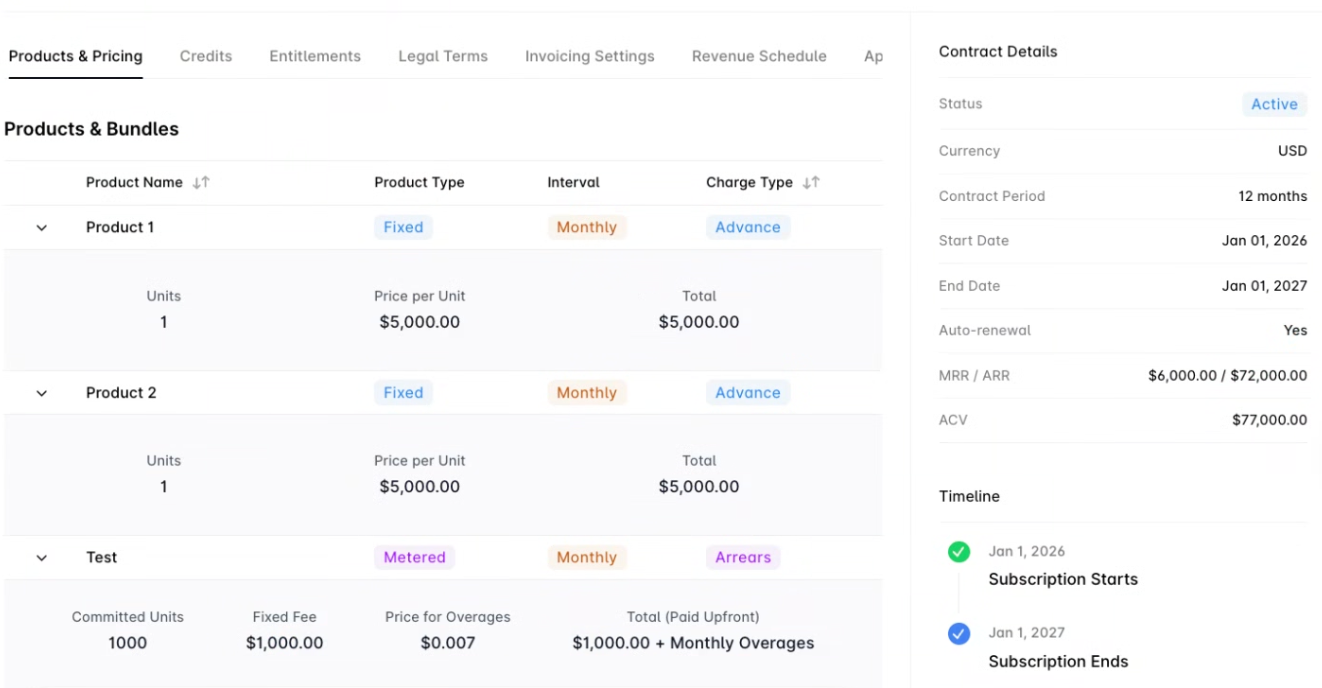
With pricing calculated, the system generates a line-itemized invoice, attaches it to the customer's account, and delivers it, either directly or via your accounting or ERP system. This can happen on a scheduled cadence (monthly, quarterly) or triggered by usage milestones.
The whole cycle runs automatically. No one has to pull a report, open a spreadsheet, or send an email. The customer gets an accurate invoice, and your finance team gets clean revenue data.
If you want to automate usage-based billing across the entire quote-to-cash workflow, read our guide on how to automate usage based billing for SaaS and AI companies.
Why revenue teams are moving toward usage based billing automation
Usage-based pricing isn't new, but its adoption has accelerated sharply. According to OpenView's 2024 SaaS Benchmarks Report, more than 60% of SaaS companies now offer some form of usage-based pricing, up from roughly 27% in 2018.
Customers increasingly expect to pay for what they use, not what they don't. And companies that adopt usage-based models tend to see higher net revenue retention because billing scales naturally with customer growth.
But the commercial logic only holds if the billing is accurate and timely. If you're manually producing invoices, you're likely experiencing some combination of:
- Revenue leakage from uncaptured usage events
- Delayed invoicing that slows cash collection
- Billing disputes caused by calculation errors
- Finance team bandwidth consumed by manual reconciliation
- Inability to scale billing operations alongside customer growth
Automation eliminates all of these. It's not just an efficiency gain, it's a revenue protection strategy.
- Adam Liska, Co-founder an CEO at Glyphic
Read the case study
Implementing usage-based billing automation: 5 features to look for
When you're evaluating how to automate usage-based billing, the right approach depends on your pricing model, your tech stack, and how much flexibility you need.
Here's what to assess.
- Native metering and event ingestion
The foundation of any consumption billing automation system is its ability to ingest high volumes of usage events reliably. Look for solutions with battle-tested metering infrastructure that handles event deduplication, late arrivals, and backfills without losing data. - Flexible pricing model support
Your pricing will evolve. Make sure the platform can support multiple pricing models simultaneously and allows you to configure pricing rules without engineering involvement.
⚠️ If every pricing change requires a developer, you've just moved the bottleneck without solving it. - ERP and accounting integrations
For most finance teams, billing automation doesn't live in isolation. It needs to connect with your general ledger, your revenue recognition process, and your collections workflow.
The best ERP systems for automating usage-based billing work because they integrate directly with your billing layer. Platforms like NetSuite, Sage Intacct, and Microsoft Dynamics 365 can receive billing data from your usage billing platform and post it automatically, eliminating manual journal entries and reconciliation. The key is that integration depth matters: you want bidirectional data flows, not just one-way exports. - Real-time visibility for customers and teams
Both your customers and your internal teams benefit from real-time usage visibility. Customers who can see their consumption before the invoice arrives are less likely to dispute charges. Internal teams who can see revenue in real time can forecast more accurately and intervene earlier when accounts are over or under their commitments. - Quote-to-cash alignment
One of the most overlooked aspects of billing automation is how well it connects to the quote to cash process. If your quotes are built on usage assumptions that don't match what actually gets billed, you'll have constant friction between sales, finance, and customers.
AI solutions for usage-based billing automation
AI is increasingly showing up in billing automation (and not just as a marketing claim). There are real use cases where machine learning, AI-powered tools, and intelligent workflows add genuine value across the billing lifecycle.
1. Alguna: Usage based billing automation for SaaS, AI, and fintech companies
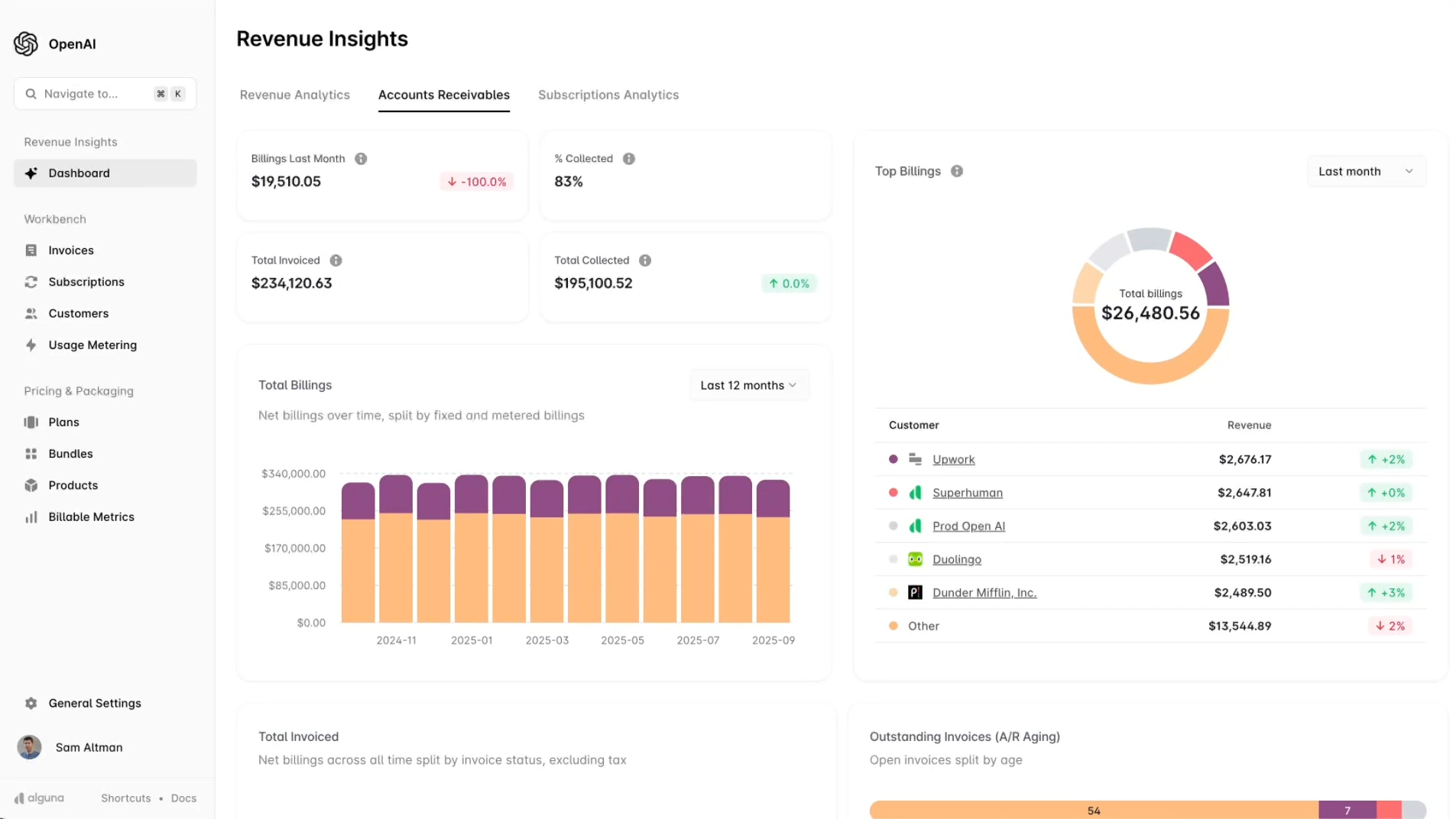
Y Combinator backed Alguna is a modern end-to-end quoting, billing, and invoicing platform built specifically for revenue teams running usage-based or hybrid pricing models.
What sets Alguna apart is the tight connection it creates between the quoting process and billing execution. Rather than treating these as separate systems, Alguna ensures that the commercial terms agreed in a quote translate directly into how usage gets calculated and invoiced, eliminating the reconciliation gaps that cause billing disputes and revenue leakage.
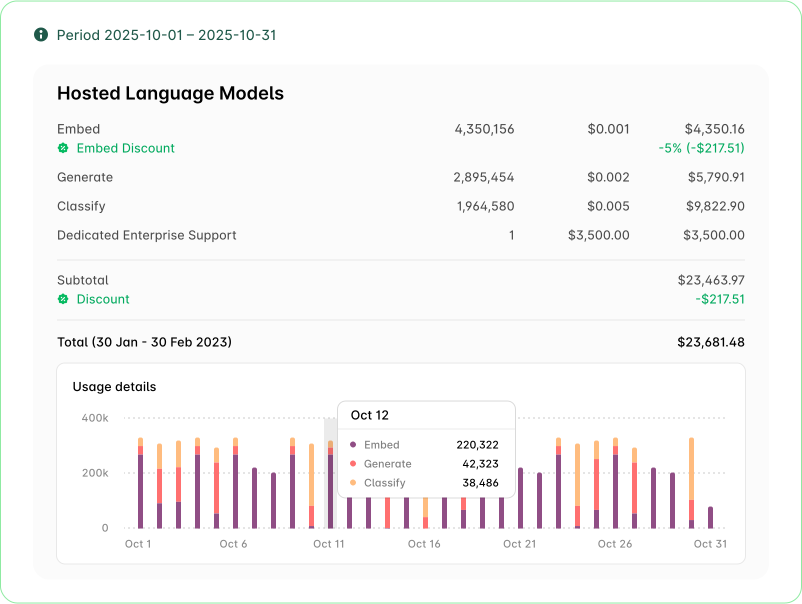
Alguna supports tiered, volume, pay-as-you-go, and hybrid pricing models, and allows non-technical teams to configure and update pricing rules without engineering involvement.
Alguna's no-code platform is particularly well suited for B2B SaaS, AI, and fintech companies that need flexibility across complex deal structures.
- Shane Curran, CEO at Evervault
Read the case study
2. Metronome
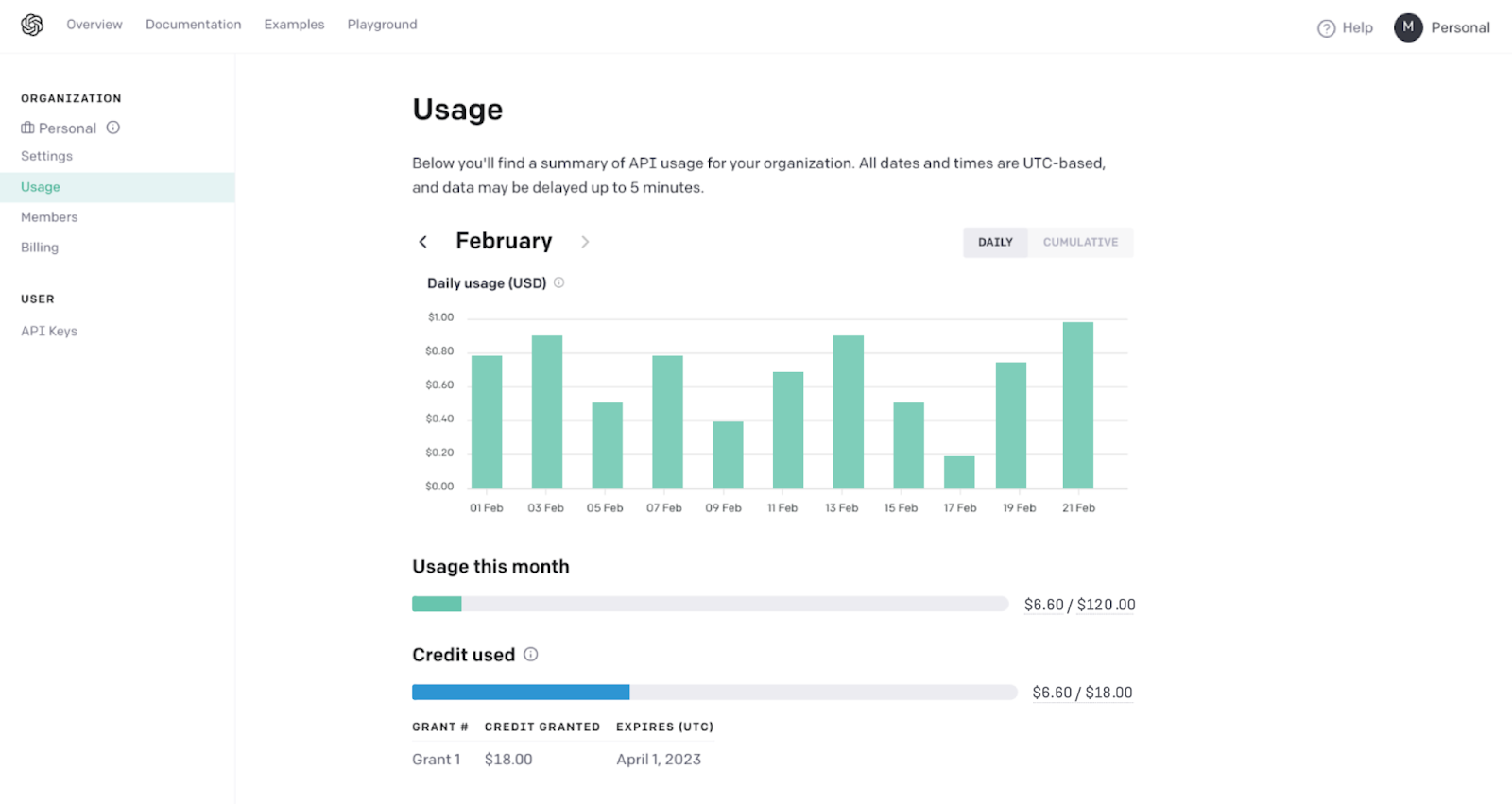
Acquired by Stripe in January 2026, Metronome is a developer-first billing infrastructure platform that specializes in high-volume usage metering and real-time rating. It’s built to handle the kind of event throughput that engineering-heavy products generate, making it a strong choice for developer tools, data infrastructure companies, and AI platforms where usage events can number in the billions per month.
Metronome gives engineering teams granular control over metering logic and pricing model configuration via API. Its real-time customer-facing usage dashboards are a standout feature, letting customers monitor their own consumption before the invoice arrives.
The trade-off is that it’s more technically oriented, so teams without dedicated engineering resources may find the implementation lift heavier than with more out-of-the-box solutions.
3. Orb
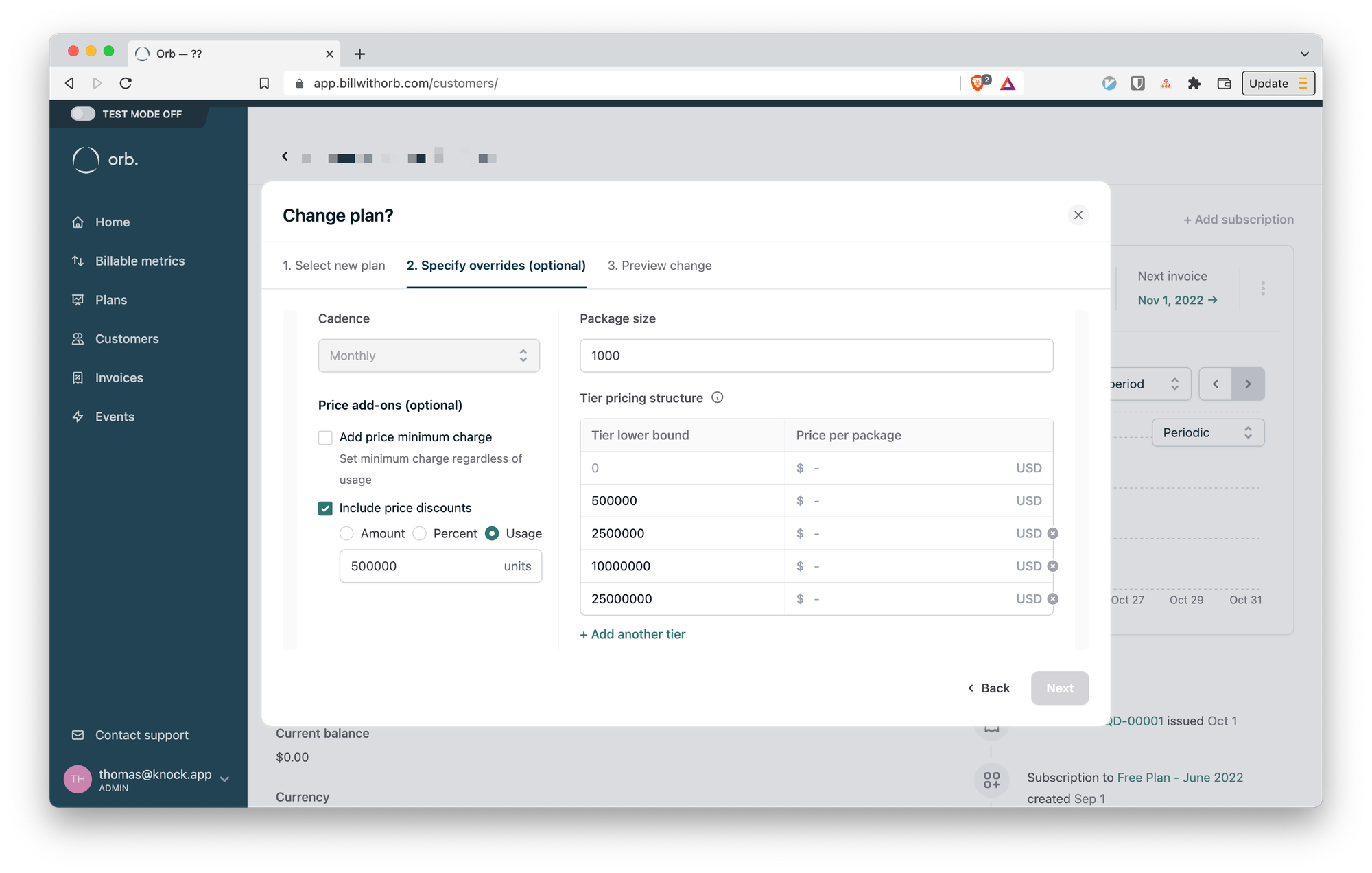
Orb positions is a billing platform built around pricing flexibility. It's a good fit for companies whose pricing models evolve frequently or vary significantly across customer segments.
Orb also offers strong reporting and analytics on top of its billing engine, giving finance teams more visibility into revenue composition and usage trends. Like Metronome, it’s API-first, so it integrates well into existing data stacks, though it requires more setup than a fully managed solution.
Choosing between automated usage billing SaaS platforms
Alguna, Orb, and Metronome are all platforms that bring robust capability to usage based billing automation.
The right choice for your team depends on where your complexity sits: if it’s in the quote-to-cash flow, Alguna is purpose-built for that. If it’s in metering infrastructure at scale, Metronome excels. If it’s in pricing model flexibility, Orb is worth a close look.
Common implementation challenges and how to avoid them
Implementing usage-based billing automation isn't without its pitfalls. Here are the challenges we see most often, and how to approach them.
Data quality at the source
Billing automation is only as good as the usage data it's working with. If events are missing, duplicated, or incorrectly attributed, your invoices will be wrong, and automation will just make those errors happen faster and at scale.
Before you automate, audit your usage data pipeline. Make sure events are emitted reliably, carried over correctly, and stored with the right metadata (customer ID, timestamp, product dimension). Investing in data quality upfront saves significant pain later.
Pricing model complexity that outpaces the platform
Some teams choose a billing platform early, then evolve their pricing model into something the platform wasn't designed to handle. The result is workarounds, custom code, and manual adjustments that erode the benefits of automation.
When evaluating platforms, don't just assess what your pricing looks like today. Think about where it might go in 12 to 24 months, and make sure the platform can support it.
Change management across finance and engineering
Billing automation touches multiple teams: engineering owns the data pipeline, finance owns the invoicing process, and sales owns the quotes that feed into it. Getting alignment across all three is often harder than the technical implementation.
Build a cross-functional working group early, map the current state of your billing process clearly, and involve all stakeholders in platform selection. The teams who have to live with the system should have a voice in choosing it.
Frequently asked questions
How does usage-based billing automation work?
It works in four steps: usage events are ingested from your product in real time, aggregated into billable quantities, run through your pricing logic (tiered, volume, overage, etc.), and converted into a line-itemized invoice that’s delivered automatically. The whole cycle runs without anyone touching a spreadsheet.
What is AI used for in usage-based billing automation?
AI for automating usage-based billing is most commonly used for anomaly detection (flagging unusual consumption spikes or drops), pricing optimization (modeling tier and overage structures against real usage data), smarter dunning management, and revenue forecasting. These capabilities sit on top of your core billing automation layer rather than replacing it.
Where can I find AI solutions for usage-based billing automation?Purpose-built billing platforms like Alguna, Metronome, and Orb are the most common starting point, as AI capabilities are increasingly built into the core product.
What are the best ERP systems for automating usage-based billing?
NetSuite, Sage Intacct, and Microsoft Dynamics 365 are the most widely used ERP systems for automating usage-based billing. Each supports usage billing to varying degrees and integrates with dedicated metering platforms to receive calculated charges and post them to the general ledger automatically.
What’s the difference between usage-based billing and subscription billing?
Subscription billing charges a flat recurring fee regardless of how much the customer uses your product. Usage-based billing charges based on actual consumption, so the invoice amount varies each period. Many companies run hybrid models that combine a base subscription fee with variable usage charges on top.
How do I implement usage-based billing automation?
Start by auditing your usage data pipeline to make sure events are being captured reliably. Then select a billing platform that supports your current pricing model and where you expect it to go. Connect your metering layer to the platform, configure your pricing rules, and integrate with your ERP or accounting system for downstream financial reporting. Involve both engineering and finance teams early, as the process touches both.
Bringing it all together
For any company running a usage-based or hybrid pricing model, usage based billing automation is the foundation of a scalable, accurate, and efficient revenue engine.
The companies that get this right, those that invest in clean data pipelines, flexible billing platforms, and tight quote-to-cash alignment, build a durable operational advantage. They collect revenue faster, lose less to billing errors, and can expand into new pricing models without rebuilding their infrastructure from scratch.
Book your personalized demo with our founders