Implementing a usage-based billing model for AI services can help align your revenue with how customers actually use your product.
Usage-based pricing (also called consumption-based or metered billing) charges customers according to the amount of service they consume, making pricing more fair and scalable than flat subscriptions.
This guide breaks down what AI services are, what usage-based billing means, why it’s beneficial for AI offerings, and step-by-step instructions to implement usage-based billing (with tools and platform examples).
What are AI services?
AI services are tools and platforms powered by artificial intelligence that enable organizations to automate tasks, analyze large data sets, and generate valuable insights.
In practice, AI services can include machine learning APIs, natural language processing tools, computer vision systems, and other AI-driven solutions delivered via cloud platforms.
These services allow businesses to offload complex AI tasks (like data analysis, image recognition, or language understanding) to specialized AI software, improving efficiency and decision-making.
Simply put, an AI service might handle everything from automating routine processes to providing predictive analytics, allowing companies to leverage advanced AI capabilities without building models from scratch.
What is usage-based billing?
Usage-based billing is the infrastructure that measures how much a customer uses your product and charges accordingly.
Instead of paying a fixed fee, customers pay only for what they consume. More usage means higher spend, less usage means lower cost.
Usage-based pricing vs usage-based billing
Pricing is the strategy of what to charge (the rates, tiers, free allowances, etc.)
Billing is the operational mechanism of metering usage, calculating charges, and collecting payment.
In implementing a usage-based model, you need both a well-designed pricing strategy and a robust billing system to meter and invoice accordingly.
Example of usage-based billing
In a usage-based billing system, the provider tracks each unit of service usage (e.g. API calls, data processed, compute hours, etc.) and applies pre-defined pricing rates to calculate the charge.
For example, if an AI image processing service charges $0.10 per 1,000 images analyzed, a customer processing 500,000 images in a month would be billed $50, while another processing 5 million images would be billed $500.
This variable charge can be standalone or combined with a base subscription fee in a hybrid model (e.g. a flat monthly platform fee plus usage overages).
Now that we’ve defined usage-based billing, let’s look at why it works so well for AI services.
5 reasons to choose usage-based billing for AI services
Adopting a usage-based billing model offers several compelling benefits for AI services, both for customers and providers:
- Aligns price with value: Customers pay in proportion to the value they get. This model feels fair as it offers a lower barrier to entry (small users pay little) and scalability for heavy users.
For AI services that might see sporadic or varying usage, clients appreciate only paying for what they actually use. - Flexibility and customer trust: Usage-based billing naturally provides flexibility. Users can scale their usage up or down without negotiating new contracts each time. This can increase trust and reduce “bill shock” because customers with visibility into their usage know that their costs will directly reflect their activity.
Many modern billing platforms even support real-time usage dashboards and alerts (e.g. “You’ve used 85% of your monthly quota”) to enhance transparency. - Revenue growth via expansion: For vendors, usage-based models can drive higher revenue from existing customers as their usage grows. Successful AI and SaaS companies have seen high net dollar retention by using usage-based pricing as customers spend more as they derive more value.
A famous example is Snowflake (a data platform with consumption-based pricing) achieving ~158% net retention, meaning customers significantly increased spend year-over-year by using more of the service.
In the AI space, if your service truly delivers value, a usage model lets your revenue expand naturally with your customer’s success. - Competitive advantage: Usage-based pricing has rapidly gained adoption across the software industry, rising from 45% of companies in 2021 to 63% by early 2023 according to an industry survey.
Particularly for AI services, which often run on cloud infrastructure (incurring per-use costs to the provider), usage-based billing helps providers cover costs and optimize pricing.
Offering a pay-as-you-go option can differentiate your AI product in a competitive market by lowering upfront commitments for new customers. - Efficient resource utilization: Internally, a usage-based model encourages efficient use of resources. Customers will be mindful of usage (since it impacts cost), potentially preventing wasteful consumption of AI resources.
Providers can also better monitor usage patterns to plan infrastructure scaling and identify which features or usage patterns drive revenue.
Whether you provide an AI API (where usage might be number of API calls or tokens processed) or an AI-powered SaaS platform, tying revenue to actual utilization ensures a win-win: customers only pay for what they use, and you capture value relative to the service you deliver.
8 steps to implement usage-based billing for AI services
Implementing usage-based billing for your AI service involves both business strategy and technical execution.
Below is a step-by-step guide:
1. Define your key usage metrics
Start by identifying the core metric(s) that will anchor your billing. Choose a measurable usage metric that correlates with the value your AI service provides.
For example, an NLP API might bill per API call or per text character processed, a generative AI image service might bill per image generated, an AI data analytics platform could charge per GB of data processed or compute hours.
It’s crucial that customers can easily understand the unit of usage and see it as fair. The metric should scale with typical customer usage, so for example, if one customer uses twice as much service, they should roughly get twice the value (and pay correspondingly).
Note: Avoid obscure or complex metrics that confuse users—clarity builds trust. Once you’ve defined the metric(s), decide on the pricing rate or tier thresholds for each (e.g. $X per API call, with volume discounts beyond Y calls).
2. Instrument and meter usage data
With metrics defined, implement the necessary tracking to meter every usage event in your product. This often means updating your AI service’s code to log usage every time the relevant action occurs (API request received, task executed, data processed, etc.), along with identifying information (like which customer/account it belongs to).
The goal is to collect accurate, granular usage data in real-time. Inaccurate metering will directly lead to billing errors, so invest in robust logging and monitoring. Many modern usage-based billing platforms provide APIs or SDKs to send usage data in real-time to their systems. If building in-house, you might set up an event pipeline (for example, streaming events to a database or message queue). Ensure the metering covers all edge cases (retries, failures, etc.) and consider how you’ll handle late-arriving data or corrections.
3. Design your pricing model and billing rules
Next, configure how usage translates into charges on the bill. You might opt for a simple per-unit pricing (e.g. $0.001 per API call), or a tiered model where the rate changes at certain usage volumes (e.g. the first 1 million calls are $0.001 each, the next million at $0.0008 each, etc.).
Some AI services use prepaid credits or tokens where customers buy a block of usage (say 10,000 credits) and consume them, paying overages if they exceed the prepaid amount. Decide if you’ll have a free tier or included usage (for instance, include 1,000 free requests per month and only charge beyond that) – this can attract new users to try your service. Also determine your billing cycle (monthly is common, but could be weekly or usage-threshold based).
Usage-based billing often bills in arrears at period-end, but you may also implement mid-cycle billing triggers for very high usage to mitigate risk (e.g. invoice a customer immediately if they hit $X of usage to avoid huge surprises). Document all these rules clearly: how usage is calculated, when invoices are generated, and any caps or rollover policies. This pricing design phase may involve collaboration between product, finance, and sales teams to ensure it meets business goals and customer expectations.
4. Choose a usage-based billing platform or build your own
To implement usage-based billing, you need a system that can ingest your usage data, apply the pricing rules, generate invoices, and charge customers’ payment methods.
Managing a usage-based model manually (or with basic spreadsheets) is error-prone and labor-intensive, so most companies use specialized billing software or integrate usage metering into their billing stack.
Evaluate whether to buy or build:
Using a platform: There’s plenty of dedicated usage-based billing software that handle the heavy lifting from usage tracking to invoice creation. Popular solutions include Alguna, Stripe Billing, Orb, and Metronome. (Find a more detailed breakdown in the next section).
Many teams start with a simpler solution like Stripe Billing and then migrate to more specialized platforms like Alguna as their usage scales or pricing needs become more sophisticated.
Building in-house: If using an external platform doesn’t fit (due to e.g. data residency or extremely custom requirements), you may consider building your own usage-based billing system.This involves significant effort as you’ll need to create a reliable metering pipeline, a rating engine to apply pricing rules, invoice generation, payment processing integration, and handling edge cases like proration, failed payments (dunning), etc. Building in-house gives ultimate flexibility, but be mindful of the engineering investment and maintenance.
However, open-source options like Lago can provide a middle ground (you self-host and customize, but you don’t have to start from zero).
5. Integrate billing with your product and payments
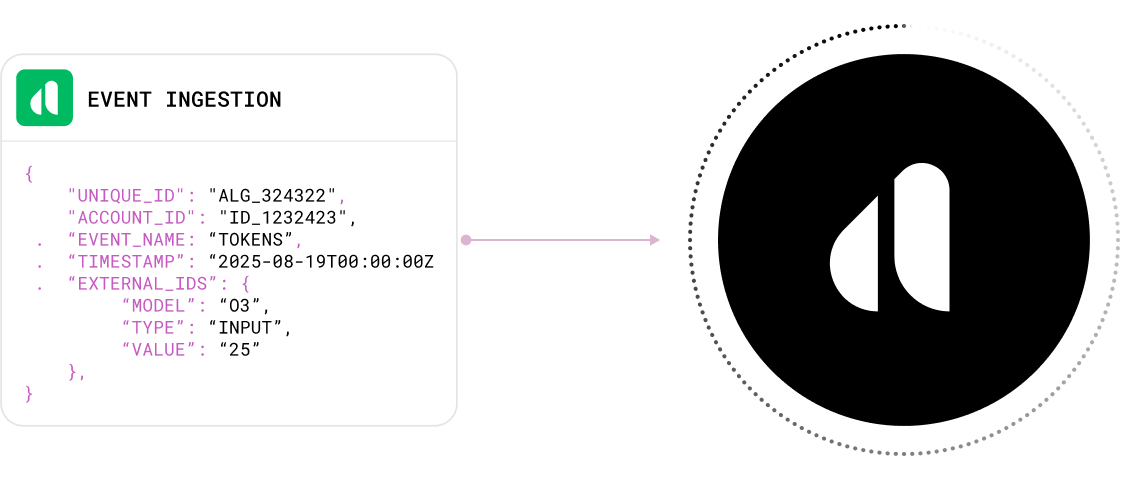
Once you’ve chosen a solution, the next step is integration. Connect your usage tracking (from step 2) to the billing system. This typically via API calls or SDKs that send usage data in real-time or in batches.
For example, if using a platform like Alguna, you would use its API to record each usage event (e.g. each API call or task) along with the customer identifier and quantity. The platform then stores and aggregates these events.
Next, set up your pricing configuration in the billing system (from step 3) – this might involve creating pricing plans, usage rate cards, and specifying how the system should calculate charges (many platforms provide web interfaces or APIs for this setup).
Make sure to also integrate with your payment gateway or processor: your billing system needs to be able to automatically charge customers. This could mean connecting to Stripe, Braintree, etc., or using the billing platform’s built-in payment integrations.
Configure invoice templates, notifications, and if applicable, a customer portal where users can see their usage and billing history. The integration phase should also cover account mapping – ensuring that your product’s user accounts match up with billing accounts, so usage events correctly roll up to the right customer invoice.
6. Test the end-to-end billing flow
Before rolling out to all customers, thoroughly test your usage-based billing setup. Use a variety of scenarios: low usage, spike in usage, going over free quotas, new customer signup, cancellation, etc.
Verify that usage data is captured accurately and that the invoice calculations match your expected pricing. A good approach is to run an internal pilot or beta test, perhaps enable usage-based billing for a small subset of customers (or a new pricing tier) before rolling it out across your entire customer base.
Check that invoices generated are correct (down to the penny) and easy to understand. If you have tiered pricing, test usage amounts around the tier boundaries to ensure the billing logic prorates or charges correctly at those thresholds.
Also test edge cases like what happens if a usage report comes in late or out-of-order, or if a customer’s payment fails. Ensuring accuracy and reliability at this stage will save a lot of customer support headaches later. It can be helpful to parallel-run the new billing model alongside your old model for a cycle (if you are migrating from flat pricing) to compare outcomes.
7. Provide usage visibility to customers
A key aspect of successful usage-based billing is transparency. Customers should never be surprised by their bill if you can help it. Implement ways for users to monitor their own usage and understand charges.
Many billing platforms let you embed usage dashboards or expose usage data via APIs so you can show it in your app. At minimum, consider sending automated usage summary emails or in-app notifications (e.g. “You used 80% of your included AI compute hours this month”).
Clear, timely usage visibility builds trust and allows customers to manage their usage proactively. When the invoice arrives, it should include a breakdown of usage units consumed and the rate charged. For example, instead of just a dollar amount, an invoice line might say “Data Processed: 3,200 GB @ $0.05/GB = $160.” This level of detail helps customers connect their usage to the charges, reducing disputes.
In case of any billing questions, have support or documentation ready to explain how usage is measured and billed.
8. Monitor, optimize, and iterate
After launching usage-based billing, it’s not a “set and forget” situation.
Monitor the system closely in the first few billing cycles. Watch for any anomalies in usage data collection or invoice generation.
Gather feedback from customers to see if they are finding the bills clear? Any confusion or pushback on the pricing model?
Internally, analyze how the usage-based model is impacting revenue. You might discover that certain features are used heavily but priced too low (or vice versa), prompting adjustments.
Iterate on your pricing strategy over time: usage-based models give you flexibility to introduce new tiers, bundle in hybrid subscription elements, or adjust rates as your costs and market evolve. Just ensure you grandfather or communicate changes to existing customers properly.
Also, keep an eye on unit economics, because with all customers on pay-as-you-go, revenue might fluctuate; forecasting will require analyzing usage trends. Over time, you may refine the metrics or add new billable dimensions (for example, an AI service might initially charge just by API calls, but later also charge for storage or output volume as the product expands).
The beauty of usage-based billing is agility, but it requires ongoing management to reap its full benefits.
9 platforms to streamline the implementation of usage-based billing
Usage metering and overages in Alguna.
When implementing usage-based billing for AI services, leveraging the right software tools can greatly simplify the process. As mentioned in step 4, here is a summary of notable usage-based billing software (and why you might consider them):
- Alguna: Y Combinator backed end-to-end billing and revenue management platform tailored for usage-based models (particularly strong for AI companies).
Alguna's platform enables AI monetization as well as SaaS monetization by offering real-time event metering, flexible pricing (supports any pricing model), customer usage dashboards, and even covers quoting and automated revenue recognition in one unified system.
It's a no-code platform purpose-built for modern revenue teams that want to move fast.
- Stripe Billing: A quick-to-start solution from Stripe that adds subscription and metered billing capabilities on top of Stripe’s payment processing. It’s developer-friendly and great if you’re already using Stripe for payments.
- Orb: A specialized usage billing platform for API-first products and services with very high usage event volumes. Orb focuses on real-time, granular metering and complex pricing logic, offering strong APIs for engineering teams. It doesn’t handle payment processing itself but integrates with payment gateways.
- Metronome: A robust usage-based billing system built for scale and precision, often used by enterprise SaaS and infrastructure companies. It can ingest millions of events and apply sophisticated pricing rules to generate precise invoices. Metronome is highly extensible via APIs, catering to teams that want deep control and are willing to invest engineering effort to integrate it.
⚠️ Metronome was recently acquired by Stripe which might affect customers
- Lago: An open-source usage-based billing and metering solution. Teams can self-host Lago’s code, giving full transparency and the ability to customize or extend features. It supports standard metered billing features (rating usage, subscriptions, etc.) without vendor lock-in or percentage-of-revenue fees.
- m3ter: A newer usage billing platform emphasizing real-time data handling and integration. It provides a strong metering engine that retains raw usage data for auditability and allows recalculating charges if pricing changes. m3ter also offers built-in integrations (Salesforce, HubSpot, Netsuite, etc.) to connect billing data across your revenue stack.
- Chargebee: A long-established subscription billing system which also supports metered usage add-ons. It’s known for a rich feature set in subscription management (trials, coupons, proration, etc.) and wide integrations, which can be useful if you have a mix of recurring and usage charges. However, its usage billing works via aggregating usage records for each billing period (not real-time event processing), and it may struggle with extremely high-frequency usage scenarios like AI token billing without custom workarounds.
- Zuora: An enterprise-grade billing platform used by large companies for complex subscription and usage billing needs. Zuora can handle intricate pricing setups (multi-tier pricing, regional pricing, commitments, overages, etc.) and multi-entity financial operations with strong compliance (ASC 606 revenue recognition, etc.). It’s powerful but complex; implementations are lengthy and costly, which makes it overkill for startups but valuable for mature enterprises.
- Maxio (Chargify + SaaSOptics + RevOps.io) – A unified billing and financial platform resulting from a merger of billing and analytics tools. Maxio offers flexible billing options (including usage-based components, prepaid plans, etc.) and robust financial reporting/analytics in one package. It bridges the gap between billing and CFO needs, providing metrics like ARR, cohort analyses, and revenue schedules alongside billing.
When selecting a platform, consider factors like ease of integration, support for your specific AI use case (e.g. billing per API call or per second of GPU time), cost structure (flat fee vs percentage of revenue), and the features you truly need (real-time billing, quote-to-cash capabilities, self-serve portals, etc.).
Moving forward with implementing usage-based billing
Implementing usage-based billing for AI services can be a game-changer. Done right, it will align your pricing with the value delivered, provide customers with flexibility and fairness, and accelerate revenue growth as usage expands.
By clearly defining your usage metrics and pricing model, accurately metering customer usage, and leveraging the right billing tools, you can transition to a usage-based model with confidence.
Remember to maintain transparency with your customers throughout the process as a well-implemented usage-based plan builds trust and can set you apart in the market.
AI services often have varying consumption patterns, so a pay-as-you-go approach makes sense for both parties. As you roll out usage-based billing, keep monitoring and refining your approach.
Pricing is never one-size-fits-all, and the beauty of usage-based models is that they’re adaptable. With the comprehensive steps and platforms outlined above, you’re well on your way to successfully implementing a usage-based billing strategy that scales with your AI business and keeps customers happy.