Lago is a solid open-source billing engine for usage-based pricing and works well for early-stage, developer-led startups.
But as SaaS companies scale their revenue operations, they typically look for Lago alternatives. Alguna is a modern quote-to-revenue platform that many teams choose when they outgrow Lago’s capabilities.
In short, Lago shines for basic metered billing with heavy developer control, while Alguna offers a broader feature set (subscriptions + usage, CPQ, revenue recognition) geared toward finance and go-to-market teams.
TL;DR: When to choose Alguna and when to go with Lago
| Scenario | Best choice | Why |
|---|---|---|
| You need to meter usage and bill via API | Alguna or Lago | API-first and event-driven billing built for scale and flexibility. |
| You want to combine usage + subscriptions + credits with no code | Alguna | No-code pricing designer supports complex hybrid models without engineering help. |
| Sales team needs quoting and contract workflows | Alguna | Built-in CPQ, quotes, e-signature, and contract management in one flow. |
| Billing system must be self-hosted | Lago | Open-source and deployable in your infrastructure for full control. |
| Finance or RevOps wants to own pricing/billing | Alguna | Visual UI empowers non-devs to own revenue ops end-to-end. |
| You’re very early-stage and want a free billing engine | Lago | No vendor fees, full transparency, customizable via code. |
| You’re scaling GTM and need full quote-to-revenue automation | Alguna | Unifies quoting, billing, and RevRec to accelerate revenue at scale. |
What is Lago? (and when it works well)
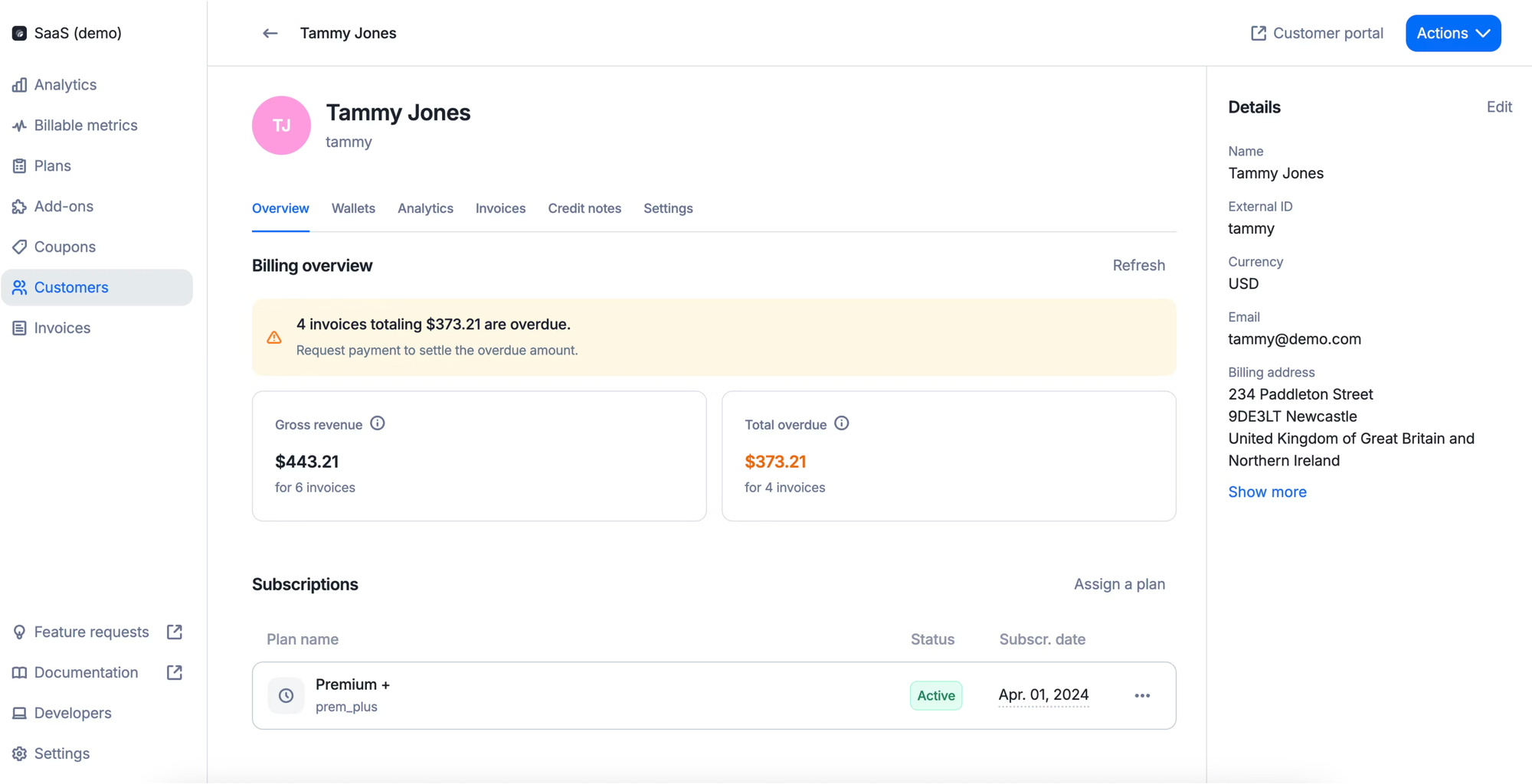
Lago is an open-source metering and billing platform launched in 2022 that has quickly gained popularity among developer-oriented startups.
In essence, Lago provides the foundational pieces of usage-based billing: you can track events (API calls, transactions, etc.), apply pricing rules, manage subscriptions, and generate invoices through Lago’s APIs and tools.
It offers metered usage tracking, subscription management, invoicing, but with the unique benefit of being open-source and self-hostable.
What Lago does well:
- Open-source flexibility and transparency: Lago’s code is fully open source, which means your developers can inspect it, customize it, and even contribute to it. This allows teams with unique billing needs to tailor the system to their use case in ways that closed “black-box” vendors might not allow.
There are no proprietary restrictions or vendor lock-in as you have full control to modify workflows or logic as needed. - Self-hosting and data ownership: Because you can deploy Lago in your own infrastructure, companies with strict data compliance requirements often gravitate to it.
All billing and usage data stays in-house when self-hosted, which is valuable for industries like fintech or healthcare that have to meet data residency, GDPR, or other regulatory demands. - Developer-first integration: Lago is built with engineers in mind. It provides clean APIs, SDKs, and a modular architecture for metering and billing. Engineering teams can integrate usage tracking into your product relatively easily, and adopt Lago incrementally.
For example, start with just its metering engine, then add billing/invoicing modules later as needed.
This modular, API-driven approach means Lago fits well for developer-led startups who might otherwise consider building a billing system from scratch.
Who Lago is for (use cases): Given these strengths, Lago tends to work best for:
- Early-stage and engineering-led teams: Startups with strong developer resources and relatively simple pricing (primarily usage-based) can leverage Lago to avoid paying for a heavier billing system.
If you’re in the stage where saving on SaaS fees is crucial and your developers are eager to own the billing stack, Lago offers maximum control at minimal cost. - Companies with strict compliance or customization needs: If your business operates in a regulated industry or requires on-premise solutions, Lago’s self-host option is a major draw.
Companies in government, healthcare, or any sector where data sovereignty is non-negotiable choose Lago so they can keep customer usage data on their own servers.
In summary, Lago is a transparent “billing engine” that shines when you need flexibility, have the engineering muscle to support it, and perhaps don’t need a lot of "fancy extras."
5 reasons teams look for Lago alternatives
If Lago is so flexible and developer-friendly, why do teams start looking for alternatives?
The reality is that as a company grows, billing needs become more complex, and many of those needs fall outside the scope of what Lago provides out-of-the-box.
Here are five common pain points that typically drive SaaS teams to look for Lago alternatives:
(1) Scaling beyond usage-only pricing
Lago’s sweet spot is usage-based billing (with some support for subscriptions), but scaling SaaS companies often introduce more sophisticated pricing models.
You might want to offer hybrid plans (subscription + usage), volume-tiered pricing, credits, or multiple metrics on one invoice. While Lago can handle basic hybrid billing, a lot of heavy lifting may fall on your engineers to set up and maintain these complex schemes.
Companies often outgrow Lago when they find that advanced pricing experiments require significant custom work or simply aren’t supported natively.
(2) Adopting a sales-led motion
Lago does not include any CPQ or quoting tools as it’s focused on billing once a customer is already on a set plan. If your go-to-market evolves from pure self-service to include salespeople negotiating custom deals, Lago by itself falls short.
Sales teams will need to create quotes and contracts outside of Lago (often in spreadsheets or separate CPQ software) and then billing has to be synced up manually. This gap is painful for organizations starting to close larger enterprise deals.
(3) Finance and RevOps friction
As billing complexity grows, so does the involvement of Finance and Revenue Operations. These teams need visibility and control, but Lago’s developer-centric nature can leave non-engineers in the dark.
There is a limited UI for finance or ops users, and no built-in integrations to CRM or ERP for smooth handoffs. This means RevOps might be exporting data to spreadsheets to do their analysis, and Finance might be manually adjusting records for accounting.
(4) Audit, compliance, and revenue recognition needs
A major trigger to look beyond Lago is when accounting and compliance requirements become significant. Lago does not provide revenue recognition features or advanced financial workflows.
Teams often switch to platforms like Alguna specifically to get built-in revenue recognition and compliance automation, so that billing and accounting are in sync with minimal manual intervention.
(5) Maintenance and engineering overhead
Finally, some companies simply reach a point where the cost of maintaining an open-source system outweighs the benefits.
Lago’s flexibility comes with responsibility: your developers have to manage updates, infrastructure (if self-hosted), and any customizations you’ve added.
As your product engineering focuses on core product development, spending time babysitting the billing system becomes less attractive. A fully-managed alternative can relieve this burden.
Teams look for Lago alternatives when they need a more comprehensive, scalable quote-to-revenue solution that covers quoting, billing, and financial operations.
What to look for when evaluating Lago alternatives
Once you’ve decided to explore Lago alternatives, what criteria should you consider?
Modern quote-to-cash needs often span multiple functions across sales, billing, finance, so you’ll want a solution that checks several boxes that Lago doesn’t.
Key capabilities to look for in Lago alternatives include:
- Unified support for subscriptions and usage: Ensure the alternative can handle both recurring subscriptions and metered usage billing in one system. Many SaaS businesses end up with hybrid models (e.g. a base monthly fee plus variable usage charges). A Lago alternative should let you configure flat fees, usage charges, or any combination without workarounds.
- Quoting and CPQ functionality: Look for a platform that includes a Configure-Price-Quote (CPQ) module or otherwise streamlines the quote/contract process. This is crucial if sales reps or customer success teams will be offering custom deals.
- Automated revenue recognition and finance-friendly features: A strong Lago alternative will go beyond billing into revenue recognition (RevRec) and compliance reporting. This means the system can automatically create deferred revenue schedules, handle multi-period revenue for subscriptions or usage, and generate reports that align with accounting standards. Finance teams should be able to rely on it for ASC 606/IFRS 15 compliance out-of-the-box.
- Finance/RevOps ownership and ease of use: One of the biggest considerations is how much the platform empowers your non-technical teams. An ideal Lago alternative will have an intuitive UI or no-code configuration for pricing plans, discounts, customer account setup, etc. Your Finance or Revenue Operations team should be able to make routine changes without creating a ticket.
- Integrated quote-to-revenue process: In a broad sense, you want a platform that doesn’t just stop at billing. The best alternatives will cover the entire quote-to-revenue lifecycle. This includes quoting/CPQ, contract management, billing/invoicing, payment collection, and revenue recognition, all in one connected flow.
When evaluating Lago alternatives, think about the full spectrum of quote-to-cash needs. Make sure the solution can handle the complexity of your pricing, the workflows of your sales and finance teams, and the technical scale you anticipate.
A checklist of “subscriptions + usage billing, CPQ, RevRec, finance-friendly interface, and scalability/integrations” is a good starting point to find a future-proof platform.
Comparison: Lago vs Alguna (feature-by-feature)
The table below compares Lago and Alguna on key features, including pricing models support, CPQ and revenue recognition, level of developer effort needed, and go-to-market scenarios.
| Aspect | Lago (Open-Source Billing) | Alguna (Quote-to-Revenue Platform) |
|---|---|---|
| Pricing Models Supported |
Usage-based metering (core focus), plus basic subscription billing. Lago can handle pay-as-you-go usage and recurring plans, but complex hybrid pricing may require custom development. Hybrid support: Some support for combined subscription + overage models and prepaid credits exists, but it’s not as flexible out of the box. Engineers might need to extend it for intricate pricing structures. |
Subscriptions + Usage natively: Designed to mix flat-rate subscriptions, metered usage charges, one-off add-ons, and even prepaid credit models on a single invoice. Supports tiered, graduated, volume-based pricing, and other models without coding. Flexible models: Alguna lets you configure complex plans (e.g. hybrid plans with base fee + usage, or pooled usage across users) via UI. This agility means GTM teams can iterate pricing schemes quickly (prepaid, postpaid, etc.) to match your business needs. |
| CPQ (Quote & Contract Support) |
None built-in: Lago does not include CPQ or quoting modules. Sales teams must use external tools or manual methods for quotes/proposals. There’s no native contract management or e-signature – Lago is focused on billing after a plan is already agreed. Workaround: Engineering or ops would need to build custom integrations (e.g. connecting a CRM or Google Sheets to Lago) to link sales quotes with billing, which can be error-prone. |
Full CPQ integrated: Alguna provides a built-in Configure-Price-Quote system. Sales reps can configure deals, generate quotes, and get contracts e-signed within Alguna. It seamlessly turns signed quotes into active subscriptions/usage plans. Contract management: With native e-signature and contract templates, Alguna handles the quote-to-contract process. This is ideal for sales-led motions – it eliminates duplicate data entry and ensures what’s sold is exactly what gets billed, automatically. |
| Revenue Recognition (RevRec) |
Not included: Lago does not offer revenue recognition or accounting rules out of the box. Finance must handle revenue recognition in spreadsheets or separate software. Compliance with ASC 606/IFRS 15 is manual. Implication: Companies often export billing data and manually create revenue schedules, which is error-prone and time-consuming. |
Automated RevRec: Alguna has built-in revenue recognition that defers revenue according to ASC 606/IFRS 15. It automates multi-period deals and reporting for auditors. Audit-ready: Integrated RevRec gives finance compliant audit trails and accelerates month-end close. |
| Developer Dependency |
High: Lago is self-hosted and API-first. Engineers are required for setup, pricing changes, maintenance, and upgrades. Even routine changes often involve scripting or deployments. Engineering overhead: Lago is powerful but requires a dev team to operate. |
Low: Alguna is a fully-managed SaaS platform with no-code configuration. Non-engineers can create and update pricing plans. Developer role: Optional. Engineers can integrate via API and webhooks, but aren't needed day-to-day. |
| Go-To-Market Fit | Product-led startups & tech-centric teams: Lago suits early-stage SaaS, dev tools, or API platforms that want control, customization, and no vendor lock-in. Best for engineering-led PLG companies with simple sales processes. | Scaling B2B SaaS with PLG + sales motions: Alguna is built for SaaS, AI, and fintech companies growing into hybrid GTM. Ideal for teams that need to support both self-serve and custom sales-driven deals with complex billing and RevOps needs. |
Table: High-level comparison of Lago and Alguna. While both aim to help SaaS companies monetize usage-based models, Lago is a lightweight, developer-centric billing engine, and Alguna is a comprehensive revenue platform bridging sales, billing, and finance.
Deep Dive: Why teams choose Alguna
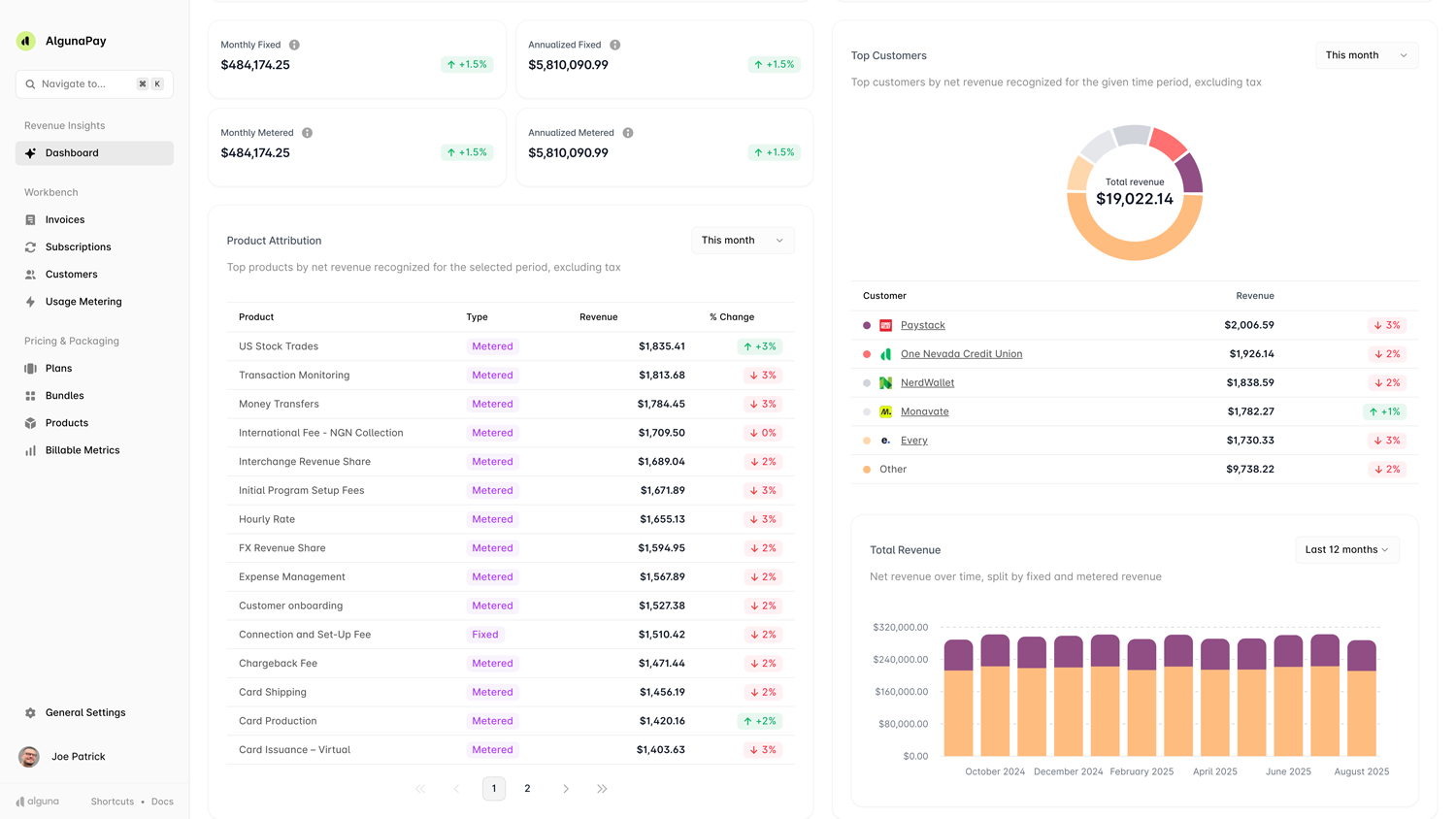
While Lago gives early-stage teams a flexible, developer-friendly billing engine, many SaaS companies eventually need more than just metering and invoicing.
That’s where Alguna comes in. Built as a full quote-to-revenue platform, Alguna helps scaling teams unify sales, billing, and finance workflows—without writing code or stitching together multiple tools.
Whether it’s configuring hybrid pricing, automating revenue recognition, or enabling sales teams to close complex deals with built-in CPQ and contracts, Alguna gives go-to-market teams the control they need to move fast and scale confidently
1. Finance and RevOps enablement (less reliance on engineering)
One of Alguna’s biggest advantages is that it’s built for business users to control. Pricing plans, discount schemes, and billing rules can be configured through a visual interface, with no-code or low-code administration.
This means Finance or RevOps leaders can introduce a new pricing model or update a rate without drafting a spec for Engineering. Teams choose Alguna because it eliminates the developer bottleneck – you don’t need to be a programmer to make changes.
The result is faster go-to-market iteration (GTM teams can launch promos or adjust usage rates on the fly) and fewer errors since the people who understand the revenue strategy can implement it directly.
2. Built-in CPQ for sales-led deals
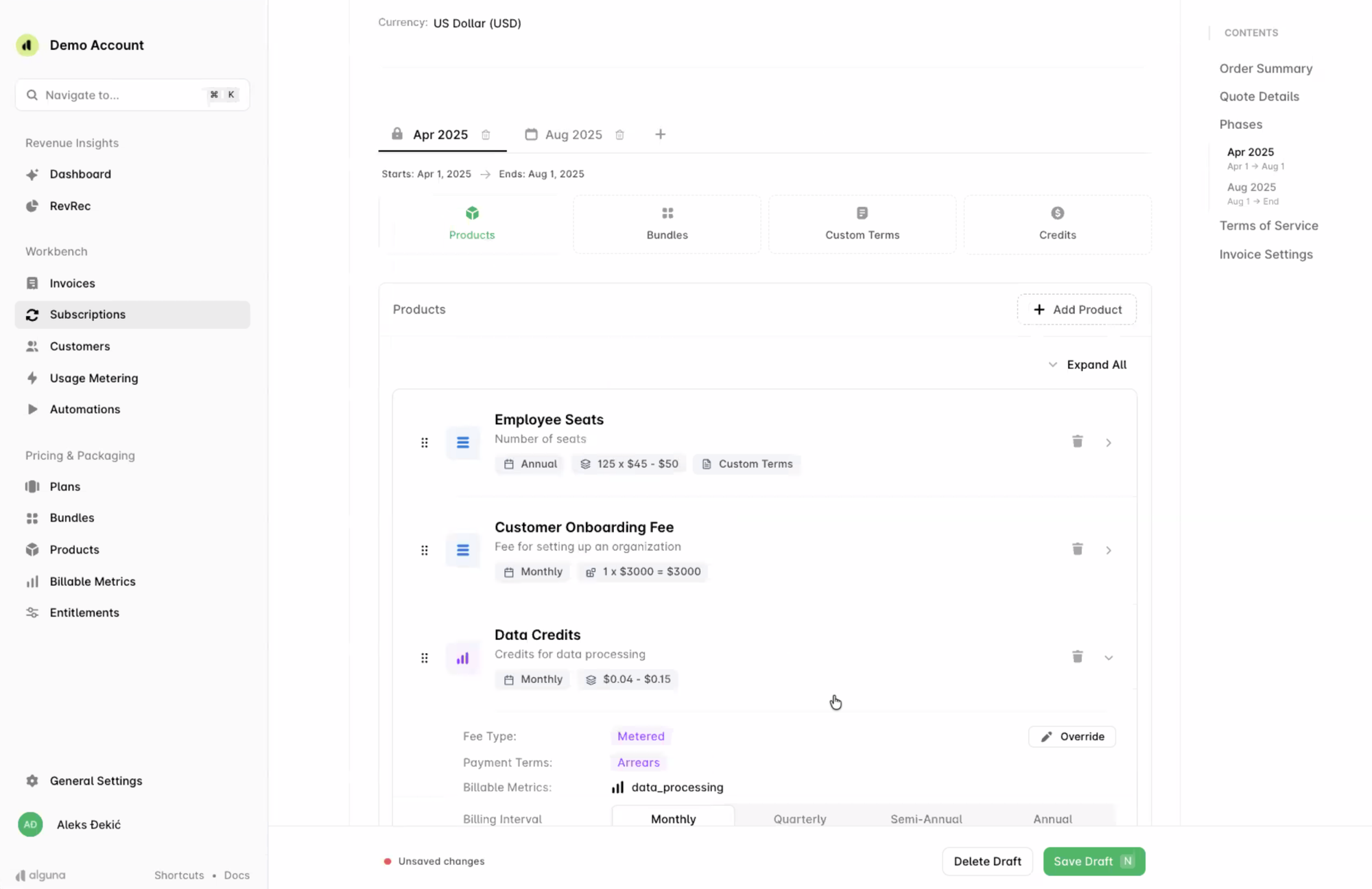
For organizations with sales teams, Alguna offers an integrated Configure-Price-Quote module with contract management. This is a game-changer for SalesOps. A salesperson can log into Alguna to configure a custom plan for a customer.
Alguna’s CPQ includes e-signature functionality, so the customer can sign the contract digitally. Once signed, that contract automatically turns into an active subscription/plan in the system, and billing follows the agreed terms.
Teams choose Alguna because it connects the dots between sales and billing: there’s no need to manually re-enter deals from a CRM into the billing system. This reduces errors (what you sell is what you bill) and saves countless hours.
Alguna lets you go from a salesperson’s quote to a live billing schedule in one seamless flow, which is something point solutions (or Lago alone) cannot do. For companies transitioning from product-led growth to adding a sales-assisted layer, this capability is often a deciding factor in opting for Alguna.
3. Flexibility to support complex pricing at scale
Alguna was designed with high-growth SaaS and AI companies in mind, which often means handling very complex and evolving pricing models. It shines in scenarios where you might have to combine multiple billing elements.
For example, you might charge a platform fee, plus per-user fees, plus usage-based fees (tokens, API calls, etc.), all on one invoice – Alguna can accommodate that easily with its hybrid billing engine. Need to introduce a new metric suddenly (say, you want to start billing based on data usage in addition to API calls)? In Alguna, it’s a configuration change, not a development project.
Alguna is built for real-time, high-volume metering, so it can ingest and rate events as they happen without aggregating them in batches. This is crucial for AI and fintech use cases where usage data can be massive. Teams choose Alguna because they see it as a platform that won’t buckle under scale or complexity.
4. Unified quote-to-revenue process (no more siloed tools)
Another reason teams opt for Alguna is to unify what used to be fragmented processes across multiple tools. In many companies, the journey from a quote to revenue recognition might involve separate systems: a CPQ tool for quotes, a billing system for invoices, maybe a spreadsheet or a revenue tool for recognition.
Alguna consolidates this entire lifecycle in one platform. The moment a deal is closed (in Alguna’s CPQ), everything downstream – invoicing, payment collection, revenue scheduling – is automatically taken care of according to the configured rules. Finance teams particularly love this because it means no more manually reconciling different systems.
If a customer’s contract says $120K/year with a true-up based on usage, Alguna will invoice it correctly and also align the revenue recognition for it, without someone exporting data to Excel. By elevating billing into a full quote-to-cash engine, Alguna ensures that Sales, Finance, and Engineering are all looking at the same source of truth.
This holistic approach is a big draw for companies that have felt the pain of stitching together tools. It’s about reliability and consistency: with Alguna, the hand-offs between quote, billing, and revenue are automated and error-free.
5. Enhanced transparency and customer experience
Alguna doesn’t just improve internal processes; it also brings value to your end customers through transparency. The platform provides customer-facing usage dashboards and detailed invoices that let your clients see exactly what they are being charged for in real time.
For example, if a customer is consuming API calls, they can log into their portal and see usage this month versus last, with projections of their bill. This level of transparency builds trust and reduces billing disputes (“bill shock” is minimized when customers can self-serve their usage data). Lago users often have to build such customer-facing reporting themselves, whereas Alguna includes it natively.
Additionally, Alguna automates things like proration, co-terming of contracts, and consolidated invoicing for multiple products. These are the kinds of operational headaches that, if done manually, can cause mistakes.
6. Reliability and support at scale
Lastly, opting for Alguna means getting a supported, continuously improving product. As a newer entrant (YC-backed in 2023), Alguna is focused on rapidly delivering features and responsive support.
Companies that switch from an open-source tool appreciate having a vendor to rely on, especially one that offers white-glove onboarding and migration help as Alguna does for new customers.
The platform’s modern architecture also means it’s cloud-native and built to integrate (with open APIs and webhooks), so it plays nicely with your existing stack. Teams often cite faster implementation times with Alguna (measured in weeks) compared to legacy enterprise systems that can take months.
All these factors, quick setup, responsive support, and a clear product roadmap, make Alguna a safer long-term choice when revenue operations are mission-critical.
Case study: Why Sequoia-backed Evervault chose Alguna for usage-based billing

Cybersecurity company Evervault initially managed billing with a mix of in-house scripts, Stripe Billing, spreadsheets, and DocuSign for contracts. As they grew, this patchwork couldn’t handle their fast-changing usage contracts.
They switched to Alguna to unify their revenue workflows. With Alguna, Evervault and their customers gained continuous visibility into usage and billing, eliminating surprises, and their finance team was able to automate previously manual tasks.
Alguna enables complex usage-based billing for them “in a way that other products can’t.”
- Shane Curran, CEO at Evervault
This story echoes why many teams choose Alguna: it’s not just about billing more customers, it’s about billing smarter and with confidence as your business model evolves.
Which teams should switch from Lago to Alguna?
If you’re currently using Lago (or considering it) and also eyeing Alguna, you might wonder: Is it time to switch? The answer depends on your stage and the challenges you’re facing.
Here are some guidelines to help you decide:
- Stick with Lago if… you are a small startup with a simple pricing model (e.g. a single subscription or straightforward usage metric) and you have sufficient engineering resources to manage billing. Lago’s open-source approach will save you money and give you full control, which is great in early stages.
- Consider Alguna if you find yourself needing features outside of Lago’s scope. For example, if your sales team is now doing enterprise deals and spending hours creating custom quotes or trying to retrofit Lago to handle special pricing, it’s a strong sign that you need a platform with CPQ.
- Switch to Alguna if your Finance team is struggling to keep up with billing data in spreadsheets, or worried about audit/compliance gaps. A clear indicator is if revenue recognition or reporting has become a headache. Maybe you’re doing manual calculations for deferred revenue, or you can’t easily answer how usage translates to revenue under GAAP. Alguna’s integrated revenue recognition is built for this scenario.
- Consider Alguna when your go-to-market complexity increases. Perhaps you started as purely self-serve but now have a hybrid sales model, or you’re expanding internationally with different pricing in each region. These introduce complexity in billing (and quoting) that Lago isn’t designed to handle elegantly. Alguna excels at managing complexity, whether it’s multiple currencies, multi-entity billing, or blending self-service usage with sales-driven contracts on the back end.
- Switch if engineering is becoming a bottleneck. This is a more internal signal. Ask yourself, Are we delaying or avoiding pricing changes because it’s too hard to update in our billing system? If yes, that’s a red flag. In an ideal world, your monetization strategy shouldn’t be held back by technical friction. Alguna allows rapid pricing iteration without dev work, so your team can respond to market demands quickly.
If you know you’ll be raising prices, introducing new product lines, or targeting enterprise clients in the next 6-12 months, you'll want to implement Alguna beforehand.
This way you won’t have to retool your billing in the middle of that growth spurt.
Frequently asked questions: Alguna as the top Lago alternative for SaaS companies
Q: Can Alguna handle usage-based billing as well as Lago?
A: Yes. In fact, Alguna was designed with usage-based billing at its core. It can capture high-volume events in real time just like Lago, and it supports all the common usage pricing patterns (pay-as-you-go, tiered usage, overages, etc.) natively.
You won’t be losing any usage-billing power by switching as Alguna will meter and bill usage at scale with the same accuracy (and with built-in dashboards for visibility).
Q: Is Alguna open source like Lago?
A: No, Alguna is a proprietary SaaS platform, not an open-source project. This is a key philosophical difference. Lago’s open-source nature gives you raw control but requires you to manage the system.
While you cannot self-host Alguna or modify its source code, you benefit from the vendor handling infrastructure and adding features on a regular basis. For teams concerned about transparency or lock-in: Alguna mitigates this by offering robust APIs and data export capabilities, but it isn’t open source.
(Reach out to Alguna’s team for any other specific questions, they’re used to helping companies evaluate this choice.)
Final takeaway and next steps
Choosing between Lago and Alguna ultimately comes down to where your company is in its growth journey and what problems you’re trying to solve.
Lago is an excellent choice for what it is: an open-source, developer-first billing engine ideal for early-stage or highly customized scenarios. But many teams hit a point where billing alone isn’t enough and they need a quote-to-revenue solution that grows with them. T
hat’s where Alguna stands out. It’s not just an alternative to Lago, it represents a step up to a more unified revenue platform. By handling everything from pricing design to quote generation, all the way through to revenue recognition, Alguna allows your Sales, RevOps, and Finance teams to operate in sync, with minimal reliance on engineering.
Book your personalized demo