If you’re running a modern SaaS or AI platform, you’ve probably felt the tension between simple subscriptions and spiky usage.
Flat fees are easy to sell and forecast, but they leave money on the table and frustrate light users. Pure usage-based pricing aligns with value, but makes revenue and customer bills volatile.
Hybrid pricing solves this by combining a predictable subscription with usage-based charges.
But if you have hybrid pricing, you need to make sure you can effectively bill for your hybrid pricing model, and that's where hybrid billing comes in.
What is hybrid billing?
Before we dive deeper into hybrid billing, let's get some clarity on the differences between hybrid pricing and hybrid pilling.
Hybrid pricing = The strategy
Example:
A SaaS company might charge:
- $500/month flat for base platform access (subscription)
- +$0.01 per API call (usage-based pricing)
This pricing structure determines how the customer is charged for value, aligning pricing more closely with how they use the product.
Why companies use it:
- Encourages adoption with predictable costs (subscription)
- Captures revenue as usage grows (usage-based)
- Reflects value delivered more accurately
Hybrid billing = The execution
Involves:
- Tracking metered usage (e.g., API calls, user seats, storage)
- Calculating charges per pricing rules
- Prorating mid-cycle changes
- Generating invoices that combine subscription + usage
- Recognizing revenue appropriately (per ASC 606/IFRS 15)
Why it matters:
Even if your pricing is hybrid, without hybrid billing infrastructure, you can’t bill customers accurately or efficiently which will result in errors in billing damage that ultimately could erode customer trust (and your revenue).
In short, hybrid billing gives you the flexibility of usage-based pricing without sacrificing the stability of recurring revenue.
| Concept | Focus | Key Question Answered | Example |
|---|---|---|---|
| Hybrid pricing | Strategy | How do we charge customers? | $X/month + $Y per API call |
| Hybrid billing | Operations | How do we track, calculate, and invoice that? | Ingest usage → rate → invoice |
Hybrid billing automation (and why it’s non-negotiable at scale)
While hybrid pricing offers flexibility for customers, it can introduce some significant operational challenges behind the scenes.
As hybrid billing often involves tracking usage in real time, calculating variable fees, managing upgrades mid-cycle, applying proration, and syncing invoices, most legacy systems aren't up for the task. At least not without significant engineering efforts and manual workarounds.
That’s where hybrid billing automation comes into the picture along with a hybrid billing software (like Alguna) that was purpose-built to accommodate hybrid pricing and AI era billing challenges.
What is hybrid billing automation?
Hybrid billing automation refers to the systems and workflows that:
- Ingest and meter real-time usage data
- Apply pricing logic automatically (e.g. thresholds, overages, tiered rates)
- Generate accurate invoices that combine subscription and usage-based charges
- Sync financial data with CRMs, accounting software, and RevRec systems
- Handle edge cases like mid-cycle changes, contract co-terming, or multi-entity billing
Why hybrid billing automation matters
- Scalability: As usage grows, manual processes break down. Automation handles thousands (or millions) of usage events without delay or errors.
- Accuracy: Eliminates invoice mistakes and revenue leakage — every API call, GB, or transaction is billed correctly.
- Transparency: Gives customers real-time visibility into their usage and charges, reducing disputes and support tickets.
- Speed: Frees up finance and ops teams from spreadsheets and manual adjustments, allowing faster close cycles and better forecasting.
- Compliance: Ensures your billing aligns with revenue recognition standards (e.g. ASC 606) and audit requirements.
What is hybrid billing software?
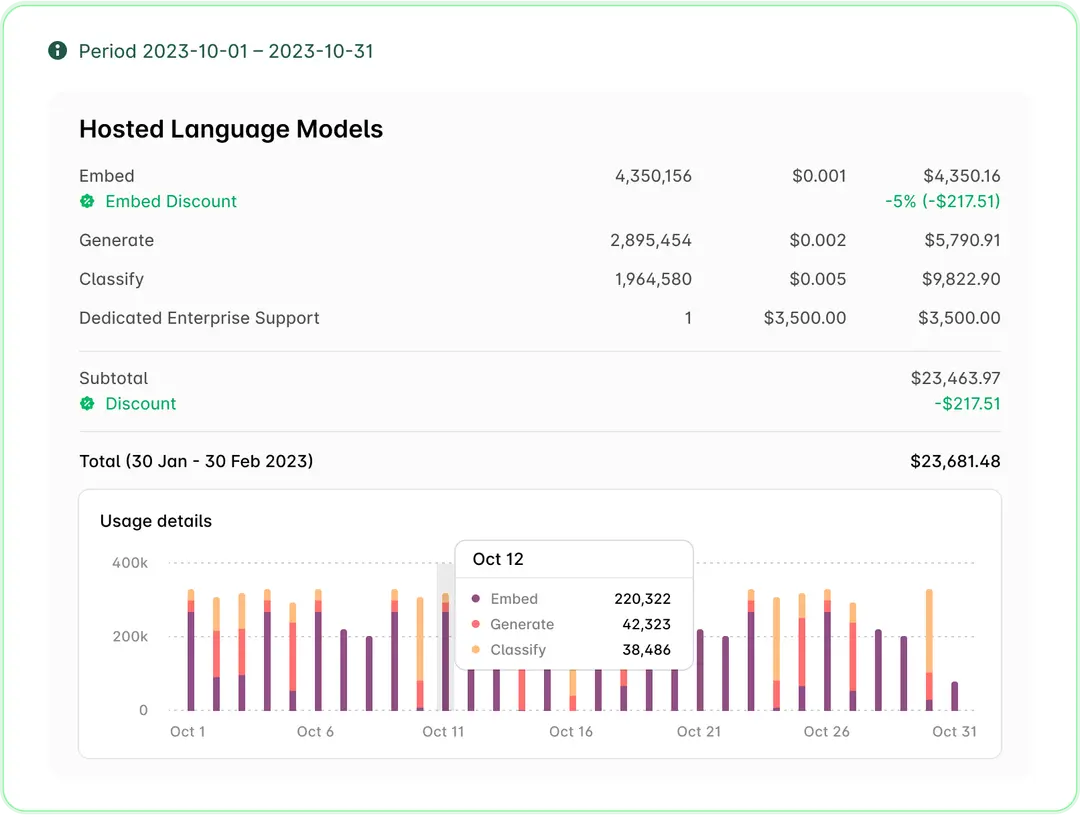
Hybrid billing software enables SaaS, AI, and fintech companies to support multiple pricing models in a single system, usually a combination of recurring subscriptions and usage-based charges. It’s built to handle the operational complexity of modern monetization strategies, especially in AI, SaaS, and fintech.
Unlike traditional subscription billing tools, hybrid billing platforms can meter usage in real time, apply dynamic pricing rules, automate invoicing, and ensure compliance with revenue recognition standards — all while integrating cleanly with your finance stack.
“As more companies blend usage-based and subscription pricing, billing has become a strategic capability. Automation is no longer optional.”
— Bessemer Venture Partners, State of the Cloud 2025
What makes hybrid billing software different?
If your pricing model includes tiers, thresholds, overages, pay-as-you-go elements, or bundled services, hybrid billing software helps you:
- Reduce manual effort from reconciliation and invoice generation
- Improve accuracy and compliance in billing and revenue recognition
- Enable faster pricing experimentation without engineering dependency
- Scale confidently as usage, customer volume, and product complexity grow
Finance and RevOps leaders are turning to specialized platforms to replace brittle spreadsheets, internal tooling, or general-purpose billing systems that can’t keep up.
Hybrid billing software: Platform overview
Here’s a list of top hybrid billing solutions to consider, each supports recurring + usage-based pricing in different ways.
| Platform | Best For | Strengths | Limitations | Pricing |
|---|---|---|---|---|
| Alguna | AI, SaaS, and fintech teams scaling complex hybrid pricing | Real-time usage metering, no-code pricing setup, built-in quoting, ASC 606 RevRec, fast setup | Newer platform; may be overpowered for basic billing needs | Starts at $399/month, no % of revenue |
| Chargebee | Mid-market SaaS with mostly recurring billing and light usage components | Mature platform, strong integrations (e.g. Salesforce, NetSuite), compliance-ready | Usage billing is not real-time; some features gated by tier | Starts at $599/month up to $100K MRR, ~0.75% on overages |
| Maxio | Finance-driven SaaS needing billing + revenue operations in one | Native RevRec, SaaS metrics, CPQ, contract billing | UI complexity from legacy product merger; not ideal for fast GTM changes | Starts at $599/month, usage-based pricing above tier |
| Stripe Billing | Startups using Stripe Payments and basic metered billing | Great developer UX, easy to launch, seamless payments integration | Limited flexibility for advanced pricing; 0.7% revenue fee scales poorly | 0.7% of billing volume + Stripe Payments fees |
| Lago | Developer-led teams needing open-source control | Open-source, customizable, supports complex usage logic | Requires engineering resources; fewer out-of-box finance tools | Free (self-hosted), or ~$1K–3K/month for managed cloud |
| Zenskar | SaaS teams with granular, event-based pricing needs | Usage ingestion engine, programmable pricing rules, strong audit trails | Still maturing; requires engineering lift for setup | Usage-based; custom quote required |
| Orb | High-volume SaaS with frequent pricing experiments | Advanced usage abstraction, event streaming, PLG-friendly | Designed for engineering-led orgs; limited no-code UI | Usage-based; free tier, then custom pricing |
| m3ter | B2B SaaS monetizing at scale across geos or currencies | Supports prepaid, drawdowns, usage tiers, FX handling | Steeper learning curve; limited UI for non-technical users | Custom quote, usage-based pricing |
Hybrid billing shouldn’t be the bottleneck
Hybrid pricing has become the gold standard for SaaS, AI, and fintech companies looking to balance predictability and performance. But without the infrastructure to support it, what starts as a smart pricing strategy can quickly become an operational headache.
That’s why hybrid billing, and more importantly, hybrid billing automation, is no longer optional.
If you’re already mixing subscriptions with usage-based charges, ask yourself:
- Are we billing customers accurately and transparently?
- Can we scale our pricing without scaling finance headcount?
- Do we have real-time visibility into usage, revenue, and risk?
- Are we ready to support pricing experiments without rewriting code?
If the answer to any of these is “no” or “not easily,” it’s time to evaluate your billing foundation.
Modern hybrid billing software platforms, especially those purpose-built for today’s AI and SaaS monetization models, don’t just help you invoice. They help you grow faster, price with confidence, and free up your revenue team to focus on strategy, not spreadsheets.
The future of billing is automated, flexible, and aligned with your pricing strategy. If your product is hybrid, your billing should be too.