Flexprice is an open-source metering and billing platform for AI and API companies. Teams usually look for an alternative when billing has to connect to the rest of the revenue process: quotes, contracts, collections and revenue recognition.
This guide compares seven alternatives. We build Alguna, so it is listed first and we say where each of the other six is the better fit.
The short answer:
- Alguna fits teams that want a developer-first billing API and the quote-to-revenue workflow in one system.
- Orb fits teams that want to define metrics in SQL and simulate pricing changes.
- Metronome fits high-volume, contract-heavy companies that are happy inside Stripe.
- Stripe Billing fits early-stage teams already taking payments on Stripe.
- Chargebee fits subscription-first SaaS with a little usage on top.
- Lago fits teams that want open source and self-hosting, like Flexprice.
- m3ter fits companies that run revenue on Salesforce.
What is Flexprice?
Flexprice (flexprice.io) is an open-source platform for usage metering, credits and billing, aimed at AI-native and API-first companies. The code is licensed under AGPL-3.0. You can self-host it in your own cloud or use the company's managed service.
The product covers event metering, usage-based and hybrid pricing, prepaid credits and wallets, entitlements, a customer portal and invoicing. The Flexprice docs describe the API, the SDKs and the self-hosting setup.
Flexprice company and funding
Flexprice raised a $1.5 million seed round led by Shastra VC, with TDV Partners and angel investor Anupam Mittal, reported in mid-2026.
The company was founded by Manish Choudhary, Nikhil Mishra and Koshima Satija and is based in India.
Flexprice pricing
Self-hosting the open-source edition is free. You pay for the infrastructure and for the engineers who run it.
The managed cloud is paid, and its plans have changed more than once in 2026. Recent third-party reports describe a pay-as-you-go plan at $199 a month plus 0.5% of billed volume, and an enterprise plan from $3,000 a month.
Check the Flexprice pricing page for the current numbers before you compare.
Why teams look for Flexprice alternatives
Flexprice does metering and credits well, and it is one of the few options you can run on your own infrastructure.
The reasons to look elsewhere are mostly about what sits around the meter.
- Sales-led deals. Flexprice starts at the usage event. Enterprise deals start at a quote: negotiated rates, ramps, approvals and a signature. Without quoting in the same system, someone rebuilds every signed contract as a subscription by hand.
- Finance workflows. Collections, dunning, revenue recognition and ERP sync are the back half of billing. Flexprice has said revenue recognition is on its roadmap, which means finance teams need another tool today.
- Operating cost of self-hosting. A billing system you host is a billing system you are on call for. Upgrades, scaling the event pipeline and audits become your team's work.
- AGPL licensing. AGPL-3.0 obliges you to share source for modified versions offered over a network. Some legal teams rule it out for that reason.
- Vendor maturity. Flexprice is a seed-stage company. Buyers with long procurement checklists often want a longer track record and a wider compliance scope.
- Revenue-share pricing. A percentage of billed volume gets expensive as you grow. Teams with large invoices often prefer a flat platform fee.
Flexprice alternatives at a glance
| Tool | Best for | Scope | Deployment | Owner (Nov 2026) |
|---|---|---|---|---|
| Alguna | Developer-first billing plus quote-to-revenue | CPQ, billing, metering, collections, revenue recognition | Managed cloud | Independent, Y Combinator-backed |
| Orb | SQL-defined metrics and pricing simulation | Metering, billing, invoicing | Managed cloud | Adyen |
| Metronome | High-volume enterprise usage contracts | Metering, rating, invoicing | Managed cloud | Stripe |
| Stripe Billing | Early-stage teams on Stripe payments | Subscriptions, basic usage, invoicing | Managed cloud | Stripe |
| Chargebee | Subscription-first SaaS | Subscriptions, invoicing, add-on usage | Managed cloud | Independent |
| Lago | Open-source self-hosting | Metering, billing, invoicing | Self-hosted or cloud, open source | Independent |
| m3ter | Salesforce-centred revenue stacks | Metering and rating | Managed cloud | Salesforce |
Ownership matters more this year than it used to. Stripe completed its Metronome acquisition in January 2026. Adyen bought Orb and Salesforce bought m3ter, and both deals closed on 1 July 2026.
If you want billing that stays neutral across payment processors and CRMs, check who owns the roadmap.
The 7 best Flexprice alternatives
1. Alguna
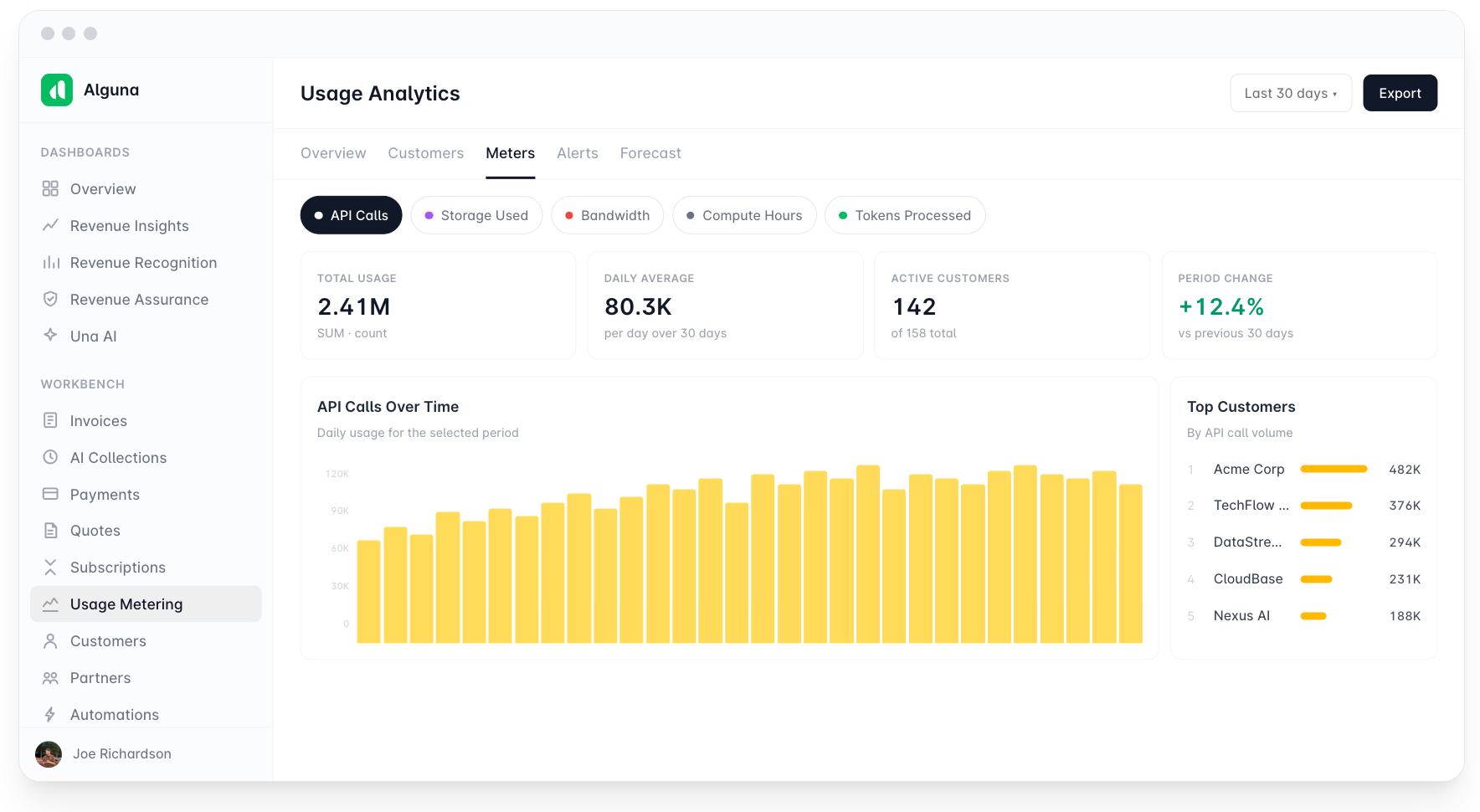
Alguna is a quote-to-revenue platform for B2B companies: CPQ, subscription and usage-based billing, invoicing, payment collection and revenue recognition in one system. Everything reads from one versioned agreement per customer, so the price a rep quotes is the price that rates usage and lands on the invoice.
What you get
- A versioned REST API with official SDKs for TypeScript, Python, Go and Rust, plus the
algunaCLI. - Usage metering with six aggregations, event deduplication, and BigQuery and ClickHouse as usage sources.
- Eleven pricing models, including matrix pricing and expression-based pricing written as formulas over several metrics.
- Prepaid credits and wallets, entitlements, hosted and embedded checkout, and a customer portal.
- Quotes with approvals and e-signature. A signed quote becomes the live subscription with no re-keying.
- An MCP server with about 60 tools, so Claude, ChatGPT, Cursor and your own agents can work on the account.
- Collections, dunning, ASC 606 and IFRS 15 revenue recognition, and two-way sync with Salesforce, HubSpot, NetSuite, QuickBooks and Xero.
- SOC 2 Type II certification.
Trade-offs: Alguna is a managed service and is not open source. If you must run billing inside your own VPC, Flexprice or Lago fit better.
Pricing: Growth plans start from $699 per month. Alguna never takes a revenue share.
How Alguna enables complex usage-based billing for Evervault
Evervault was growing fast. But that growth soon revealed deep cracks in their billing infrastructure. Using a mix of in-house metering, Stripe Billing, spreadsheets, and DocuSign, they were struggling to manage fast-moving usage contracts and flexible customer deals.
With Alguna, billing no longer lives in silos and usage data is being ingested automatically. Today, both Evervault and their customers can monitor usage and billing continuously, eliminating billing surprises and improving transparency.
“Alguna enables complex usage-based billing for us in a way that other products can’t.”
– Shane Curran, CEO at Evervault
2. Orb (Adyen)
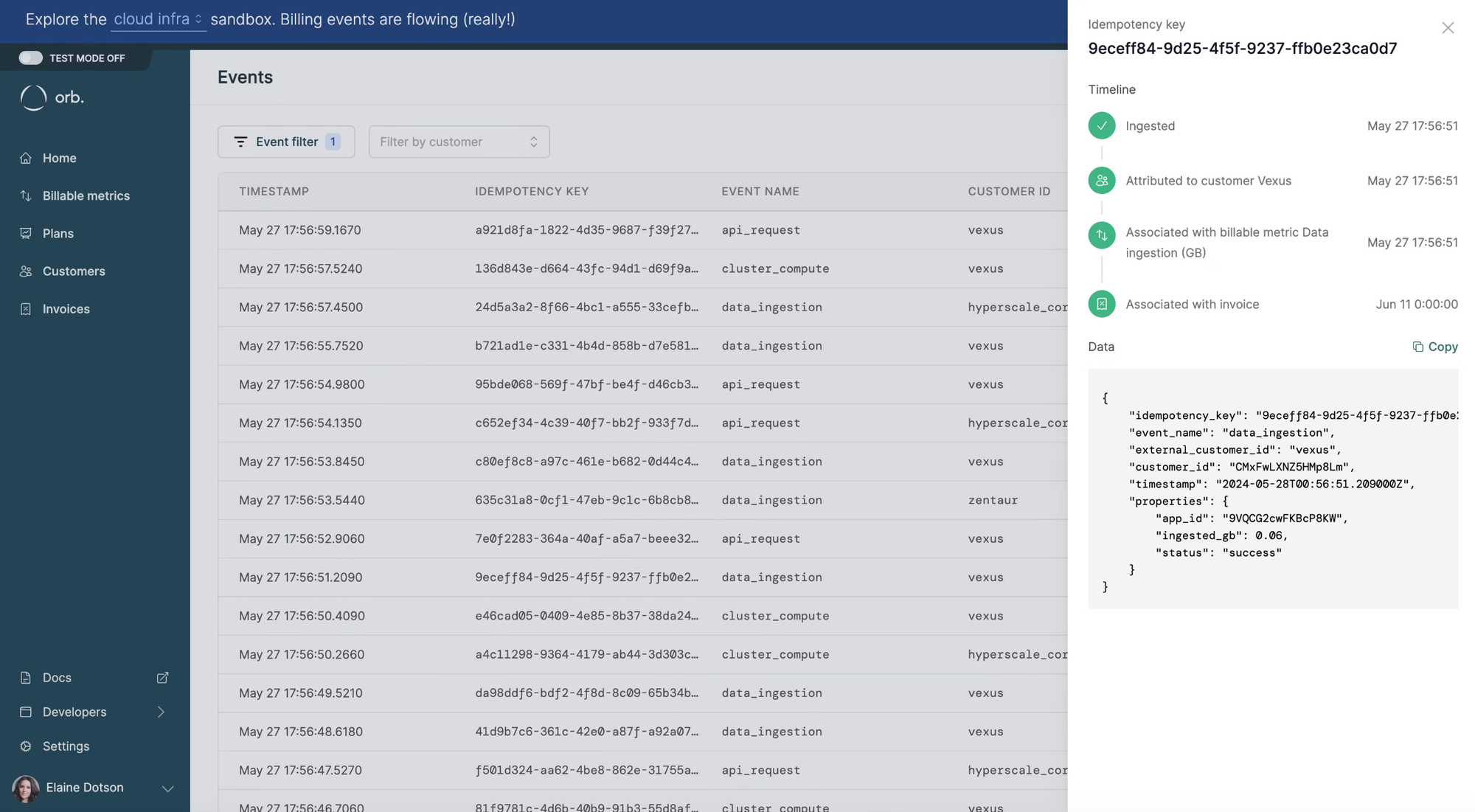
Orb is a managed usage-based billing platform. Its best-known features are billable metrics defined in SQL and simulations that show how a pricing change would have affected past invoices.
Flexprice vs Orb for usage-based billing: Flexprice gives you source code and self-hosting. Orb gives you a managed service with deeper pricing analysis and a longer enterprise track record. Orb does not publish its prices.
Trade-offs: Adyen has owned Orb since July 2026. Orb still runs as a stand-alone product, but its roadmap now sits inside a payments company. Quoting and contract workflows need a separate CPQ.
3. Metronome (Stripe)
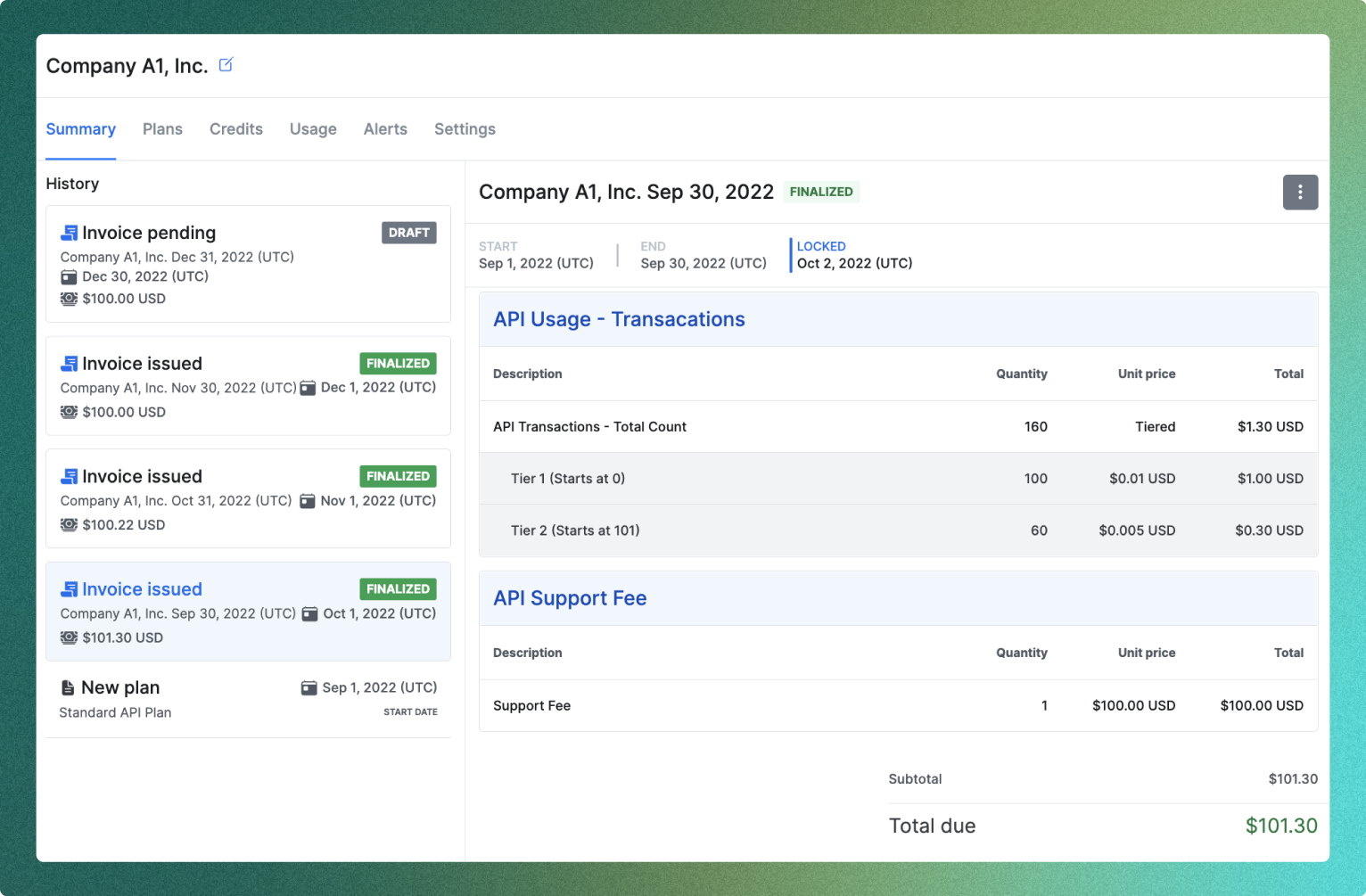
Metronome is a metering and rating engine built for very large event volumes and negotiated enterprise contracts.
Stripe has owned it since January 2026 and positions it as its advanced usage-based billing product.
Is Flexprice better than Metronome for SaaS? For a small SaaS team that wants to start free and self-host, Flexprice is the easier start. Metronome is built for bigger contracts and bigger budgets, and its pricing is quote-based.
Trade-offs: implementation is an engineering project, and the product is now tied to Stripe's stack.
4. Stripe Billing
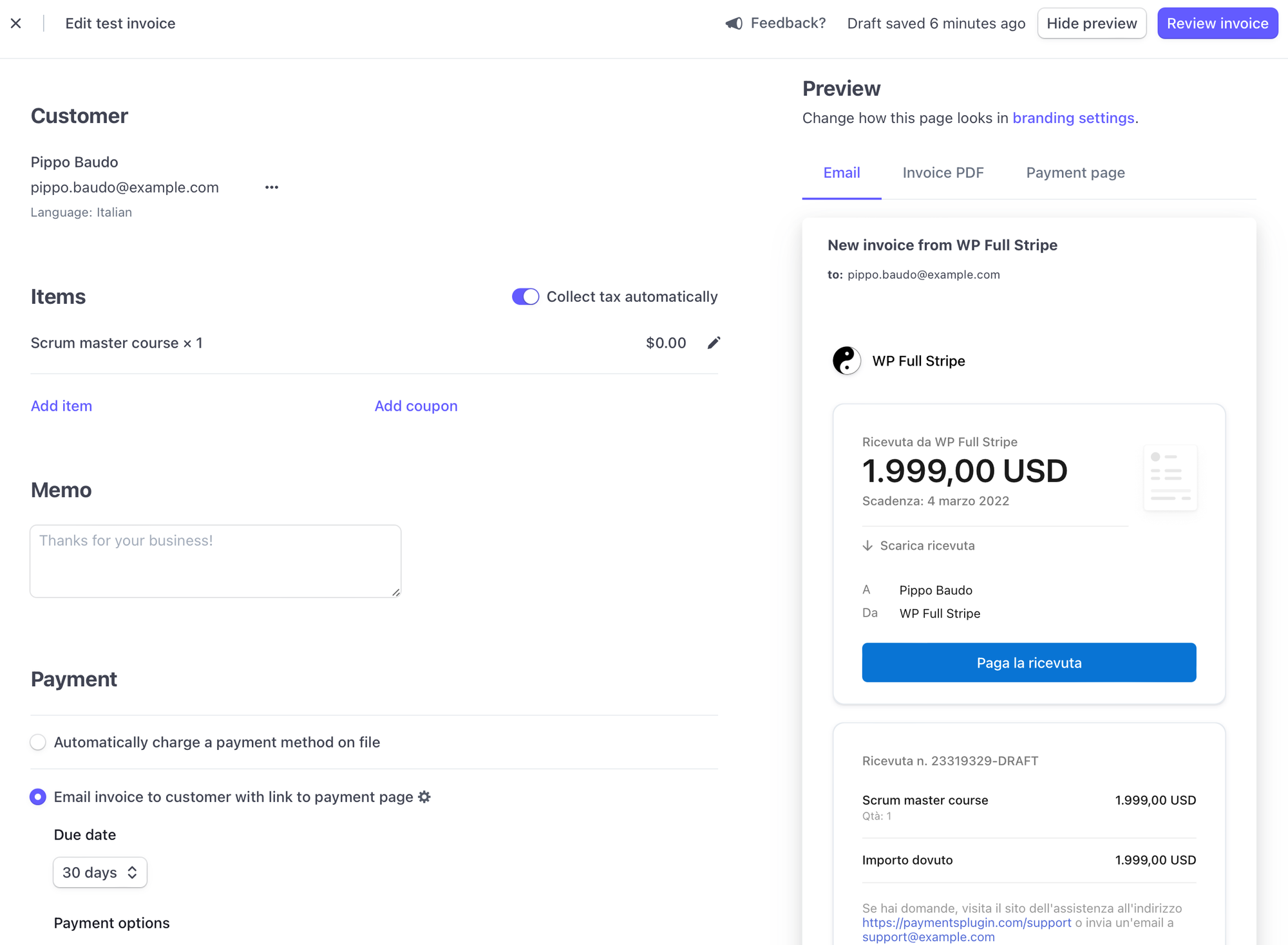
Stripe Billing adds subscriptions, invoices and basic usage-based pricing to Stripe payments. It is the fastest way to send a first recurring invoice if Stripe already processes your cards.
Flexprice as an alternative to Stripe Billing: teams usually leave Stripe Billing when pricing gets complicated: several meters, prepaid credits, custom contracts. Flexprice handles those cases better. So do the other tools on this list.
Trade-offs: Stripe Billing charges a percentage of billing volume on top of payment fees. Contract terms, ramps and multi-entity invoicing take custom code.
5. Chargebee
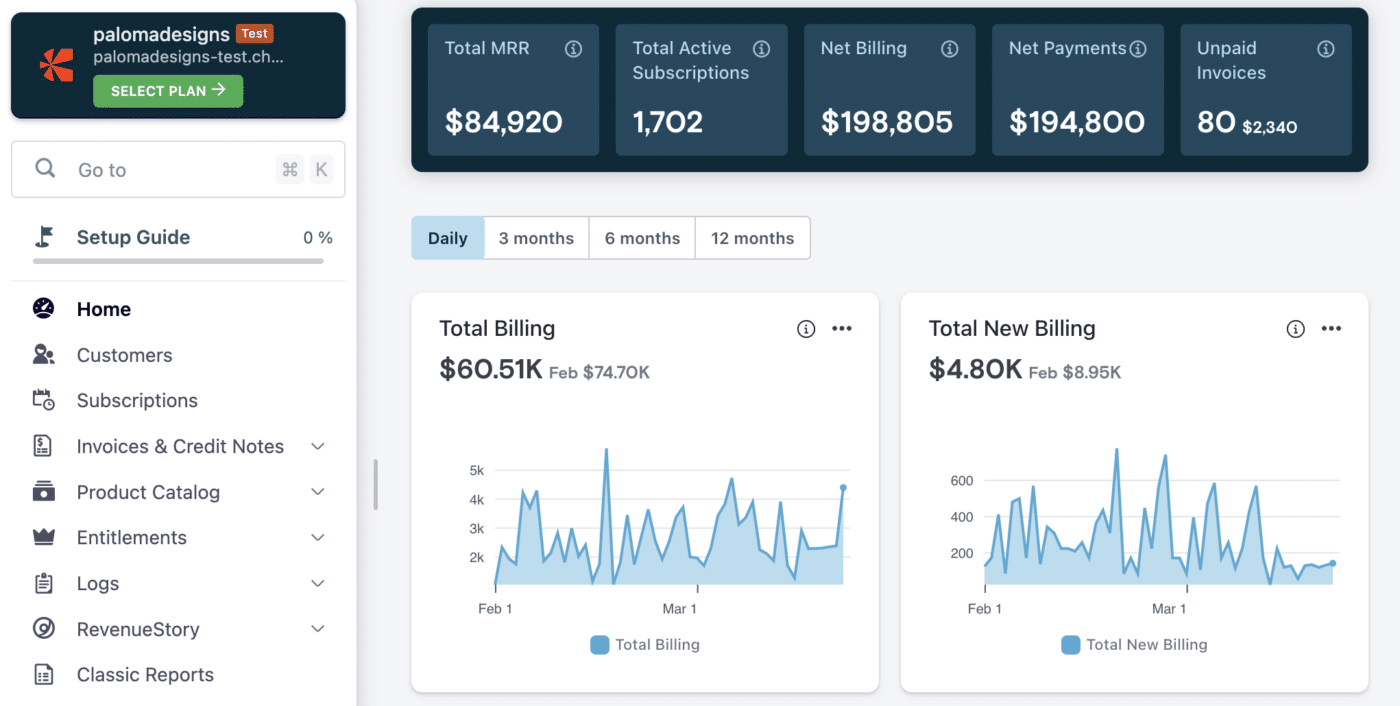
Chargebee is a long-established subscription management platform. It covers plans, trials, invoicing, dunning and tax across many payment gateways, with usage billing added on.
Flexprice vs Chargebee for consumption billing: Chargebee was designed around recurring plans, and usage is an add-on to them. Flexprice was designed around the usage event. For an AI startup that bills on tokens or credits, Flexprice is the closer fit of the two. Chargebee wins when you need mature subscription operations.
Trade-offs: real-time metering and credit burn-down are not Chargebee's core strength.
6. Lago
Lago is the other well-known open-source billing platform. Like Flexprice, it is AGPL-licensed and can be self-hosted or bought as a cloud service.
Trade-offs: some features, such as the customer portal and tax integrations, sit in paid tiers. Self-hosting carries the same operating cost as Flexprice.
7. m3ter (Salesforce)
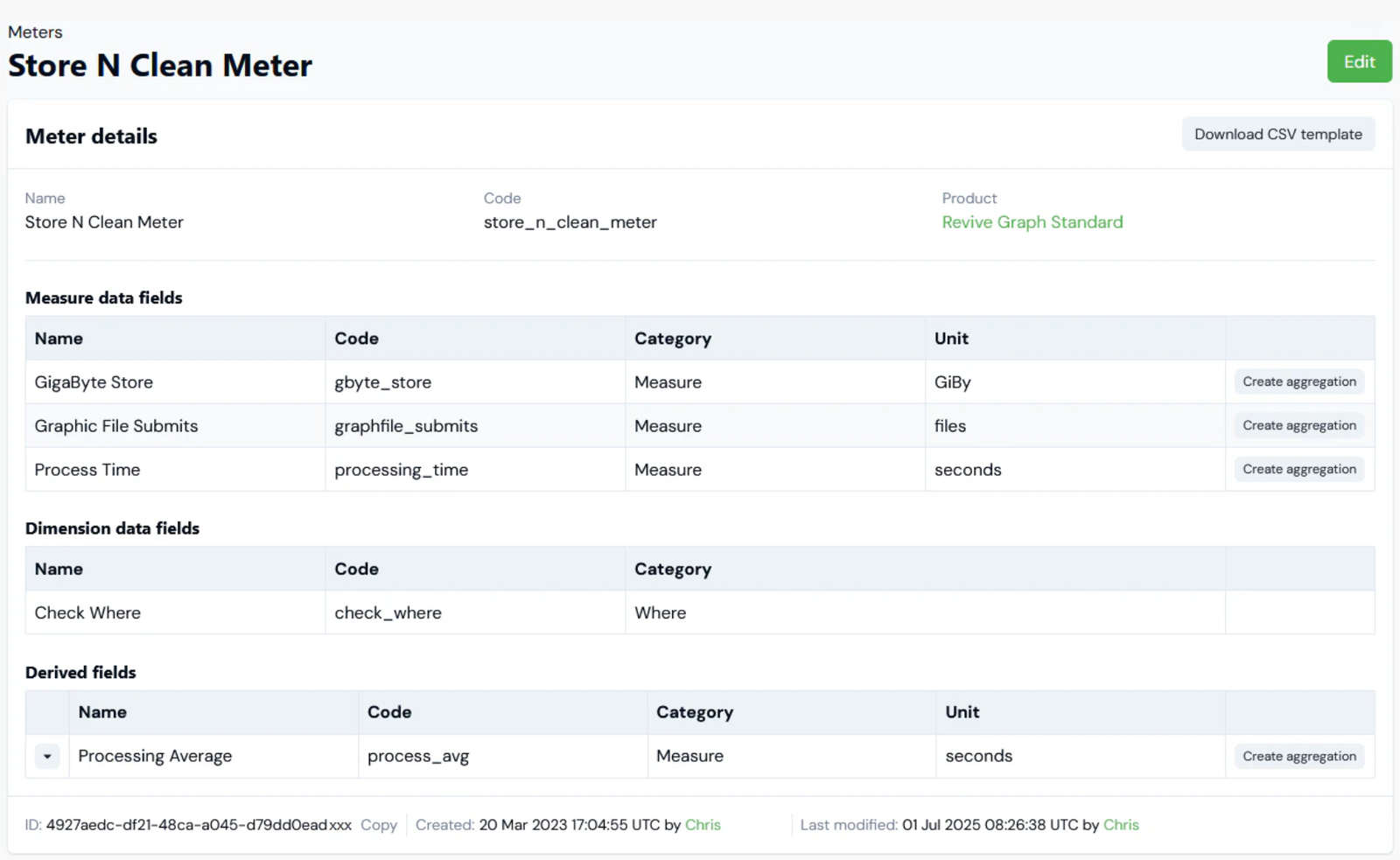
m3ter is a metering and rating service that feeds usage charges into CRM, billing and ERP systems. Salesforce acquired it in July 2026 to add consumption pricing to its revenue management product.
Trade-offs: m3ter is one layer of the stack, and you still need the systems around it. Its direction is now set by Salesforce.
Why developers choose Alguna
Developers pick Alguna because the integration is small and stays small. You send usage events and read entitlements. Pricing changes, contracts and invoices happen in the platform, without a deploy.
Metering takes one call
Define a billable metric once, then send events as usage happens. This is the whole ingestion path in the TypeScript SDK:
import { Alguna } from "@alguna/sdk";

const alguna = new Alguna({
  apiKey: process.env.ALGUNA_API_KEY,
  apiVersion: "2026-04-01",
});

const result = await alguna.events.ingest({
  events: [
    {
      unique_id: crypto.randomUUID(),
      event_name: "api_request",
      account: "acme-user-4821",
      timestamp: new Date().toISOString(),
      properties: { endpoint: "/v1/analyze", tokens: 1500 },
    },
  ],
});
if (result.failed.length > 0) console.warn("rejected:", result.failed);
Three details in that snippet save real work:
unique_idis an idempotency key. A resent event is counted once, so retries are safe.accountaccepts your own customer identifier as an alias. You never have to store Alguna IDs.- The response lists which events were ingested and which failed, so you resend only the failures.
Built for retries and version pinning
- Date-based versions. Every request carries an
Alguna-Versionheader. Your integration keeps the request and response shapes of the date you pinned, even after you upgrade the SDK. - Idempotent writes. Every write accepts an
Idempotency-Key. The SDKs send one for you and reuse it on each retry. - Sensible retries. The SDKs retry
408,429,502,503and504with backoff. They never retry a500, because the request may have changed data. - Typed errors. A failed call raises a typed error with the HTTP status and an
X-Request-Idyou can hand to support. - Signed webhooks. Every delivery is signed and retried with exponential backoff.
- A real sandbox. Sandbox and production have separate keys, data and base URLs.
SDKs, a CLI and an agent guide
The SDKs and CLI are generated from the same OpenAPI spec as the API reference, so every endpoint has a typed method and a command.
npm install @alguna/sdk            # TypeScript
pip install alguna                 # Python
go get github.com/alguna-io/alguna-go
cargo add alguna                   # Rust
npm install --global @alguna/cli   # CLI
The CLI prints JSON or NDJSON and supports --dry-run, which suits CI jobs and one-off scripts. For coding agents there is a single-page agent guide with the URLs, auth, versioning, object model and errors.
High-volume event metering
The events endpoint takes up to 100 events per request. You scale by sending more requests in parallel, and deduplication by unique_id keeps the counts right. For backfills and continuous high-volume feeds, connect BigQuery or ClickHouse as a usage source and skip the API.
Agents can use the same account
The MCP server at https://api.alguna.io/mcp exposes about 60 tools under the permissions of the person who connected it. An agent in Cursor or Claude can look up a customer, ingest usage events or draft a subscription with no bespoke integration.
Engineering stops owning pricing changes
This is where Alguna differs most from a metering-only tool. Your code sends events and checks entitlements. Finance and sales change prices, build quotes and amend contracts in the dashboard. A new pricing model can go live the same day with no engineering work.
Evervault moved off Stripe and went live on Alguna in two weeks with no customer impact. ComplyAdvantage launched usage-based self-serve billing with no engineering time.
Start with the developer quickstart or book a demo to see your own pricing model running.
How to choose a Flexprice alternative
Four questions settle most evaluations.
- Must billing run on your own infrastructure? If yes, compare Flexprice with Lago. If no, a managed service removes the on-call work.
- Do you sell through sales as well as self-serve? If reps negotiate contracts, pick a platform where the signed quote becomes the subscription. Otherwise you will maintain a sync between CPQ and billing.
- Who changes prices? If every pricing change needs an engineer, pricing will change slowly. Look for no-code plan and price configuration on top of a strong API.
- Who owns the vendor? Three of the tools on this list now belong to a payments company or a CRM company. Check that their direction matches your stack.
If your answers are managed, both motions, finance, and independent, Alguna is built for that case.
Frequently asked questions: Flexprice alternatives
What is Flexprice?
Flexprice is an open-source metering and billing platform for AI and API-first companies. It covers usage events, credits, entitlements and invoicing, and you can self-host it or use the managed cloud at flexprice.io.
How much does Flexprice cost?
The self-hosted open-source edition is free under AGPL-3.0. The managed cloud is paid. Recent reports put it at $199 a month plus 0.5% of billed volume, with enterprise plans from $3,000 a month. Confirm the current figures on the Flexprice pricing page.
How much funding has Flexprice raised?
Flexprice raised a $1.5 million seed round in mid-2026, led by Shastra VC with TDV Partners and Anupam Mittal.
How does Flexprice compare to Orb?
Flexprice is open source and can be self-hosted. Orb is a managed service with SQL-defined metrics and pricing simulation, and it has been part of Adyen since July 2026. Choose Flexprice for control of the code and Orb for pricing analysis. Choose Alguna if you also need quoting, collections and revenue recognition.
Is Flexprice better than Metronome for SaaS?
For an early-stage SaaS company, Flexprice is usually easier to start with, because it is free to self-host. Metronome suits large enterprises with heavy event volume and negotiated contracts, and it is now a Stripe product.
Flexprice or Chargebee: which is better for AI startups?
Flexprice fits token and credit pricing better, because it was built around usage events. Chargebee is stronger for seat-based subscriptions. AI startups that also close enterprise contracts should look at a platform that covers usage billing and quoting together, such as Alguna.
Is Flexprice a good alternative to Stripe Billing?
Yes, for teams that have outgrown Stripe Billing's usage features and are comfortable running open-source software. Teams that prefer a managed service usually compare Alguna, Orb and Metronome.
Is Flexprice good for SaaS billing?
Flexprice works well for SaaS products with usage-based or credit-based pricing. It is a weaker fit for sales-led SaaS that needs quotes, approvals, contract amendments and revenue recognition in the same system.
Which billing platform is best for high-volume event metering?
Metronome, Orb, m3ter, Flexprice and Alguna all ingest usage events at scale. The differences are in what happens after ingestion. Alguna deduplicates events by ID, accepts batched API calls or a direct BigQuery or ClickHouse connection, and prices the result on the same record that drives the quote and the invoice.
What is the best Flexprice alternative for developers?
Alguna, if you want a managed service. It has a date-versioned API, SDKs in four languages, a CLI, signed webhooks, a sandbox and an MCP server. Lago, if you need open source.