Ever lost a deal because your billing setup couldn't handle your pricing model?
Or perhaps you've (slowly and painfully) watched a customer churn because they outgrew a rigid plan?
Well, that's the cost of inflexible billing.
The good news is that a growing number of SaaS billing software and AI monetization companies are solving this with truly flexible billing.
In this guide, we'll walk you through what flexible billing actually means, why it matters for SaaS and AI companies specifically, the best practices you should follow, and how to implement it in your own business.
Whether you're evaluating your first flexible billing solution or rethinking an existing setup, this is your starting point.
What is flexible billing?
Flexible billing is a billing approach that allows companies to offer multiple pricing structures, charge customers based on actual usage, and adapt payment terms to fit different customer needs, all within a single platform.
Unlike traditional flat-rate billing, billing flexibility means you're not locked into one model for every customer.
Think of it this way: a startup paying for your product needs something very different from an enterprise. Flexible billing software lets you serve both, without building separate billing systems for each.
Flexible billing vs. traditional billing
| Feature | Traditional billing | Flexible billing |
|---|---|---|
| Pricing model | Fixed flat rate | Usage-based, hybrid, tiered, or custom |
| Billing cadence | Monthly or annual only | Daily, monthly, annual, or milestone-based |
| Customer segments | One-size-fits-all | Tailored per segment or contract |
| Scalability | Limited | Scales with customer growth |
| Revenue recognition | Simple, manual | Automated, compliant with ASC 606 / IFRS 15 |
| Ideal for | Predictable, homogeneous customer base | SaaS, AI companies, and complex sales motions |
Types of flexible billing models
Flexible billing isn't one thing. It's a spectrum of approaches you can mix and match depending on your product and customer base.
The most common models include:
- Usage-based billing: Customers pay based on what they actually consume, e.g., API calls, seats, storage, or compute hours. Common in AI and infrastructure products.
- Tiered pricing: Different price points unlock different feature sets or usage thresholds. Good for capturing value across multiple customer sizes.
- Hybrid models: A combination of a base subscription fee plus usage-based charges on top. Offers revenue predictability alongside growth upside.
- Milestone or project billing: Charges tied to specific deliverables or phases. Common in services-heavy SaaS businesses.
- Flexible subscription billing: Subscriptions that can be paused, upgraded, downgraded, or adjusted mid-cycle without manual intervention.
For AI companies specifically, flexible AI billing options and discounts have become a competitive differentiator.
When models vary in cost and usage is unpredictable, customers need pricing that reflects what they actually use, not a fixed rate that may punish low-usage months or leave money on the table during high-usage ones.
Why billing flexibility matters for SaaS and AI companies
In the last couple of years alone, products have become more complex, sales cycles longer, and buyers expect pricing to reflect the value they receive.
A rigid billing model creates friction at nearly every stage of the customer journey.
According to a 2024 report by OpenView Partners, 61% of SaaS companies now offer at least one usage-based pricing model, up from 27% just five years ago. The reason is straightforward: customers want to pay for what they use, not what they might use.
Here's where inflexible billing creates real business problems:
- Sales lose deals because pricing doesn't fit the prospect's buying structure
- Finance teams manually manage exceptions and custom contracts
- Customers churn when their usage decreases and they feel overcharged
- Revenue teams can't scale because billing becomes a bottleneck
- AI-native products are especially exposed since their usage patterns are inherently unpredictable
The most forward-thinking companies are now looking for flexible billing and revrec for AI companies that handles not just invoicing but also revenue recognition automatically, so finance teams stay compliant without adding headcount.
5 best practices for flexible billing
Getting flexible billing right takes more than flipping a switch. Here are the practices we recommend for SaaS and AI companies building or improving their billing setup.
1. Start with your customer segments, not your product features
Before you configure anything, map out your customer segments. A startup using your product as a side project has fundamentally different needs from an enterprise running it as core infrastructure.
Your billing model should reflect those differences, not flatten them.
Ask yourself:
- What does value look like for each segment?
- How predictable is their usage?
- What's their preferred payment cadence?
- How sensitive are they to overage charges?
2. Choose a flexible billing solution that supports multiple pricing models natively
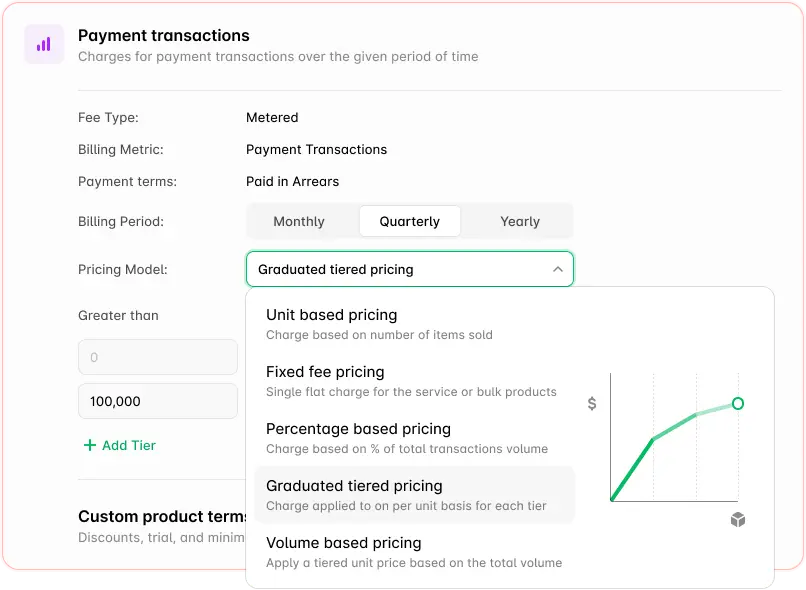
Flexible billing software comes in many shapes and forms. Some platforms bolt usage-based features onto a subscription foundation, which creates reconciliation nightmares. Look for a flexible billing solution that was built to support multiple models from the ground up, whether that's tiered, usage-based, hybrid, or custom.
When evaluating platforms, compare how they handle revenue recognition. Many of the most flexible billing automation solutions for SaaS 2025 now include native revrec capabilities, which is critical for compliance with ASC 606 and IFRS 15.
3. Automate mid-cycle changes
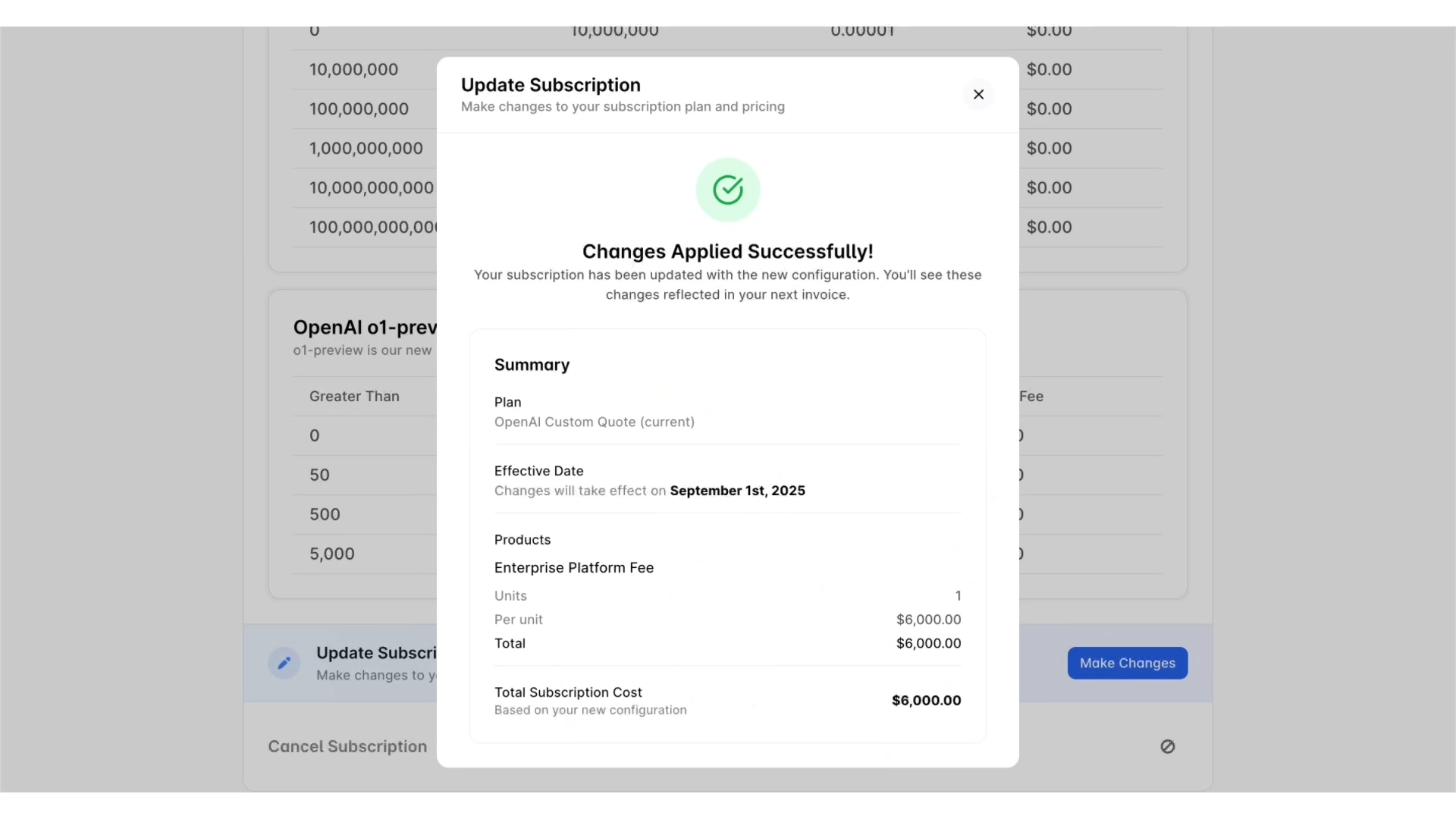
One of the biggest advantages of flexible subscription billing is the ability to handle upgrades, downgrades, and pauses mid-cycle without manual intervention.
If your team is manually calculating prorations or issuing credits, you're leaving money on the table and creating error risk.
Automate:
- Prorated credits and charges on plan changes
- Overage notifications and automatic tier upgrades
- Renewal reminders and payment failure workflows
- Contract amendments and custom pricing updates
4. Keep pricing transparent and explainable
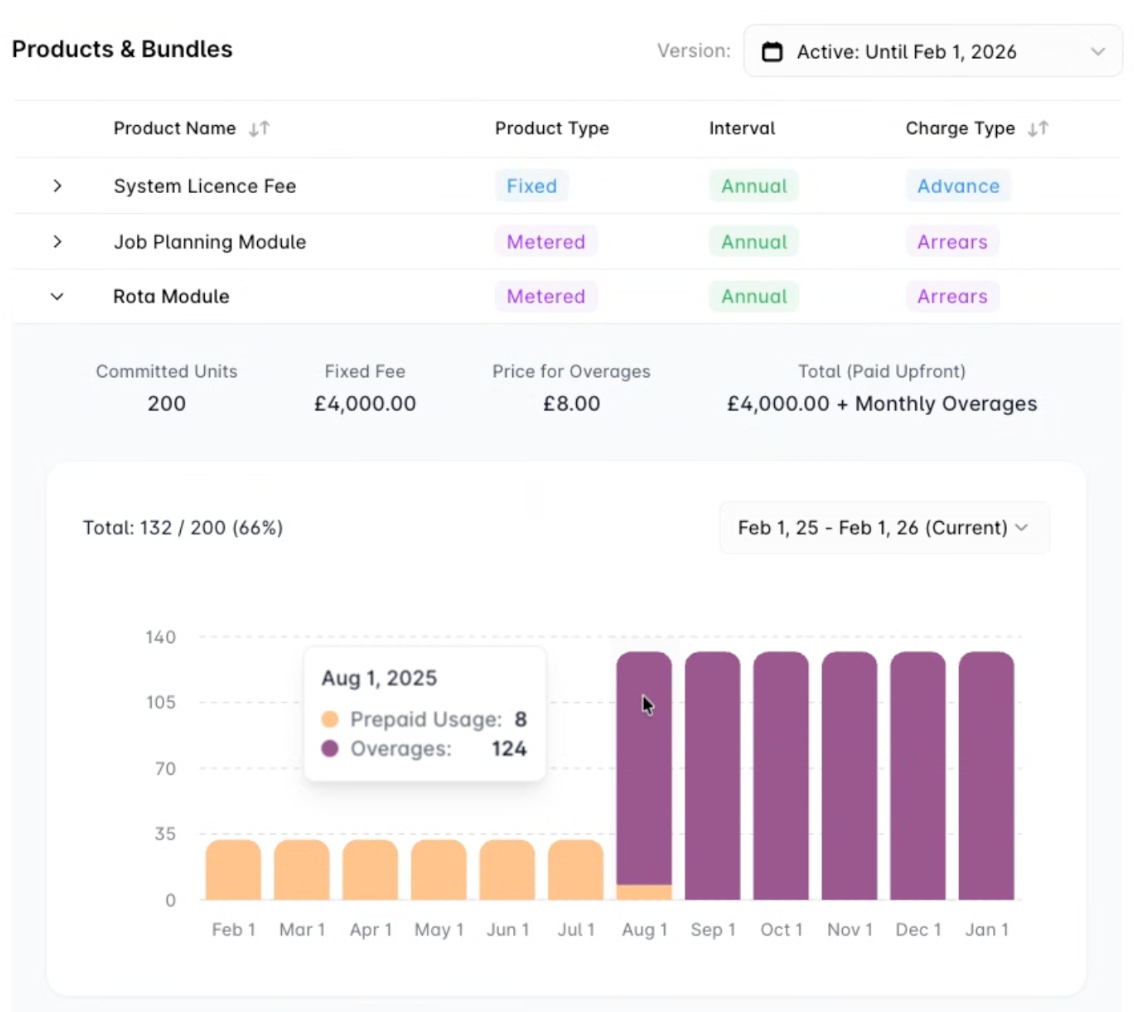
Flexible billing only works if your customers understand your pricing, and what exactly they're getting billed for.
Complexity is the enemy of trust. If a customer can't quickly understand why their invoice changed month-over-month, you'll generate support tickets and erode confidence.
Best-in-class billing UX includes:
- Clear, itemized invoices that map charges to usage
- Real-time usage dashboards for customers
- Proactive notifications before thresholds are reached
- Simple language in contracts and pricing pages
5. Align billing with revenue recognition from day one
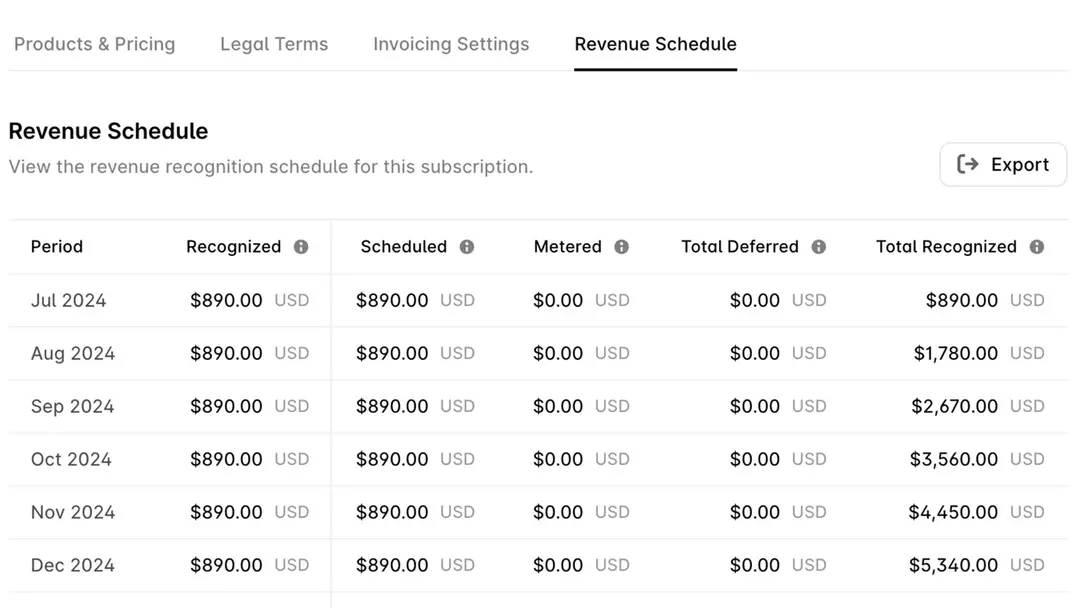
This is especially important for flexible billing and revrec for AI companies. Usage-based and hybrid models create complex revenue recognition scenarios where when cash is collected doesn't match when revenue is earned. Get this wrong and you've got an audit problem.
Look for flexible billing automation solutions that generate the correct journal entries automatically, tie recognized revenue to performance obligations, and produce audit-ready reports without manual spreadsheet work.
How to implement flexible billing in your SaaS or AI company
Ready to move? Here's a practical, step-by-step approach to implementing flexible billing without disrupting your existing customers or revenue operations.
Step 1: Audit your current billing setup
Before you change anything, understand what you have. Map out:
- All current pricing models and tiers
- Which customers are on custom contracts
- Where your team is doing manual billing work
- How you currently handle mid-cycle changes
- Your revenue recognition process and where it breaks down
- Any integrations between your CRM, billing tool, and finance system
This audit will surface the gaps your flexible billing solution needs to fill, and help you prioritize which features matter most.
Step 2: Define your target pricing architecture
Work with your sales, product, and finance teams to define the pricing models you want to support. Don't try to build everything at once. Start with the two or three models that cover 80% of your deals.
Common starting points for SaaS companies:
- A base subscription with usage-based add-ons
- A tiered model with per-seat pricing
- A pure usage-based model with a monthly minimum
Step 3: Evaluate flexible billing software
When evaluating flexible subscription billing platforms, look beyond the feature checklist. Consider:
- Integration depth: Does it connect natively to your CRM and ERP, or does it require custom middleware?
- Revrec support: Does it handle revenue recognition automatically or do you still need a separate tool?
- Contract flexibility: Can sales teams configure custom pricing without engineering involvement?
- Scalability: Can it handle your volume at 10x current growth without performance issues?
- Support for AI billing: Does it support token-based, compute-based, or API-call-based pricing natively?
| Criteria | What to look for | Why it matters |
|---|---|---|
| Model support | Usage, tiered, hybrid, custom | Covers all customer types |
| Revrec | ASC 606 / IFRS 15 native | Avoids audit risk |
| Mid-cycle changes | Automated prorations | Reduces manual work |
| CRM integration | Native, bidirectional sync | Keeps sales and finance aligned |
| AI billing support | Token or API-call pricing | Critical for AI products |
| Reporting | Real-time revenue dashboards | Enables data-driven decisions |
Step 4: Migrate existing customers thoughtfully
One of the most common mistakes companies make is migrating all customers to the new system at once. Instead, take a phased approach:
- Start with new customers only while the system stabilizes
- Identify a small cohort of existing customers for a controlled migration
- Communicate changes clearly and explain the benefits to customers
- Give customers a transition period with pricing protection if needed
- Use the feedback from early migrations to refine your process
Step 5: Monitor, iterate, and optimize
Flexible billing isn't a set-it-and-forget-it system. The models that work today may need adjustment as your product, pricing, and customer base evolve. Build a regular review cadence to assess:
- Which pricing models are winning in competitive deals
- Where customers are hitting friction in their billing experience
- Whether your billing data and finance data stay in sync
- How revrec is performing against actuals
Flexible billing means better win rates
The companies winning on pricing right now are ones whose billing model removes friction at every stage of the customer journey.
They close faster because pricing fits the buyer.
They retain longer because customers aren't punished for low-usage months or hit with surprise invoices.
They scale cleaner because their billing infrastructure keeps pace with their growth instead of becoming a bottleneck.
For SaaS companies, the window to get this right is narrowing. Buyer expectations have already shifted, and the gap between companies with flexible billing infrastructure and those without is showing up in win rates, net revenue retention, and time-to-close.
For AI companies, the urgency is even higher. Your product's cost structure is fundamentally variable. Your billing model needs to reflect that from day one, not after your first audit, your first enterprise churn, or your first finance hire who tells you the spreadsheets aren't working anymore.
The right flexible billing solution handles the complexity so your teams don't have to, and it compounds in your favor the longer it's in place.