Configure Price Quote (CPQ) software is one of those systems that almost every B2B company ends up needing. Still, many teams don’t fully understand what CPQ is, what problem it actually solves, or why it plays such a central role in modern revenue operations.
If you’re selling anything more complex than a flat monthly subscription, such as think usage-based pricing, tiers, discounts, bundles, or multi-year contracts, CPQ quickly becomes foundational.
This article breaks down:
- The configure price quote definition
- How CPQ works in practice
- Why CPQ has become a core pillar of RevOps (not just a sales tool)
What is configure price quote (CPQ)?
Configure Price Quote (CPQ) is software that helps companies accurately configure products, apply pricing rules, and generate sales quotes, fast and without errors.
In simple terms, CPQ answers three critical questions every sales deal creates:
- What exactly is the customer buying? (Configuration)
- How much should it cost? (Pricing)
- How do we present it as a formal, customer-facing quote? (Quoting)
CPQ is a system that standardizes how products are packaged, priced, and quoted so sales teams can close deals efficiently while RevOps and Finance teams maintain revenue accuracy and control.
Why CPQ exists: The problem it was built to solve
Before CPQ, most sales teams relied on:
- Spreadsheets
- Static price books and product catalogs
- Email approvals
- Manual quote documents
That approach breaks down quickly when:
- Pricing varies by customer segment
- Discounts require approvals
- Contracts include ramps, overages, variable usage, or commitments
- Sales, finance, and RevOps need alignment
CPQ emerged to replace ad-hoc quoting with repeatable, governed workflows, especially as B2B SaaS and enterprise pricing became more complex due to emerging AI pricing models.
Configure price quote process: How it works
CPQ can sound complex, but the configure price quote process is surprisingly straightforward (especially if you're using modern, no-code CPQ software).
At its core, configure price quote software turns pricing rules, product logic, and approval guardrails into a repeatable quoting process your revenue facing teams can trust.
In RevOps, the quote is the source of truth for what gets booked, billed, and recognized. Configure price quote software standardizes the steps from product selection to pricing to approvals so downstream systems don’t inherit messy data.
While implementations vary, most CPQ systems follow the same core flow:
1. Configure: What the customer is buying
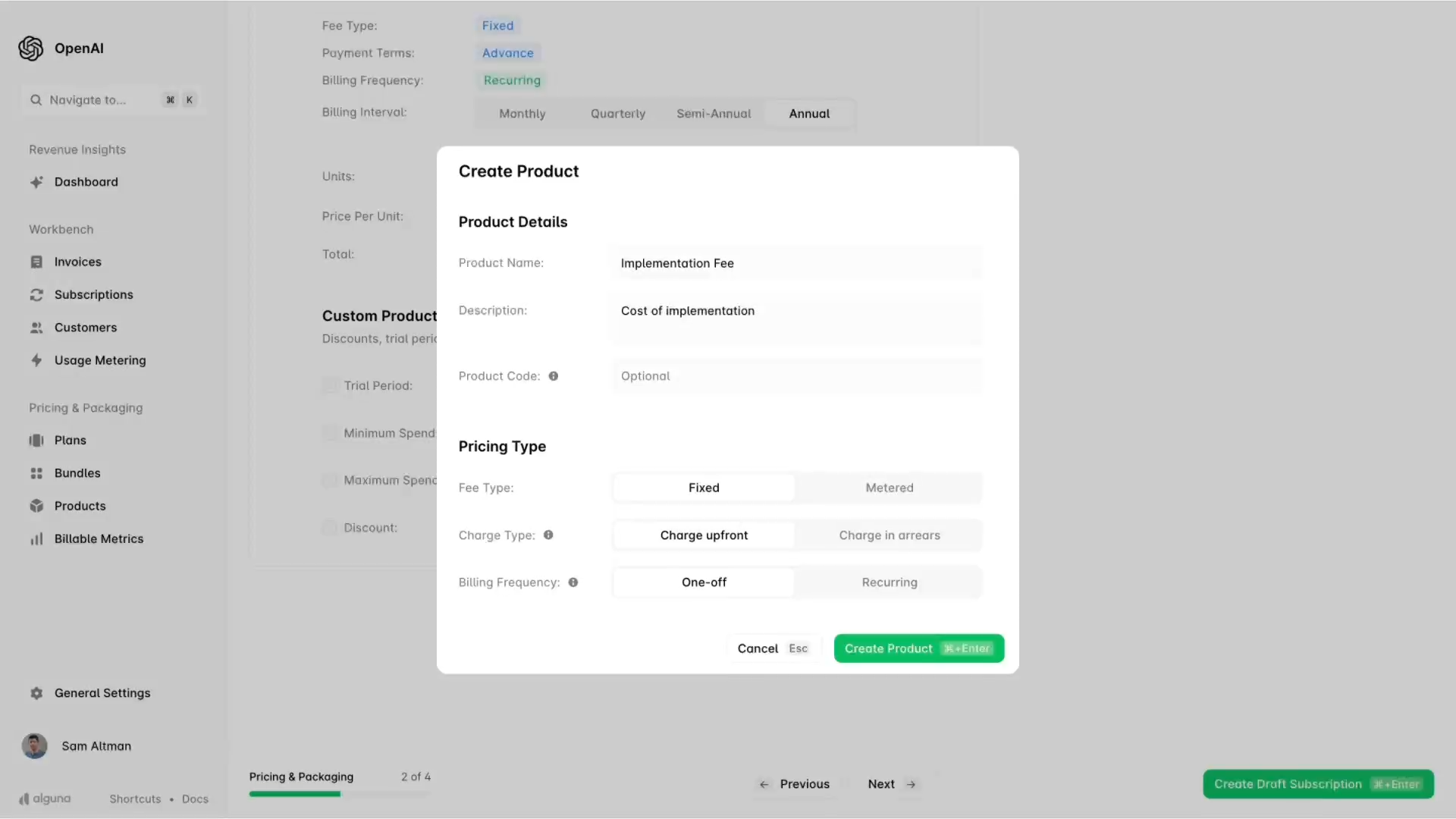
Sales reps select products, plans, usage components, add-ons, and contract terms guided by predefined rules that prevent invalid combinations.
2. Price: How much it costs and why
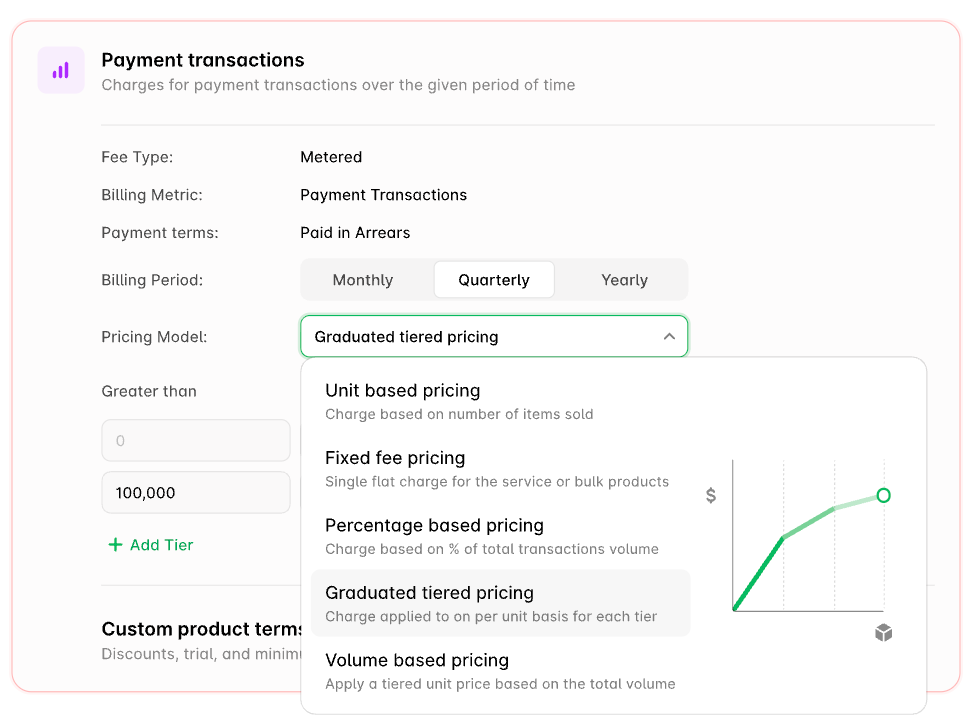
The system automatically applies:
- List pricing
- Volume tiers
- Commitments and overages
- Discounts
- Regional or customer-specific pricing rules
This ensures pricing consistency without manual math.
3. Quote: How the deal is presented to the customer
Finalalzing and sending a quote in Alguna.
CPQ generates a formal quote document (or order form) with:
- Line items
- Pricing breakdowns
- Custom contract terms
- Approval workflows if thresholds are exceeded
The result: faster quotes, fewer errors, and fewer surprises downstream.
What is configure price quote in a RevOps context?
Traditionally, CPQ was seen as a sales tool. In modern companies, it’s a revenue operations system.
Revenue operations (RevOps) exists to align Sales, Finance, and Customer Operations around a single revenue process. CPQ sits right at the front of that process.
CPQ as the starting point of the revenue lifecycle
In modern revenue operations, the quote is not just a sales artifact, it’s the blueprint for everything that follows. What gets configured and priced in CPQ directly determines how billing, invoicing, revenue recognition, and reporting behave downstream.
That’s why CPQ increasingly sits at the very start of the revenue lifecycle.
What gets quoted determines:
- What gets billed
- How usage is measured
- How invoices are generated
- How revenue is recognized
If CPQ is disconnected from billing and finance, teams inherit:
- Contract mismatches
- Billing disputes
- Revenue leakage
- Painful month-end reconciliation
That’s why RevOps teams increasingly treat CPQ as part of the entire revenue infrastructure, not just sales enablement.
Why CPQ matters more as pricing models evolve
Modern SaaS monetization and B2B pricing is no longer simple.
Companies are moving toward:
- Usage-based pricing
- Hybrid pricing models (e.g. subscriptions + usage)
- Outcome-based pricing
- Credits and prepaid commitments
- Ramped contracts
These models introduce pricing dynamics that spreadsheets and static price books and product catalogs can’t handle.
Configure price quote dynamics now include:
- Variable usage metrics
- Time-based ramps
- Overage logic
- Minimum commitments
- Multi-entity or multi-currency contracts
CPQ is often the first system forced to absorb this complexity, subsequently, it exposes whether a company’s revenue stack is ready to scale.
CPQ vs “just quoting in a CRM”
Many teams start by quoting directly inside their CRM. That works—until it doesn’t.
CPQ becomes necessary when:
- Deals require approvals
- Pricing rules need enforcement
- Contracts vary meaningfully by customer
- Finance needs confidence in booked revenue
At that point, CPQ acts as a governance layer between sales creativity and revenue accuracy.
The role of CPQ in preventing revenue leakage
Revenue leakage rarely comes from big mistakes—it comes from small ones that compound. Mispriced discounts, inconsistent contract terms, manual overrides, and unclear approvals all start at the quoting stage.
CPQ plays a critical role in preventing these issues by enforcing pricing discipline before revenue is ever booked.
From a RevOps perspective, CPQ helps prevent revenue loss by:
- Enforcing pricing guardrails
- Reducing manual discounting errors
- Ensuring quotes match contract terms
- Creating clean inputs for billing and invoicing
In other words, CPQ protects revenue before it’s even booked.
CPQ is no longer an optional part of your revenue infrastructure
So, what is configure price quote really?
It’s not just a quoting tool.
It’s not just a sales accelerator.
And it’s definitely not just a "nice-to-have."
CPQ is the front door of your quote-to-revenue workflow.
If it’s fragile, everything downstream suffers.
As revenue operations teams take ownership of the entire quote-to-revenue lifecycle, CPQ becomes a strategic lever, one that shapes how fast you sell, how accurately you bill, and how confidently you scale.
If you’re evaluating your revenue stack, understanding CPQ is the first step.