In a world where buyers expect instant, accurate quotes and product bundles that match their unique needs, Configure‑Price‑Quote (CPQ) software has gone from a nice‑to‑have to an essential part of the revenue stack.
Manual spreadsheets and disconnected systems can’t keep up with the speed and complexity of modern deals. Today’s best CPQ tools use AI‑driven pricing, guided selling, deep CRM/ERP integrations and no‑code configurators to turn quoting from a bottleneck into a competitive advantage.
This guide explores what CPQ software is, why legacy tools like Salesforce CPQ are reaching end‑of‑life, and how a new generation of no‑code CPQ platforms is reshaping sales operations. We compare leading solutions—both enterprise heavyweights and modern, RevOps‑friendly contenders—so you can choose the best CPQ software for your business in 2026.
What is CPQ software?
At its core, CPQ software guides sales teams through complex deals by ensuring the right products are sold at the right price, while enforcing business rules, discount limits, and approvals.
A robust CPQ platform goes beyond formatting a PDF. It guides sellers through complex configuration logic, syncs with CRM and ERP data, and automates approvals and contracts.
Why legacy CPQ software fall short
Many teams still rely on traditional CPQ systems like Salesforce CPQ, which was designed for simple subscription or SKU‑based packages in a pre‑AI era.
Users often hit roadblocks because:
- Code‑heavy setup: Pricing logic is implemented through custom scripts and “Price Rules,” so any change requires developer time.
- No native support for usage‑based billing: Traditional CPQ cannot meter usage or support token/credit models, forcing teams to bolt on billing systems or hack together workarounds.
- Fragmented workflow: Quotes live in one system, while billing and revenue recognition reside elsewhere, leading to data handoffs and sync issues.
- High admin overhead: Large catalogues and sprawling rules make Salesforce CPQ slow and hard to maintain.
5 benefits of CPQ software
CPQ software helps sales and revenue teams move faster while keeping pricing accurate and compliant. By automating configuration, pricing, and approvals, CPQ removes friction from the sales process and makes complex deals easier to sell at scale.
Key benefits of CPQ software include:
- Faster sales cycles: Generate accurate quotes in minutes instead of days.
- Fewer pricing and configuration errors: Built-in rules ensure every quote is correct and compliant.
- Stronger margin control: Discount guardrails protect revenue without slowing sales.
- Support for complex pricing: Easily handle subscriptions, usage-based pricing, bundles, and multi-year deals.
- Better sales and finance alignment: Quotes flow cleanly into billing and revenue systems, reducing rework.
The rise of no‑code CPQ software
Modern revenue teams operate differently. They want to launch pricing experiments quickly, mix subscription and usage‑based models, and connect quoting to billing without relying on engineering.
This has fuelled a rise in no‑code CPQ platforms. These are visual builders that let non‑technical teams set up product configurations, pricing rules, and approval flows on their own.
No‑code CPQ delivers several advantages:
| Advantage | Description | Evidence |
|---|---|---|
| Speed | Pricing changes or promotions can be launched in minutes, not months. Modern quote-to-cash tools automate approvals, billing, and renewals so teams move from quote to cash in minutes. | Sales teams see 10× faster quote generation and 95% reduction in approval time. |
| Flexibility | RevOps can iterate pricing without developer bottlenecks and support modern pricing models such as usage-based, outcome-based, or AI-credit pricing. | The best platforms handle usage-based and hybrid pricing natively. |
| Accuracy & Adaptability | Rules ensure quotes are compliant and correct, while no-code tools adapt quickly as pricing evolves. | Teams can double quote-to-cash speed and ramp new reps 30% faster. |
| Lower Cost | Eliminates months-long implementations and ongoing developer dependence. | Implementation cycles shrink from months to weeks. |
Crucially, no‑code CPQ tools connect quoting directly to contracts and invoices, keeping sales and finance aligned and eliminating manual re‑entry errors.
The result is cleaner data, fewer delays, and faster cash flow.
Best CPQ software: 3 no-code CPQ tools for SaaS, AI, and services
SaaS, AI, and services companies rarely sell simple, one-size-fits-all pricing. Deals often combine subscriptions, usage-based charges, credits, services, ramps, and custom terms. Still, many teams still rely on CPQ software built for static SKUs and heavy IT involvement. That mismatch creates slow quotes, pricing errors, and constant dependency on engineering or Sales Ops.
The following no-code CPQ software stand out in 2026 for SaaS, AI, and services businesses that need speed, flexibility, and scalability (without the overhead of legacy CPQ systems).
1. Alguna: Best CPQ software for streamlining quote-to-cash
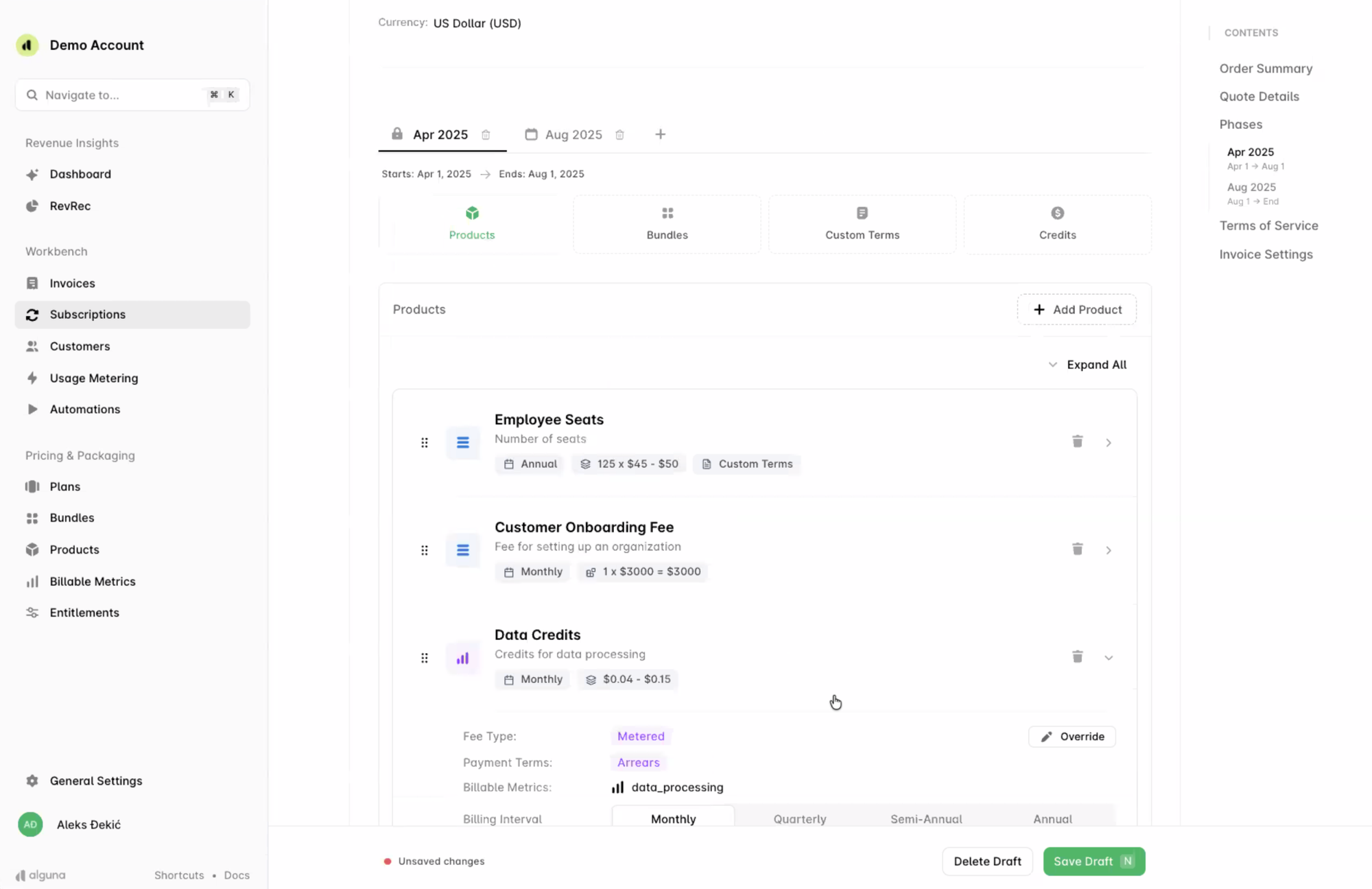
Alguna is a no-code CPQ built specifically for SaaS, AI, and fintech companies. It unifies CPQ, billing, usage metering, invoicing, and revenue recognition in a single source of truth.
• Built by experienced fintech operators (Primer, Dojo, Bank of America)
• Trusted by companies like ComplyAdvantage, Evervault, and more
Best for
High-growth SaaS, AI, and fintech teams running hybrid pricing models and AI pricing models.
Key strengths
- True no‑code configuration: Revenue teams can configure pricing rules, approval flows, and product bundles in minutes.
- Flexible pricing engine: Supports flat, tiered, usage‑based, prepaid‑with‑overages and multi‑attribute pricing models.
- Built-in e-signature: Customers can review pricing, accept terms, and sign—directly in-line.
- Unified quote‑to‑cash workflow: Quotes convert automatically into contracts, billing and invoicing, with integrated dunning and revenue recognition compliance.
- Multi-entity and multi-currency support: Designed for global SaaS and AI businesses.
- Deep CRM integrations: Native plugins for Salesforce and HubSpot enable reps to manage quotes directly inside their CRM.
- Prebuilt templates: Templates for SaaS, AI, fintech and services accelerate quote creation.
- Unified quote-to-cash workflow: Say goodbye to friction between sales and finance as quotes automatically flow into Alguna's billing engine.
- Fast implementation: Get up and running in weeks and accelerate your sales cycles with clear overview of revenue movements.
Limitations
- Newer platform compared to legacy CPQs
- Can be more than needed for extremely simple quoting use cases
Pricing
Paid plans start at $699/month, flat fee, no revenue share. Free tier available.
Alguna’s CPQ is built as part of a unified quote-to-revenue platform, so quotes don’t stop at signature. They flow automatically into billing, usage tracking, collections, and revenue recognition—without custom integrations or manual cleanup.
Book a demo to see how Alguna works in practice, and how modern Sales and RevOps teams use it to:
- Launch complex pricing models (usage, hybrid, credits) without engineering
- Eliminate handoffs between CPQ, billing, and finance
- Get real-time visibility from quote to cash
2. DealHub: Best CPQ software for deal collaboration
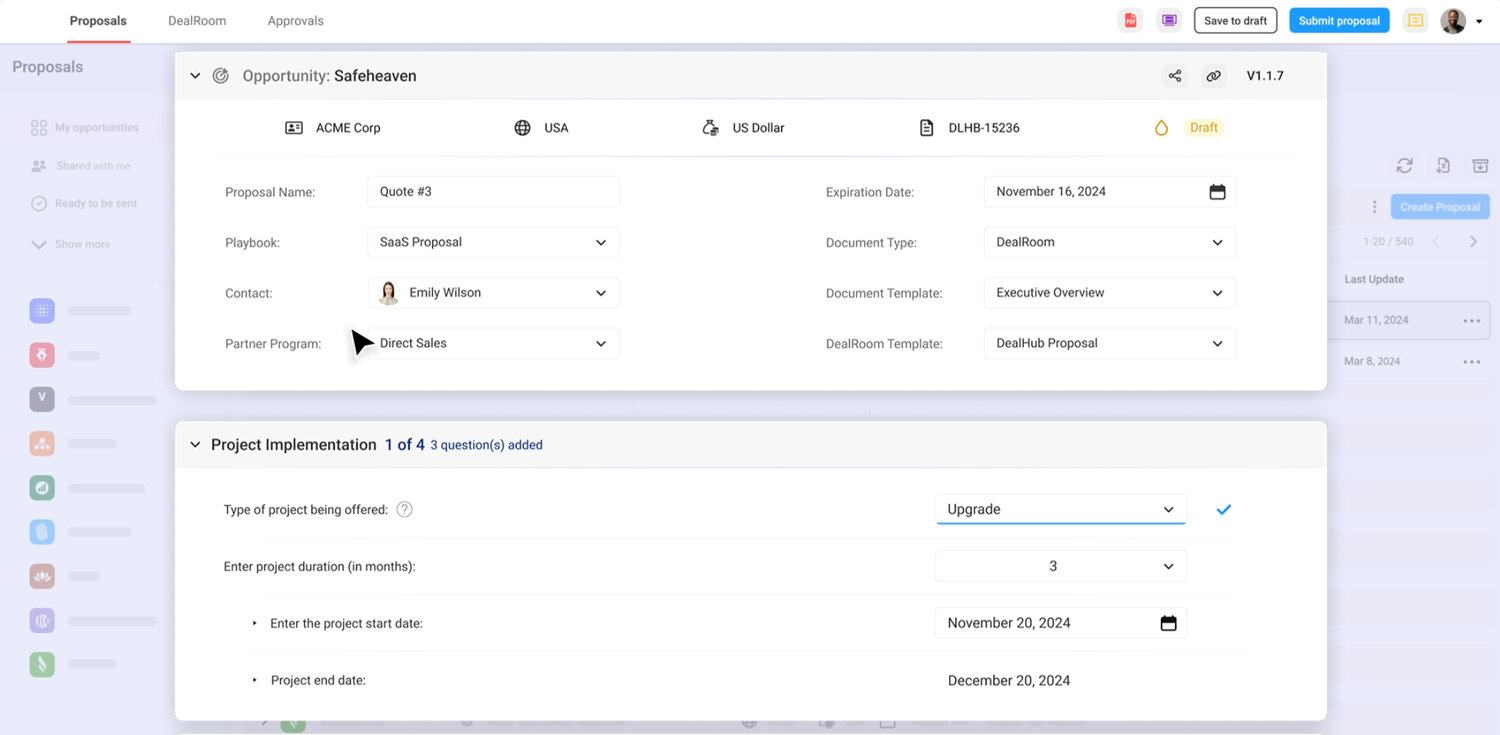
DealHub is a no-code CPQ and deal orchestration platform designed to help sales teams manage complex, multi-stakeholder deals. It combines CPQ, contract lifecycle management (CLM), and digital sales rooms into a single workspace focused on collaboration and deal execution.
Best for
B2B sales teams running sales-led or RevOps-driven motions that require strong collaboration, guided selling, and structured deal workflows, especially in SaaS and services.
Key strengths
- Guided selling workflows: Helps reps configure the right products, pricing, and discounts through structured, rule-based flows.
- Digital sales rooms (DealRoom): Centralized buyer-facing workspace for quotes, contracts, and deal collaboration.
- No-code configuration: RevOps teams can configure pricing rules, approvals, and workflows without writing code.
- Built-in contract lifecycle management (CLM): Generate, redline, approve, and sign contracts within the same platform.
- Multi-CRM support: Works with Salesforce, HubSpot, and Microsoft Dynamics.
- Fast implementation: Many teams go live in weeks, not months, with an intuitive UI that’s easy for reps to adopt.
Limitations
- Usage-based and metered pricing often require manual setup or external billing systems.
- Broad feature set can feel complex for teams that only need CPQ.
- Pricing and advanced functionality skew toward the higher end of the market.
Pricing
Custom pricing based on seats and modules. Typically positioned as a premium CPQ + CLM solution starting at minimum $10,000 per year.
3. Nue: Best CPQ software for Salesforce-led companies
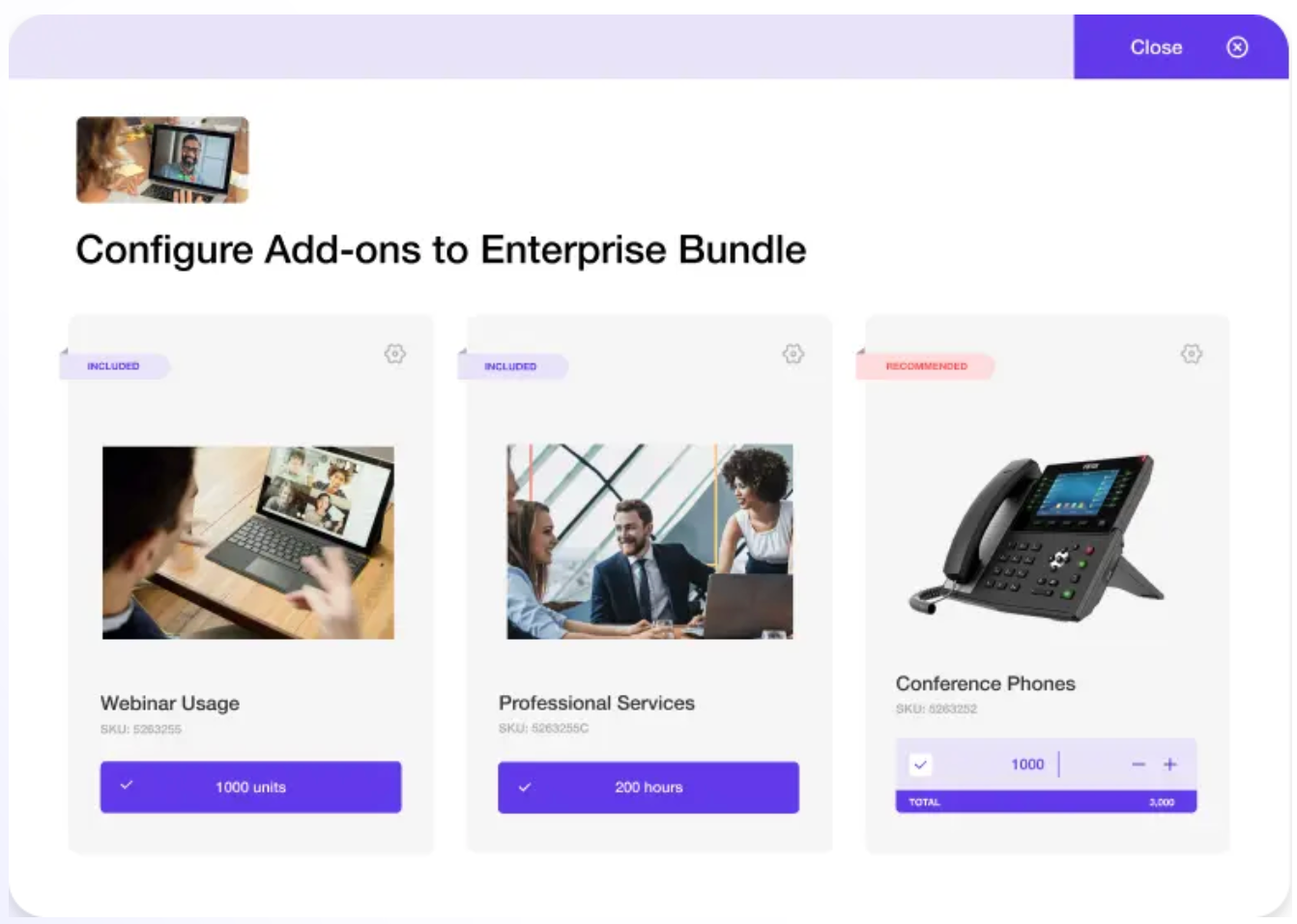
Nue is a Salesforce-native, no-code quote-to-revenue platform that unifies CPQ, billing, and usage metering. It's designed to support hybrid SaaS models that blend sales-led and self-serve motions within a single system.
Best for
High-growth SaaS companies running hybrid GTM models that want a Salesforce-native CPQ and billing solution with strong usage-based pricing support.
Key strengths
- No-code CPQ builder: Configure products, pricing rules, bundles, and approvals without engineering support.
- Usage-based billing and metering: Native support for usage-based pricing with API and CSV ingestion.
- Unified quote-to-cash workflow: Quotes convert directly into subscriptions, billing schedules, and renewals.
- Salesforce-native experience: Runs directly inside Salesforce with real-time data sync and minimal context switching.
- Multi-entity and multi-currency support: Designed for global SaaS businesses operating across regions.
- Advanced approvals and routing: Strong approval workflows that help enforce pricing and compliance at scale.
Limitations
Salesforce-centric design limits flexibility for non-Salesforce teams.
Platform is still maturing compared to long-established enterprise CPQs.
Fewer large-scale enterprise case studies than legacy vendors.
Pricing
Plans start at $25 per user/month, with additional costs for advanced approval functionality.
8 best CPQ software options for enterprises and manufacturers
Large enterprises and manufacturing organizations often have complex product structures, deep ERP integrations and stringent approval workflows.
The following platforms stand out for robust capabilities:
1. Salesforce CPQ: Best CPQ software for Salesforce-led orgs
Salesforce CPQ is deeply integrated with Salesforce CRM and offers guided selling, automated quote‑to‑contract processes and a vast partner ecosystem. However, the product is pricey, has a steep learning curve and works best for companies already all‑in on Salesforce.
⚠️ With innovation moving to Agentforce Revenue Management, teams should plan for alternatives.
2. PROS CPQ: Best manufacturing CPQ software
PROS CPQ brings real pricing science to the table. It uses historical data and demand signals to recommend optimal prices and dynamically adjusts pricing by region, volume and product mix. This makes it attractive for high‑volume quoting and margin‑sensitive industries like manufacturing and distribution.
The downside is a longer implementation cycle and a focus on pricing optimisation over user experience.
3. Oracle CPQ: Best CPQ software for global enterprise
Oracle CPQ is built for large organizations managing intricate product configurations, contract‑based pricing and massive quoting volumes. It excels at advanced configuration logic, deep ERP/CRM integration and multi‑language/multi‑currency quoting. Recent AI enhancements improve pricing suggestions and quote acceleration.
However, the platform requires heavy implementation resources, has a higher cost structure and can feel clunky compared to newer, UX‑focused tools.
4. Tacton CPQ: Best CPQ software for engineer-to-order manufacturing
Purpose‑built for manufacturers, Tacton CPQ handles advanced configuration logic and CAD automation. It can generate 2D/3D drawings based on configured quotes. The platform excels in engineering‑heavy industries with build‑to‑order workflows.
Its niche focus means it’s overkill for simpler products, requires specialist support and comes with a learning curve.
5. HubSpot CPQ: Best CPQ software for SMBs using HubSpot CRM
HubSpot CPQ lives inside HubSpot Sales Hub, making it appealing for small to mid‑sized businesses already using HubSpot. It enables fast quote generation, built‑in approvals, e‑signatures and ties payments directly to quotes.
The trade‑off is limited configuration logic and scaling limitations, so it suits straightforward pricing rather than complex bundles.
6. PandaDoc CPQ: Best CPQ software for proposal-heavy sales teams
PandaDoc started as a document automation platform, so its CPQ strength lies in creating branded proposals that embed videos, case studies and dynamic pricing tables. It integrates with popular CRMs and offers quick quote generation and embedded e‑signatures.
However, it lacks deep configuration logic and advanced approvals, making it better for startups and service businesses focused on presentation over complexity.
7. Experlogix CPQ: Best CPQ software for ERP-centric manufacturing
Experlogix CPQ focuses on handling complex configurations in ERP‑heavy environments. It offers tight integration with Microsoft Dynamics 365, NetSuite and Salesforce. It has strong configuration logic, CAD integration, and quote‑to‑production support.
Its functional UI and longer setup time make it best for manufacturers and distributors with heavy ERP reliance.
8. Mobileforce: Best CRM-native CPQ software
Mobileforce CPQ is designed for enterprise and upper mid-market teams that run complex sales processes inside a CRM, most commonly Salesforce. It provides guided selling, discount and approval workflows, and CRM-native quoting to help large sales teams generate accurate quotes without leaving their CRM.
Its focus on CRM-embedded workflows and structured approvals makes it a strong fit for enterprises that want faster quoting inside Salesforce, but it relies on external systems for billing, invoicing, and revenue recognition.
How to choose the best CPQ software
Selecting the right CPQ solution isn’t only about feature checklists; it’s about aligning the tool with your sales motion, pricing models and operational capacity.
Consider the following factors:
- Implementation time and ease of setup: Traditional CPQs can take six months or more to deploy. Modern no‑code tools promise launch in weeks, but always verify with customer examples and clarify whether implementation is self‑service or vendor‑led.
- Pricing model flexibility: Ensure the CPQ can handle your current and future pricing strategies—recurring, usage‑based or hybrid—without custom code.
- Integration depth: A CPQ is only as good as its integration with your CRM, billing and e‑signature tools. Look for native connectors or robust APIs that keep quote and billing data aligned.
- Scalability and multi‑entity support: If you operate across regions or entities, make sure the platform handles large catalogues, multiple currencies and localized tax rules.
- Analytics and automation: Modern CPQs should offer dashboards for quote cycle times, discount trends and approval bottlenecks, plus automation for renewals and notifications.
- Cost and ROI: Beyond license fees, factor in implementation, training and administration. A true no‑code CPQ should reduce developer reliance and deliver ROI through faster deal cycles and fewer errors.
FAQ: CPQ software comparison and buying Questions
This FAQ covers the most common CPQ software comparison and buying questions to help you quickly narrow down the right solution for your sales, RevOps, and finance teams.
What’s the best CPQ software for streamlining quote-to-cash?
For companies looking to streamline the entire quote-to-cash lifecycle, Alguna is best-in-class quote-to-cash process CPQ software because it unifies CPQ, billing, invoicing, and revenue recognition in a single system.
This eliminates manual handoffs between sales and finance, reduces billing errors, and speeds up time to cash. Traditional CPQs typically stop at quoting and require multiple downstream tools to complete the process.
What’s the best CPQ software for Salesforce?
If Salesforce is your system of record, the best CPQ software is one that integrates natively and keeps quoting aligned with downstream billing. Alguna is a strong option for Salesforce-led teams that need modern pricing, usage-based billing, and clean quote-to-cash workflows.
Salesforce CPQ is suitable for simpler subscription models, while tools like Nue are often chosen for Salesforce-native quote-to-revenue use cases.
What’s the best CPQ software with custom pricing features?
For teams that need highly flexible pricing (custom quotes, ramps, usage tiers, credits, and hybrid models), Alguna is a strong choice. It supports fully configurable, no-code pricing logic without engineering.
Enterprise alternatives like PROS also offer advanced pricing, but typically with longer setup and higher complexity.
Which CPQ software offers AI-powered product suggestions?
CPQ platforms with AI-assisted recommendations include PROS, which focuses on AI-driven pricing and product recommendations, and newer CPQs that embed guided selling logic to suggest bundles and add-ons based on deal context.
What’s the best CPQ software for pay-as-you-go pricing?
For pay-as-you-go and consumption-based pricing, Alguna stands out because it natively supports usage metering, overages, and credits directly in CPQ and billing. This avoids custom workarounds common in legacy CPQs.
What’s the best CPQ software for Salesforce integration?
If Salesforce is your core system, Salesforce CPQ and Salesforce-native tools like Alguna or Nue integrate deeply with Salesforce objects and workflows. Alguna is often preferred when teams also need modern pricing and billing beyond basic quoting.
Which CPQ software is best for the manufacturing sector?
For manufacturing and engineer-to-order workflows, Tacton and Experlogix are commonly used. They excel at complex product configurations, CAD integration, and ERP-centric environments.
What’s the best CPQ software with upsell and cross-sell features?
CPQ tools with guided selling and bundle logic, such as Alguna and DealHub, help surface upsell and cross-sell opportunities automatically during quote creation, increasing average deal size without manual effort.
How long is CPQ software implementation?
Implementation time varies widely. Legacy enterprise CPQs can take 3–6+ months, while modern no-code CPQ platforms like Alguna often go live in weeks, depending on pricing complexity and integrations.
What are some CPQ software options with usage-based pricing support?
CPQ software with native usage-based pricing support includes Alguna, Nue, and Subskribe. These platforms can quote usage, manage overages, and pass usage data directly into billing.
Which CPQ software offers the best deal governance?
For strong deal governance, pricing guardrails, approvals, and auditability, Alguna and DealHub are commonly used. They enforce approval rules automatically while still allowing sales to move quickly on standard deals.
Where can I get a CPQ software demo?
Most CPQ vendors offer demos directly through their sales teams. If you want to see modern no-code CPQ with usage-based pricing, billing, and deal governance in action, booking a demo with Alguna is a good place to start.
Match your CPQ software to how you sell
There is no one‑size‑fits‑all CPQ software solution.
Enterprise giants like Salesforce CPQ, PROS and Oracle offer depth and ecosystem strength, but come with a lot of (unnecessary) complexity and high cost. Specialist tools like Tacton or Experlogix excel in manufacturing and engineering contexts, while lightweight CPQ software inside HubSpot or PandaDoc suit simpler deals.
For SaaS, AI and services companies seeking agility, the new generation of no‑code platforms, including Alguna, DealHub, and Nue, deliver speed and flexibility that legacy systems can’t match. They empower revenue teams to experiment with pricing, automate approvals and connect quoting directly to billing without writing code.
Ultimately, the best CPQ software is the one that aligns with your product complexity, pricing model and sales process. By considering the factors outlined above and weighing the strengths and trade‑offs of each platform, you can choose a CPQ solution that turns quoting into a catalyst for growth.