• Pricing on customer value, not infrastructure units
• Combining usage with base fees or minimum commitments
• Making usage visible in real time
• Using credits to simplify complex pricing
• Designing pricing for expansion, not penalties
• Automating metering, billing, and revenue recognition earl
Usage-based billing has quickly become the default monetization model for AI companies. Whether you’re charging per API call, token, workflow, seat-plus-usage, or outcome, tying revenue directly to consumption aligns pricing with value
(At least in theory.)
But in practice, many revenue teams struggle to make usage-based billing work at scale.
Bills feel unpredictable. Customers don’t understand what they’re paying for. Finance teams can’t forecast revenue. Sales gets stuck explaining invoices instead of closing deals.
This guide explains how AI companies can optimize usage-based billing models from pricing design to metering, customer experience, and revenue operations, so billing becomes a growth lever instead of a bottleneck.
What is usage-based billing in AI companies?
Usage-based billing is a pricing model where customers pay based on how much of a product or service they consume rather than a fixed subscription fee.
For AI companies, usage often maps to:
- API calls or requests
- Tokens processed (input/output)
- Compute time or inference minutes
- Credits consumed
- Seats plus usage (hybrid model)
- Outcomes (documents processed, calls analyzed, predictions run)
Unlike traditional SaaS, AI usage is variable, spiky, and often non-linear, which makes billing optimization significantly more complex.
Why usage-based billing is harder for AI companies than traditional SaaS
Many AI companies adopt usage-based pricing because competitors do—or because infrastructure costs demand it. But the model introduces challenges that don’t exist with flat subscriptions.
Common issues include:
- Unpredictable customer bills, leading to churn or pricing distrust
- Opaque usage metrics customers can’t easily interpret
- Misalignment between pricing and perceived value
- Revenue volatility that complicates forecasting and planning
- Manual billing processes that don’t scale with growth
Optimizing usage-based billing requires more than just tracking consumption. It requires rethinking pricing strategy, product design, and revenue infrastructure together.
7 ways AI companies can optimize usage-based billing models
The difference between AI companies that struggle with usage-based billing and those that scale it successfully comes down to optimization. That means choosing the right usage metrics, balancing flexibility with predictability, designing pricing for human buying behavior, and building billing systems that can grow with real-world usage patterns.
Below are 7 proven ways AI companies can optimize usage-based billing models so pricing supports growth, customer trust, and long-term revenue instead of becoming a drag on sales, finance, and product teams.
1. Align usage metrics with customer value (not internal costs)
One of the biggest mistakes AI companies make is pricing based on what’s easy to measure instead of what customers value.
Bad usage metrics:
- Raw tokens
- CPU milliseconds
- Low-level infrastructure units customers don’t understand
Better usage metrics:
- Documents analyzed
- Calls processed
- Records enriched
- Successful outcomes delivered
- Workflows completed
If customers can’t intuitively connect usage to value, billing will always feel arbitrary, even if the math is correct.
2. Introduce hybrid pricing to reduce volatility
Pure usage-based billing often creates revenue whiplash—for both customers and finance teams.
That’s why most successful AI companies use hybrid pricing models, such as:
- Base subscription + usage overage
- Minimum commit + usage drawdown
- Credits with top-ups
- Tiered usage bands with overages
- Seat-based pricing + AI consumption
This approach gives customers predictability while preserving upside as usage grows.
3. Make usage transparent and real-time
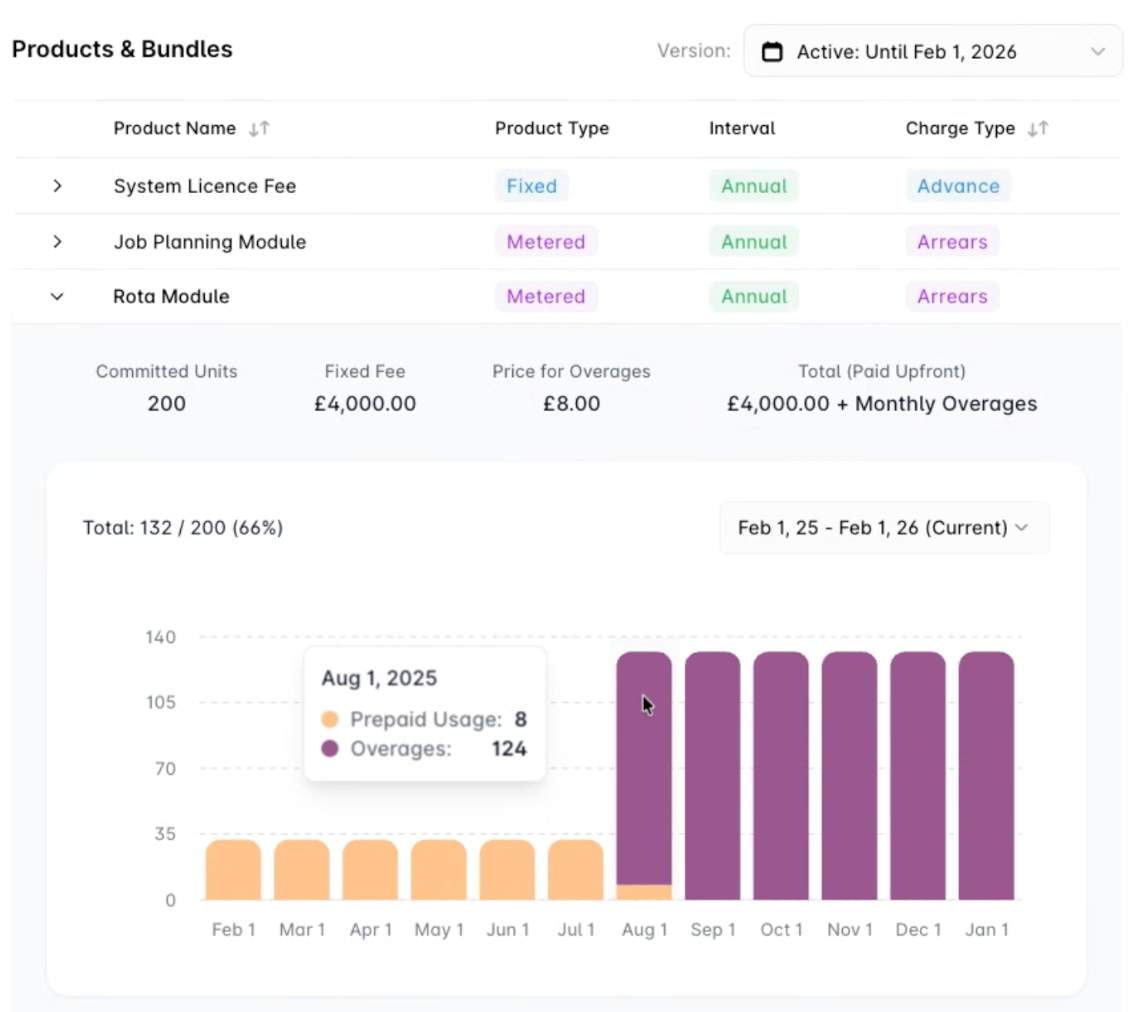
Usage and overages in Alguna.
Customers are far more comfortable with usage-based billing when they can see it as it happens.
Best-in-class AI billing experiences include:
- Real-time or near-real-time usage dashboards
- Clear unit definitions and examples
- Budget alerts and spend thresholds
- Forecasted end-of-month estimates
When customers understand their usage, billing becomes a control mechanism—not a surprise.
4. Design pricing for human buying behavior, not just APIs
AI usage is often triggered by engineers, but paid for by finance or procurement. That gap creates friction.
To optimize billing models, AI companies must account for:
- Multiple personas (developer, product, finance, exec)
- Non-linear adoption curves
- Internal customer budgeting cycles
- Approval thresholds and spend limits
Pricing that works for developers but breaks procurement will stall expansion.
5. Use credits to simplify complex usage
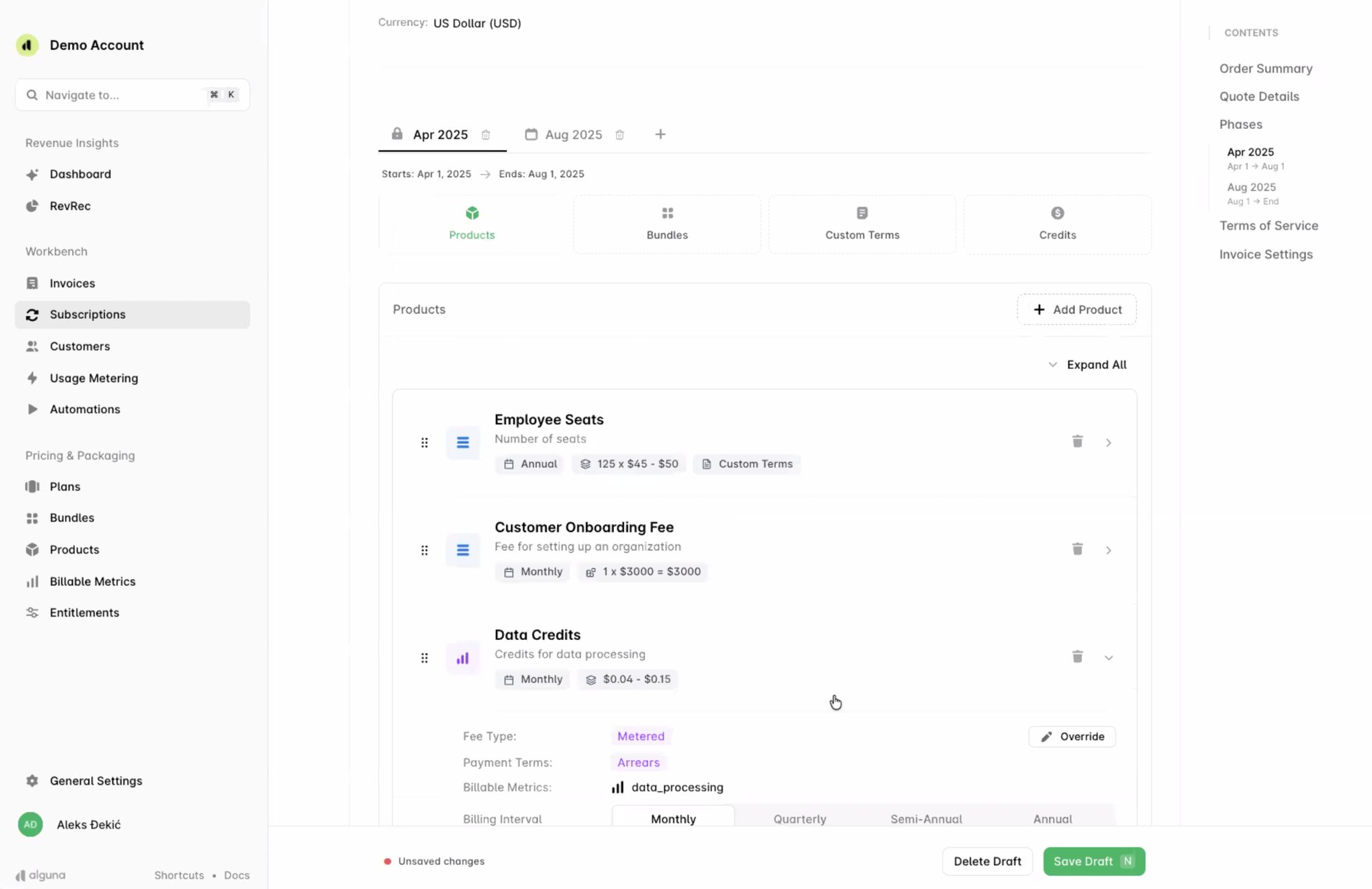
Credits are one of the most effective tools for optimizing usage-based billing in AI.
They allow you to:
- Abstract away multiple usage metrics
- Bundle different AI capabilities together
- Offer promotions without changing list pricing
- Support custom enterprise contracts
Credits also make it easier for customers to reason about spend without tracking every underlying unit.
6. Automate metering, billing, and revenue recognition early
Many AI startups handle usage billing with spreadsheets, custom scripts, or patched-together tools early on. That approach rarely survives growth.
As usage scales, companies run into:
- Inaccurate or delayed invoices
- Manual revenue reconciliation
- Audit and compliance risk
- Inability to support custom pricing
Optimizing usage-based billing requires end-to-end automation across metering, billing, invoicing, and revenue recognition.
7. Price for expansion, not just entry
The best usage-based billing models are designed to expand naturally as customers get value.
That means:
- Avoiding punitive overage pricing
- Rewarding increased usage with better effective rates
- Making upgrades feel like a natural next step
- Designing pricing tiers around customer maturity
Expansion should feel like progress—not a penalty.
Common mistakes AI companies make with usage-based billing
To summarize, AI companies often struggle when they:
- Price on technical metrics customers don’t understand
- Rely on pure usage without predictability
- Hide or delay usage visibility
- Treat billing as a finance problem instead of a product experience
- Build billing systems too late
Avoiding these mistakes early compounds into better retention, expansion, and trust.
Usage-based billing is a growth decision
For AI companies, usage-based billing isn’t just a pricing model—it’s part of the product and go-to-market strategy.
When optimized correctly, it:
- Aligns revenue with customer value
- Supports rapid experimentation and iteration
- Enables scalable enterprise growth
- Reduces friction between sales, finance, and customers
When done poorly, it creates confusion, churn, and internal chaos.
AI companies that win are the ones that treat usage-based billing as a core strategic capability, not an afterthought.